Showing posts with label German Christmas Customs. Show all posts

Tuesday, December 10, 2013

Christmas Markets of Today and Yesterday


Christmas Market in Stadt Saarburg

This December I was at a loss for an idea that reflected the Christmas Season in Kreis Saarburg.  After eight years of posts about Christmas customs in the Rhineland area of Germany, there wasn't much I hadn't tried to research.  Then I found an article that was brief yet concise, full of interesting details I had not known.  Thus the information that follows is taken from that source.  

In the spirit of the season of the Christmas market, I am including photos from markets which are near to Kreis Saarburg, even though one market is in Strasbourg, France.  After all, a Prussian general once referred to our ancestors as "painted French."  And at the time the Christmas markets developed, German and French citizenship could change from week to week.

The History of the Christmas Market

The centuries-old tradition of the Christmastime markets were joyful occasions for weary villagers and gave them something to look forward to on the long winter nights.  The first Christmas markets were held at a time when regular markets took place throughout the year. The first Christmas markets were little more than winter markets that lasted a couple of days. Instead of the colorful booths that are a part of Christmas markets in our time, traders in some cities just laid their goods out as best they could, sometimes even in the street.  

I found it surprising that as early as the 17th century, gift-buying at Christmas Markets had already become a usual thing.  There is something about the Christmas spirit that opens the heart and also, at times, the purse.

The usual place for the Christmas Market to be found was surrounding a city's church.  In larger cities, the main church was chosen in order to attract the most buyers when residents arrived for the services.  According to the writer of the article I am using as a basis for my post, a priest in Nürnberg in 1616 complained that he did not hold the afternoon service on Christmas Eve because no one attended.  They were waylaid by the Christmas market.

The same article says, "It is likely that the Christmas markets drew more visitors when religious reformer Martin Luther instituted new customs for Christmas.  Before Luther, the exchanging of presents took place on the saint days of St. Nicholas, December 6, or of St. Martin, on November 11.  It was Luther who suggested that children receive presents from “the Christ Child,” hence the name “Christkindlsmarkt” (Market of the Christ Child), a popular name for many Christmas markets especially in the south of Germany."

In the past, only local tradesmen were allowed to sell their wares at the city’s market, which led to the distinctive regional character of today’s markets.  Because in the past each region had its own customs and needs, Christmas markets have continued to focus their wares in that direction, giving each market a distinctive air.  They specialize in "local delicacies and traditional products." 

Beyond the commercial aspect of the markets, they have another function: a cheerful, high-spirited place for local residents to meet as well as a place to sell their homemade crafts, decorations, and ornaments.

The items in the Christmas market in each city are not all unique, or course. There are traditional German handicrafts that can be found at nearly every Christmas market.  There have to be nutcrackers, wooden figurines, straw stars and smokers as well as the iconic cookie tins, glass balls, toys, and tin tree ornaments.

Since most of us will not have a chance to tour these Christmas markets, here are some photos taken at regional Christmas markets by the photographers listed below:


Christskindl Market in Stadt Saarburg

At the Saarbrucken Christmas Market
'

Saarbrucken Market


Strasbourg's Famous Christmas Market

Strasbourg Market at night


Market is next to Strasbourg Cathedral still!

Strasbourg Market classic items


Delicious Bakery in Strasbourg


Trier Christmas Market closeup


Trier Christmas Market in the market square

The Joy of the Trier Christmas Market 

Merry Christmas Wishes from the Singleminded Offshoot!


Source: 
http://www.germany-christmas-market.org.uk/christmas_in_germany.htm

Pictures: 
Trier Volksfreund Täglischer Newsletter 
Josiane of Lorraine
City of Trier Webpage

Monday, December 05, 2011

A Lothringen Christmas

Nativity Scene at the 2009 Christmas market in Metz, Lorraine, France
Photo by Josiane of  Lorraine


In today's world of rapid transportation, we would  consider eastern French Lorraine - which was known to my ancestors as Lothringen - a "stone throw" away from my Kreis Saarburg ancestors' villages.  It is not surprising, given the proximity to the French border, that some of the Christmas customs in Lothringen were much the same as those in Kreis Saarburg.

In a book by Josef Ollinger called "Geschichten und Sagen von Saar und Mosel, the author includes French Lorraine as a part of the above-named German regions, with Christmas customs that would have been very familiar to my Kreis Saarburg ancestors.  Since many of the traditions, whether from Lothringen or Kreis Saarburg, were unfamiliar to me, I thought it would be fun to share them for this post.

Christmas Preparations

The Midnight mass was the most important part of the Christmas time, and a true family celebration.  In the days before Christmas, in order to get ready for the Midnight mass, everyone in the family gathered together to practice the church hymns so that the singing would be especially beautiful on the holy night.

Christ Child baking Christmas cookies 
During Advent, the children kept an eye on the evening sky.  If there was a red sky when the sun set, they knew that the Christkind was busy baking Christmas cookies.

Willow and hazelnut switches were cut by the householder, if possible it was a midnight cutting which gave the branches the best defensive power.   They were bound together and meant to defend against trouble-making spirits who wanted to do evil on the night of the Christ Child's birth.

Christmas Eve

For Lothringen households, the hearth in the kitchen was the heart of the Christmas Eve celebration.  It was the time for the Christbrand, the Christmas fire.  The members of the family dressed in their Sunday/holiday best and spent Christmas eve in the kitchen, sitting close to the hearth.  Two men of the family brought the Obstbaumstamm, the fruit tree log, inside.  It had been cut in summer so that it would be thoroughly dry.  The log was laid on the hearth, and the mother and daughters of the family carefully wound ivy tendrils around the log.  After the log was decorated, the father said a blessing over the log. One end of the log was pushed firmly into the glowing embers, so that the log would burn down from that end to the other.

Modern children's book of Christmas carols
After these ritual ceremonies had been performed, everyone gathered around the hearth to eat Christmas Kuchen and drink hot mulled wine, the Glühwein.  Until it was time to leave the house for the Christmas Eve Midnight Mass, the family sang familiar Christmas carols, "Ihr Kinderlein, kommet," "Es ist ein Rose entsprungen," "Morgen, Kinder, wird's was geben,""Von Himmel hoch, da komm ich her," "Christkindelein, Christkindelein."

They also shared familiar Christmas stories.  In some areas of Lothringen, three stools were placed near the hearth so that, if the Holy Family should arrive, they would have a place to sit and warm themselves.  It was strongly forbidden to sit on the non-burning end of the log, which would surely lead to calamity in the future ( a matter of common sense as well as a superstition in my opinion).

The appearance in the hallway of the house of the Christ child with his silver wings was the high point of the Christmas Eve celebration for the young ones.  Dressed in white, the Christ Child walked into the Stube (good room) and asked each child to sing a Christmas song or say a prayer, admonished them to be good children, gave them some sweets - and disappeared.

In families where the Christkind did not appear in person, the children put their largest shoes around the edge of the hearth on Christmas Eve.  In the morning the shoes were filled with apples and nuts.

Midnight 

Before going to the Midnight Mass, the householder went out to wake his bees in their basket hives.  He said, in blessing, "the Savior has been born."  It was believed that the bees hummed/sang all during the time of the Midnight mass.  The householder also went to the stable to spread a thick layer of straw beneath the animals to protect them from predator's teeth and claws during the upcoming year.  Another legend said that at midnight, in honor of Christ's birth, the animals were given the gift of speech.

It was also believed that if someone wanted to learn who in the village would die within the next year, he or she must be in the cemetery when the clock struck midnight on Christmas Eve.  Then the faces of those who would not live to see the next Christmas would appear.  If there was a face that could not be recognized, it meant that the person who stood in the cemetery would die that year.

The Midnight Mass was the holiest and most important experience of the Christmas religious experience.  In addition, because it was believed to bring good luck, some families attended all three Christmas masses to give them special blessings in the coming year.

Christmas Day

The house held a jug with the Barbara
Zweige which had been cut about Dec. 4. Usually these were cherry branches that had budded, the flowers meant to open by Christmas Eve. The cherry branches (Kirschzweig
) or other fruit tree cuttings were placed in water and kept in a warm room after they were cut. If all went well, on Christmas day the sprig displayed blossoms. If  the branch bloomed precisely on December 25th, it was regarded as a particularly good sign for the future.

December flowering cherry tree branches,
Wikipedia Commons 
After the Midnight Mass, there was a special "night meal" at which meat was a special part of the repast, a treat that was not very often a part of a meal, no matter what time of day or year.

Other Superstitions

After the Christmas Eve log had been completely burned, the fire was left to die out, since the ash and charcoal had gained a wonderful power of blesssing. The wife carefully saved what was left of the Christmas Eve fire.The charcoal would be placed under the bed of the man of the house and on the timberwork of the storeroom stall and of the stable.  This protected all from lightening, fire, and sickness.

The Christmas log's ashes were spread on the fields to make them fertile for the next year's crops, to destroy weeds and vermin, and to protect the land from hexes and any evil enchantments which resided in the earth.

The dreams of the 12 days of Christmas, der Losnächte which lasted from the 24th of December until January 6, were thought to foretell a person's future in the coming year, each night representing one month.

Preparing this month's blog post has put me in the Christmas mood much earlier than usual.  Yesterday, St. Barbara's feast day, I cut three small apple tree branches with buds and brought them inside - in the hope that on Christmas day, they will show at least one flower and good luck will follow me in the new year.


Sources:
Josef Ollinger, Geschichten und Sagen Von Saar Und Mosel, 2005
Anne Diekmann and Willi Gohl, Das Große Liederbuch, 1975


Friday, December 19, 2008

Nikolaus, Knecht Ruprecht, and the "Cheeky" Girl


In past posts, I've written about Saint Nikolaus Eve, both in the early centuries and in more recent times. But I can't resist one more St. Nikolaus story, this one from perhaps 50 or so years ago. You've probably heard of the film "The Nightmare before Christmas." This one could be called "The Nightmare before St. Nikolaus Day". A woman who lived in Irsch as a child and experienced a fearsome Nikolaus visit tells her story like this:

The Nikolaus Eve at our Home

For my siblings and me, the observance of Nikolaus Eve was full of stress because Nikolaus brought his assistant, the servant Ruprecht (Knecht-Ruprecht in German*). And he left behind a very fearful impression on me.

Now the evening was here and the banging and chain rattling on the wooden steps outside our door were so great that it was frightening and we were afraid. The kitchen door was flung open with great force and Nikolaus and Knecht Ruprecht came inside.

Knecht Ruprect's red tongue showed all the while because he let it hang out of his mouth. On his back he lugged a sack that was so big that a child would fit inside. Two long, stuffed stockings with shoes sewed to them were stuck to the outside of the bag, a sight that scared me stiff because I thought I would be stuck to the bag in the same way. I started to bawl.

Nikolaus took his big book and quickly leafed through it as if he already knew what the devil had written in it. He looked at me and then said that I had been rude to my Aunt Lena. And he had observed that, in the street, I was a cheeky child. He was going to take me with him, just as I had feared. But before he took me away, I should pray the "Our Father."

As I finished the Our Father, Knecht Ruprecht tugged at me. But I held on to the cutlery drawer. I pulled on it with force and it swung out of the cupboard with a dreadful clanging.

My grandma came down the stairs and helped me out of my jam. In that moment, I loved my grandma more than ever.

As a punishment, Nikolaus gave me a stick and he and Ruprecht started away. But my grandma wasn't finished with them; she snatched a gift from Nikolaus. Face beaming, she brought it to me

Thus ends the story submitted by Hedwig Rice to the monthly Irsch internet newsletter - sent free to subscribers with an interest in reading it.

My family, descended from ancestors who once lived in Irsch, also celebrated St. Nicholas Eve. After reading Frau Rice's story, I'm grateful that St. Nicholas came alone to our Wisconsin farm home and the only sound we heard was of his sleighbells. Never did our cutlery drawer suffer from a visit from St. Nicholas!

*For more on the history of Sankt Nikolaus and Knecht Ruprecht, use the search box at the top of the page.

Thursday, December 07, 2006

Christmas in the Hunsrück


A popular version of the Christkind


Oberzerf, the home village of my Rauls ancestors was at the edge of the Hunsrück region in what was then Kreis Saarburg. Since my great-great grandmother, Magdalena Rauls, was born on December 25, I have a special interest in the Christmas customs of her village in 1827. The closest I have come so far is the small book called, "Die Hunsrücker Küche," (Hunsrück cooking) by Christiane Becker. Along with recipes for traditional Christmas treats, there is a description of some of the Christmas customs of the Hunsrück of the last century.


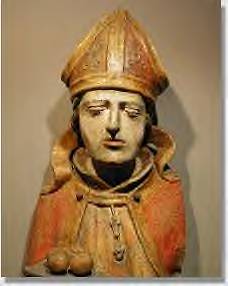
A figure of St. Nicholas from the 13th century


But first, a little history. The eve of the feast of St. Nicholas on Dec 6 was originally the time when children in German-speaking regions received gifts. Saint Nicholas was clothed in a bishop's red robe, somewhat like today's Santa Claus or Weihnachtsman. On his head was a miter, and he carried the staff of a bishop of the Catholic Church. Martin Luther urged his followers to stop this custom which had such strong Catholic church connections. The Christ child, he preached, gave the greatest gift to mankind, and children should receive presents from him on the day that commemorates his birth. The change began in the northern regions where the majority of the population was Lutheran, but by the nineteenth century, even in the Catholic regions, the Christkind brought gifts on Christmas eve. However St. Nicholas retained his popularity in the Catholic areas, continuing to bring presents on St. Nicholas eve. (There is more information on the celebration and customs of St. Nicholas eve in my archived post from January 2006).

Literally translated, the word "Christkind" means Christ child. However, in the 19th century, the Christkind was not represented by a babe in a manger but rather by an angelic figure with golden wings and long blond hair. In some parts of Germany, especially Bavaria, teenage girls clothed in white dresses and wearing golden wings played the Christkind, but customs varied. Christiane Becker, author of "Die Hunsrücker Küche," describes the Christkind custom in the small village of Götzeroth in the Idarwald as follows: On Christmas eve, the Christkind, face covered with a veil, went from house to house, accompanied by the "Stabbegloose", two figures in black clothes and hats. Both carried a staff and hid their black painted faces behind a beard of flax. The raccous sounds of staffs and bells were eagerly awaited by the children because the trio were bringing gifts. The Stabbegloose would push their boisterous way into each house in the village, followed by the Christkind. As a reward for their turbulent visit, they were rewarded with money or, in earlier times, with Kuchen. The actual visit of the Christkind was done in fewer and fewer places as the 19th century progressed, and today such a custom is a rarity.

Baking for Christmas was done during the season of Advent. At sunset in December when the sky was a shimmering red, there was an old saying in the Hunsrück: "The Christkind is baking sugar cookies." The women and children of the family were busy making familiar Christmas recipes. The aroma from the kitchen, which had been turned into a virtual bake shop, permeated the whole house. Naturally, there was quite a bit of tasting of the Zuckerblätjer, as the cookies were called in the Hunsrück dialect. But the Zuckerblätjer soon disappeared into cans and glass jars, to await Christmas eve. There were nut cookies, Lebkuchen, spritz cookies, cinnamon wafers, and chocolate balls in the recipe box of Becker's grandmother.

Except in rare exceptions like the one mentioned above, the Christkind was not seen by the children. He brought the gifts and trimmed the Christmas tree behind a locked door in the good room of the home, aided by parents and sometimes also by grandparents and relatives. The curious children waited impatiently for the door to open, but by the time the Christmas bells were rung and the door was flung wide, the Christkind had gone.