Tuesday, October 01, 2013

Looking Inside the Ranzen Satchel

Antique Ranzen on ebay
Child's School Slate


I have begun my vacation. You will understand when I say that I was not planning to post to my blog. But shortly after my last post, "Schultüte und Ranzen Go to School," Ewald Meyer, who grew up in the little village of Beurig, gave me some exceptional details about his own Ranzen after he read the blog post. I am very glad to have this new information about his school days when writing paper in a school satchel was rare.

Rather than add this content to the September 6, 2013 blog post, which would make it unlikely that people who have already read that post would read it again, a short new post seemed a better idea. Therefore, this month's post is mostly written by Ewald Meyer with a few additional details which were left out the last time I posted.

Here is what Herr Meyer says he carried to school in his satchel on the first day of his first year in school - my translation. "When I first went to school in Beurig in 1937, the Schultüten (see last post) were still unknown here. They existed in Beurig only since about 1950."

He goes on to say that in his satchel were a slate with a wiping cloth, a wooden pen box with pen for the first written exercises, and a small box with a wet sponge to clean the blackboard. There was a primer in the satchel for learning to read. The slate's front panel had double lines which were to help the youngest students write the letters of the alphabet by giving them ample space. On the back side there were squares for mathematical problems.

As I had surmised in the last post, the Schultüte was not known in the villages of Kreis Saarburg until the 1950s. In the local history book, "Beurig Lese- und Bilderbuch," there are yearly photos of the first grade class for each school year. From 1950 on, the Schultüte is held by every child. Earlier pictures, dating back to 1908 show no sign of the paper cone filled with little gifts.

In Beurig, where Herr Meyer went to school, first grade students were known as ABC Schütze. Schütze, Herr Meyer tells us, is derived from the Latin "tiro" or raw. Thus, a recruit who was drafted into the military, was known as a Schütze. The beginning school children therefore became the "ABC Schütze."

In some places in Germany, i-Dotze or i-Männchen was the nickname for the first-time scholars, a throwback to the time when the first letter of the alphabet to be learned was the letter "i." It was the most easily taught. Sometimes on the school grounds the little ones were teased with the following nonsense rhyme:

i-Männchen,
Kaffeecänchen,
Abgeleckte Heringsschwänzchen'"

This translates as
"i-little people, 
little coffee pots, 
licked-off herring tails." 

 It defiinitely seems to lose something in translation.


Sources:
Der Blumenbaum, Oct, Nov, Dec 2005, p. 68. 
Ewald Meyer e-mail


Friday, September 06, 2013

The Schultüte and the Ranzen Go to School

Early photo of boy with Schultüte and Ranzen

Wooden Ranzen School Satchel


School has just begun in Germany, and it seemed to me that a post about the Schultüte would be very timely. American school children, as well as most other school children outside of Germany are not familiar with the custom of the sugar cone Schultüte. In fact, the English language has no exact equivalent word for it, but the picture above will give you the idea of this "school bag." (Tüte means "bag" when translated literally; however the Schultüte was in the shape of a cone.)

After seeing some pictures of a young relative from the area near Saarburg, Schultüte in her arms and a shy smile on her face, I wanted to determine if the custom reached back to the time of my Kreis Saarburg great grandparents or, if not, just when and where did this custom originate.

To begin my search, I called up the German version of Google and found two good articles that answered many of my questions. One of the first things I learned was that German children of the 19th century did have my version of a school bag - something called a "Ranzen," a word that means satchel.   Not every child's family could afford a leather Ranzen and those who had them guarded them carefully. They were shaped like a small briefcase with backstraps. The Ranzen was the German school child's prize possession. The true Ranzen was leather except in areas where people were poor but wood was plentiful. A poor child from the Schwarzwald might have a Ranzen made of wood, as illustrated in the picture above.

I also learned that the beginning of the school year has been a special occasion since the middle ages, usually celebrated with a special church service and a procession to the school and/or the presentation of cookies baked in the shape of letters of the alphabet. It was a momentous event for these young children to take the first steps away from their parents' home into a school room.

In some parts of Germany, parents accompanied their child on the first day of school and stayed for a time, while the children became acquainted with each other and with the teacher. In other regions, the celebration of the first day of school took place in the home, often with godparents and other relatives present. It is my impression that, as the 19th century began, education was less highly valued than in the later days of the century. Parents, especially those who were struggling to put food on the table during the hard times in the 1840s and 1850s, were less than enthusiastic about a child being taken away from the work on the farm for several years.  Such might have been the case for some of my ancestors.  It is not likely that they had either Ranzen or Schultüte.

The Schultüte did not appear until the 19th Century. The first documented report of the cone-shaped Schultuete comes from the city of Jena in 1817, closely followed by reports from Dresden (1820) and Leipzig (1836). It caught on in popularity in the bigger cities first and spread eventually to the small towns and villages of northern Germany.  One source I read was of the opinion that the sugar cone Schultüte was a way of "sweetening" a young child's anxiety at beginning school.

About forty years after the acceptance of the Schultüte as a tradition in northern Germany, a book about the sugar cone tree was written for young children and even recommended by a teaching manual used in many schools. It was meant to be read to a child just before the little beginner started attending school. In this tale, a Schultüte'sugar cone tree began to sprout and grow in the school basement. It produced not fruit but cones with sugar cubes and candies.  It was time for the little ones to go to school when they were brave enough to go into the school's cellar and pick the tree's cones which had now matured and were filled with sweets.

There was also a difference in the Schultüte's first appearance in North Germany to the adoption of it in south and western Germany. The Schultüte was almost unknown in the Catholic part of Germany in the mid 1800s. In the Catholic areas, it is my guess that a blessing for the new little scholars and perhaps a procession from the church to the school took place, sometimes with and sometimes without parents and godparents on hand. One source says that in rural areas there was possibly a large "baked pretzel" for the whole class or small school day treats from the teacher to reasure newcomers on their first day.

After the introduction of compulsory education in all of Germany in 1871, the demand for sugar cones increased greatly and were very commonplace in north German schools as the first years of the 20th century began. By the 1930s, the Schultüte occasionally appeared in the schools of west and south but did not really become a custom until after WWII.

Today the custom has changed in that less and less sweets are appearing in the Schultüte, with more practical gifts such as crayons and pencils, small toys, CDs, books and even articles of clothing replacing them for the good health of the child.

My research about the origins and time period of the Schultüte revealed that none on my ancestors carried such a prize to their first day of school.  But I do hope they had a teacher who distributed small treats or let them share a pretzel.


Sources: 
Der Blumenbaum, vol. 26, no. 3
Der Blumenbaum, vol 23, no. 2
http://fanzone50.com/Oberstein/schultueteHistory.html
http://fanzone50.com/misc/Schultuete.html http://www.brauchwiki.de/Die_Schultüte
http://www.erster-schultag.de


Wednesday, July 31, 2013

The Delinquent in His Old Home Village

Cemetery in Rüber 

Polch Railroad Station

Polch City Hall

Rhineland emigrants who left their country in the 1840s and 1850s have descendants who would be willing to hunt in every archive in Germany, if it would assure them of information similar to the story of this daring and determined ancestor.

A genealogist who belongs to a collateral line of the descendants of the emigrant I will write about gave me copies of the transcribed documents that make up the story.  She was unsure about the wisdom of using the emigrant's full name, so I will call him Mathias Namenlos.  Namenlos is the German word for nameless.  From documents kept in the State Archive of Koblenz, and the skill of three people: a German-speaking relative, an experienced researcher who knew his way around the archive, and a skilled translator of old German documents, this unusual story emerged.

The archive documents tell the story of the emigrant who returned, for a short time, to the Alte Heimat of Rüber, Germany in the Rhineland. This ancestor had left the Rhineland in 1854 to take up residence in the United States; then came back three years later.  It reminds us that we can never assume. Since this is not my ancestor, I haven't investigated sources in this country to see if there is any travel record from 1857 for this former immigrant who journeyed back to Germany to claim his share of the estate of his father.  But there were times when people returned for some reason and it is something to check when writing the family story..

The documents of Mathias Namenlos are also a prime example of the change in attitude of the Prussian government concerning emigration during the 1850s and onward.  In the first half of the 1800s, emigration was rarely a matter of concern to the Prussians or to other kingdoms.  Sometimes it was actually encouraged in order to free the local cities and villages from families who might, at some time in the future, become a drain on the funds for the poor which had to be provided to those who were truly without any other means of survival. Poor people, of course, also paid no taxes to the Prussian Emperor; therefore they were of very little interest.

But by the second part of the century, many of the people who decided to emigrate were not quite as poor. They were inhabitants who were able to make a living and who contributed the taxes demanded by the Prussians. These emigrants had learned that relatives, friends, and neighbors who had already gone to the United States were, for the most part, prospering.

Also at this time, the shipping companies saw a growing market for transportation across the ocean, carrying people as well as cargo. They sent their agents and representatives to stimulate interest in a move to a country with more opportunity than they could expect to have in their current living situation. The agents were now not popular with those who governed the Rhineland.

Enter Mathias Namenlos, returning to his home country and village after spending three years in America. The Mayor of Polch, who also governed tiny Rüber, grew suspicious when, about the same time that Mathias Namenlos appeared, the younger brother of Mathias applied for permission to emigrate as did five other young people from the area.

In 1857 the "kingly constabulary" of Rüber received a communication from the Mayor of Polch that Mathias Namenlos, a former resident of Rüber, now living in North America, was again staying in Rüber. In the following documents "the plot thickens": 

No. 1193
Polch, July 16, 1857

Mathias Namenlos, in the past living in Rüber, now living in North America. He is supposed to be suspicious to tempt others for Emigration. The kingly constabulary herewith is ordered to catch him and to bring him here to me.
The Mayor
... Driesch

Negotiated at Polch, July 17, 1857

The kingly constabulary caught the above mentioned Mathias Namenlos.  The caught Namenlos declared the following on request:

My name is Mathias Namenlos, I am 33 years old and I was born in Rüber. I am currently living in Mil:Waukie in the State of Wisconsin in North America.

On April 1854 I emigrated to North America by the approval of the kingly administration of Koblenz. I am now back to dispose my fatherly heritage, which are some acres. I sold the acres at a price of 1,100 Thaler to my brother Joseph Namenlos of Rüber, whom shall be given the money from Johann Anton Müller of Mayen (probably a money lender).

My brother Johann, who requested his emigration, sold his acres, too, by the same procedure and at a price of 1,200 Thaler. We are scheduling to emigrate together as soon as we both have approval.

I herewith declare forcefully that I did not tempt others to emigrate. I even did not tempt my brother Johann to do so.

I do not own a passport and for my legitimation I have (unreadable words) citizen document (prossibly a set of first papers for citizenship filed in Milwaukee, Wisconsin) of April 17, 1857 that I hereafter would like to read out.

Reading out loud, approved and signed.
Signature of Namenlos and The Mayor

Things did not go well for Mathias who was currently back in his home village, Rüber, to take his rightful share of the division of his father's estate. The Mayor of Polch, after taking the statement of Mathias, added his own report before sending both documents to the Kingly Administration in Koblenz. He named six young men who had requested permission to emigrate from Rüber shortly after the arrival of Mathias. For this reason, he said, "Now I am suspecting that he tempted the above mentioned people for emigration." He went on to say that he had no proof this was the case, but since Namenlos could not show any acceptable documents as to his status, he wanted to know how the Administration in Koblenz wanted him to proceed. He suggested that Mathias be banished after he had been able to finish his family affairs which Mathias had said would take until October.

However after more bureaucratic paperwork flowed from the Kingly Administrator to the higher Administration he served who commented that it was likely that Mathias Namenlos was an emigration troublemaker, the Kingly Administrator was told to set the banishment date of his choosing. The lower level Kingly Administrator, in an August 3 communication to the Mayor of Polch, set the date of banishment for Mathias as August 15. For whatever reason, the Mayor of Polch waited until August 12 to send the notice to Rüber, giving Mathias only three days to leave or be subject to the Prussian civil code. Case closed.

There is one last document in the case file of the former citizen of Rüber. Since there was no way that Mathias Namenlos could finish the inheritance work and book passage back to America in just three days, he stayed on.  On August 24, the "kingly policemann Hoffmann" arrested Mathias who had been seen again in Rüber and brought back to Polch. The next day "the deliquent" declared on request:

Negotiated at Polch on August 25, 1857

"I avow that the kingly order had been handed out to me on 12th of this month but I could not leave because:

1. I could not finish my deals yet

2. I did not have any possibility for traveling

Currently I got my deals ready so I am able to leave and to follow the order directy.

The delinquent had been told that he is ordered again to leave the Kingdom within 24 hours otherwise he would be punished or brought to the Border of the kingdom with the help of the police.

The delinquent has been released into freedom after the negotiation."

Signature: Driesch

Since no further documents were found, I assume that Mathias Namelos did leave, probably in the company of his brother Jonathan and one or more of the other men who had gotten permission to emigrate. 

With the reception by the Prussian Government to former residents of Prussian cities and villages being most unfriendly, any stay was likely to be short and definitely not pleasant.  For us, descendants of former Prussian citizens, the documents are another amazing set of records that despite two world wars still survive in the German archives - if we are determined enough to search.

Sources:
Documents from the
Landesarchiv Koblenz

Pictures: 
MSU Study Abroad Program
Stady Polch http://www.polch.de/sv_polch/
en.db-city.com


Tuesday, June 25, 2013

Blog Anniversary: A Few Favorites of 2005


A farmer's implement - the hackplow

The Halfen room updated
A barge stop at the inn

Saarburg's upper city


June 24 is my blogging anniversary for 'Village Life in Kreis Saarburg." I wrote my first post on June 24, 2005, working at the dining room table with my sister giving me verbal instructions on how to set up a blog and how to write a post. At that point I didn't know the difference between those two words. When I had finished that first post, I wondered if I would want to write another one and, if I did, how long it would be before I ran out of ideas. That was eight years ago and the ideas keep coming!

I had a nostalgic look back at those first posts this anniversary morning and am glad that I wrote them (even though I knew very little about what I was doing at the beginning). Some of those first-year posts are especially dear to my heart because of the circumstances that surrounded my choice of subjects.  To see the full post, click on its title.


"The upper city is slightly newer than the lower city. Houses and shops began to spread up the hill as the city grew. Saarburg was a market town and the markets gave names to streets and squares in both the upper and lower city. There was the horse market, the fruit market, the butter market in the upper city, and the old market in the lower city. The Butter Markt runs along side the Leukbach, a stream which runs through the upper city, then forms a waterfall and drops toward the old city. The waterfall on the Leukbach powered a water wheel for the former grist mill which is now a museum. Above the city stand the ruins of a castle built in 964. All around the city there are steep hills covered with vineyards."
Have you ever seen a place for the first time and fallen in love with it at first look - almost as if it might be the place you were always meant to be. That is what happened to me on a sunny day in July 1984 when I arrived in the upper city of Saarburg. I had been many beautiful places all over the US and Europe and seem some spectacular scenery, but the upper streets of this city of approximately 6,500 population claimed my heart forever. When, some years later, I had a chance to buy a two-volumn history of the city, I jumped at the chance, even though I knew how heavy it would make my luggage. This very early post was a pleasure to write, bringing back memories and explaining much of the history I had not known.


"Each day there were also rest stops and during that time the sailors and the Halfen would discuss any problems along the next stretch in the river. Lunch would be carried ashore from the ship and eaten at an inn or tavern, with the landlord providing the dishes, tableware and the wine. The shipowner, of course. paid for the wine that the landlord of the inn placed on the table."
This subject was special to me. It was very likely that my ancestor, Johann Meier, had been a handler for the horses pulling the barges, guiding them along the tow path along the Saar River. I had heard that these men were called "Halfen." Since my apartment was on the west bank of the Saar, I asked my German landlord if he knew anything about these men. He looked at me in amazement and then excitement. He was a descendant of a barge-building family of sailors. The apartment which I had rented was once a place where the men who handled the barge horses took shelter and slept after a day of encouraging their team of horses to pull one of the heavy barges against the tide of the river. It was very possible I was sleeping in the same place that my great-great grandfather once laid his head. I'm sure though that my lodging was much more comfortable.


"Up here we bind the grape vines, and below us runs the plow. Between wine hill and plow, between furrow and vine, that is our way of life on our farms. And year in and year out all life and all nature go back and forth; spring and fall, summer and winter between wine hill and plow. With dung spreading, digging, planting, cutting, tying, binding up, and harvesting. With plow, sower, mower, sickle and plow, so must we all struggle and toil."
That is a description of a Kreis Saarburg farmer's life from sunrise to sunset; from spring through the winter time. It is written in German and in rhyming verse which, in this post, I did my best to translate into a prose description. The book was a gift from Herr Ewald Meyer who had translated it from the old dialect of Kreis Saarburg to modern German, managing to keep the rhyme, rhythm and mood. I grew up on a farm, and the lovely descriptions brought back many memories of farm life in the 20th century. These poems, however, described farm life in the 1800s. It was like spending a year with my farming ancestors, learning that they had worked even harder than their descendant, my father.


"An older person acts as the matchmaker. If permission to marry is given, the engagement is announced. It is made official when the young man and the members of his family are invited to a fine dinner at the home of the bride-to-be. It is also the occasion of the first gifts."
I wanted to write a novel about a young woman who runs away to marry a suitor from a poor family against her father's will. But without knowing the marriage customs of the time, I wouldn't be able to create an accurate setting. Then, in 2003, on a river cruise in Normandy, I had found a book that described in great detail their marriage customs in the 19th century. I knew enough Spanish to figure out the general content of the chapter on weddings, even though the book was written in French (the pictures also helped a great deal). With the additional help of my sister and one of my best friends, I learned so much about the wedding customs of Normandy. Then within a short time, I also found two books in German that explained wedding customs, those in Bavaria and those in the Hunsruck (the very places I needed). To my delight, almost all the customs were the same as in Normandy. And I had the stuff of a great chapter for my novel.

Each time I compose a post for this blog, I increase my understanding not only of Kreis Saarburg but also of most of the rest of Germany.  Blogging has been fun and very educational for me.  But there is a problem.  The mass of information I've collected is not as easily accessible as I would like.  If you are a reader of my posts, I hope to have a partial solution to that problem in year nine of "Village Life in Kreis Saarburg."


Friday, May 31, 2013

From 1861 Irsch Kreis Saarburg to 1863 St. John Wisconsin

The Old Home
Photo from www.Irsch/Saar.de


The New Land
If you read posts on this blog regularly, you will recognize the name of the author of today's post which I have translated into English - Ewald Meyer. Herr Meyer has written two books, one about the village in which he now lives, Irsch; and one about the village in which he was born, Beurig. Those two villages are about a mile apart. So Ewald Meyer definitely has a wealth of information on the history of these two villages in Kreis Saarburg. 

Herr Meyer and his wife Helena have become good friends who continue to help me with my research whenever I need some elusive information on life in Kreis Saarburg or translation from the old German scripts. To my surprise, this month Ewald Meyer wrote a piece about Irsch's Germans in America for the Irsch monthly on-line newsletter. The family he described just happen to be my great-great grandparents, Johann Meier and Magdalena Rauls and their children. He wrote in German so, although I was bursting with pride and wanted to share my delight, I could not refer my friends or my blog's readers to a URL. Therefore I did my best to translate his article as my blog post for this month.

With apologies for any translation mistakes I make with my self-taught German, this is my attempt to share the May Irscher Newsletter article writtem by Herr Meyer to be read by the residents of Irsch, Kreis Saarburg, Rhineland, Germany."

GERMANS IN AMERICA 
by Ewald Meyer 

"During the colonization period of the United States of America, Germans were the largest non-English-speaking population. Around 1900, Wisconsin had about 2 million inhabitants, 710,000 of whom were of German descent. 

After publishing a list in 2002 of emigrants to the United States in the "Irsch Chronicle" on the Irsch Homepage, descendants of Irsch immigrants to the U.S. finally had an answer to their questions about the German home of their ancestors, "Where is Irsch in the former Prussia?" From then on, continuing to this day, a flood of requests for information have been received over the Internet. Visitors from overseas who are looking for their ancestors are not rare in Irsch. 

A particularly strong connection exists between a woman from Waukesha, Wisconsin and our family. For the time being, she has intensively researched the history of the emigration of her great-great grandparents: John Mayer (Meier, Meyer, Maier) from Irsch and Magdalena Rauls from Oberzerf. She is writing a book about them. In advance of that, extensive information on the project is contained in her versatile blog about Irsch, indexed on the Irsch-Saar website and called "Village Life in Kreis Saarburg, Germany" It is under the "Documents" link. To date, she has traveled to Germany four times and now calls our country "my old homeland."

In April 1861 her great-great grandparents with their family and some other families from Irsch started on their way to Le Havre. After receiving the naturalization permit, the 35-year-old John Mayer and his 33-year-old wife Magdalena Rauls Meier with their 10-year-old son Mathias; the 7-year-old daughter, Anna; the son, Johann 2; Michael,10 months old; and a 50-year-old uncle left for America on board the sailing ship "Rattler." A total of 197 passengers were crowded into it, including yet more families and people from Irsch. Thirty-two days after a perilous voyage across the Atlantic, they reached the Port of New York on 9 May 1861. 

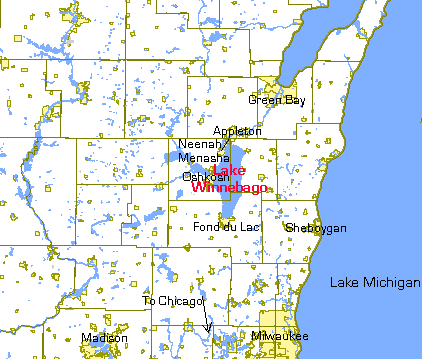
At length they settled in St. John, Wisconsin where already by 1856 some former immigrants from Irsch had joined a few others in this near wilderness in northern Calumet County. Possibly among them were John Mayer's sister Anna, born on February 26, 1829 and brother Michael, two years younger. The early years of the settlers were marked by hard work to convert the forest land into fertile farmland. Today, St. John in Woodville Township is located between Lake Winnebago and Lake Michigan in one of the most fertile farmlands in Wisconsin.

Since the settlers were almost all Catholic, in 1862 they established a parish church built of wooden logs. Between 1862 and 1869, the parish was run by the pastor from another village called Hollandtown (because it was first settled by emigrants from Holland). He came once a month to celebrate the Mass and the sacraments. In 1865 a new church was built because the log church was now too small for the church members. It was consecrated by the Archbishop of Milwaukee and dedicated to St. John the Baptist. The old log church became the first school building for St. John. The children of the settlers of St. John were taught by Theresa Wolf, a German Catholic who had, with her parents, immigrated a short time before. In 1870 Father Anton Leitner became the first priest of the parish.

 The parish of St. John celebrates its 150th anniversary this year on three Sundays in May, after re-establishing the original stones in the old part of the cemetery and doing extensive renovation and restoration work on the church. The Centenial festival committee was led by Joe Kees and his sister, two descendants of an early Irsch immigrant, Michael Kees, their great-great grandfather. The religious belief that originated with the St. John founders is still conserved and living today.

St. John the Baptist Church, St. John, Wisconsin
St. Gervasius and Protasius Church in Irsch
Photo from www.irsch/saar.de


Ewald Meyer, Germans in America,  htpp://www.irsch/saar.de


Sunday, April 28, 2013

"America Letters" and a Wisconsin Catholic Church


This year the small village of St. John, Wisconsin will celebrate the 150th Anniversary of its parish church, established in 1862 and dedicated to St. John the Baptist.  Since this is a blog about the life and customs of villagers in Kreis Saarburg Germany and the small villages of Irsch, Zerf/Oberzerf, it may seem strange that I am writing a post about an American Catholic church.  But this is not just any Wisconsin Catholic community and church.  It became the new home for a very significant  chain emigration from the village of Irsch to the village of St. John.

I want to write about a generally unknown and uncelebrated early settler, perhaps the earliest person of all to take his family and leave Irsch, Kreis Saarburg, and settle in St. John, Town of Woodville, Calumet County, Wisconsin.  Unfortunately, he has somehow been missed when, over the years, the storis of this settlement have been written

There is another reason for writing this post beyond the identity of the man who is probably the first settler of St John.  It is also a great example of the effect on emigration from Germany of the “America Letters,” as mail from the United States came to be called.   When such letters crossed the ocean to be read by the relatives and villagers of the old homeland, many people who had been doubtful about leaving now dared the trip across the Atlantic to a strange country.  At least one of those letters, long lost, surely came from a resident of Irsch who settled in a place he liked and told others in his German village about it.

I was not paying any attention to the St. Gervasius and Protasius church records of Philip Thomas and his family when I searched for my Irsch ancestors.  I was trying to figure out why Johann and Magdalena Meier had chosen to live in tiny St. John,Wisconsin.  They had selected this remote area of Wisconsin to be their home for the rest of their lives.   Other emigrants from Irsch did the same thing.  It was good farming land, of course.  But why this farm land?  

There was one reason that seemed likely.  Someone in the group of families from Irsch who became the first link in the chain of emigrants from the village of Irsch, sailed in March of 1861 to settle in St. John.  Someone must have had a relative who would be waiting for them, I reasoned, someone who had given advice on how to make the trip based on experience.  In other words, a former Irsch resident who was writing "America letters."

I searched the centennial books created for the St. John Parish anniversatries in 1962 and in 1987 to find a name that was not on the list of residents, as recorded by the immigration officials in Saarburg, who had traveled to Wisconsin in 1861 and 1862,  These people were listed as the very first emigrants from Irsch.  But I doubted.  Like Adrian Monk, the quirky but amazing detective on one of my favorite TV mysteries, I tried to find motives and clues others did not recognize; someone who had arrived before 1861, who had not been listed in the records of the time (the careful filing of documentation only started about 1860-61) and who was now hiding in plain sight, waiting to be discovered. 

I started with the 1860 Federal Census of the United States for the Township of Woodville in Calumet County.  This was in the days before so many records were digitized and available on the Internet.  I stuck my head into a dunce-cap microfilm reader at the library and scanned the Town of Woodville census line by line.  I believed I would recognize a family surname from Irsch.  I had spent so much time reading and rereading the microfilms of St. Protasius and Gervasius Catholic Church at LDS branch libraries that I had most of them memorized.  It was as if I myself had been born in that town and could say, “Yes, that’s an Irsch name all right.”  I had to search the census twice but on the second try, I found a name I thought might be the one I was looking for: a farmer named Philip Thomas, born in Prussia.  He had a wife and children and, as I thought, all had been baptized in Irsch.

Philip Thomas was born in 1808 in Beurig.  He was a Landwirt (a farmer who owned land) in the village of Irsch, married to Anna Britten of Irsch.  Philip was 48 years old, hardly the time a man might have been expected to leave the village he had resided in for so many years and make a harrowing trip.  Why did he do it?  His good luck in raising several children beyond the time of most danger for early death, worked against his staying in the Heimat.  He had four sons and two daughters.  His land holdings in Irsch, probably not very large, would by law be divided into six parts after his death, both sons and daughters inheriting.  This was a law imposed on the area when they were a part of France and never changed after Prussia took power.  Like so many emigrants, lack of land for the children to inherit and survive was most likely the motivating factor for Philip Thomas' decision to leave Irsch.

The Philip Thomas family arrived in the United States in June 1856 according to Philip's first papers in which he swore his intent to become a citizen of the US, and renounced the emperor of Prussia.  The Calumet County courthouse is where he filed his petition for citizenship on 1 April 1859.  In July 1860, the US Federal Census of Wisconsin lists him with $1,800 in real estate and $250 in personal estate in the Town of Woodville, Calumet County Wisconsin.

Philip’s wife, Anna, was the sister of one Heinrich Britten who still lived in Irsch.   The two families probably maintained contact through letters.  Philip would have described the availability of good, low-priced farming land with lots of trees that would leave the soil rich once the land was cleared.  It would also would provide logs for houses and barns. Evidently Heinrich began planning to take his family to Calumet County to join his sister and brother-in-law,  sharing the content of these America letters as well as his plans with his neighbors.  These families, including the family of Johann and Magdalena Meier, my 2nd great grandparents, decided to emigrate as a group.  In March 1861 they began their travel together from Irsch to the Port of Le Havre in France on their way to join the Thomas family.

I cannot produce any letters that Philip Thomas sent back to Irsch.  My evidence, I know, is circumstantial, but similar letters are recorded in a book called News from the Land of Freedom: German Immigrants Write Home, edited by Walter D. Kamphoefer, Wolfgang Helbich, and Ulrike Sommer.
  
I think I may, with my circumstantial evidence, get Philip Thomas and his family noted among the first settlers from Irsch to St John.


Saturday, March 30, 2013

Palm Branches, Pussy Willows, Boxwood and More


Pope Benedict with palm branches familiar to us


Boxwood "palm" branches on a pole
Pussy willows on Palm Sunday

It is a common mistake of mine.  I assume the way we in Wisconsin do things now (or did those things in the early years of my life) must be the way they are/were done in the European countries so many of our ancestors came from.  I remember my Palm Sundays, standing in church while the Priest said prayers of blessing over the palm branch I held tightly.  My palm branch looked just like the one carried by Pope Benedict in the picture above.  When I came home, my mother showed me how to braid (I am still not good at this) or curl the fronds.  The branch was placed behind the crucifix on my bedroom wall, to be replaced in one year by a new one.  End of story.

So  I had no plan to do a blog post about Palm Sunday because I assumed most readers would have a familiarity with such a palm branch.   Then I had an e-mail from a friend who lives in France near the German border.  She told me that her youngest granddaughter, who is five+, was anxiously looking forward to her first Palm Sunday service, which she would attend with her aunt. My friend said she herself was planning to spend the day before Palm Sunday with her granddaughter whom she loves dearly.  She would take her some boxwood from her own yard.  Obviously this was a different experience than the one which a child in an American Catholic Church would have.

A French website was able to shine some light on the use of palms versus boxwood:

The Gospel of St. Matthew says that the disciples were cutting branches from the trees and strewed the road (Mt. 21/8). These branches were probably olive branches.  Species of tree branches used today are varied. Palm branches are carried in processions in some regions like the southern provinces of Spain and those of Portugal. In most French departments, they have been replaced by boxwood.  In some, like Provence, the branches of laurel and olive trees are carried.  They use olive branches in Italy and parts of Spain. In England, they carry goat willow; in Holland, holly.  In Poland willow twigs symbolize rebirth and resurrection. Germany and Alsace often form a plant which is on a wooden rod adorned with boxwood and/or other branches and decorations.

It became clear to me that many people who come to church on Palm Sunday already have their hosanna branch, whatever the type, firmly in hand.

That brought into question what people in the land of my ancestors did with their "palms" after they were blessed.  A book with the title (translated) "Stories and Legends from the Saar and Mosel" by Josef Ollinger answered that question in more ways than I had ever thought possible.  Most of these beliefs and customs were from olden times in the small country villages.

The blessed branches were a  protection against sickness, crop failure, and disaster and were reverenced in many ways during the course of a year.  Villagers in farming communities in the Mosel and Saar would make use of the pieces/ twigs of the blessed branches, possibly on the same day that the "palm" branches had been blessed:

*A piece was placed over the house door to protect the family.

*Each crucifix in the home had a piece of the "palm" branch behind it to protect the house from sickness and disaster.

*The small holy water founts in each room held a little piece of a "palm" branch.

*Another small piece was taken to the cellar to prevent spoilage of the vegetables that were kept there.

*In the stable, the stalls of the animals had pieces of "palm" to protect them from sickness.

*The part of the barn where equipment was kept and the grains were stored received a piece of "palm" branch to protect from lightening and fire.

*A part of the blessed "palm" was burned in in the oven so that the smoke going to heaven would protect the house from lightening.

*A piece of palm was inserted in each field in the land belonging to the farmer, in order to beg God to give a good harvest.

*Young men put a piece of "palm" on their hat;s young girls wore a piece at their breast.  The author doesn't say this, but it seems that palms might have been considered a help in finding a sweetheart.  It also occurs to me that a sprig of boxwood or pussy willow would be the most attractive form of "palm" to wear.

*It was believed that if a "palm" leaf was chewed and swallowed, it would protect against a fever.

*When someone died, the hands of the deceased were folded holding a rosary and a "palm" branch.

*In the cemetery, if the grave had a holy water holder to bless the grave of the deceased, a piece of blessed "palm" would be included.

Some might call all of these customs mere superstitions of an uneducated class of people.  To me it shows the humility of people close to the earth and aware of their dependence on something much greater than themselves.

Sources:
http://92.catholique.fr/faq/fetes_rameaux_liturgie.htm
Ollinger, Josef, "Geschichten und Sagen von Saar und Mosel, CONTE Verlag, 2005


Thursday, February 28, 2013

A Place For Small Things


A very small book on wine from my favorite Saarburg bookshop and a wine cup from Irsch, the home of my Great-great grandparents 
A "must purchase" at Saarburg's Golden Autumn celebrarion


The shelves where my bits and pieces reside

On many visits to Germany and especially Kreis Saarburg, I have brought home a heart full of extraordinary memories, a head full of vivid impressions and often also a suitcase with large envelopes or folders filled with materials from an ancestral search which had been singularly successful. I have never been able to return home from a trip to Germany (or anywhere) without souvenirs as well.* Due to space limitations of my luggage and the strength of my back, the souvenirs were usually small things that reminded me of a happy occasion or something special I had seen. I treasured them and put them on my dining room table as soon as I unpacked and for a time, there they stayed.

After a few days I looked at them less and knew it was time to find a permanent place for them. So often, they did not fit together in a lovely grouping.  They were usually rather small and could not stand alone.  Should I pack them away?  I knew that I would want to see them now and then and be reminded of the Alte Heimat. Fortunately, I have a very large, glass-door bookcase in my dining room.  On two of the shelves I keep a few books in German and my German treasures. When I want to see my memories, they are in the best of all possible places.


Bits and Pieces for Your Ancestral Information "shelf."

This blog post is not about my souvenirs although you may be wondering by now.   It is about something that strikes me as very similar. As I write my blog posts, I will come across "lovely or curious small things" that remind me of my little souvenirs. Each is a piece of information not large enough to make a whole post. But there will be times when I, and hopefully you, will want to look at one of these little gems because it is uncommonly important to your understanding of an ancestor's way of life or because a surprisingly few sentences will sometimes be as full of information as an entire chapter in a book or a full-blown post on this blog.

The Ice Saints
This short piece of information explained a phrase I'd heard since I was a child.  One of my aunts who loved to garden always talked about the "iceman days" in spring.  I had no idea this was a Germanic piece of history.  The belief that the killing frost days in May came from the old homeland.  Sometimes only three, sometimes five saints with feast days in May were known as the "Eisheiligen" or Ice Saints.:  May 11, the feast of St. Mamertus, May 12 the feast of St. Pankratius, and May 13 the feast of St. Servatus.  Two other Saints are often added to the Eisheiligen - May 14, the feast of St. Bonifatius and May 15, the feast of St. Sophie.  The tradition seems to have been confined to northern and middle Europe, especially the areas in and around France, Germany, and later, Sweden.  Most often, the number is three, but some places also add Saint Boniface and Saint Sophia (as "Cold Sophie") to the original trio.  So beware planting before the feast of "Cold Sophie" even if the feast of Saint Boniface is a beautiful warm day.

Schneeglöckchen
These are little flowers that bloom earlier than any other plant in Germany. Snowdrops, the very early forest wildflowers of spring, are poisonous but beautiful. Schneeglöckchen means little snowbells in German, ("littlesnowbells"), the three words written as one, something very common in the German language The plant is native to a large area of Europe, stretching from the Pyrenees in the west, through France and Germany to Poland in the north, Italy, Bulgaria, Northern Greece, Ukraine, and European Turkey. It usually pokes it head through snow around the spring equinox although it can sometimes be found as early as late February. The flowers were probably the first welcome sign to our ancestors that spring was on the way.

Mosellied
In the year 1846, the Casino in Traben-Trarbach on the Mosel, came into being.  It was a rather elite club for gentlemen.   At times it was even frequented by Prince Wilhelm of Prussia.  The board members of the Casino, with a goal of saving and enhancing the culture of the area, decided an anthem should be composed to celebrate the Mosel River.  A wagon load of Mosel wine would be given to the winning entry.  A total of 171 entries were received.  Under a point system devised by the board, the song, "The German Rhine Bride," was chosen.  It told of the meeting of the Rhine and the Mosel (at Koblenz) as a wedding of the two great rivers.   It was the submission by Julius Otto of Dresden; the melody composed by his father.  The load of Mosel wine (1,350 bottles) went off to Saxony. As time passed, it was obvious that the song was not being accepted by singing societies. The text was too dry, some said.  Others thought the song was too long.  After a year, the casino jury met again and chose another song,"In many German lands" or more simply, Mosellied (Mosel Song).  The song was rehearsed by the glee club "Liederkranz" of Trier and spread like wildfire among the singing societies along the Mosel.  The new anthem's text was written by Theodore Reck and the music was composed by the Trier cathedral's organist Georg Schmitt.  It did become the anthem song for the Mosel and is still sung today.  Unfortunately, the wine stayed in Dresden. 

The Postal Coach
In the 19th century, Zerf had the service of a postal coach as did most of the small villages.   It also was available to carry passengers, but riding in it was no pleasure. Few people used this method of transportation because of the discomfort and lack of space inside, the hard wheels and thin padding of the seats. Every bump and pothole would be felt. The coach was hot and dusty in summer and cold and wet in winter. The horses were changed periodically and one of such places was Zerf, probably at the Gasthaus there. In addition to the discomfort of the ride, most of the inhabitants of Zerf and Oberzerf did not have enough money to pay for a trip, even one as short as a visit to Saarburg. Traveling on foot, or a journey by horse and wagon were the usual ways for a villager to travel to the Kreis Stadt, the equivalent of a county seat in the USA.

Stress Exclamation 
In moments of severe frustration or anger, I have been told that my Kreis Saarburg ancestors might have blurted out "Majosebetha," a combination of Maria (the Virgin Mary), Josef (St. Joseph) and Elisabetha (St. Elizabeth).  The exclamation is sometimes still used today.


*On my first visit to Irsch, I met my distant relatives and came home with a gift of three bottles of Riesling wine made from the choice green grapes grown in Irsch. I carefully packed the bottles in my carry-on luggage, and I prayed that there was no law that would prohibit me from entering the country with them. If U.S. Customs had not let me into the US with that wine, I think I might have stayed outside of the baggage claim area asking everyone in line for passport check if they had a corkscrew. 


Monday, January 28, 2013

The Nursing Madonna of Beurig


This amazing Madonna in its Catholic pilgrim church was unknown to me until 2002 when Ewald Meyer brought me from his home in Irsch to Beurig to visit it. That was a trip of about one mile. Herr Meyer had grown up in Beurig, which in former centuries, (sometimes only 88 people) would rightly have been considered a tiny village. As early as the 16th century, however, the church in this small vilage was as much a pilgrimage site as Lourdes, Fatima, and Santiago de Compostela. It was visited by numerous pilgrims from neighboring countries. All of my Rhineland ancestors must have known this pilgrimage site, visited it, most likely as part of a village pilgrimage, and been awed by it (The hardship of their pilgrimage was not impressive as most lived within 10 miles of it). Ewald Meyer, as a resident of Beurig, regarded the pilgrim church and the Madonna that it was built to protect as a source of pride for the village of his birth. A few years ago he wrote an extensive chapter about it in the book, Beuriger Lese- und Bilderbuch.

On the day we visited, Herr Meyer described, in German, the interior of the church and the location and size of the former Franciscan abbey. That order of priests and monks had been put in charge of the pilgrimage church in the 17th century. My German was not good enough to understand a lot of the detail in his explanation. But I did understand and laugh when he called my attention to a corner across from the entrance to the church. It was, he said, the former location of a bakery, because the pilgrims had been fasting and were very hungry when their pilgrimage was over. Those bakers understood how to select a good market place for their breads.

I really didn't appreciate the significance of the Beurig Madonna during that first visit. She was dwarfed by the fine late Gothic-style church built for her. I knew she was venerated and that some people were said to have experienced miracles through her intercession after they completed a pilgrimage to this site. I didn't look closely at the statue, carved by an unknown artist, on that first visit, and I completely missed something rarely seen on any statue of the Virgin Mary - her uncovered breast, about to give nourishment to her child, Christ, as he looked up into her face.  The statue is small in proportion to the tall altar piece in which she rests.

The Nursing Madonna

According to legend, the statue of the nursing Madonna - in Latin called "Madonna lactans" - was discovered by a miller’s apprentice. He found the wooden figure in the branches of an oak tree, which was being propelled downstream during a flood of the Saar River. This is said to have happened in the year 1304, which is also regarded as the first year of pilgrimage. The moment the villagers heard the story, they flocked to visit this miraculous Gnadenbild (image of the Virgin and Child).

A printed brochure once distributed to visitors to the pilgrimage site explained the story with a variation as follows: A miller's lad was making his way home through the Kammerforst (a woodland at the border of Beurig) when the evening church bells rang out. The bell known as "the angel of the Lord" rang out and was answered by a heavenly voice that led the boy to the statue, which was in the branches of an oak tree.

The representation of the nursing Virgin seems to refer to the Gospel of Luke (11:27) "Happy the womb that bore you and the breasts you sucked." However, this representation was not considered proper with the Catholic Church authorities of the times. Very early on it was "veiled" so that only the head of the baby could be seen. The rest of the child's body and the entire body of the Virgin Mother were covered in a very ornate dress of silk. From 1512 until 1955, the Madonna of Beurig looked very similar to other religious statues of the Madonna.

The restoration of the original icon was done in 1955 under Pastor Weber.  It was the first time in almost 500 years that a Beuriger congregation would see the original grace and expressiveness of the Virgin Mother's image in "unclouded beauty," with her right arm holding the infant as safely as if he sat on a throne. The intimate relationship between mother and child is evident and touching as I discovered in my second visit to the Madonna side chapel.

Mary's crown was not a part of the figure until the early 20th Century.  Retired Mayor Nicholas Ritzler wrote in 1912 in his History of the Castle and Town Saarburg: "A proof of the high veneration for the Beuriger Madonna gave rise to the solemn coronation a few years ago..." His description is probably based on the Jubilee pilgrimage of 1907.

The Pilgrims

Pilgrims came immediately after they heard the news of the discovery of the miraculous image. The first pilgrimage chapel was a small building of clay and wood. In 1330 a Marian society was established, which continued in existence until 1803. In 1479 the wooden chapel was replaced by a small stone church, but this too soon proved too small for the crowds. An impressive pilgrimage church was built between 1512-16.

At the start of the 17th century, pilgrimages to Beurig continued to increase. The parish priest was overwhelmed by looking after all the pilgrims. To provide him with support, in 1609 the Franciscans of the Cologne Order took over pastoral care of the pilgrimage/pilgrims and between 1615-28 they built an abbey with a place for the pilgrims to be housed during a short stay. The Franciscans remained in Beurig until 1803. This was a time when Napoleon ruled; he had pushed the border of France all the way to the left bank of the Rhine. This abbey as well as most others within France were abolished as part of Napoleon's secularization of all Catholic Church properties. After the departure of the Franciscans, the pilgrimages ceased, the abbey assets were auctioned off by the French, and the church was gifted by Napoleon to the village in Beurig as their parish church. Around the middle of the 19th century the concept of Beurig as both a parish and a pilgrim church was re-established; and pilgrimages came to life again.


Postcard showing the Madonna chapel and the veiled Madonna

Sunday, January 20, 2013

When the Name's the Same

Elizabeth Hauser and Mathias Meier are
my great-grandparents born in 1850 in Irsch.
He called her Lis; she called him Theiss


When I decided to write a novel about my Kreis Saarburg ancesters, I perceived a real problem almost immediately. My 2nd great-grandmother and her sister were both named Magdalena, and there was no good way to distinguish between them. The practice of naming the child after the godparent of the same sex resulted not only in two Magdalenas in the Rauls family but also two brothers named Mathias as well.

How was I going to distinguish which child in the Rauls family I was writing about? I considered Magdalena the older and Magdalena the younger. Or Mathias, (1818) and Mathias (1822). Those options did interfere a gread deal with the smooth flow of the story. For example: "Magdalena the older took the butter dish from the cupboard and handed it to Magdalena the younger." Or "Mathias (1822) bent to retrieve the dish while Mathias (1818) used his fingers to mop up all of the butter that had fallen from the plate." It was indeed a conundrum to be solved.

Many genealogist friends suggested I use the middle name, since that was commonly done in their ancestors' parts of Germany. However, in Kreis Saarburg, for whatever reason, there is rarely any church record showing that the newly baptized inhabitant of the village had a middle name. Perhaps that would have been frowned upon - a bit like stepping out of their class and imitating their betters. Was this some part of the sumptuary laws for the region of Kreis Saarburg?

I decided that using derivative names for my characters was the way to proceed, and I asked Ewald Meyer to give me those derivatives in the old Mosel Frankisch dialect, which he did. Also, he included information about the feast day of the Saint to whom each baptismal name pertained. He reminded me that in earlier centuries, children celebrated their Saint's name day, not their birthday.

Here are the derivative names and feast days for the majority of my Kreis Saarburg ancestors:

Matthias: (The Apostle who took the place of Judas. The grave of the Apostle Mathias is believed to be in Trier.)
The feast day of St Matthias/Matthew is the 21st of September.
The dialect names derived from Matthias are Mattheis, Theiss, Thias, Maeddi, Mattes, Mathes, Maddy, Matz, Maetz


Johann/John: (I have a problem here, since we have both St. John the Apostle and St. John the Baptist to consider)
The feast day of St Johann/John the Apostle is the 27th of Dezember, the feast day of St. John the Baptist is the 24th of June.
The dialect names derived from Johann are : Hanni, Häns, Hansi

Nikolaus/Nicholas:
The feast day of St. Nicholas of Myra is the 6th of December. The dialect names of St. Nikolaus: Kläs, Kloas, Nikla, Nekla,

Peter/Simon Peter
The feast day of St. Peter is the 29th of June (Peter and Paul)
The dialect names derived from Peter are Pitter, Pitt

Michael
The feast day of the Archangel Michael is the 29th of September
The dialect names derived from Michael are Michel, Mechel

Heinrich/Henry
The feast day of St. Henry, Holy Roman Emperor, is the 13th of July
The dialect names derived from Heinrich are Heinz, Reckes

Gerhard
The feast day of the Holy Gerhard of Cologne is the 23rd of April.
The dialect name derived from Gerhard is Gerd

Phillipp
The feast day of the Apostle Phillipp is the 11th of May
The dialect name derived from Phillipp is Fips

Magdalena/Magdalene:
The feast day of Mary Magdalene who stood under Christ's cross is the 22nd of July.
The dialect names derived from Magdalena(also in high German) are Magda, Lena, Leni, Lenchen

Anna:
The feast day of Saint Ann, the mother of Mary is the 26th of July
The dialect names derived from Anna are Ann, Annchen, Änni

Elizabeth:
The feast day of St. Elizabeth, the mother of St. John the Baptist, is the 5th of November.
The dialect names derived from Elizabeth are Lisbeth, Lissi, Lis, Ella, Elli

Margaretha;
The feast day of St. Margarete of Antioch is the 20th of July.
The dialect names derived from Margaretha are Margret, Gret, Gre’it, Gretel, Gredel,

Maria: (A name so beloved that from the 18th century on, the name of Mary was often given as the second name of male children, such as Carl Maria von Weber)
The feast day of the Holy Name of Mary is the 12th of September
The dialect names derived from Maria are Márie, Mari`, Ria, Merri

Susanne:
The feast day of St. Susanne, martyr, is the 11th of August
The dialect names derived from Susanna are Suss, Sanni, Sannchen

Agnes:
The feast day of St. Agnes, martyr, is the 21nd of January
The dialect name derived from Agnes is Angnes

Helena:
The feast day of St. Helena, mother of the Emperor Constantine, is the 18th of August
The dialect names derived from Helena are Lena, Leni, Lenchen, Len, Hella, Helene


I chose to send only the above names to Herr Meyer since they are the most prominent in our family tree. There are many more names and their derivatives in the Mosel Frankisch dialect as well as in other dialects. Possibly you will never need to know them because you don't have two or more living children with the same name in the same family. But there are other reasons for being aware of derivatives. A knowledge of derivative names might help one realize that Grandmother Lena was not Magdalena, but rather Helena; or that an ardent list transcriber made an assumption that the record keeper had put the names in the wrong column. Take the very unusual derivative name for Heinrich, which is Rekes. The transcriber helpfully switched the order because the surname happens to be identical to a given name. Pity the genealogist who is searching for Heinrich Adam on a passenger list but is unable to find him because he is transcribed as Adam Rekes. Talk about a brick wall!


Postscript: even though I had not asked for a derivative summary of my name, Herr Meyer included a great many short and pet forms for Katarina: Kaija, Kaja, Kari, Karin, Karina, Karen, Kareen, Katalin, Kate, Käte, Käthe, Kathy, Karna.  The feast day of St. Katharine of Alexandria is the 25 of November.