Showing posts with label rural villages. Show all posts

Tuesday, September 29, 2015

The Harvest of Survival Food

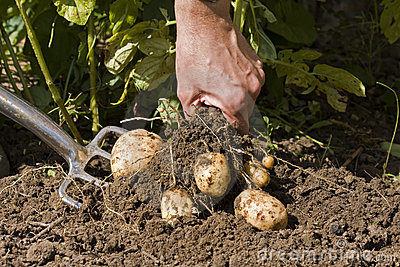
Digging potatoes
picture by dreamstime.com
Gathered cabbage
picture by Burpee.com

With September over, the autumn work on the farms in Kreis Saarburg in the 1800s was about to start. The successful harvest of two very important crops made the difference between a winter of sufficient food or of on-going hunger or even starvation.

The late summer months brought to an end the farmers' work in hay and grain fields. Many of those fields already were harvested and then planted for the next year. Now it is time for the autumn crops to join the hay and grains which are already stored in the barn.  All ages of family members are cutting, digging, picking and gathering. The grapes hang heavy on their vines (I have been told that almost every farm in the Saar River Valley grew grapes for their own wine making), and they will be harvested. The chestnut tree catkins of the spring now have turned a strong rust red inside their spiny covers and can be gathered up for cooking or roasted as a winter treat. The nut also could be ground into a baking flour.  The youngest children gathered the nuts and any fruits like plums and pears that could be dried for use in the cold months.
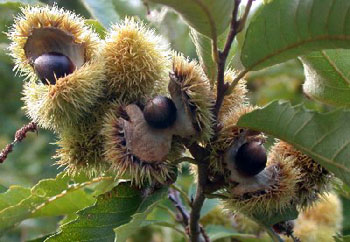
Chestnuts

Some of the hardest work of the autumn is bringing in the potato crop, a labor that calls for rugged days of digging and bending to get that year’s yield into storage in a cool dark place so that the potatoes will last for the entire winter.  All the peasant farmers depended on the potatoes as a major winter food source.

In a good year sacks would stand full and thick throughout the whole field. Parents and the older children worked together in the potato field. Each worker dug the potato stock with a hoe or fork which loosened the plant from the ground.  Next the potato stock was grabbed with the free hand and pulled from the earth, the potatoes mostly hanging tight to it.

 Usually three baskets were used for sorting the newly dug potatoes that were pulled from the stock or picked up from the ground where they had fallen from the stock. The big, thick potatoes went into the first basket, the little ones or those that had been damaged by hoe or fork were thrown in the second basket and used as food for the pigs. The third basket held the medium sized potatoes which would be used as seed potatoes for planting in the spring. The half dry stocks of the potato plants were thrown aside to dry. Landless day workers helped with the harvest for a share of the crop of the larger farms. At noon the housewife or the grandmother prepared a noon meal. Most fields were far from their farmhouse and their meal was carried to the field for them. There was laughter and gossip to make the work more pleasant.  At the end of the day, the sacks were loaded into a wagon and unloaded, usually into the cool dark cellar.

It took about three days to finish the potato harvest. When the potato stocks had dried completely some days later, the young would make a high pile ready to be burned. The roasting of potatoes once the potato stocks were burning was one of the highlights of the year for the the young.  It seems to have been the equivalent of a giant marshmallow roast.  They scraped the potatoes and held them on the fire with pointed sticks. The potatoes roasted to a very white delicate texture inside. They were also very hot. There were many shouts because of slightly burned mouths and fingers during the night of the big potato fires.


Bonfire of potato stocks
In 19th century Germany and for centuries before that, cabbage played a major part in the winter food supply of peasant farmers and craftsmen. Cabbage was their only winter vegetable.  The German word for cabbage is Kohl but in the Saarburg Kreis dialect it was and still is known as Kappes.

Kohl/Kappes is a vegetable that, like the potato, could help keep families from starvation during a long winter. This plant did not require a lot of ground space relative to the size of the head of cabbage that could be harvested from it. Like potatoes, cabbage could be kept all through the winter. Unlike potatoes though, the cabbage had to be sliced into a large barrel and made into Sauerkraut, a fermented cabbage.

The entire family was involved in the process of making sauerkraut. Two of the most important people in preparing sauerkraut were the cabbage cutter and the stomper. The father of the family or, at times, a migrant worker who went from house to house during cabbage season, was usually the cutter. The cutter placed a long board with a cabbage shredder embedded in the center over two stools. He sat on the board and ran the cleaned head of cabbage over the shredder. The finely cut cabbage fell into the tub placed on the floor between the stools.


Krauthobel (cabbage shredder)
When the tub was filled, it was emptied into a well-cleaned barrel, and other ingredients like salt, sugar, herbs, sour apples, and herbs like dill were added. In wine producing areas like Kreis Saarburg, wine was also an important sauerkraut ingredient and made what was called Weinkraut. Each layer of cabbage added to the barrel was stomped, usually by young sons (or daughters) of the family whose feet and legs were washed thoroughly and then covered with stockings called Krauttretensocke (kraut stomping socks). When the last layer of cabbage was in the barrel and stomped, it was covered with a round piece of wood that fit tightly and it was held down by a stone. According to the recipe book, Das Leibgericht, (The Favorite Meal) by Hans Fischer, sauerkraut making began about November 1 and the kraut was ready to eat after about 4 weeks of fermentation.

One interesting side note. I read that in the Hunsruck area, the bridal meal had to include sauerkraut as one of the dishes served because it was considered to be lucky. It is my suspicion that the origin of this story came from necessity since most weddings were celebrated between Christmas and Lent, a time when the workload was light for all the families and when sauerkraut was the only vegetable available on the bride and groom's special day.


Sources
http://paleoleap.com/eat-this-chestnuts/
Christiane Becker, Die Hunsrücker Küche
Joseph Ollinger, Geschichten und Sagen von Saar und Mosel.
Hans Fischer, Das Leibgericht.
Der Blumenbaum, April, May, June 2002


Wednesday, November 12, 2014

The Pig Herder

Bremen square gives a tribute to the pig herder


To try to hang on to my German vocabulary when I haven't had a chance to speak it or review a practice tape for some time, I picked up a book that is at least somewhat close to my reading level, Geschichten und Sagen von Saar und Mosel by Josef Ollinger. Once again, I learned something new and I wanted to share it with you.

The chapter I chose to read was full of facts about a job that Olinger says was considered one of the four most useful occupations in any Rhineland village. This is the order of their worth: Pastor, teacher, mayor, herder. The first three did not surprise me, but I had not known that a sheep, pig, goat or cow herder held such an important post. If you discovered that your ancestor was a pig herder, you might make the mistake of thinking his was a lowly position. To the contrary, herders were valuable and respected for what they did.  They were the farmers' insurance that their animals were cared for in a way that assured these assets would thrive. All of them depended on the herders to find good foraging spots for their animals and guarded them from any form of danger.  So important were these herders that they were entitled to special rent-free dwellings, "Hertenhaüsern" (herder houses), for themselves and their families. They were also provided with a small piece of land for a garden.

In the 19th century, especially the first half, all but very tiny villages had a herder for each kind of animal. Hence the occupation "sheep herder, goat herder, cow herder, pig herder" can be found in the pages of church baptismal records which usually list the occupation of the father of a newly baptized child. The occupation of herder was one that was often passed from father to son.

The work of the herder was seasonal. It was not unusual for the village teacher to take over the job of herder when school ended in March and the children went to work in the fields. The herder of pigs might supplement his income by doing the fall slaughtering for farmers who had raised a pig for a winter supply of smoked ham and sausage. For this service, the herder received a piece of the meat from each pig he slaughtered.

Many of the herders were gone by the late 1800s, choosing to migrate to the industries in nearby cities. But in the little town of Tunsdorf, which is in Saargau area near Kreis Saarburg, Nikolaus Adler, the son of the former pig herder, kept his job until 1959, when he retired. He felt great pride in the work he had done, especially because, in all the years he worked, he had never lost a pig.

Each year Adler started his work as a herder on March 17, the feast of St. Gertrude,  called St. Gertraud in most of Germany. This saint's' feast day was often associated with the coming of spring. Some examples of Gertraud lore: "A sunny Gertraud's day will bring the farmer happiness. If Gertraud's day is sunny, it is the gardener's delight. If it freezes on the Gertraud day, the land will need 40 more days to warm it enough for planting. If it freezes on Gertraud's day, all summer will be cool."  St. Gertraud's day somewhat resembles groundhog day in U.S.

In his book, Josef Olinger described this last herder of Tunsdorf as a daily presence, walking the village road with a horn he tied around his neck with a piece of rope. There were three different notes that he blew. One was used to signal the pigs to come out to him. At that horn note, pigs left their pens without coaxing and came through the farm yard into the road. From one end of the village to the other, new pigs joined those which had been called out earlier. If a farmer neglected to open their stall, his pigs would push and might break the pen's latch at the sound of that horn call. A different horn note alerted the farmers whose pigs were still in the stable. They knew it was time to open the pen latch rather than risk a broken stall. The third note was one that seemed to calm the pigs as they walked, assuring them that the herder was looking out for their well being.

Male pigs and boars did not leave their pens. They were fed a diet of table scraps and garden root vegetables, fattened as much as possible for the slaughter in the fall.  The sows and the young pigs ate from the meadows and woodlands. They could use their snouts to dig for food in the fields chosen by the herder. There was enough vegetation to sustain them during the summer months. A successful herder like Nikolaus Adler knew the best places for forage.  On hot days, he would look for a spot in the shade to keep the pigs tender skin from the burning sun.  He would try to get permission from the village forester who protected the government's woodland to allow the pigs to search for acorns and beechnuts that had dropped to the ground, a gourmet treat that the pigs loved.

Since pigs are not easy to keep together in a herd, Adler had two dogs that helped him round up a sow or young pig that went astray.  His dogs were rough mongrel types but devoted to their master and to the job for which he had trained them. Even a huge sow with formidable strength did not deter the dogs. One sharp bite to a sow's rump or leg, and the animal hurried to regain the safety of the herd.

In the evening, the herder brought the pigs back to their pens. The older pigs recognized the barn and stable which they had left that morning and trotted to it willingly without any help from the herder.  The very young pigs sometimes wanted to stray into the wrong farmer's pen.  Nikolaus Adler knew his pigs so well that there was never any mixup.  If a piglet strayed in the wrong direction, Adler would call to his dog, "Kastor, get me the little one" and the dog would sort the piglet out and bring it back for delivery to the proper barn. The number of pigs grew smaller until each was back in the pen where it belonged.

On Fetten Donnerstag, (Fat Thursday), which was the Thursday before the beginning of Lent,  Nikolaus Adler was paid, mostly in foodstuffs like meat, grain, sausage, and lard.  Each house that paid him also served him a glass of Schnaps.  I can only assume that the herder had a significant hangover, perhaps lasting until Ash Wednesday.

Photo: http://shannon313.files.wordpress.com/2010/07/img_3287.jpg

Tuesday, October 07, 2014

Surprising Village Residents

Johann Nepomuk
Government Worker


Regine Braconnier
Photo from Kommern Open Air Museum Website


The open air Museum in Kommern, with its costumed interpreters, allows one to step back into the lives of ancestors who lived in the northern part of the Rhineland. While the farm buildings are somewhat different from those in Kreis Saarburg in the lower Rhineland, many of the customs and living conditions would be very similar to those of the people of Kreis Saarburg's villages and small cities. 

In addition to interpreters who take on the identity of farmers, craftsmen, day laborers, etc., three of the historical figures described in detail on the museum's website were such interesting inhabitants of the area that I have translated their stories to share them you. The interpreters at the museum dress in the costume of their time as you can see in the two pictures above.  

The Government Man

Johann Nepomuk lived in Schwerz, a village in the upper Rhineland. He was a government worker commissioned by the Prussian government in 1816 to describe the agriculture of the Rhineland. For this purpose he spent three years creating records of Rhenish lands, coming in contact with many people and documenting the land they owned and the outlook for agriculture in a part of Prussia far removed from Berlin. At the open-air museum, visitors can look over his shoulder as he works with maps and writes down his observations about the farms for his reports to Berlin.

The actor who plays Nepomuk says, "It is exciting to see how we make a journey into history possible." The young and the old can observe the clothing of that time or watch a letter being written by the writing instruments of the past, using a font that some of the oldest visitors still know from their school days and that the young ones have never seen. They "can touch history."

The Upper Middle Class Frau

In 1892 Sybilla Schmitz was living in Poppelsdorf near Bonn, and her story is interpreted for visitors by a woman dressed as a visitor just arrived in her home village.  Sybilla was born in 1833 in Ruppenrod in the Westerwald, the daughter of wealthy farmer and mayor August Mungenast. In 1847 she moved to Bonn to live with her godmother, whose husband "had achieved something." As a trained cabinetmaker he ran a thriving furniture manufacturing business. In Bonn Sybilla attended a girls' school where she received lessons in music, handicrafts, painting and French. There she met her future husband Hermann, who worked as an administrative lawyer at the Rheinische Friedrich-Wilhelms-University and later held a senior position in the direction of the Agricultural Academy in Poppelsdorf. Thanks to the elevated position of her husband, Sybilla Schmitz lived in a spacious house with front garden and there was a servant to take care of the house and its cleaning. Ladies of the house in those circumstances had spare time, and this was the case for Sybilla. She had activities like a Reading Society weekday visits to her friends, and opportunities to travel.

The invention of modern transport such as horse-drawn trams and the steam train made it easier for people of Sybilla's class to travel longer distances. It was possible to visit her family in Ruppenrod, the village of her birth and perhaps stay for a few days.

 The Traveling Trader and Mousetrap Maker

Regine (Jien) Michels was born in 1833, the daughter of a poor farmer in Kirchweiler in the Eifel. It was a place that was shrinking, partly on account of the bad harvests from 1843 to 1845. In 1858, Regine married Hans Braconnier, a trader, who owned a farm in Neroth which was only 5 5 kilometers away. Like almost all others in Neroth. Braconnier, in addition to his farm needed a trade route to survive. A third pursuit to earn money was the production and sale of mousetraps.

For Regine this marriage with Hans was an economic improvement. The butter and eggs which the farm produced earned money for the couple or could be exchanged for other goods. Regine ran the farm while her husband was working his trading route and with the additional money, they were able to buy sheep, lease some more land, and send their sons Robert and Francis to school. With the help of her ​​mother, sister and the Braconnier children, Regine was able to keep making the mousetraps when her husband was traveling, sending them to him in the mail. In 1872 Hans Braconnier had increasing discomfort in his knees, so that Regine had to become the traveling trader for the family. She enjoyed the change and tells visitors, (through the interpreter who plays her role at the Kommern museum), "Working as a peddler, I made money and saw something of the world!"

When any one of these three people entered a farming village to visit it, children probably stared and followed after them. For their parents, it made for a bit of excitement in their long day. For this blog, it adds one more lively view of the colorful Rhineland village life.

Source:
http://www.kommern.lvr.de/de/im_museum_unterwegs/menschen/menschen_1.html

Sunday, November 17, 2013

Giving Thanks and Celebrating Autumn in Kreis Saarburg

Irsch, St. Gervasius and Protasius Catholic Church in Autumn 2004
Irsch, St. Gervasius and Protasius Catholic Church in Autumn 2010


Potatoes, squash, apples, grapes


Halloween celebrated, we look forward to Thanksgiving in the United States, and Christmas is already here in if you believe shop windows, TV ads, and some radio and television stations.

In Kreis Saarburg, there are also celebrations but they seem to meld better into the autumn of the year.  Here are some that originated with our ancestors and are still a part of the excitement of early and late fall.

Giving Thanks For the Harvest 

Autumn customs in one of my Heimat villages come to mind at this time of year as the leaves fall and pumpkins, squash, root vegetables and winter apples appear in our American markets.  We use many of them for the feast of Thanksgiving, decking our tables with cooked or baked varieties.

An article I read in a German language book explained the thanksgiving of German farming communities of the past.  They thanked God for the harvest, whether good or bad, by sharing their crops with God who gave them.  This has been carried on for centuries, even to the present day.  God's table in the Church, is decorated with the produce of the current year.  There may be squash, cabbages and other large vegetables, but there are often dry seeds of all kinds: flax, rye, wheat, oats, barley, legumes of all kinds.  All are harvested from German soil, traditionally from the soil that surrounds the village where the church is located.

I had seen this kind of decoration on autumn trips to my ancestors' village church in Irsch, enchanted with the kind of workmanship I generally associate with the Rose Bowl parade.  The closeup pictures above and the one below show the elegance of the most commonplace of decorating materials and the time given to produce this kind of thanksgiving to God from the fruit of the land.


Giving Thanks for St. Martin, Happy Children, and Rabimmel, Rabammel, Rabumm

Over the past several years, I have explained many of the traditions associated with St. Martin's Day (also known as Martini) as well as the importance of his November Feast.  If you click on the St. Martin's Day label at the right of the post page, the many activities associated with the day as well as the history and social customs are described, including carrying hollowed out gourds or pumpkins lit with candles.  

The custom of this celebration is still alive and well in the villages around Saarburg and in that city itself.  Most of 2013's customs are much the same as in the 1800s, although the lanterns carried by the children as they parade in the street are made of fireproof material and lighted with safe candles of one kind or another.  The Irsch website page just recently announced the village's 2013 lantern parade:

"The St. Martin's traditional lantern procession in Irsch will take place on Saturday, 09.11.2013 (November 9, 2013).  The assembly place is the parish church of Irsch at 5:30 p.m.  It will begin with prayer and a short homily about the holy St. Martin. Then the lantern parade (about 6 p.m.) led by St. Martin (on horseback) will parade to the Irsch multi-purpose hall. Once there, the great St. Martin's bonfire will be ignited and the Martin Brezeln (St. Martin pretzels) will be given to the children.

The lantern parade will be accompanied by the music society of Irsch as well as the torch bearers of the volunteer fire department, who also provide for the safety of traffic management and the burning of the St. Martin fire.  All children and adults are welcome  Hot drinks and snacks will be sold. The net proceeds as in prior years will again be used for the cost of transporting Christmas packages to help the needy in such countries as Romania."

In the event that you would like to see a typical St. Martin's parade, you can watch the video called "Rabimmel, Rabammel, Rabumm." The German words are given as subtitles on each screen of this very traditional children's song.  Unfortunately the translation in English below does not rhyme.

I go with my lantern
And my lantern goes with me
Up above the stars are shining,
Down here we're shining.
The rooster, he crows; the cat meows.
Rabimmel, rabammel, rabumm.
The rooster, he crows; the cat meows.
Rabimmel, rabammel, rabumm.

I go with my lantern
And my lantern goes with me.
Up above the stars are shining,
Down here we're shining.
St. Martin, he marches on.
Rabimmel, rabammel, rabumm.
St. Martin, he marches on.
Rabimmel, rabammel, rabumm.

I go with my lantern
And my lantern goes with me.
Up above the stars are shining,
Down here we're shining.
Lantern light, don't go out on me!
Rabimmel, rabammel, rabumm.
Lantern light, don't go out on me!
Rabimmel, rabammel, rabumm

I go with my lantern
And my lantern goes with me.
Up above the stars are shining,
Down here we're shining.
A sea of light in honor of Martin.
Rabimmel, rabammel, rabumm.
A sea of light in honor of Martin.
Rabimmel, rabammel, rabumm.

I go with my lantern
And my lantern goes with me.
Up above the stars are shining,
Down here we're shining.
My light is out,
Rabimmel, rabammel, rabumm.
We're going home,
Rabimmel, rabammel, rabumm.


Giving Thanks for a Blog Recovered

Due to circumstances I do not understand, for two weeks I lost access to this blog.  When I tried to make a correction in one of the previous posts, Blogger refused to let me do it.  After a great deal of wasted time and several curt notes to Blogger, all ignored, I had the good luck to bumble back into possession.  I was so thankful.  But it made me realize that, had I not had that bumbling good luck, I could never have posted to this blog again.  It would have been necessary for me to start an entirely new blog. So if you are a regular reader, you would probably have concluded that I got tired of blogging and quit without a goodbye.  

There are two ways to find out if I have been forced to start a blog with a new name: Register as a follower of my blog, and I will be able to notify you about where to find my new posts.  Or you can use my e-mail address (which you can find by reading my profile) to e-mail me.  

In the meantime, I promise to try to keep "Village Life in Kreis Saarburg" posts of the future right here.

Happy Thanksgiving to all


Sources:
Die Martinsumzug, http://www.irsch-saar.de/irschnew.htm
English for Rabimmel, Rabammel, Rabumm, http://german.about.com/library/blmus_laternegeh.htm

'

Saturday, March 30, 2013

Palm Branches, Pussy Willows, Boxwood and More


Pope Benedict with palm branches familiar to us


Boxwood "palm" branches on a pole
Pussy willows on Palm Sunday

It is a common mistake of mine.  I assume the way we in Wisconsin do things now (or did those things in the early years of my life) must be the way they are/were done in the European countries so many of our ancestors came from.  I remember my Palm Sundays, standing in church while the Priest said prayers of blessing over the palm branch I held tightly.  My palm branch looked just like the one carried by Pope Benedict in the picture above.  When I came home, my mother showed me how to braid (I am still not good at this) or curl the fronds.  The branch was placed behind the crucifix on my bedroom wall, to be replaced in one year by a new one.  End of story.

So  I had no plan to do a blog post about Palm Sunday because I assumed most readers would have a familiarity with such a palm branch.   Then I had an e-mail from a friend who lives in France near the German border.  She told me that her youngest granddaughter, who is five+, was anxiously looking forward to her first Palm Sunday service, which she would attend with her aunt. My friend said she herself was planning to spend the day before Palm Sunday with her granddaughter whom she loves dearly.  She would take her some boxwood from her own yard.  Obviously this was a different experience than the one which a child in an American Catholic Church would have.

A French website was able to shine some light on the use of palms versus boxwood:

The Gospel of St. Matthew says that the disciples were cutting branches from the trees and strewed the road (Mt. 21/8). These branches were probably olive branches.  Species of tree branches used today are varied. Palm branches are carried in processions in some regions like the southern provinces of Spain and those of Portugal. In most French departments, they have been replaced by boxwood.  In some, like Provence, the branches of laurel and olive trees are carried.  They use olive branches in Italy and parts of Spain. In England, they carry goat willow; in Holland, holly.  In Poland willow twigs symbolize rebirth and resurrection. Germany and Alsace often form a plant which is on a wooden rod adorned with boxwood and/or other branches and decorations.

It became clear to me that many people who come to church on Palm Sunday already have their hosanna branch, whatever the type, firmly in hand.

That brought into question what people in the land of my ancestors did with their "palms" after they were blessed.  A book with the title (translated) "Stories and Legends from the Saar and Mosel" by Josef Ollinger answered that question in more ways than I had ever thought possible.  Most of these beliefs and customs were from olden times in the small country villages.

The blessed branches were a  protection against sickness, crop failure, and disaster and were reverenced in many ways during the course of a year.  Villagers in farming communities in the Mosel and Saar would make use of the pieces/ twigs of the blessed branches, possibly on the same day that the "palm" branches had been blessed:

*A piece was placed over the house door to protect the family.

*Each crucifix in the home had a piece of the "palm" branch behind it to protect the house from sickness and disaster.

*The small holy water founts in each room held a little piece of a "palm" branch.

*Another small piece was taken to the cellar to prevent spoilage of the vegetables that were kept there.

*In the stable, the stalls of the animals had pieces of "palm" to protect them from sickness.

*The part of the barn where equipment was kept and the grains were stored received a piece of "palm" branch to protect from lightening and fire.

*A part of the blessed "palm" was burned in in the oven so that the smoke going to heaven would protect the house from lightening.

*A piece of palm was inserted in each field in the land belonging to the farmer, in order to beg God to give a good harvest.

*Young men put a piece of "palm" on their hat;s young girls wore a piece at their breast.  The author doesn't say this, but it seems that palms might have been considered a help in finding a sweetheart.  It also occurs to me that a sprig of boxwood or pussy willow would be the most attractive form of "palm" to wear.

*It was believed that if a "palm" leaf was chewed and swallowed, it would protect against a fever.

*When someone died, the hands of the deceased were folded holding a rosary and a "palm" branch.

*In the cemetery, if the grave had a holy water holder to bless the grave of the deceased, a piece of blessed "palm" would be included.

Some might call all of these customs mere superstitions of an uneducated class of people.  To me it shows the humility of people close to the earth and aware of their dependence on something much greater than themselves.

Sources:
http://92.catholique.fr/faq/fetes_rameaux_liturgie.htm
Ollinger, Josef, "Geschichten und Sagen von Saar und Mosel, CONTE Verlag, 2005


Monday, November 14, 2011

On St. Martin's Day, Winter is Not Far Away

Saint Martin's Day Procession, Saarburg 2011


St. Martin's Day, November 11, marked, in former times, the start of winter. It was a day which affected the residents of each village in many ways. It was the time when interest and lease payments were due. This was the origin of the following farmers' saying, "Sankt Martin ist ein harter Mann für den, der nicht zahlen kann." ("Saint Martin is a hard man, for those who cannot pay.") It was a better day for the sheep herders and the servants who received their yearly pay on this day. The geese lost their heads, literally, at the beginning of winter, and the celebration of the feast included roast goose for those families that could afford it. "Sankt Martin ist ein guter Mann, er bringt die Bratgans uns heran," was another farmer's saying that represented St. Martin's Day (Saint Martin is a good man; he brings the roast goose to us).

By St. Martin's Day, the field work and the harvest were finished. I was surprised to learn that in earlier times, Advent began right after St. Martin's Day, with the eating of meat strictly forbidden during the entire period. Therefore, the roast goose eaten on the saint's feast day was the last meat that would appear on the table until Christmas Day and this must have greatly increased the enjoyment of the St. Martin's Day meal.

The custom of the St. Martin's procession is one of the few that is still observed in the current time, as the picture above shows. The children go out with colorful lanterns, following St. Martin on horseback, dressed as a Roman soldier, who leads the parade. At the end of the procession, a giant Martin's bonfire is lit and the children receive
Brezeln, a bread pretzel formed into distinctive symmetrical loops from a long strip of intertwined dough.


After St. Martin's Day, the hard work of the months of harvest came to an end and the cold winter months began. The soil began its yearly rest. Then farmers too could sit near the stove or the fireplace, rest, and enjoy a break from the heavy labor which would not start again until spring.

In the autumn, some of the fruits gathered had been mashed and put in oak barrels to ferment. In the winter came the time to distill or "burn" the fermented fruit into Schnapps. Many kinds were made. The cherries, Mirabel plums and Zwetsch plums made an especially fine Schnapps that would be served on special occasions and feast days. For every day, a Schnapps made of pressed apple peelings called "
Balesch" was a drink for workdays. A typical farmer would drink Balesch each morning after his breakfast. It was meant to protect against every kind of illness. If a person had a stomach ache, not the doctor but Balesch was the prescription.

When the weather was cold enough to freeze, the farm's pig was slaughtered for the family's winter food. Often the village butcher would come to the farm to make sure that no scrap of this valuable animal was wasted. The farmer's wife had already filled the large pig kettle with water and heated it on the fireplace. The pigs legs were bound together and the animal was dragged into a pile of clean straw. The butcher knelt down on the pig as it struggled to avoid the sharp pointed knife but in vain. The butcher made a cut from the throat to the heart and the farmer's wife caught the flowing blood in a large pan. Then the pig was covered in straw which was set on fire, burning the bristles from the pig's skin. The pig was pitch black as the fire was extinguished and his carcass was lifted on to the butchering table.  Any remaining bristles shave off and washed with the hot water that had been heating in the kitchen. It took more than one man to lift the pig's carcass and hang it on a ladder which leaned on the outer stable wall. The housewife then carefully cleaned the inside of the carcass, and it was left there until the rind or outer skin would harden with the cold.


The following day, the butcher returned, cutting the pig into pieces to be smoked, made into sausages or eaten fresh.  Even though the farmer's wife had previously felt compassion for the animal she had fed and tended throughout the year, now she could not but be happy as she thought about the tasty ham, bacon, fresh meat and sausage that she would put on the table for her family during the winter months.

Many cellars were made of stone which was an especially good place to store the winter supply of produce that was the result of months of hard work growing and harvesting it.  The stone construction helped keep the cellar at a temperature that was ideal for storage purposes all through the year. It had kept things cooler in the summer and now would be warm enough to avoid freezing the winter food supply. From November on, the cellar stored wine, potatoes and other root vegetable, and crocks of cut cabbage fermenting into Sauerkraut.

The farmer had felled trees and chopped wood for the fireplace in the first days of the winter season and stored it in a shed or shelter. The smaller branches of the trees were tied together into giant bundles. The smaller twigs were useful for quickly starting a fire on a cold winter morning.

All in all, the coming of winter was a time to be looked forward to for the hardworking farmers of the small villages in the Rhineland. For the farmers, there was now time to sharpen the tools that had been dulled from the cutting of crops or tilling the soil and to make any necessary repairs to the farm equipment. These were the hours when the father, mother, and children had opportunities to spend with each other in simple pleasures; when the men had the time to talk and have a drink together, when the women had no more field work and could sit to spin or knit, either alone or with a few women neighbors, and most of all it was a period when the children could once again look forward to the visit from St. Nikolaus and the wonderful celebration of Christmas.

I grew up on a small Wisconsin dairy farm and I remember winter's pleasures, especially seeing my father eating a leisurely supper because there was no hurry to get ready for the outdoor work of the next day. Those were times of family laughter and togetherness and is probably one of the reasons, unlike many other people in Wisconsin, I still look forward to the coming of winter and the memories that go with it.


Ollinger, Josef. Geschichten und Sagen von Saar und Mosel, 2005
Jean Morette.
Landlleben im Jahreslauf, 1983

St. Martin Photo by Josiane of Lorraine

Saturday, February 26, 2011

The Building That Was Left Behind

Getting near to hallowed ground in 2004

Every time I came to Irsch - from the 1980s to my last visit in fall of 2010 - I passed the place where my ancestral home once stood.  Part of it, greatly changed over time, was still there.   But I had no idea I was walking or driving past what was, for me, hallowed ground.   

I had asked about records that would show the location of Johann and Magdalena Meier's house many times over the years and was always told that those records no longer existed.  In a village that had seen severe destruction from the time of Napoleon to World War II,  I had to accept the idea that I would never know where my Meier (or Hauser, Schawel, or Weber) ancestors had actually lived.  

I also thought that I had exhausted the resources in the Koblenz Archive when I found great-great- grandfather Meier's and Hauser's emigration documents.  But that was definitely not the case.  That Archive has so much more to offer - if you know how to look.  A genealogy friend told me about a researcher friend in Germany who used the Archive documents regularly and about the possibility of additional records.  She encouraged me to write him and ask him if he would do a search for me when he next visited the Archive.  He graciously agreed.  That was in about July of last year.

Just back from my trip to Germany in September  and October 2010, I retrieved my mail and found a package full of documents from the Archive.  It had been sent by the German researcher.  There were Kataster maps of Irsch and Zerf, or what we here in Wisconsin would call plat maps.  There were also pages of tax lists.  They dated from approximately 1829.  The Kataster maps showed not only numbered land holdings, but also tiny sketches of each house in the village.  It was possible to see the shape and relative size of each dwelling including the barn-house where Johann and Magadalena, my 2nd great grandparents had lived just before they came to Wisconsin!

No. 4091- Barn House of Matthias Meier in 1829, future home of Johann Meier and Magdalena Rauls Meier
That was exciting but would not have been as much help without the tax documents which came with the maps.  The copies of tax lists gave the size of each land parcel by number, told what type of land it was, the name of the area in which it lay (Beim Holzapfel Baum, In Der Wolfshek),  and showed the tax rate for each piece of land, no matter how small.  I matched Kataster number to Prussian tax number, and found the pieces of land owned by my Meier and Rauls ancestors in 1828-9, including their dwelling.

Herr Ewald Meyer of Irsch, who has always been a wonderful help to me, is able to read the old German handwriting, and once more I counted on his aid.  I sent copies of the documents to him, knowing that he would be able to read the difficult handwriting on the tax lists and also hoping that there might be a place in Irsch and Zerf to keep this duplicate information as an example of what a wealth of family history information can be found at the Archive in Koblenz.

E-mails began to fly back and forth.  I learned that the Meier family had pasture land, two small garden plots (neither close to the house they lived in) some fallow land - 19th century Germany used the three field system at this time - and one small field of "wild land/hedges."  Herr Meier, analysing the total land ownership in 1829 of Matthias Meier, Johann's father, came to the conclusion that he was a "small farmer" known as a Kleinbauer.  He had barely enough land to feed his family and probably owned very little livestock -- perhaps a cow or two and a pig.  To pay the taxes on the land, most Kleinbauern like Matthias had to have a second way to make a living, perhaps as a small-time craftsman such as a tailor or barge puller.

I thought my knowledge of the area couldn't get any better than that - but it did.


Remains of the Barn House of Johann Meier today
As always, Herr Meyer went the extra distance - and then some.  Soon after he got my package of documents, I received e-mail pictures of the part of the dwelling - the storage barn and the stable - which exists today in highly remodeled form. It is owned by the family across the street, even though it stands wall to wall with the home of another Irsch resident.  The Fisch family uses the former home of my ancestors for storage of wood, tractors, and other equipment.  This remodel was done sometime after I visited Irsch in the 1980s.  Because of the German love of order and paperwork, there were documents which spanned the time of the first remodel in 1927 and, after a visit from Herr Meyer, Herr Fisch, the current owner, was willing to give them over for scanning.  You can imagine my excitement when the e-mail scans arrived in my mailbox. 

First the building of today.  Notice the wall without windows in the new storage building.  That was the length of the Meier family's living space - and the width of their quarters was about one-third of that length.  According to my calculations, there could hardly be more than three rooms on the first floor; and each room on the first and second floors would have been about 6 feet by 7 feet in size.   Have you ever felt your kitchen or bedroom was too small?  It is probably palatial by these standards.
Diagram of the Barnhouse of Johann Meier in Irsch

The three colors on the diagram indicate remodel plans by Michael Britten in 1927 (red) and the later remodel (green) by the neighbor across the street, Herr Fisch.

Also notice the size of the stall area and the storage barn, (Stall und Scheune) compared to the size of the family's living quarters.

There was also a diagram for the walls and roof of the house.  You can see that in the last remodeling of the barn area; that is, the stable and storage, the top of the roof was reshaped and now has the flatter roof one can see in the current photo taken in 2011.  Before that time, there was a second floor for the living quarters.  A little more than a year before they applied for permission to come to America, Johann and Magdalena Meier had five children, and it is likely that Johann's father Matthias and his unmarried uncle Michael also lived in the house with them.


view of the buildings from the main street


It seems that by 1927, the part of the structure that had been the living quarters was in very bad condition and at that time was rebuilt by Michael Britten and combined with the storage area.


The living quarters faced the side street off of the larger main road
The final site plan shows an unusual land pattern.  The land on which the Meier dwelling sat had been divided into three separate plots: house, stable, and storage areas - each have their own site number.  Did Johann and Magdalena have a difficult time selling their dwelling and barn before they left for America and divided the lot for a quicker sale?  Another idea to be considered for my novel.

The building that was left behind saw its worst time in 1945 because of its unfortunate location near the German defense line set up to stop the invading WWII Allied troops if they managed to cross the Saar River.
American GI walks where once Johann and Magdalena lived

History ebbs and flows, changing destruction into renewal, enmity into friendship and, with luck; it allows families, once divided by unhappy circumstance, reconnection in future generations.  I feel privileged to be part of such a reconnection.

Sources:
Landeshauptarchiv Koblenz, Kataster 001_Best.737 Nr.164 Bl.103 tif; Cataster 002_Best.737 Nr.164 Bl.103 tif;
Catastral-Steuer, Mutter-Rolle für die Catastral-Steuer der Gemeinde Irsch
Photo collection of Ewald Meyer, Irsch 


Sunday, July 18, 2010

From Bishop's Crosier to Napoleonic Flag to Prussian Eagle


The Palace of the Archbishop/Elector of Trier


As we know, there was no Germany as such until the 20th Century. Instead there was a so-called German Empire made up of large to very small territories ruled by kings and dukes and both civil and religious princes, called "Electors." The governance of the villages of Irsch, Serrig, Zerf, and Oberzerf, for instance, was in the hands of an elector who was one of the princes of the church. In effect, the peasants who lived in the small villages and worked the land had an Archbishop as their ruler. The residence of the Archbishop went back and forth over the years between Koblenz and Trier, but in his book about Irsch, Ewald Meyer points out that the Trier was always the spiritual center for these villages. The monasteries or churches of the Trier Diocese were the intermediaries of the Archbishop and governed in much the same way as the civil authorities who served the civil electors of other Germanic kingdoms or territories.

The line between secular and spiritual was almost non-existant for most of our Rhineland ancestors until 1792 when Napoleon conquered the territory and enlarged the country of France to include Trier and Saarburg along with all the villages along the Saar and the Mosel Rivers and all the land in between. France had the Rhine River as its new border and a multitude of new subjects who spoke only German. While the idea of "Freedom, Equality and Brotherhood," the slogan of the French revolution was something that many of the new French/German subjects admired, they missed their old spiritual home as Napoleon began to secularize life in this new part of France.

It was a shock to his German-speaking subjects to learn that Napoleon had developed his own calendar. Sunday was abolished and its replacement, Dekadentag, was introduced; now every tenth day was a day of rest. In place of the Christian holidays there were secular celebrations. Processions, such as the those of Corpus Christi and Good Friday were prohibited. This situation continued until the Pope and Napoleon reached an agreement or Concordat in 1801.  Faith and religion were again recognized.

However, there were still significant changes.  Irsch, for instance, became a "secular parish:" that is, it no longer was under the power of a prince/archbishop. The parish pastor was appointed with the approval of the Civil Prefect and the Bishop had to take an oath to the Constitution.  Among the new civil authorities there was hostility to the Church and its former powers.  Thus there were newly established Civil Registry offices. Civil marriage was introduced and required.  The clergy had to take the oath to the French Republic, and the pastors were instructed that the recording of births, marriages, and deaths, that had formerly been only the responsibility of the church, was now secondary to the creation of civil records.

In 1802 the monasteries and abbeys were dissolved, that is, their lands now belonged to France, not to the Catholic Church. Clerical dress was forbidden. For a time the "secular pastors" were expected to live on the offerings of the faithful, including small tithes or by means of citizen offerings of lambs, piglets, hay, flax or other core necessities. But by 1804, the Irsch pastor received 500 francs in state salary per year.

Irsch and Zerf now each had a Maire and a deputy who were assigned civic duties at the local level.  Johann Baptist Britten of Irsch was appointed the first mayor of that village.  In Zerf, a Herr Schneider was the first mayor.  Though liberty, equality and fraternity were the ideals of the time, the governance under this ideal was far from free of charge. Rather, the taxes increased, and the burden became unbearable for the rural poor. The position of Maire was not a popular one, since his office was in charge of tax collection, sometimes enforced with penalties or even violence.  Under these circumstances, anger grew as some of the wealthy used their power to buy monastic estate. They, rather than the Church, became the new "landlords.". While the big landowners could afford to have large windows in their buildings, cottages with their tiny windows provided sparse light for the impoverished villagers.

With the arrival of the allied armies in the Rhineland in 1814 and the Battle of Waterloo in 1815, Napoleon's downfall was sealed.  The Maire now called himself the Bürgermeister, and the Municipal Council was now the Community Council. The first Paris Peace Treaty signed on May 30, 1814 returned France's border to its January 1, 1792 state.

For two years, part of the territory which France lost was divided between two powers. To the left of the Mosel River the Prussian Empire handled administration while the section of territory to the right of the Mosel fell under the control of the Österreichisch-Bayrischen (Austrian-Bavarian) coalition. This included the villages of Irsch, Serrig, and Zerf. It was not long, however, before the Prussian Empire claimed everything Napoleon had lost. According to Ewald Meyer's history of the village of Irsch, the Prussian Eagle was stamped on everything. There Prussian who originated in the north of Germany considered themselves "true Prussians.  They looked down on these newly-conquered Prussian citizens who were sometimes referred to by their northern Prussia countrymen as "painted French."

The northern Prussians' contempt for its new "painted French" citizens was returned in kind by the residents of Kreis Saarburg. They called the Prussian Adler (eagle), symbol of the Prussian Empire, "the cuckoo."

Even today the Prussian Adler is considered a symbol of seizure or sequestration.

When I began my family history efforts many years ago, my Aunt Helen told me her grandfather, my great grandfather, who was born in Irsch, had been proud that he was Preußisch.   Things change!

I, of course, didn't speak German then or know anything about German history.  It took me awhile to realize that Prussian and Preußisch were one and the same.

Sources:
Ewald Meyer, Irsch/Saar: Geschichte eines Dorfes.
Edward Christofel, Der Hochwaldort am Fuße des Hunsrücks.