Showing posts with label Zerf. Show all posts

Friday, September 14, 2012

Catholic Choirs - A Joyful Noise Unto the Lord

The Door of Faith at St. Gervasius and Protasius Catholic Church in Irsch

Hymn: Holy God, we praise You


If you are writing a novel and you know your main character, your great-great grandmother, came from a long line of Catholics and that she and your great-great grandfather passed that Catholic faith on to their descendants to the present day, you might wonder if part of her Catholic heritage included a love of singing her prayers that she exercised by being a part of a church choir.  Were there Catholic church choirs in the villages in which she lived, or did the congregation of those churches just sing together to honor their Lord and God? In earlier times, how did the villagers of Oberzerf and Irsch "make a joyful noise unto the Lord" and in what form?"

I went to the history books written about the villages of my Rhineland ancestors to search.  Local histories of Zerf, Irsch, and Serrig, where the Catholic church was the heart of each village, satisfied my mind that the Catholic church choirs of the time existed and were made up of both men and women. They certainly existed during the 19th century, the time period when Magdalena Rauls Meier worshipped in the churches of Saint Laurentius (Zerf), Saint Wendalinus (Oberzerf), and Saints Gervasius and Protasius (Irsch) 

The Catholic Churches in Zerf and Oberzerf.

The St. Laurentius Catholic church choir did exist in the late 18th and the 19th century.  Since Oberzerf is about a mile away, it  had a smaller chapel and was called a daughter church.  It was dedicated to St. Wendalinus.  The school in Zerf was an integral part of the Catholic church of that village, and the teacher also served as a sexton for the church in order to earn extra money for himself and his family. Caspar Goetten (1770) probably played the organ as part of his sexton duties, and he is described in the old records as a Vorsänger, that is, someone who stood before the congregation and directed the singing of a choir or the congregation. It is also likely that Lehrer Goetten trained a group of school children as a choir. After Caspar Goetten no longer taught, his son Nikolaus (1813) served as teacher and choir leader. He had, it seems, a number of supporting adult singers to help when more complicated choral music was required for the mass. This was not a choir with the stature and organization of modern times, but its men and women who wanted to use their voices to pray probably did practice regularly so they could sing the Latin songs and responses together as a choir.  The school children, male and female, sang together at services as well.

Nikolaus Trapp took over as teacher and organist in Zerf from 1837-1856 at the end of which time he was transferred, at his request, to the newly built school in Oberzerf. Herr Trapp also brought together the choir group in Zerf, which was the larger of the two churches.  The teacher who replaced Herr Trapp in Zerf was a Herr Diné. He assisted Herr Trapp from about 1846 on, and he took the organist position in 1885 when Herr Trapp was no longer teaching. But he had helped Nikolaus Trapp as an organist and church choir director before that time, perhaps in Oberzerf. Evidently, the choir was a very important part of the Zerf Catholic church's liturgy.

The Catholic Church at Serrig

The first evidence of a St. Martin Catholic church choir in Serrig is documented in 1789 in the church administrative records. A payment of four Thaler to Christophel Tressel from Irsch to serve as the choir leader of the church in Serrig was recorded. In 1790, Herr Tressel was again paid four Thaler to direct the Serrig choir of "Sänger und Sängerinnen," which means that both male and female singers were part of the choir group that sang for the Holy Mass in the Serrig Catholic church.

By 1827 Serrig was a full-fledged parish church which was no longer dependant on the church at Irsch. The choir must have continued because the pastor of the new independent parish asked the Diocesan authorities for a clarification about the singing of songs during services. The answer received was that the choir only should continue to sing the Latin Mass and hymns; the congregation could join in the singing of any songs that were written for the German language. Almost always these would have been sung at the end of the mass

The Catholic Church in Irsch

In Irsch the Catholic Saints Gervasius und Protasius church choir was founded in 1780. The first choir director was the same Christoph Tressel who trained the choir in Serrig. This teacher and sexton was assigned the job of working with the choir as an additional part of his duties. The history of Irsch written by Ewald Meyer does not indicate whether women as well as men sang in the choir. But the information on the church choir of Serrig, once the "daughter" church of the larger "mother" church of Irsch, most likely could be applied to Irsch as well, since the choir director was the same person and he trained a male and female choir in Serrig.

Yes, I believe my great-great grandmother had the opportunity to sing in both the choir of Zerf, the village a short way from where she grew up; and in Irsch, her home village after her marriage.

Hymn singing by the congregation during the service was not that common in the Catholic churches of the 19th and 20th centuries because of the Latin liturgy. Many of the hymns from the 1700 and 1800s were written in the vernacular, the common language of the people; but they were sung during the church service mostly by Germany's Lutheran congregations. During the Catholic masses, the choir sang in Latin and the congregation was silent, only listening to the music. Their time to sing was almost always after the Mass liturgy was concluded; and the people had been told, in Latin, that the mass had ended and they should go in peace.

In the illustration above you see the German words for the hymn I knew as "Holy God We Praise Thy Name." When I was growing up (before the changes of Vatican II) this hymn was sung at the end of mass by the congregation in the Sacred Heart Church in Sherwood Wisconsin at the end of especially celebratory Masses. It was my favorite hymn, there was something so powerful and prayerful about it that made it very special to me and, of course, I could understand the words which were in English.

GROSSER GOTT, WIR LOBEN DICH (translation)
Holy God We Praise Thy Name 
Holy God, we praise Thy Name;
Lord of all, we bow before Thee!
All on earth Thy scepter claim,
All in Heaven above adore Thee;
Infinite Thy vast domain,
Everlasting is Thy reign.

Hark! the loud celestial hymn
Angel choirs above are raising,
Cherubim and seraphim,
In unceasing chorus praising;
Fill the heavens with sweet accord:
Holy, holy, holy, Lord.

Holy Father, Holy Son,
Holy Spirit, Three we name Thee;
While in essence only One,
Undivided God we claim Thee;
And adoring bend the knee,
While we own the mystery.

I hope that the final hymn sung by my great-great grandparents on the Sunday before they left Irsch in order to emigrate to Ameria was "Grosser Gott wir loben Dich" and that it was sung again in the new country when their log cabin church at St. John, town of Woodville, Calumet County, Wisconsin was used for the first time.

Notes:
1) "Grosser Gott wir loben Dich" is a beautiful classic Catholic hymn, used by the Church for more than two centuries. The words are attributed to Ignaz Franz, in Maria Theresa’s Katholisches Gesang Buch (Vienna: circa 1774) and it was translated from German to English by Clarence A. Walworth, 1858. The English translation is not literal; it was adjusted to maintain the rhyme.

2) In honor of the "New Year of Faith 2012-2013," proclaimed by Pope Benedict XVI, the blog "Catholic Gene" is hosting a “Doors of Faith” celebration online. Bloggers are asked to share their own or their ancestors faith experiences. This is my contribution. On October 11, The Catholic Gene will share some of the websites that are participating

Sources:
Der Hochwaldort Zerf am Fuße des Hunsrücks, by Edgar Christoffel
"Die Geschichte des Kirchenchores 'Cäcilia' Serrig,"in the chapter "Serrig: Landschaft Geschichte und Geschichten" by L. Thinnes, from Serrig; Landschaft Geschichte & Geschichten by Klaus Hammächer et al.
Irsch/Saar: Geschichte eines Dorfes by Ewald Meyer
Photo from http://www.irsch-saar.de/bildmat.htm

Thursday, July 05, 2012

Early Posts Remembered


Wedding  Document from Hunsruck


Barge Stop on the Saar

Zerf farm life shown in village museum -
horn planters
Saarburg mill stream

On June 24 I celebrated an anniversary of sorts - my 7th full year of written posts for "Village Life in Kreis Saarburg". That means that this blog post begins year eight! When I wrote that first post, seven years seemed an impossibly long time to continue my project; now it seems impossible that the time has gone so fast. As these early posts are probably the most neglected, it seems fitting to bring them to the forefront again as part of my personal anniversary observance and as examples of ways to learn family history from less used sources.

My very first post on this blog was about Easter customs in the Hunsrück area of Germany. I bought a small recipe book, self-published, in a bookstore and it was a treasure. In searching for traditional recipes my ancestors might have enjoyed, i found not only recipes for Easter dinner, but also a gold mine of information about the traditions that went along with the recipes. For instance, children began to gather moss from the forests about two weeks before Easter so that they would have enough for a soft nest. The night before Easter, the moss nests were carefully placed in the garden, thus inviting the Easter Hase to lay its eggs there. But what if it rained on the evening of Easter Saturday? The children brought the nests inside and placed them in the kitchen, using a little willow basket to help keep the moss in nest-shape form. Recipe books can be a great source of information! 

My next four posts were written about a visit to a small village museum in Zerf, Germany. This dusty little museum was crammed full of farm implements, furniture for the living spaces, tools, baskets and buckets carried to the fields, harnesses for the ox, horse, or cow. There was even a reconstructed stone bake oven. That museum was the labor of love of one man in the village. When he died, the museum was kept closed unless one applied for permission to see it. The mayor kept the key in his office. Luck was with me when I visited because a local resident procured my entry. I had a guided tour from the mayor and his wife, and was given a guide to items in the museum. Because they knew I was coming, the mayor's wife had hand typed it especially for me. Through the blog, I was able to share that guide, along with the pictures I took, since much of what was inside that large room would be very similar to other village museums all over Germany. And there are many almost-forgotten museums in every state in the United States. When visiting the places where ancestors lived for a time, it is wise to ask if there is an almost forgotten museum. One of my favorite souvenirs of that day in Zerf was the tiny wooden peg I was given. Such pegs were used in place of a nail by the shoemaker when constructing the sole of a shoe.

I wrote three posts about wedding customs. My little Hunsrück recipe book - mentioned above - had the ingredients for traditional dishes served at a wedding meal in a location near Kreis Saarburg, Germany. It also included some traditional Hunsrück wedding customs in addition to the recipes for wedding dishes. On two other visits to Europe, I had stumbled across books that included the wedding lore of Normandy and weddings in Bavaria. So I included two other posts as a comparison to the Hunsrück wedding celebration. It was interesting that very far-flung areas had many baptism, marriage and death ceremonies and customs that were similar, something good to know when one is unable to find the "perfect" social history of the ancestors' town. A lot of the birth, marriage and death rituals in other parts of Germany, especially if the same religion was practiced, can be described (with proper notation) when writing a family history. There is more chance of being right than being wrong.

The history of Saarburg, Germany, which is the equivalent of a county seat in the US, was the subject of another early post. A German city which is designated a Kreis is one where the officials, who were a step above the local mayors, had offices and where most of the residents of the small villages had to travel when legal matters complicated their lives. The growing middles classes were likely to live in the Kreis or county seat in the 19th century. There were also owners of mills, tanneries, inns, and a great number of shopkeepers, since a city that could call itself a Kreis was a market town for cattle, produce, etc. My ancestors, I am sure, made a trip or three to Saarburg, sometimes to buy what they could not barter in their small village; or to sell produce. After the market closed for the day, there was an opportunity for the visiting villagers to observe the way of life in the "big city"- in what to them must have been a place of fascination. While there may not be that special book about your ancestors villages, there undoubtedly is some published information about the county seat or a larger city nearby, whatever it was called.

My grandmother had told me that her grandfather was a sailor, a story I dismissed as fictitious until I grasped the concept that a sailor did not necessarily sail on the ocean. The men who transported cargo in the unglamorous barges going up and down the Saar River were also sailors/seamen. The craftsmanship and ability necessary to build and sail the barges was greatly respected in Saarburg and the neighboring villages. It was a proud profession passed down from one generation to another, and it is doubtful that grandma's grandfather, Johann Meier, came from one of these families. But was he a hired "sailor" or one of the Halfen? As if to lend credence to Grandma's story, Johann still owned his own coil of rope, the kind used for pulling the barges, which he sold to a sailor from Beurig before leaving for America. It's always wise to take family stories with a grain of salt, but don't overlook the kernel of truth in the process. 

Some people believe that local customs have to be learned from the people who lived at the time. With today's quick-changing technology, it may seem that memories of the way life was lived told by parents or grandparents can't help much in recreating the lifestyle of great-grandparents and their parents. It's easy to forget that customs changed much more slowly even 50 years ago, and that a parent or relative or even a careful listener of one's own generation may have a head filled with details and tales a genealogist has never heard. All you have to do is ask. That's why I recorded every detail that Ewald Meyer and his wife Helena described about earlier times in their village of Irsch. Sometimes we were discussing customs from their lifetimes (more than a hundred years later than the period at which my great-great grandparents had lived there). It didn't take me long to realize that, from their reminiscing, I could learn about traditions which were observed in much earlier times. Using those notes, I wrote the blog post, "Of Apple Wine, Cabbage, and Other Everyday Things."

Yes, I've learned a lot about the Rhineland villages of my ancestors right from the beginning of my posting. Organizing my information well enough to make it clear to a reader often showed me anomalies that I would have missed otherwise, and even better, new thoughts occurred that put me on the track of more and more resources. Some of those documents and pictures I had never dreamed I would hold in my hands. And writing this post about my 2005 posts shocked me too. It reminded me how quickly I forget; how much I've already forgotten. Thank goodness for celebrating anniversaries!

Saturday, September 03, 2011

Pilgrimage to the Holy Robe in Trier


Next year from April 13 to May 15, the Cathedral in Trier will open the Chapel of the Heilige Rock.  The Heilige Rock is thought to be the garment with no seams that Christ wore on his way to Calvary. The exposition of the Holy Robe is a special time and thousands of faithful come to the Trier Dom where it is housed in the special chapel that is only rarely accessible to the public. The last actual Heilige Rock pilgrimage was made in 1996.

The Holy Robe is the most important relic held in the Trier Cathedral. According to tradition, the Empress Dowager Helena, mother of Constantine the Great, brought the seamless robe of Christ to Trier. There is no exact verification of this since the Holy Robe is first mentioned in a document from the 12th century when it was moved from the west choir of the Cathedral to the new altar in the east choir in 1196.

The time between the showings of the Heilige Rock has varied over the centuries. The first showing was at the time of the dedication of the new high altar of the Cathedral in 1512.  Pilgrims saw the Holy Robe held high for their veneration, when for several days the garment was taken from its storage place behind the altar and held out for the people to view.  Following this pilgrimage, once a year from 1513 to 1517, another pilgrimage occurred.

There were only four occasions for such pilgrimages in the 16th century and then, most likely because of historical events like the 30 Years War and successive smaller wars, the garment was removed from the Trier Cathedral several time to the fortress at Ehrenbreitstein, near Koblenz, to secure its safety and the pilgrimages stopped.  When Napoleon attacked the city in 1794, the garment was taken to the interior of Germany for safety and kept at Augsburg.  This, however, caused the Bishop of Trier to have difficulty negotiating its return.  The garment was restored to the Trier Cathedral in 1810.  In celebration of the return, a pilgrimage to the Dom was made by the faithful from many parts of Germany.  

In 1844, when the Holy Robe was next exhibited, masses of people, some sources say a million, reverently came to see it, including those from Zerf who were led by their priest, Father Matthias Guckeisen. In these years of the 1840s, when there was extreme poverty and disease in Zerf and the surrounding area, the strong Catholic faith of the people put their trust in God by making a pilgrimage, praying for improved conditions.


In 1891, Pope Leo XIII granted pilgrims who participated in the pilgrimage a plenary indulgence, which brought almost two million people to the Trier Cathedral for the celebration.

Since the time of the Cathedral renovation in 1974, the Holy Robe has been kept in its wooden shrine, which was built in 1891.  It lies under an air-conditioned glass, where only a glimpse of it can be seen.  The entire garment can no longer be viewed. The original state of the textile has altered too much to allow for full viewing because of the past events and the unfavorable storage conditions .

The last pilgrimage, held in 1996, was estimated to have brought over a million people to Trier.  Since then, annual Holy Robe Days have been held at the Trier Dom. Only during the Holy Robe Days is the Holy Robe chapel of the Dom accessible. 

The painting by August Gustav Lasinsky at the beginning of the blog, as well as the line drawing in the content itself, record the famous pilgrimage of 1844. The Lasinsky painting, done in 1847, is a good representation of the clothing worn by the people of the area at that time.  Be sure to click on the picture two times to compare the clothing of the lower and the middle classes.

Sources:
Edgar Christoffel, Der Hochwaldort Zerf am Fuße es Hunsrücks, 1981
Trierer DOM web page - www.dominformation.de
Catholic Encyclopedia - http://www.newadvent.org/cathen/07400b.htm

Sunday, July 18, 2010

From Bishop's Crosier to Napoleonic Flag to Prussian Eagle


The Palace of the Archbishop/Elector of Trier


As we know, there was no Germany as such until the 20th Century. Instead there was a so-called German Empire made up of large to very small territories ruled by kings and dukes and both civil and religious princes, called "Electors." The governance of the villages of Irsch, Serrig, Zerf, and Oberzerf, for instance, was in the hands of an elector who was one of the princes of the church. In effect, the peasants who lived in the small villages and worked the land had an Archbishop as their ruler. The residence of the Archbishop went back and forth over the years between Koblenz and Trier, but in his book about Irsch, Ewald Meyer points out that the Trier was always the spiritual center for these villages. The monasteries or churches of the Trier Diocese were the intermediaries of the Archbishop and governed in much the same way as the civil authorities who served the civil electors of other Germanic kingdoms or territories.

The line between secular and spiritual was almost non-existant for most of our Rhineland ancestors until 1792 when Napoleon conquered the territory and enlarged the country of France to include Trier and Saarburg along with all the villages along the Saar and the Mosel Rivers and all the land in between. France had the Rhine River as its new border and a multitude of new subjects who spoke only German. While the idea of "Freedom, Equality and Brotherhood," the slogan of the French revolution was something that many of the new French/German subjects admired, they missed their old spiritual home as Napoleon began to secularize life in this new part of France.

It was a shock to his German-speaking subjects to learn that Napoleon had developed his own calendar. Sunday was abolished and its replacement, Dekadentag, was introduced; now every tenth day was a day of rest. In place of the Christian holidays there were secular celebrations. Processions, such as the those of Corpus Christi and Good Friday were prohibited. This situation continued until the Pope and Napoleon reached an agreement or Concordat in 1801.  Faith and religion were again recognized.

However, there were still significant changes.  Irsch, for instance, became a "secular parish:" that is, it no longer was under the power of a prince/archbishop. The parish pastor was appointed with the approval of the Civil Prefect and the Bishop had to take an oath to the Constitution.  Among the new civil authorities there was hostility to the Church and its former powers.  Thus there were newly established Civil Registry offices. Civil marriage was introduced and required.  The clergy had to take the oath to the French Republic, and the pastors were instructed that the recording of births, marriages, and deaths, that had formerly been only the responsibility of the church, was now secondary to the creation of civil records.

In 1802 the monasteries and abbeys were dissolved, that is, their lands now belonged to France, not to the Catholic Church. Clerical dress was forbidden. For a time the "secular pastors" were expected to live on the offerings of the faithful, including small tithes or by means of citizen offerings of lambs, piglets, hay, flax or other core necessities. But by 1804, the Irsch pastor received 500 francs in state salary per year.

Irsch and Zerf now each had a Maire and a deputy who were assigned civic duties at the local level.  Johann Baptist Britten of Irsch was appointed the first mayor of that village.  In Zerf, a Herr Schneider was the first mayor.  Though liberty, equality and fraternity were the ideals of the time, the governance under this ideal was far from free of charge. Rather, the taxes increased, and the burden became unbearable for the rural poor. The position of Maire was not a popular one, since his office was in charge of tax collection, sometimes enforced with penalties or even violence.  Under these circumstances, anger grew as some of the wealthy used their power to buy monastic estate. They, rather than the Church, became the new "landlords.". While the big landowners could afford to have large windows in their buildings, cottages with their tiny windows provided sparse light for the impoverished villagers.

With the arrival of the allied armies in the Rhineland in 1814 and the Battle of Waterloo in 1815, Napoleon's downfall was sealed.  The Maire now called himself the Bürgermeister, and the Municipal Council was now the Community Council. The first Paris Peace Treaty signed on May 30, 1814 returned France's border to its January 1, 1792 state.

For two years, part of the territory which France lost was divided between two powers. To the left of the Mosel River the Prussian Empire handled administration while the section of territory to the right of the Mosel fell under the control of the Österreichisch-Bayrischen (Austrian-Bavarian) coalition. This included the villages of Irsch, Serrig, and Zerf. It was not long, however, before the Prussian Empire claimed everything Napoleon had lost. According to Ewald Meyer's history of the village of Irsch, the Prussian Eagle was stamped on everything. There Prussian who originated in the north of Germany considered themselves "true Prussians.  They looked down on these newly-conquered Prussian citizens who were sometimes referred to by their northern Prussia countrymen as "painted French."

The northern Prussians' contempt for its new "painted French" citizens was returned in kind by the residents of Kreis Saarburg. They called the Prussian Adler (eagle), symbol of the Prussian Empire, "the cuckoo."

Even today the Prussian Adler is considered a symbol of seizure or sequestration.

When I began my family history efforts many years ago, my Aunt Helen told me her grandfather, my great grandfather, who was born in Irsch, had been proud that he was Preußisch.   Things change!

I, of course, didn't speak German then or know anything about German history.  It took me awhile to realize that Prussian and Preußisch were one and the same.

Sources:
Ewald Meyer, Irsch/Saar: Geschichte eines Dorfes.
Edward Christofel, Der Hochwaldort am Fuße des Hunsrücks.

Saturday, June 05, 2010

Two Churches Watched by the Eye of God


Main Altar in Oberzerf Church


Today Zerf and Oberzerf are considered one municipality, even though they are more than a mile apart.  But in the 1800s, Zerf and Oberzerf were distinct villages in Kreis Saarburg, each with its own Roman Catholic church, even though only one priest served both.

The main church was in the larger village of Zerf - as was the cemetery for both churches.  I can only guess about the celebration of the daily and Sunday Masses for these two churches.  My theory is that a daily Mass and Masses for special celebratory occasions such as Easter, Pentecost, Christmas Midnight Mass and the conferring of the Sacrament of Confirmation (requiring a Bishop) were all held in the larger Zerf church.  The Chapel Church in Oberzerf may have had a Sunday mass each week, as well as wedding and funeral Masses for the residents of the village.

A Visit to the Chapel Church of Oberzerf 

It was unusual that tiny Oberzerf had a place of worship all its own.  My Oberzerf ancestors lived in one of the smallest of the Saarburg Kreis villages. They were fortunate to have a spiritual home so close to them - the place where even the poor, landless day worker or pig herder of Oberzerf could experience beauty, both sacred and temporal.

Magdalena Rauls, my 2nd great-grandmother, her parents, brothers, sisters and all of her relatives, neighbors and friends, lived in Oberzerf. The pastor of both the two churches lived in the parish house in Zerf.  It was there that the villagers walked when they wanted permission to marry and have the banns of matrimony read, and it was from there that the pastor had to be summoned when one of the family required what the Catholic Church today calls "The Sacrament of the Dying."  

The altar of the Oberzerf church which is pictured at the beginning of this post is thoroughly described in the Zerf history by Edgar Christoffel.  It was a wooden high altar which had been designed and built about 1730 or a few years later.   It was baroque in style with a large curved niche that held the tabernacle.  Each side column had it's own capital supporting a pinnacle altar piece which stands above them.  This apex has two columns, similar to the ones below, supporting a curved, carved top.  A sunburst with a symbol of the eye of God fills its center.  The wood was painted to resemble the marble this little parish could never have afforded. 


On the window side of the church there was a stand holding a 60 cm high figure of Saint Hubertus. It was a hand carved oak baroque figure also dating from around 1730, about the time the old church was built.   Hubertus is in the garb of a Bishop and holds a staff. His stole and garments are very finely worked. A hunting horn is in his left hand and a small animal figure with antlers in the form of a cross stands at his right. These things signified that he was the patron saint of hunters and foresters. Legend has it that Hubertus, a wealthy young noble, went off to hunt while most people in his town were at Good Friday services. He chased a stag which suddenly turned to face him. The animal had a cross between his antlers. Hubertus heard the voice of God telling him to quit his worldly ways or he would surely find himself in hell. Hubertus heeded the warning, becoming a saintly cleric and bishop, devoted to helping the poor.

The oldest statue in the Oberzerf church is thought to be that of St. Anthony of Padua, much venerated because he was the patron Saint of the poor.  Its style is that of southern French statues in about the 1600's.  The statue of St Anne with her daughter Mary, the mother of Christ, was also displayed and venerated.

An eight sided wood pulpit in the little church dated from 18th century.  The chapel church was renovated in 1831, and a work, written in 1939 which described cultural landmarks of the region, called the Oberzerf Chapel Church a pleasing place to visit.  Unfortunately, the church was extremely damaged in World War II and the church of today is from about 1960.

The Parish Church of Zerf


The main altar of the Catholic Church in Zerf from 1858?                                    


The dominant Catholic church of the Zerf parish, located in what was then sometimes called Niederzerf (lower Zerf), was dedicated to St. Laurentius.  References to a Catholic church located in Zerf were noted even before the 30 Year's War.  The Niederzerf  church was rebuilt or refurbished many times over the last several centuries.   It is believed that those previous churches stood in the same location as the current church; a rocky hill that overlooks the valley where the Grossbach stream separates from the Ruwertal river.

By the 19th century, the Zerf church and bell tower from the previous century were once again badly in need of renovation.  So in 1819-1820, construction of a new building was begun with a bell tower around 30 meters high.  On May 26, 1830 the new church with its impressive tower was dedicated again to St. Laurentius but this time St. Sebastian was also included as a protector of the parish.  The bishop who officiated at the consecration was Joseph von Hommer.

Almost 40 years later, in 1859, that tall bell tower experienced a fire and the top portion of the tower had to be rebuilt.

The altar in the picture above is somewhat similar to the one in the chapel church in Oberzerf.  It is baroque in style though much bigger in size.  As you can see in the photo, the top section of the altar also contained a symbolic representation of the eye of God.  The University of Marsburg identifies the altar as one constructed in 1723.  The description of the new altar from 1858 in Herr Christoffel's book as well as photos from the early years of the 20th century match the Marburg picture in almost every detail.  Whether from the 18th or the 19th century, the handworked statues of St. Laurentius and St. Sebastian stood to each side of the central part of the altar piece.

It seems (if I have not misinterpreted a very complicated sentence construction from Herr Christofell's history of Zerf) that in the 1850's, the altar dating from the early 18th century which was from the St. Laurentius Church in Saarburg was sold to St. Laurentius parish in Zerf for a cost of 50 Taler, and that high altar was installed in Zerf.  The 1858 altar was destroyed during WWII.

Several statues were described by Herr Christoffel, but I was unable to tell if they dated from the time my ancestors lived in Oberzerf.  One important object that was a part of the church in their time was a baptismal font from 1838.  It was made of sandstone and the pedestal portion shows an apple tree with a serpent wound around the trunk.  The bowl of the font had perpendicular deep grooves and in each groove was carved a bell-shaped flower.

Conclusion

Perhaps it will seem that I have spent an inordinate amount of time describing the churches of my ancestors, but I think of it as plugging holes.  I began this blog to organize my factual materials in order to find illusive facts when I was ready to write a detailed novel.  I decided to share my material with anyone who chose to look for a topic which was also of interest to them.  

I started my writing with the most general material.  As I begin my sixth year of this blog, I'm capturing smaller and smaller details of the villages; and the books about the churches in the three Kreis Saarburg villages of my ancestors are filled with meaningful descriptions - for me.  I do hope that these last three posts will give you an idea of the church structures that your own ancestors knew.  With that in mind, let me refer you to an excellent source of pictures from the University of Marburg photo archive, with its 1.7 million pictures.   It was the source of the picture of the main altar in Zerf and is the first source listed below.   Perhaps you will find a picture of the church of your ancestors.

Sources:  Pictures
http://www.fotomarburg.de/
http://www.roscheiderhof.de/kulturdb/client/index.php
Nico Haas Thomassin, Trier
Theo Hasse, Zerf.


Sources: Text
Christoffel, Edgar.  Der Hochwaldort Zerf am Fuße des Hunrücks, Verlag W. Rassier, Saarburg, 1981

Wednesday, November 25, 2009

The Memorials of our Ancestors


Wegkreuz or way-cross near Taben-Roht


A common sight on television news, whether national or local, is bouquets of flowers, stuffed animals, candles, and perhaps a styrofoam cross, to mark the spot where a tragedy occurred. It is a way of expressing sorrow, sometimes from people who did not know the victim but were touched by their sad story.

Our ancestors had similar reactions to tragedy. Whether they brought temporary objects to express their sorrow is difficult to know. But they, mostly strong believers in God and his mother Mary, also erected markers that stood for a century or longer. And these monuments were not always built to commemorate a tragedy. Although I knew that all of my ancestral villages had sturdy crosses or tiny chapels with religious themes, I hadn't thought about their meaning in more than a superficial way until this week.

What I realized is that times of death were not the only occasions when our ancestors expressed their feelings in a very public way. Here are descriptions of three separate monuments in or near one of my ancestral villages. Each monument was erected for a situation that elicited a strong emotion; strong enough to preserve the memory of it for at least a century.

Sudden tragedy

On the high road between Zerf and Hermeskeil, the monument called simply "At the thick stone" stands. It is a light-colored marker similar in shape to a cemetery cross. It replaces the original wooden cross which stood in the same place. At the time it was erected, somewhere between 1794-1814, the area between Zerf and the Hochwald (high wood) continued to be a dangerous place. It was here that two wagon drivers who were underway with a load of goods were attacked by robbers who had stretched a rope across the rode, causing the horses to fall. After stopping the wagon, the bandits could murdered the drivers and made off with the goods they carried. In tribute and sorrow, a wooden cross was erected which lasted until about 1920 when it was so badly deteriorated that it was replaced with the monument now called the Ottskreuz, since it had stood for a time on the grave of the sister, Frau Ott, of one of the slain drivers.

A Married Couple's Disappointment
In Irsch, on the road leading in the direction of Ockfen, a cross about six feet high was erected in 1781. The upper part was a baroque-styled, arched crossbeam roof that hung over the crucifix. Near the foot of the cross, there was a small picture of the Virgin Mary of the Seven Sorrows. At the base of the monument was an inscription in Latin, indicating that being childless was a great sadness. This monument was erected by the school teacher, Christoph Tressel and his wife, Maria Elizabeth. Legend has it that the couple was childless and that this was a great sorrow to them. Herr Tressel was the teacher, sexton, and founder of the church choir in Irsch. He was also the teacher in Beurig and Ockfen. Thus the monument came to be called the Schulkreuz or "School Cross." It also served as a place where people, in times of trouble, often came to pray to the sorrowful Christ and to the virgin mother of the seven sorrows.

Thanksgiving for Good Fortune
A new-found friend, who lives in France near the German border where my ancestors once lived, sent me the picture above and the story of a Wegkreuz or way-cross monument." She found it not too far from my ancestral village of Serrig, and she knew I'd be interested in a story from that area. But the legend about this monument was not at all what I had expected:

On a cold winter afternoon in the year 1868 a little girl from the village of Hamm caused a schoolroom disturbance that interrupted the instruction of her teacher, a very stern woman. The teacher, as punishment, put the child into a dark little shed where the wood which heated the school was kept.

It was snowing by the time classes were over for the day, and the teacher and the other children had forgotten all about the little girl who was still locked in the woodshed. Later, as the church sexton was going about his appointed chores, he passed by the school. He heard cries coming from the shed and went to investigate. Releasing the child, he told her to hurry home to her parents. Unfortunately, it had already begun to snow in the afternoon and now, in the dark, the child was having a difficult time finding her way. She became more and more disoriented and confused as she wandered until, finally, she sank down into the snow, exhausted. A miller, traveling was on his way from Hamm to his own village of Taben-Roht when he heard whimpering. He searched and found the child and walked back the way he had come in order to see her safely home again.

The parents were so grateful that, in thanksgiving to God, they erected a cross, known as Barschels Kruez, or Barschels Cross (Barschel is the small district where the little girl was found). The cross of gratitude lasted for almost 100 years and then was rebuilt by the village of Taben-Roht in 1999 in order to highlight this piece of the area's history.

As our annual celebration of Thanksgiving, with its family gatherings, good food, and (usually) football approaches, this last memorial has made me think - of all of the times, big and small, when what could have been a tragedy turned into an occasion for my own personal thanksgiving day. While it's probably not possible for me to build a memorial, at least I hope I remember to buy some flowers to give thanks the next time I experience such an instance.

Sources:
*Christoffel, Edgar. Der Hochwaldort Zerf Am Fusse Des Hundrücks Landschaft; Geschichte, Kultur; Gegenwart. Saarburg, Verlag W. Rassier, 1981
*Meyer, Ewald. Irsch/Saar; Geschichte eines Dorfes. Geminde Irsch, 2002

*Verkehrs-und Verschönerungsverein, Taben-Rodt

Sunday, November 02, 2008

Salt Lake City Discovery

Church of Jesus Christ of Latter Day Saints Temple in the foreground, the Tabernacle in the center, and our hotel (the Plaza) and the Family History Library at the far left (Photo by Carole Kortenhof)


Eliminating possibilities - that's mostly what I did during my stay in Salt Lake City last month. I can't complain, or course, because previous visits have given me the names and stories of my ancestors from Irsch, Zerf, and Serrig in Kreis Saarburg. By now, though, I am seeking bits and pieces, looking for hints to collateral line relatives whose success at hiding from me could stymie Sherlock Holmes himself.

One interesting snippet that I discovered was from The Antwerp Emigration Index by Charles Hall. I had never paid much attention to it because it covers only one year, 1855, and only one port. This time I picked it up on the offhand chance that it would help me solve a mystery that so far has me totally frustrated.

I am searching for the younger sister of my 2nd great grandfather, Johann Meier. When he emigrated in 1860, he told the Mayor of Beurich, who was taking his application, that he was going to America to improve his life and that he already had two brother-in-laws in America. One brother-in-law was Matthias Rauls, the brother of Johann's wife, Magdelena. The other had to be the husband of his sister Anna. Unfortunately, Anna did not marry in the parish church of Irsch, her home parish. It's possible that she married in her husband's parish and then the two left for America. It is also possible that she decided to emigrate when she was still single and left before any real emigration records are available, marrying somewhere in her adopted homeland. Thus I don't know if I am searching for Anna Meier or Anna _______. Complicating my life is the fact that emigration records from the Trier area before 1856 do not seem to have been kept.

After searching for Anna's marriage record in the parishes neighboring her home village of Irsch and finding nothing, I decided to see if the 1855 Antwerp Emigration Index showed any trace of her. Once again, no Anna Meier. But what I did find delighted me. In that year, 37 residents of Zerf/Frommersbach left Antwerp for America on the ship Daylight.
I have a 662 page book about the history of Zerf (in German) and it lists all of the emigrants who were found in emigration documents filed in the Koblenz Archive. Not any of the thirty-seven passengers on the Ship Daylight are named in that history. So even though I did not find anyone I was looking for, I'm able to write my own personal addendum to "Der Hochwaldort Zerf am Fuße des Hunsrücks" by Edgar Christoffel. And I'll keep looking for Anna.
We know that people from the Rhineland began to emigrate in the 1840s. Passports were issued at that time, but the Archive at Koblenz does not have the paperwork which made those passports possible to locate for the Trier and Saarburg region. It was not until about 1857 that a systematic effort was undertaken to keep emigration papers.
Before the completion of the Trier to Saarbrucken railroad in 1860, Antwerp was the most accessible seaport for emigrants leaving the Trier and Saarburg area for other countries.
According to the introduction to the book, The Antwerp Emigration Index was extracted and compiled by the non-profit organization, Heritage International. “It deals with emigrants from Germany, Switzerland, Italy, Belgium, France and the Netherlands…There are in excess of 5,100 immigrants whose origins are given here.“ Heritage International used the passenger records of 38 ships which left the port of Antwerp in the year 1855. “…Destinations of the emigrants were New York, Boston, New Orleans, Rio Grande & Australia.”
Unfortunately, the researchers did not give the destination of each one of the 38 sailings (most of the ships sailed two times from Antwerp to their destination), nor did they give sailing dates, except that they gave each ship a number according to its first departure date of the year. The Zerf emigrants were on Ship No. 28, the Daylight. It left Antwerp during the last third of the sailing season and yet this was its first sailing from the port of Antwerp.
The passenger list information furnished in the Antwerp Emigration Index gives: 1. Passenger Name 2. Age 3. Place (whether of residence or birth is not clear) 4. Ship Number 5. Place Where Passport Was Issued. (These were people who were emigrating legally and almost all of them had a passport that was issued in Trier)
Aboard the Ship Daylight
1. Johann Allmescheid, age 57, from Oberzerf
2. Mary Allmescheid, age 51, from Oberzerf
3. Johann Baermohen, age 28 from Zerf
4. Johanna Baermohen, age 39 from Zerf
5. Nikolaus Bernardz(y), age 26, from Oberzerf
6. Susanna, Brixus, age 44, from Zerf
7. Johann Peter Christ, age 52, from Zerf
8. Gert. Christ, Gert., age 47, from Zerf
9. Matthias Eiler, age 53, from Zerf
10. M. Eiler, age 50, from Zerf
11. Matthias Lillig, age 37, from Zerf
12. Sus. Lillig, age 40, from Zerf
13. Johannes Lillig, age 39, from Zerf
14. Margaretha Lillig, age 37, from Zerf
15. Michael Maier, age 32, from Zerf
16. Sus. Maier, age 33, from Zerf
17. Johannes Maier, age 56, from Zerf
18. Helena Maier, age 47, from Zerf
19. Nic. Merz, age 48, from Zerf
20. M. Merz, age 43, from Zerf
21. Jacob Muller, age 58, from Zerf
22. Johannes Muller, age 38, from Zerf
23. Cath. Muller, age 42, from Zerf
24. Joh. Muller, age 39, from Zerf
25. Moore Muller, age 48, from Zerf
26. Joh. Palm, age 57, from Frommersbach
27. A. Palm, age 57, from Frommersbach
28. Johannes Schneider, age 39, from Zerf
29. Barb. Schneider, age 39, from Zerf
30. Nic. Schneider, age 53, from Zerf
31. Johannes Schommer, age 42, from Frommersbach
32. A. Schommer, age 36, from Frommersbach
33. Math. Schwindling, age 53, from Zerf
34. Cath. Schwindling, age 56, from Zerf
35. Pet. Schwindling, age 30, from Zerf
36. Susanna Schwindling, age 27, from Zerf
37. Johannes Wagner, age 58, from Zerf
A few random thoughts about this boatload of Zerf villagers. The average age of the emigrants was 47.7 years old and 30 per cent of the emigrants were over 50. And something seems to be missing - no children are listed - and I have no explanation why!

Friday, September 12, 2008

The Village School


Top: "Auf der Eselbank" (the donkey bench for fools), woodcut from around 1880
Bottom: A music lesson


As teachers return to their classrooms for the school season, it seems a good time to step back into history and look at the typical classroom in small villages in the Saarburg area. There is a wealth of material about education in the villages of Irsch, Zerf, and Serrig (Kreis Saarburg), taken from three village history books written by Ewald Meyer, Edward Christoffel, and Klaus Hammächer as well as from the Roscheiderhof on-line museum tour.

Ewald Meyer and Edward Christoffel were teachers in Saarburg before their retirement, and it isn't surprising that they looked at schooling from the perspective of both the school teacher and of the students whom they taught. Because their books overwhelm me with information, I'm going to cherry pick the facts that appeal to me and that I may want to find again later. What a nice feature of Blogspot that anyone can "word search" the entire blog with words like "school" or "teacher" or "1849" or"eselbank" (the donkey bench was the equivalent of wearing a dunce cap)

Education in early times

Ewald Meyer describes the beginnings of the occupation of schoolmaster in the very early days of the village of Irsch. He says that in the beginning, there were no schoolhouses. The schoolteacher went from house to house to teach, probably receiving payment in kind at each place that took him in. The first reference to a salary for a teacher is found in the 1302 when Irsch was governed by the Electors in Trier (Archbishops who were princes of the church and who participanted with the secular princes in governing the German states). The mention of salaries for teachers does not occur in any further documents until the end of the 17th century.

By 1780, Irsch and Serrig, which were sister parishes, had school houses that were rated as "good" upon an inspection by Pastor Canaris from Konz, who had been designated as school visitor by the Trier Archbishop. The school in Beurich, about a mile from Irsch, was not completely finished. The children of Ockfen and Krutweiler received their education in the main room of various houses in those villages. There were 31 boys and 25 girls enrolled in the Irsch school; approximately the same number in Serrig. The emphasis was on reading. None of the children in Serrig could write or do arithmetic; in Irsch there were five boys who could write as well as read.

The teacher/sacristen of Irsch was paid in money (the alb) and grain for his church duties such as grave digging. He received more for digging an adult parish member's grave than for that of a child. He had a small piece of meadow land, enough to give him about a wagonload of hay and three very small pieces of garden. He shared in the drudgery and duties of any ordinary citizen of the village except that he did not have to take a turn as village watchman. When a storm was approaching, he would be the one to ring the church bells. Each child taught to read and write brought him 14 alb; reading only brought him 12 alb.

Teaching School in the "French Time"

Irsch and Zerf became a part of France when Napolean redrew the map of Europe. Under the new regime, the children were to be educated with the ideals of the French revolution, says Edgar Christofel. Every community was to have a primary school. In Zerf, the municipal administrator, who had the reponsibility for hiring a teacher, chose Nikolaus Goetten, the son of the retired Caspar Goetten, who had been the village teacher in the time of the Electors.

The curriculum was ambitious in the early years of the French government. In addition to reading and writing in both German and French, the students were to be taught arithmetic, natural history, health and how to be a "moral" citizen of this new French Republican government. Religious instruction was not to be given.

This ambitious educational curriculum was hindered greatly by the lack of education of the teachers (a common problem in most villages) as well as the meager pay. There were courses designed to improve instruction offered by the Catholic Church, and Herr Goetten of Zerf had taken the short training course offered by the seminary at St. Mathias in Trier. That first curriculum initiated by the French government fell by the wayside by 1802. The revised curriculum consisted of reading, writing, arithmetic, and French (if the teacher was knowledgeable in that language). By 1809, the curriculum had been reduced to reading, writing, and "a basic understanding of arithmetic." Religious instruction was again allowed, since almost all the schools were still connected to the village churches.

Most of the Zerf teachers at this time had to supplement the pittance they received from the villages for their work as teachers. They lived in the schoolhouse or taught out of their own homes. The Zerf teacher, Nikolaus Goetten, lived in a cold damp schoolhouse which was badly built and covered with a straw roof.

Schools in the Early Days of Prussian Rule

According to the Irsch parish history, there was a school inspection in November of 1816. The report on school conditions identifies Matthias Romey as the only teacher for the school. It says that this teacher "earned very little in the way of money or produce" and lived, with his wife, in the school building. Since he taught only from mid-November until Easter each year, he supplemented his income by spinning wool. The report then noted that he did his job happily and was "loved and treasured" by the community.

Most teachers in village schools had to have additional work, especially in the months when school was not in session, a period from Easter until the feast of St. Martin on November 11. Such jobs as pig herder or broom binder provided supplementary income so that the village teachers could support their families. One school report noted that the teacher carried out his trade as a broom binder whenever his class became too clamorous, leaving the classroom to get away from the noise.

In 1816 there were about 100 children in the Irsch schoolhouse which, as just mentioned, was also living quarters for Herr Romey and his wife. It was much too small to be a satisfactory place of learning. The priest who oversaw the school villages tried to help the community develop a plan for a larger building in 1819. However, there was so much poverty that the villagers could not come up with enough money for such a project and no help was forthcoming from the Prussian government. Finally, in 1828 a new "double schoolhouse" was built. The village added another teacher's house in 1833 when a second teacher was hired. The principal subjects taught were reading, writing, arithmetic, and Bible instruction.

Zerf too needed another teacher. The school population was as high as 100 students in 1826. As in Irsch, school subjects were reading, writing and arithmetic along with religious instruction. The children were divided, boys in one section, girls in another. But by 1837 the students were separated in a new way, into a lower school and an upper school. It seems, from Herr Christofel's account, that both sections were instructed by the one teacher, Nicholas Goetten until 1833 when another teacher (unnamed) was hired. Herr Goetten was 60 years old at that time. In addition, he performed the duties of a sacristan for the church. Nikolaus Trapp began a teaching career in Zerf when he was engaged to teach the older children in 1837. At this time he also took over the duties of sacristan. Herr Goetten continued teaching because he had no pension and no other means of support. This was the situation for most teachers well past the mid-point of the century.

Klaus Hammächer, in his history of the village of Serrig, the sister parish of Irsch, says that the schoolrooms of the early 19th century were usually also the home of the teacher, since most villages could not afford a separate residence for him. The teacher's workroom was also the living quarters for him and his family and inadequate for either one. Often the classroom was narrow and humble, cold and damp, not a good place for instruction or for hygiene. Its furnishings were paltry; there was no regulation of what equipment a schoolroom should have. Long planks served as school benches, and the students were crowded on to them. Their writing table served double duty as the eating table of the teacher's family or a worktable for whatever occupation the teacher had to supplement his income. The teacher's desk might be a small wall table, if such a thing was available at all.

School in the Second Half of the 19th Century


"Wooden benches arranged in even rows, blackboard rags tied to the slates, and a slightly raised desk in front of the class - this is how a classroom looked during the Empire." Roscheiderhof Museum describes its recreation of a village classroom that dates from sometime around 1890.

The guide to the Roscheiderhof Museum says that by the midpoint of the 19th century, the concept of universal education and teacher training was common in all areas of Prussian Empire. Usually schools in the country had only one class, where the village children were taught by one teacher only, from the first year of schooling to the eighth. This meant the schoolroom was often bursting at the seams. The guiding figure for class size was 60 pupils, but often there were up to 100 children sitting on the benches. It is therefore understandable if lessons seemed to be taught by rote: the teacher presented the material, the pupils learned it by repeating it or copying it.

Apart from reading, writing and arithmetic, music and religion were very important subjects in the schools of the Empire. Not only were hymns practiced in music lessons, but also patriotic songs which were sung on high holidays such as the Emperor's birthday. Physical exercise was considered part of the school's contribution to pre-military training, and this is why only boys had it. They had to line up in pairs and practice marching on the teacher's orders. Girls had handiwork lessons at the same time. They usually crocheted, knitted and darned, but also cooking, baking and preserving were taught.

Religious instruction was usually given by the pastors. A distinction was made between Bible history and "Catechism". In addition to this religious instruction the church had a great influence on school life. Educating the children to be good Christians was the goal. In order to achieve this, the village youth were subjected to the authority of the pastor and teacher beyond the school room. Anyone who was caught stealing apples in the afternoon or seen out on the streets at a late hour, or who did not attend mass before school was punished with a caning. School was supposed to instill discipline, and a good upbringing was considered more important than education.

By the 1890's, schools were improving as the economy all over the Prussian empire got better. There were schools with the proper furniture and with lists of materials that every single-class school must have, such as a globe, wall maps, pictures for the study of natural science, violin, abacus, and two large blackboards. Especially in the cities, a child beginning school was given a Schultüten, a large, cone-shaped parcel filled with pencils, rulers, crayons, candy and other small items to mark the special occasion.

Christoffel, Edgar. Der Hochwald Zerf am Fuße des Hunsrücks. Verlag W. Rasier, Saarburg 1981.
Meyer, Ewald. Irsch/Saar: Geschichte eines Dorfes. Ewald Meyer, 54451 Irsch, 2002
Hammächer, Klaus. Serrig: Landschaft, Geschichte & Geschichten. 2002

http://www.roscheiderhof.de/topframe-e.html
"The Schooling of German Youth," Der Blumenbaum. Sacramento German Genealogy Society, Nov.,Dec. 2005


Thursday, March 06, 2008

Straw, Wood, Fire


Zerf Volunteer Fire Department Garage - 2004


During this snowy winter, I resolved to clean up my office. While the effort was only partially successful, I did find a lot of interesting material I had completely forgotten about. One especially valuable find was of some photocopied pages from a book by Edgar Cristofel, "The History of the Landkreises of Trier-Saarburg from the beginning until the present (Die Geschichte des Landkreises Trier-Saarburg von den Anfängen bis zur Gegenwart 1815-1992). Herr Cristofel's research into the history of the region was extensive, and I will probably quote his work again in the future. This time what drew my attention was the attempt of the Prussian government to try to avoid one of the most feared disasters of the time - fire.

In past posts I have described the typical Trier/Saarburg Einhaus in which the house and barn were brought together under one roof. These dwellings belonged to land-owning farmers of at least moderate means. But not every resident of a village in Kreis Trier or Saarburg had such dwellings, especially not in the period between the fall of Napoleon in 1814 and the mid-point of the century, when poverty was widespread.


Historic reconstruction of a wall at Rosheiderhof Open-Air Museum


In his book Herr Christofel says that in the early part of the 19th century, many of the houses in a rural village were only one story high and rather small. Such villagers were day workers who did not own land. Instead they worked for the landed farmers as field hands. There were also struggling craftsmen like the broom binders and basket weavers. All of these families lived in very small houses with roofs of straw or thatch. Wood beam construction was used and the walls of the houses were constructed from clay, stone, or sometimes a combination of both. Straw or thatched roofs were the rule, except for the roof of the mayor's house and the roof of the church. Slate or tile might be used on the roof of the schoolhouse but not always. Even most of the farm dwellings still had straw roofs.

The wooden beam construction of the houses, the roofs of straw or thatch, and the crops of hay and straw stored under the one roof that served as both house and barn made for a tinderbox environment in all of the villages of the region. In the year 1822 in the little village of Kenn in Kreis Trier there was a fire that destroyed 122 houses, stables, and other out buildings.

When a fires broke out, a householder would seek help from his neighbors to fight the fire. They used the only method they had to put out the blaze. A bucket brigade would be formed; and if the fire was controlled, the embers were raked apart and stamped out. Little by little villages built up a crew that could be called out for a fire.

Fire Prevention Decree of 1837

Aware of the constant threat of fires burning out of control, in 1824 the Prussian Government decreed that any house built after that time could not be roofed with straw or thatch. One can assume that many the emperor's subjects violated this rule because of the poverty of the times.

In June 1837, a new rule was promulgated by the Prussian government. It was called the "General Rule for Halting Fire Danger". It applied to any place in a city or village where houses stood together and had several requirements.

Roofs: A straw- moss- or wood-type roof was not allowed when the house was less than 2,000 Prussian feet from the other buildings in the village. Where houses stood together, any new roof had to be constructed of slate, metal, or clay. Permission or an exception was only made when the property owner lacked the means to be able to replace a straw or wooden shingle roof with a slate- or clay-type shingle.

Permission to cover a roof with straw, wood, or any other flamable material could only be granted by the Landrat, the head administrator in each Prussian district. Anybody who ignored the regulation and reroofed a dwelling with straw without this permission was fined a penalty of 1-5 Prussian Taler. In the case of a new building constructed with a straw roof and without permission, the violator was "punished." Herr Cristofel did not explain what the punishment might be.

Lanterns: Each house had to have a closed lantern, and only with this kind of lantern was one allowed to walk on wooden floors, in the stalls and stables of the barn or any other places where there was a danger of fire. The lantern had to be available for inspection in each household.

Fire-fighting: In each city or large village, a Brandcorps (fire corps) had to be formed. Residents from the community were chosen by vote of the governing council of the city or village and approved by the Burgermeister. Once the Brandcorps was formed, they voted on which of them would be the fire chief. Some community members were not permitted to be part of the fire corps. People over 60, under 15, priests and religious, teachers, sick and infirm, government officials, and doctors were excluded. The fire corps had to meet twice a year under the guidance of the mayor or his representative in order to practice using their firefighting equipment.

When a fire broke out in the community, the inhabitants were made aware by whatever means possible; the ringing of a bell, a village drummer or the cries and alarms of the night watchman.

In spite of the fire laws and regulations, a good many of the houses in the rural villages were still covered by straw roofs until the last 20 years of the century. The volunteer fire companies with fire-fighting equipment also came into being about that time.


Christoffel, Edgar, Die Geschichte des Landkreises Trier-Saarburg von den Anfängen bis zur Gegenwart 1815-1992. Der Akademischen Buchhandlung Interbook, Trier, c2000

Friday, July 29, 2005

A Visit To The Zerf Heimat Museum


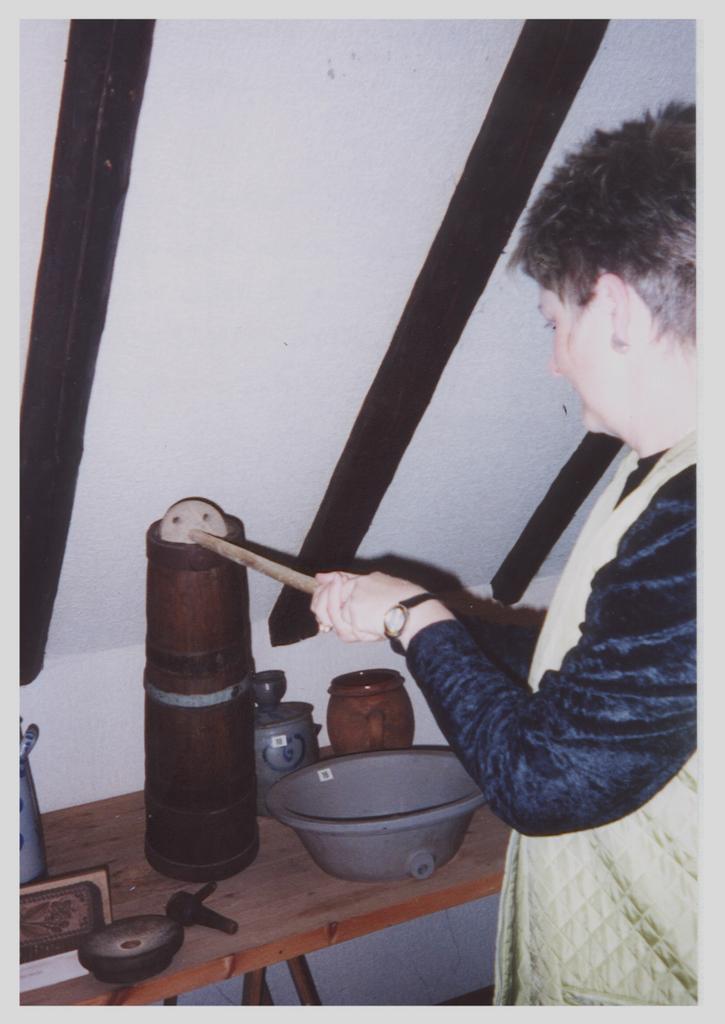
Edith Rommelfanger with butter churn
and the bowl used as a cream separator


In 2002 I planned a trip to the Saarburg area to try to learn more about the lives of my ancestors. I learned that the little village of Zerf, where my great-great grandmother had been born in 1827, had a Heimat Museum, a place where the everyday house and farm tools of the 19th and early 20th century could be seen.

I wrote to the museum to learn more about the open hours but never received a reply. Shortly before my trip, I decided to contact the mayor of the village to find out if there was any way that I could inside the museum. (It sounded so perfect for the kinds of information I needed that the thought that I might not be able to see it was making me crazy). In my letter, I gave my e-mail address as well as my home address and offered to pay for any costs involved.
Almost immediately I received a reply from Edith Rommelfanger, the mayor's wife. She said that when I arrived in the area, I should call, and they would arrange to show me the museum. From then on, the fates stepped in and made my visit to the museum as easy as finding a cheesehead in Green Bay.

Once I arrived in Saarburg, the call for an appointment to see the museum was made not by me but by Ewald Meyer, a retired teacher who was writing a history of another of my ancestral villages, Irsch bei Beurig. Herr Meyer took me "under his wing" and became my charming guide and chauffeur during my visit to Germany.

When all the arrangements were made, Herr Meyer and I drove to Zerf and were met by the mayor, Manfred Rommelfanger and his wife who gave me a two-hour tour of the museum, which is only open by special appointment.

As a souvenir, I was given several sheets of information on the exhibits. I believe Frau Rommelfanger herself wrote them, and she asked if I would translate the pages, which explained the majority of the exhibits, into English so that, should another American arrive, an English text would be available. She understood that my German is mostly self-taught and that mistakes were possible. She did not seem to mind. So when I came home I did my best at a translation and sent it to her.

I have decided to share some of this information in my blog from time to time, hoping that I have made only small errors in translation and that you will enjoy reading about some of the artifacts and how they were used. I will include a picture if I have one available. The quotation marks will indicate which information is translated from my Heimat Museum guide. Information that I added to help myself understand is in parentheses.

Heimat Museum Zerf
"This exhibit is about butter production. The first step was the Milchentrahmung or milk separation. A milk bowl served that function. It had a plug and a little sieve or filter. After approximately 12 hours the plug was removed, skim milk flowed off; and the lighter cream that had collected above was held back by the filter. The successor of the milk bowl was the centrifuge. There was a small bell on this centrifuge. As long as it made a sound, the cock had to remain closed, because the rotating speed was not yet fast enough. As soon as the little bell stopped, one untwisted the cock, and the centrifuge began the separation. The cream came out in front and the skim milk in the back."

"For honey production in former times a bee shed could be made in a very simple way. One pushed four stakes into the ground, placed a slanted roof covered with Ginster (broom) on top; and put the (woven) straw hives underneath." (Broom grows wild all over temperate Europe to a height of 3 to 5 feet. It produces numerous long, straight, slender bright green branches, tough and very flexible. The bright yellow fragrant flowers are large, in bloom from April to July, and are succeeded by oblong, flattened pods, about 1 1/2 inch long. The pods are nearly black when mature. They burst with a sharp noise when the seeds are ripe, flinging them some distance. The continuous crackling of the bursting seed pods on a hot, sunny July day is quite noticeable. The flowers have a great attraction for bees; they contain no honey, but an abundance of pollen).