Showing posts with label Oberzerf. Show all posts

Friday, September 14, 2012

Catholic Choirs - A Joyful Noise Unto the Lord

The Door of Faith at St. Gervasius and Protasius Catholic Church in Irsch

Hymn: Holy God, we praise You


If you are writing a novel and you know your main character, your great-great grandmother, came from a long line of Catholics and that she and your great-great grandfather passed that Catholic faith on to their descendants to the present day, you might wonder if part of her Catholic heritage included a love of singing her prayers that she exercised by being a part of a church choir.  Were there Catholic church choirs in the villages in which she lived, or did the congregation of those churches just sing together to honor their Lord and God? In earlier times, how did the villagers of Oberzerf and Irsch "make a joyful noise unto the Lord" and in what form?"

I went to the history books written about the villages of my Rhineland ancestors to search.  Local histories of Zerf, Irsch, and Serrig, where the Catholic church was the heart of each village, satisfied my mind that the Catholic church choirs of the time existed and were made up of both men and women. They certainly existed during the 19th century, the time period when Magdalena Rauls Meier worshipped in the churches of Saint Laurentius (Zerf), Saint Wendalinus (Oberzerf), and Saints Gervasius and Protasius (Irsch) 

The Catholic Churches in Zerf and Oberzerf.

The St. Laurentius Catholic church choir did exist in the late 18th and the 19th century.  Since Oberzerf is about a mile away, it  had a smaller chapel and was called a daughter church.  It was dedicated to St. Wendalinus.  The school in Zerf was an integral part of the Catholic church of that village, and the teacher also served as a sexton for the church in order to earn extra money for himself and his family. Caspar Goetten (1770) probably played the organ as part of his sexton duties, and he is described in the old records as a Vorsänger, that is, someone who stood before the congregation and directed the singing of a choir or the congregation. It is also likely that Lehrer Goetten trained a group of school children as a choir. After Caspar Goetten no longer taught, his son Nikolaus (1813) served as teacher and choir leader. He had, it seems, a number of supporting adult singers to help when more complicated choral music was required for the mass. This was not a choir with the stature and organization of modern times, but its men and women who wanted to use their voices to pray probably did practice regularly so they could sing the Latin songs and responses together as a choir.  The school children, male and female, sang together at services as well.

Nikolaus Trapp took over as teacher and organist in Zerf from 1837-1856 at the end of which time he was transferred, at his request, to the newly built school in Oberzerf. Herr Trapp also brought together the choir group in Zerf, which was the larger of the two churches.  The teacher who replaced Herr Trapp in Zerf was a Herr Diné. He assisted Herr Trapp from about 1846 on, and he took the organist position in 1885 when Herr Trapp was no longer teaching. But he had helped Nikolaus Trapp as an organist and church choir director before that time, perhaps in Oberzerf. Evidently, the choir was a very important part of the Zerf Catholic church's liturgy.

The Catholic Church at Serrig

The first evidence of a St. Martin Catholic church choir in Serrig is documented in 1789 in the church administrative records. A payment of four Thaler to Christophel Tressel from Irsch to serve as the choir leader of the church in Serrig was recorded. In 1790, Herr Tressel was again paid four Thaler to direct the Serrig choir of "Sänger und Sängerinnen," which means that both male and female singers were part of the choir group that sang for the Holy Mass in the Serrig Catholic church.

By 1827 Serrig was a full-fledged parish church which was no longer dependant on the church at Irsch. The choir must have continued because the pastor of the new independent parish asked the Diocesan authorities for a clarification about the singing of songs during services. The answer received was that the choir only should continue to sing the Latin Mass and hymns; the congregation could join in the singing of any songs that were written for the German language. Almost always these would have been sung at the end of the mass

The Catholic Church in Irsch

In Irsch the Catholic Saints Gervasius und Protasius church choir was founded in 1780. The first choir director was the same Christoph Tressel who trained the choir in Serrig. This teacher and sexton was assigned the job of working with the choir as an additional part of his duties. The history of Irsch written by Ewald Meyer does not indicate whether women as well as men sang in the choir. But the information on the church choir of Serrig, once the "daughter" church of the larger "mother" church of Irsch, most likely could be applied to Irsch as well, since the choir director was the same person and he trained a male and female choir in Serrig.

Yes, I believe my great-great grandmother had the opportunity to sing in both the choir of Zerf, the village a short way from where she grew up; and in Irsch, her home village after her marriage.

Hymn singing by the congregation during the service was not that common in the Catholic churches of the 19th and 20th centuries because of the Latin liturgy. Many of the hymns from the 1700 and 1800s were written in the vernacular, the common language of the people; but they were sung during the church service mostly by Germany's Lutheran congregations. During the Catholic masses, the choir sang in Latin and the congregation was silent, only listening to the music. Their time to sing was almost always after the Mass liturgy was concluded; and the people had been told, in Latin, that the mass had ended and they should go in peace.

In the illustration above you see the German words for the hymn I knew as "Holy God We Praise Thy Name." When I was growing up (before the changes of Vatican II) this hymn was sung at the end of mass by the congregation in the Sacred Heart Church in Sherwood Wisconsin at the end of especially celebratory Masses. It was my favorite hymn, there was something so powerful and prayerful about it that made it very special to me and, of course, I could understand the words which were in English.

GROSSER GOTT, WIR LOBEN DICH (translation)
Holy God We Praise Thy Name 
Holy God, we praise Thy Name;
Lord of all, we bow before Thee!
All on earth Thy scepter claim,
All in Heaven above adore Thee;
Infinite Thy vast domain,
Everlasting is Thy reign.

Hark! the loud celestial hymn
Angel choirs above are raising,
Cherubim and seraphim,
In unceasing chorus praising;
Fill the heavens with sweet accord:
Holy, holy, holy, Lord.

Holy Father, Holy Son,
Holy Spirit, Three we name Thee;
While in essence only One,
Undivided God we claim Thee;
And adoring bend the knee,
While we own the mystery.

I hope that the final hymn sung by my great-great grandparents on the Sunday before they left Irsch in order to emigrate to Ameria was "Grosser Gott wir loben Dich" and that it was sung again in the new country when their log cabin church at St. John, town of Woodville, Calumet County, Wisconsin was used for the first time.

Notes:
1) "Grosser Gott wir loben Dich" is a beautiful classic Catholic hymn, used by the Church for more than two centuries. The words are attributed to Ignaz Franz, in Maria Theresa’s Katholisches Gesang Buch (Vienna: circa 1774) and it was translated from German to English by Clarence A. Walworth, 1858. The English translation is not literal; it was adjusted to maintain the rhyme.

2) In honor of the "New Year of Faith 2012-2013," proclaimed by Pope Benedict XVI, the blog "Catholic Gene" is hosting a “Doors of Faith” celebration online. Bloggers are asked to share their own or their ancestors faith experiences. This is my contribution. On October 11, The Catholic Gene will share some of the websites that are participating

Sources:
Der Hochwaldort Zerf am Fuße des Hunsrücks, by Edgar Christoffel
"Die Geschichte des Kirchenchores 'Cäcilia' Serrig,"in the chapter "Serrig: Landschaft Geschichte und Geschichten" by L. Thinnes, from Serrig; Landschaft Geschichte & Geschichten by Klaus Hammächer et al.
Irsch/Saar: Geschichte eines Dorfes by Ewald Meyer
Photo from http://www.irsch-saar.de/bildmat.htm

Saturday, June 05, 2010

Two Churches Watched by the Eye of God


Main Altar in Oberzerf Church


Today Zerf and Oberzerf are considered one municipality, even though they are more than a mile apart.  But in the 1800s, Zerf and Oberzerf were distinct villages in Kreis Saarburg, each with its own Roman Catholic church, even though only one priest served both.

The main church was in the larger village of Zerf - as was the cemetery for both churches.  I can only guess about the celebration of the daily and Sunday Masses for these two churches.  My theory is that a daily Mass and Masses for special celebratory occasions such as Easter, Pentecost, Christmas Midnight Mass and the conferring of the Sacrament of Confirmation (requiring a Bishop) were all held in the larger Zerf church.  The Chapel Church in Oberzerf may have had a Sunday mass each week, as well as wedding and funeral Masses for the residents of the village.

A Visit to the Chapel Church of Oberzerf 

It was unusual that tiny Oberzerf had a place of worship all its own.  My Oberzerf ancestors lived in one of the smallest of the Saarburg Kreis villages. They were fortunate to have a spiritual home so close to them - the place where even the poor, landless day worker or pig herder of Oberzerf could experience beauty, both sacred and temporal.

Magdalena Rauls, my 2nd great-grandmother, her parents, brothers, sisters and all of her relatives, neighbors and friends, lived in Oberzerf. The pastor of both the two churches lived in the parish house in Zerf.  It was there that the villagers walked when they wanted permission to marry and have the banns of matrimony read, and it was from there that the pastor had to be summoned when one of the family required what the Catholic Church today calls "The Sacrament of the Dying."  

The altar of the Oberzerf church which is pictured at the beginning of this post is thoroughly described in the Zerf history by Edgar Christoffel.  It was a wooden high altar which had been designed and built about 1730 or a few years later.   It was baroque in style with a large curved niche that held the tabernacle.  Each side column had it's own capital supporting a pinnacle altar piece which stands above them.  This apex has two columns, similar to the ones below, supporting a curved, carved top.  A sunburst with a symbol of the eye of God fills its center.  The wood was painted to resemble the marble this little parish could never have afforded. 


On the window side of the church there was a stand holding a 60 cm high figure of Saint Hubertus. It was a hand carved oak baroque figure also dating from around 1730, about the time the old church was built.   Hubertus is in the garb of a Bishop and holds a staff. His stole and garments are very finely worked. A hunting horn is in his left hand and a small animal figure with antlers in the form of a cross stands at his right. These things signified that he was the patron saint of hunters and foresters. Legend has it that Hubertus, a wealthy young noble, went off to hunt while most people in his town were at Good Friday services. He chased a stag which suddenly turned to face him. The animal had a cross between his antlers. Hubertus heard the voice of God telling him to quit his worldly ways or he would surely find himself in hell. Hubertus heeded the warning, becoming a saintly cleric and bishop, devoted to helping the poor.

The oldest statue in the Oberzerf church is thought to be that of St. Anthony of Padua, much venerated because he was the patron Saint of the poor.  Its style is that of southern French statues in about the 1600's.  The statue of St Anne with her daughter Mary, the mother of Christ, was also displayed and venerated.

An eight sided wood pulpit in the little church dated from 18th century.  The chapel church was renovated in 1831, and a work, written in 1939 which described cultural landmarks of the region, called the Oberzerf Chapel Church a pleasing place to visit.  Unfortunately, the church was extremely damaged in World War II and the church of today is from about 1960.

The Parish Church of Zerf


The main altar of the Catholic Church in Zerf from 1858?                                    


The dominant Catholic church of the Zerf parish, located in what was then sometimes called Niederzerf (lower Zerf), was dedicated to St. Laurentius.  References to a Catholic church located in Zerf were noted even before the 30 Year's War.  The Niederzerf  church was rebuilt or refurbished many times over the last several centuries.   It is believed that those previous churches stood in the same location as the current church; a rocky hill that overlooks the valley where the Grossbach stream separates from the Ruwertal river.

By the 19th century, the Zerf church and bell tower from the previous century were once again badly in need of renovation.  So in 1819-1820, construction of a new building was begun with a bell tower around 30 meters high.  On May 26, 1830 the new church with its impressive tower was dedicated again to St. Laurentius but this time St. Sebastian was also included as a protector of the parish.  The bishop who officiated at the consecration was Joseph von Hommer.

Almost 40 years later, in 1859, that tall bell tower experienced a fire and the top portion of the tower had to be rebuilt.

The altar in the picture above is somewhat similar to the one in the chapel church in Oberzerf.  It is baroque in style though much bigger in size.  As you can see in the photo, the top section of the altar also contained a symbolic representation of the eye of God.  The University of Marsburg identifies the altar as one constructed in 1723.  The description of the new altar from 1858 in Herr Christoffel's book as well as photos from the early years of the 20th century match the Marburg picture in almost every detail.  Whether from the 18th or the 19th century, the handworked statues of St. Laurentius and St. Sebastian stood to each side of the central part of the altar piece.

It seems (if I have not misinterpreted a very complicated sentence construction from Herr Christofell's history of Zerf) that in the 1850's, the altar dating from the early 18th century which was from the St. Laurentius Church in Saarburg was sold to St. Laurentius parish in Zerf for a cost of 50 Taler, and that high altar was installed in Zerf.  The 1858 altar was destroyed during WWII.

Several statues were described by Herr Christoffel, but I was unable to tell if they dated from the time my ancestors lived in Oberzerf.  One important object that was a part of the church in their time was a baptismal font from 1838.  It was made of sandstone and the pedestal portion shows an apple tree with a serpent wound around the trunk.  The bowl of the font had perpendicular deep grooves and in each groove was carved a bell-shaped flower.

Conclusion

Perhaps it will seem that I have spent an inordinate amount of time describing the churches of my ancestors, but I think of it as plugging holes.  I began this blog to organize my factual materials in order to find illusive facts when I was ready to write a detailed novel.  I decided to share my material with anyone who chose to look for a topic which was also of interest to them.  

I started my writing with the most general material.  As I begin my sixth year of this blog, I'm capturing smaller and smaller details of the villages; and the books about the churches in the three Kreis Saarburg villages of my ancestors are filled with meaningful descriptions - for me.  I do hope that these last three posts will give you an idea of the church structures that your own ancestors knew.  With that in mind, let me refer you to an excellent source of pictures from the University of Marburg photo archive, with its 1.7 million pictures.   It was the source of the picture of the main altar in Zerf and is the first source listed below.   Perhaps you will find a picture of the church of your ancestors.

Sources:  Pictures
http://www.fotomarburg.de/
http://www.roscheiderhof.de/kulturdb/client/index.php
Nico Haas Thomassin, Trier
Theo Hasse, Zerf.


Sources: Text
Christoffel, Edgar.  Der Hochwaldort Zerf am Fuße des Hunrücks, Verlag W. Rassier, Saarburg, 1981

Sunday, November 02, 2008

Salt Lake City Discovery

Church of Jesus Christ of Latter Day Saints Temple in the foreground, the Tabernacle in the center, and our hotel (the Plaza) and the Family History Library at the far left (Photo by Carole Kortenhof)


Eliminating possibilities - that's mostly what I did during my stay in Salt Lake City last month. I can't complain, or course, because previous visits have given me the names and stories of my ancestors from Irsch, Zerf, and Serrig in Kreis Saarburg. By now, though, I am seeking bits and pieces, looking for hints to collateral line relatives whose success at hiding from me could stymie Sherlock Holmes himself.

One interesting snippet that I discovered was from The Antwerp Emigration Index by Charles Hall. I had never paid much attention to it because it covers only one year, 1855, and only one port. This time I picked it up on the offhand chance that it would help me solve a mystery that so far has me totally frustrated.

I am searching for the younger sister of my 2nd great grandfather, Johann Meier. When he emigrated in 1860, he told the Mayor of Beurich, who was taking his application, that he was going to America to improve his life and that he already had two brother-in-laws in America. One brother-in-law was Matthias Rauls, the brother of Johann's wife, Magdelena. The other had to be the husband of his sister Anna. Unfortunately, Anna did not marry in the parish church of Irsch, her home parish. It's possible that she married in her husband's parish and then the two left for America. It is also possible that she decided to emigrate when she was still single and left before any real emigration records are available, marrying somewhere in her adopted homeland. Thus I don't know if I am searching for Anna Meier or Anna _______. Complicating my life is the fact that emigration records from the Trier area before 1856 do not seem to have been kept.

After searching for Anna's marriage record in the parishes neighboring her home village of Irsch and finding nothing, I decided to see if the 1855 Antwerp Emigration Index showed any trace of her. Once again, no Anna Meier. But what I did find delighted me. In that year, 37 residents of Zerf/Frommersbach left Antwerp for America on the ship Daylight.
I have a 662 page book about the history of Zerf (in German) and it lists all of the emigrants who were found in emigration documents filed in the Koblenz Archive. Not any of the thirty-seven passengers on the Ship Daylight are named in that history. So even though I did not find anyone I was looking for, I'm able to write my own personal addendum to "Der Hochwaldort Zerf am Fuße des Hunsrücks" by Edgar Christoffel. And I'll keep looking for Anna.
We know that people from the Rhineland began to emigrate in the 1840s. Passports were issued at that time, but the Archive at Koblenz does not have the paperwork which made those passports possible to locate for the Trier and Saarburg region. It was not until about 1857 that a systematic effort was undertaken to keep emigration papers.
Before the completion of the Trier to Saarbrucken railroad in 1860, Antwerp was the most accessible seaport for emigrants leaving the Trier and Saarburg area for other countries.
According to the introduction to the book, The Antwerp Emigration Index was extracted and compiled by the non-profit organization, Heritage International. “It deals with emigrants from Germany, Switzerland, Italy, Belgium, France and the Netherlands…There are in excess of 5,100 immigrants whose origins are given here.“ Heritage International used the passenger records of 38 ships which left the port of Antwerp in the year 1855. “…Destinations of the emigrants were New York, Boston, New Orleans, Rio Grande & Australia.”
Unfortunately, the researchers did not give the destination of each one of the 38 sailings (most of the ships sailed two times from Antwerp to their destination), nor did they give sailing dates, except that they gave each ship a number according to its first departure date of the year. The Zerf emigrants were on Ship No. 28, the Daylight. It left Antwerp during the last third of the sailing season and yet this was its first sailing from the port of Antwerp.
The passenger list information furnished in the Antwerp Emigration Index gives: 1. Passenger Name 2. Age 3. Place (whether of residence or birth is not clear) 4. Ship Number 5. Place Where Passport Was Issued. (These were people who were emigrating legally and almost all of them had a passport that was issued in Trier)
Aboard the Ship Daylight
1. Johann Allmescheid, age 57, from Oberzerf
2. Mary Allmescheid, age 51, from Oberzerf
3. Johann Baermohen, age 28 from Zerf
4. Johanna Baermohen, age 39 from Zerf
5. Nikolaus Bernardz(y), age 26, from Oberzerf
6. Susanna, Brixus, age 44, from Zerf
7. Johann Peter Christ, age 52, from Zerf
8. Gert. Christ, Gert., age 47, from Zerf
9. Matthias Eiler, age 53, from Zerf
10. M. Eiler, age 50, from Zerf
11. Matthias Lillig, age 37, from Zerf
12. Sus. Lillig, age 40, from Zerf
13. Johannes Lillig, age 39, from Zerf
14. Margaretha Lillig, age 37, from Zerf
15. Michael Maier, age 32, from Zerf
16. Sus. Maier, age 33, from Zerf
17. Johannes Maier, age 56, from Zerf
18. Helena Maier, age 47, from Zerf
19. Nic. Merz, age 48, from Zerf
20. M. Merz, age 43, from Zerf
21. Jacob Muller, age 58, from Zerf
22. Johannes Muller, age 38, from Zerf
23. Cath. Muller, age 42, from Zerf
24. Joh. Muller, age 39, from Zerf
25. Moore Muller, age 48, from Zerf
26. Joh. Palm, age 57, from Frommersbach
27. A. Palm, age 57, from Frommersbach
28. Johannes Schneider, age 39, from Zerf
29. Barb. Schneider, age 39, from Zerf
30. Nic. Schneider, age 53, from Zerf
31. Johannes Schommer, age 42, from Frommersbach
32. A. Schommer, age 36, from Frommersbach
33. Math. Schwindling, age 53, from Zerf
34. Cath. Schwindling, age 56, from Zerf
35. Pet. Schwindling, age 30, from Zerf
36. Susanna Schwindling, age 27, from Zerf
37. Johannes Wagner, age 58, from Zerf
A few random thoughts about this boatload of Zerf villagers. The average age of the emigrants was 47.7 years old and 30 per cent of the emigrants were over 50. And something seems to be missing - no children are listed - and I have no explanation why!

Friday, July 29, 2005

A Visit To The Zerf Heimat Museum


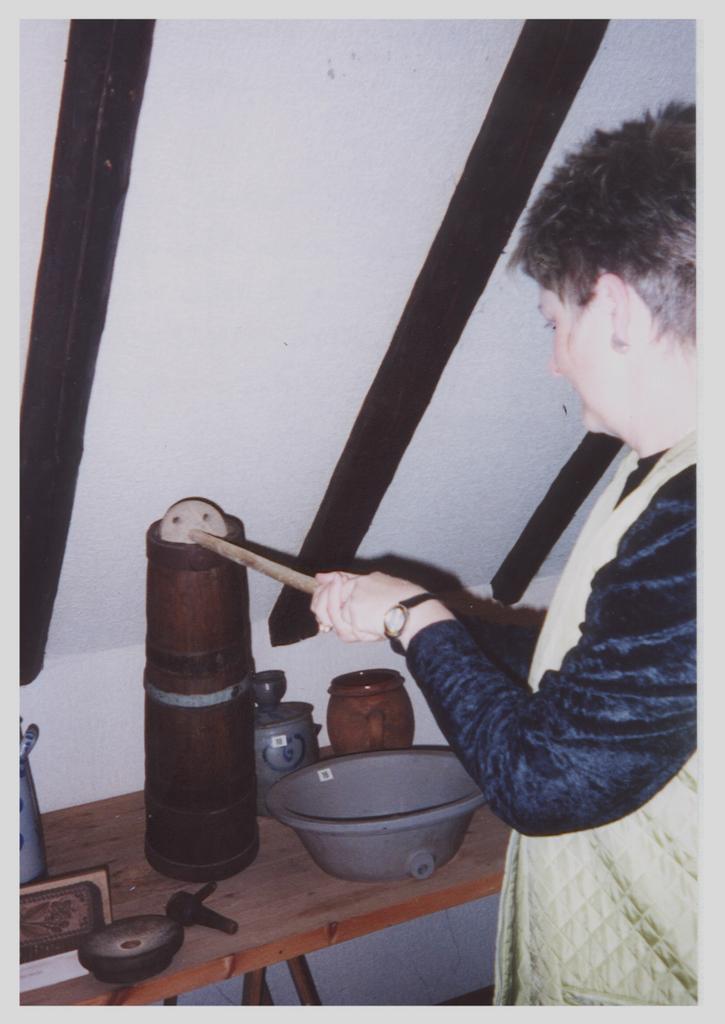
Edith Rommelfanger with butter churn
and the bowl used as a cream separator


In 2002 I planned a trip to the Saarburg area to try to learn more about the lives of my ancestors. I learned that the little village of Zerf, where my great-great grandmother had been born in 1827, had a Heimat Museum, a place where the everyday house and farm tools of the 19th and early 20th century could be seen.

I wrote to the museum to learn more about the open hours but never received a reply. Shortly before my trip, I decided to contact the mayor of the village to find out if there was any way that I could inside the museum. (It sounded so perfect for the kinds of information I needed that the thought that I might not be able to see it was making me crazy). In my letter, I gave my e-mail address as well as my home address and offered to pay for any costs involved.
Almost immediately I received a reply from Edith Rommelfanger, the mayor's wife. She said that when I arrived in the area, I should call, and they would arrange to show me the museum. From then on, the fates stepped in and made my visit to the museum as easy as finding a cheesehead in Green Bay.

Once I arrived in Saarburg, the call for an appointment to see the museum was made not by me but by Ewald Meyer, a retired teacher who was writing a history of another of my ancestral villages, Irsch bei Beurig. Herr Meyer took me "under his wing" and became my charming guide and chauffeur during my visit to Germany.

When all the arrangements were made, Herr Meyer and I drove to Zerf and were met by the mayor, Manfred Rommelfanger and his wife who gave me a two-hour tour of the museum, which is only open by special appointment.

As a souvenir, I was given several sheets of information on the exhibits. I believe Frau Rommelfanger herself wrote them, and she asked if I would translate the pages, which explained the majority of the exhibits, into English so that, should another American arrive, an English text would be available. She understood that my German is mostly self-taught and that mistakes were possible. She did not seem to mind. So when I came home I did my best at a translation and sent it to her.

I have decided to share some of this information in my blog from time to time, hoping that I have made only small errors in translation and that you will enjoy reading about some of the artifacts and how they were used. I will include a picture if I have one available. The quotation marks will indicate which information is translated from my Heimat Museum guide. Information that I added to help myself understand is in parentheses.

Heimat Museum Zerf
"This exhibit is about butter production. The first step was the Milchentrahmung or milk separation. A milk bowl served that function. It had a plug and a little sieve or filter. After approximately 12 hours the plug was removed, skim milk flowed off; and the lighter cream that had collected above was held back by the filter. The successor of the milk bowl was the centrifuge. There was a small bell on this centrifuge. As long as it made a sound, the cock had to remain closed, because the rotating speed was not yet fast enough. As soon as the little bell stopped, one untwisted the cock, and the centrifuge began the separation. The cream came out in front and the skim milk in the back."

"For honey production in former times a bee shed could be made in a very simple way. One pushed four stakes into the ground, placed a slanted roof covered with Ginster (broom) on top; and put the (woven) straw hives underneath." (Broom grows wild all over temperate Europe to a height of 3 to 5 feet. It produces numerous long, straight, slender bright green branches, tough and very flexible. The bright yellow fragrant flowers are large, in bloom from April to July, and are succeeded by oblong, flattened pods, about 1 1/2 inch long. The pods are nearly black when mature. They burst with a sharp noise when the seeds are ripe, flinging them some distance. The continuous crackling of the bursting seed pods on a hot, sunny July day is quite noticeable. The flowers have a great attraction for bees; they contain no honey, but an abundance of pollen).

Monday, July 25, 2005

A Visit to the Zerf Heimat Museum - Work in the Fields

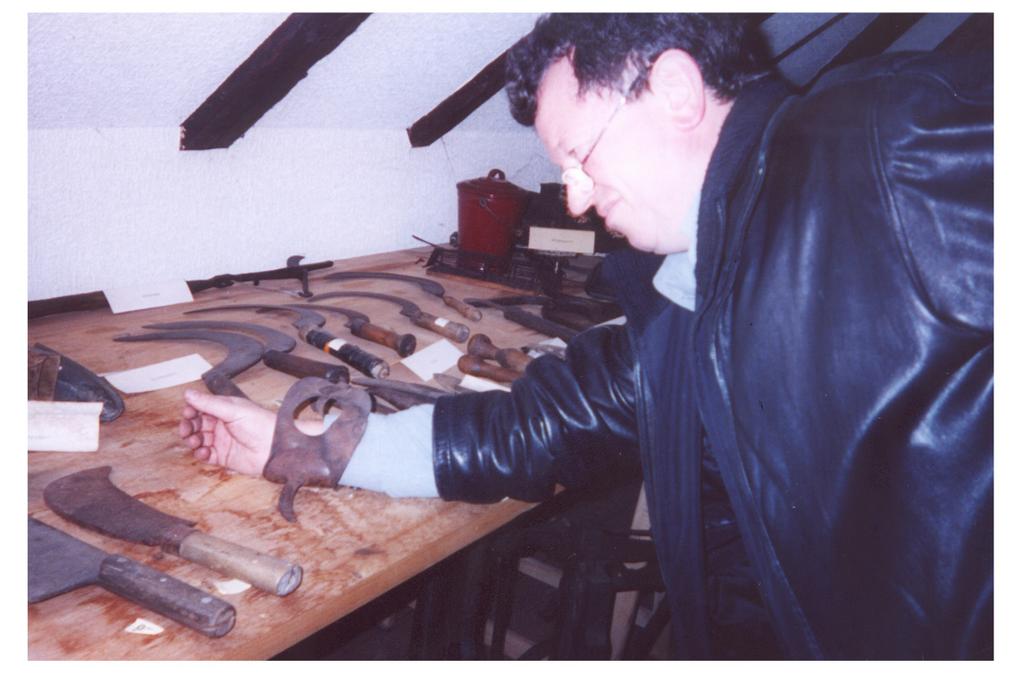
Zerf's Mayor, Manfred Rommelfanger, wears a wrist cutter sometimes used for grain or flax. Sickles at the right; Ginstereisen at the left


"Next to each other here you see Sichel (sickles) and the somewhat stronger Ginstereisen (iron tool for cutting brush). In former times Ginster was dried and used as straw for the cattle stalls. (See A Visit to the Zerf Heimat Museum for a description of the broom shrub called Ginster). The women used sickles to cut the grain stems and bind them into sheaves. They also used them to cut weeds. With a sickle, the goat farmers cut the grass and weeds along the waysides and the field borders to feed to their animals."

"The Dengelstöcke was a device that sharpened or 'whet' metal by hammering it. It was used for scythes when they became dull. The Denkelstöcke was struck into the ground or, more often, into a wood log. The cutting edge of the scythe was worked on with the hammer. The hammer had to be rounded at the head so that no depression was made in the scythe when it was struck."

"Reiserbesen (twig brooms) were made of birch twigs. In former times, most were bound with hazelnut switches; later with wire. The Reiserhaken (twig axe) was used to cut the birch twigs. The birch twigs was pressed together for binding with the broom press. After binding, the brooms were trimmed and shaped with the small Reisermesserchen (little twig knife). One used the twig brooms for sweeping of house, yard and stable."


"Planting tools lie on this table (center). Vegetable seedlings, beets, lettuce, etc. were planted in field and garden with them." (I was told that most are made of cow or ox horns. The tip of the horn was cut off so that the seeds could slowly come through. Different sizes of horns and how much of the tip of the horn was removed allowed for the planting of various sizes of seeds)

Here are Loheisen, iron tools for stripping bark (Lohecken) (tool at the back of the table). They are also called Lohlöffel or bark spoons. With them the bark was stripped from the oak trees. In former times one extracted Gerbsaüre (tanning acid) from this bark. The acid was necessary to process animal hide for leather." (At times there were as many as 20 tanneries in Saarburg in the 1800's, and the selling of the bark to the tanneries provided farmers with a much needed cash crop).

"Here one sees Schlotterfässer, small barrels made out of wood, horn and sheet metal (far left). The name Schlotterfass (shaking barrel) comes from the typical noise which developed when the whet stones inside knocked together. The farmer hung the Schlotterfass, which contained the whetstones and the water, on his belt when he went mowing. Then, if necessary, he could always sharpen the scythe."

"For beet cultivation, the Hackpflug plow was used. A cow led between the rows could pull it. Then the farmer only had to hoe the soil crosswise between the plants to chop out weeds." (To my surprise, I learned that many farmers could not afford an ox or a horse for field work. So their cow/s were pressed into service, very much decreasing the amount of milk that a cow could produce)

Saturday, July 23, 2005

A Visit to the Zerf Heimat Museum - Conclusion

The following section ends my information about the Zerf Heimatmuseum. It contains a description of miscellaneous artifacts not covered in the other posts. Just like the other entries I have posted, these artifacts may help paint a better picture of daily life in the village of Zerf and/or of the many other small villages near the Saar and Mosel rivers.

As I explained in my first post on the Zerf museum, the descriptions below without parentheses are my translations from the German language museum guide I received as a souvenir at the time of my visit. Anything in parentheses is additional information gleaned from other sources which I hope makes the original description a bit clearer.

Now back to the museum


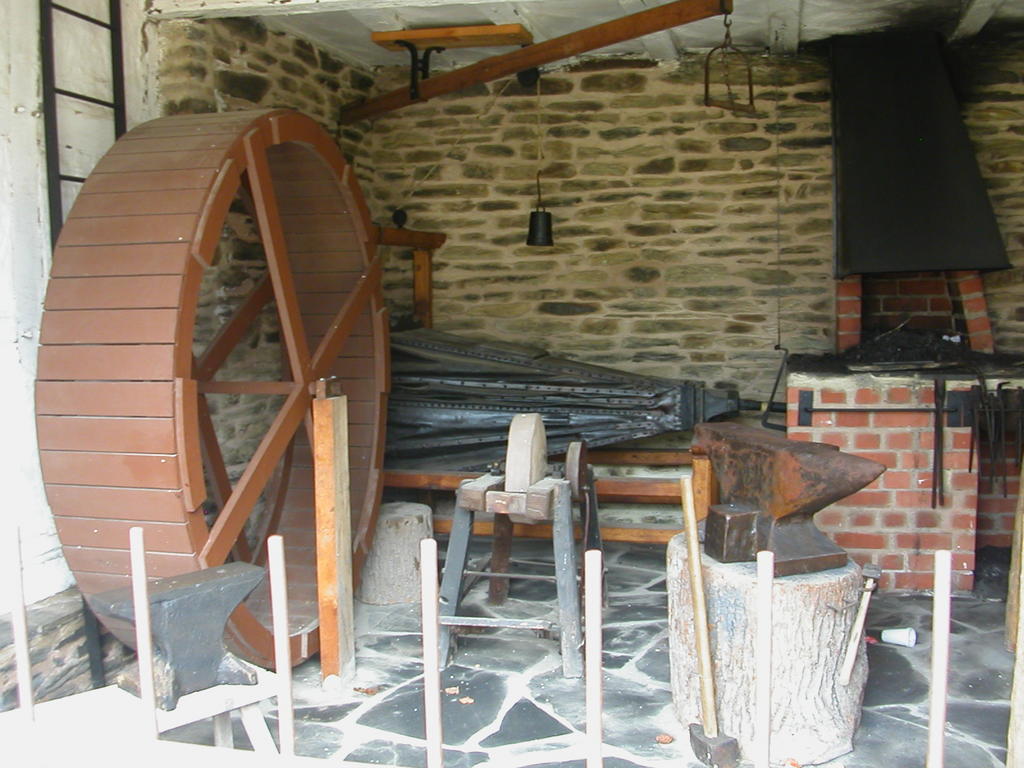
In the blacksmith's shop one can see the forge with the bellows, anvil, hammers, pliers, a bending machine for bending the eisenreifen (iron wheels) for the farm wagons. (According to the book, Serrig: Landschaft, Geschichte & Geschichtenby Klaus Hammächer, a dog could be trained to run inside the wheel shown in this picture. As he ran, he powered the bellows and the flame of the forge. The picture was taken at the Roscheider Hof open air museum near Konz)

Trumpets were used by Schweinehirt (swineherds). At the sound of the trumpet, the farmer opened the pig stalls and the Schweinehirt drove the pigs into the oak forests and guarded them there. In the evening the Schweinehirt brought them back with the trumpet signal. On the Feast of St. Martin (November 11) the Schweinehirt received a measuring beaker/cup full of grain for each pig under his care. (St. Martin's day was also the traditional time to prepare for winter by slaughtering pigs, geese, and other animals since they would soon be unable to forage for food and would have to be fed by the farmer)

The half Vierzel was a measuring instrument for grain. In former times the grain was not weighed; it was measured with this container. Four half Vierzel 'filled not too much and not too little' ( leveled?) equaled one hundredweight of corn, barley or wheat. Six half Vierzel made up a hundredweight of oats, because oats is finer. In earlier times, the teachers in the village were often also the swineherds, because there was no school in the summer (when the pigs could roam). School was held from St. Martin's Day to Easter.

One could distinguish cow, sheep and goat bells by the different tone qualities.

The small Nicholas bells were used by the adults to make the children aware of the feast day some weeks before it arrived. They rewarded the children's obedience by putting small gifts at the door on St. Nicholas Eve

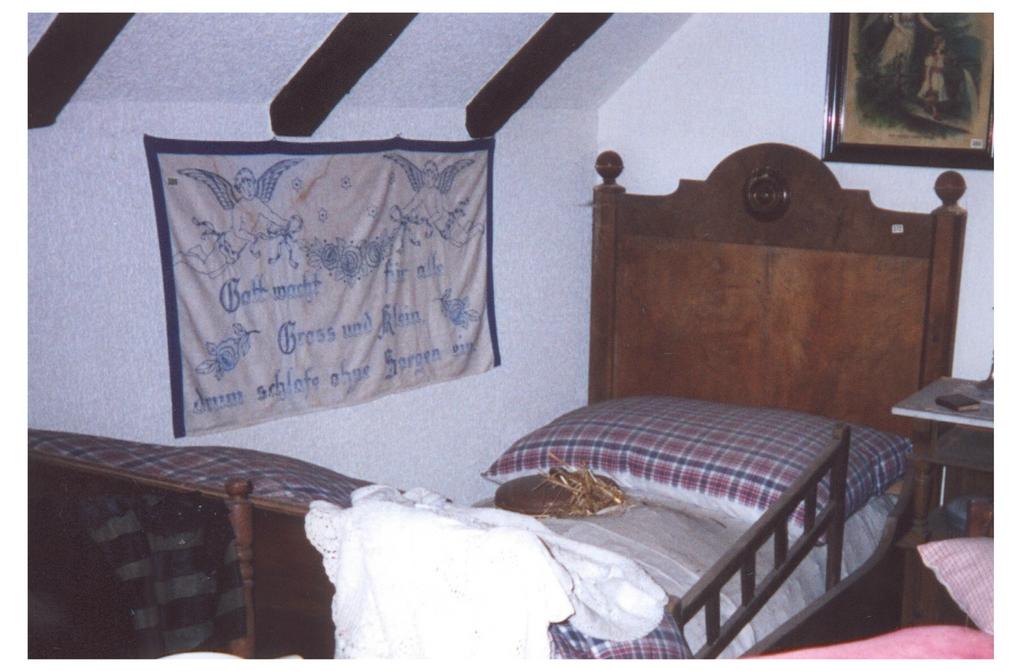
In the bedroom we see the straw filled mattress, the pillow filled with grain chaff, and the feather bed. (The villagers made use of almost any part of the crops that they grew, even in the bedroom. For instance, small pouches were filled with grape seeds and could be heated to ease pain, much as we can relax tight muscles by using the same sort of pouch and heating its "magic crystals" in a microwave. These grape seed pouches are still sold at the "Golden Autumn" festival and market in Saarburg)

The broad low-lying wooden box sled was, in former times, a popular plaything for the children during the long, snow-rich winters.

Kleppern (wooden clappers) and Raspeln (a rattle-like wooden device which rotated and made a rasping sound when shaken by its long handle) replaced the bells during Holy Week when bells could not be rung on Good Friday and Holy Saturday.

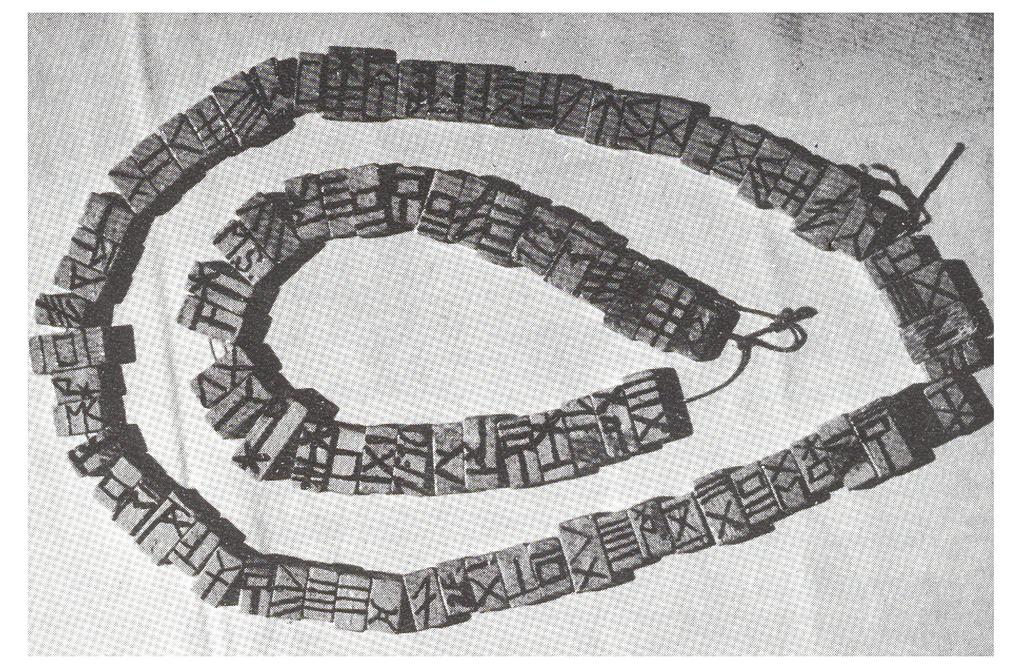
This is the Rosenkranz on which the house sign and hedge land identifiers for the Gehöfershaft were placed. These blocks were drawn in a lottery for distributing the Lohhecken among the farmers in the Gehöfershaft. (Above is a photo from Der Hochwaldort Zerf am Fuße des Hunsrücks, by Edgar Christoffel, c. 1981, Verlag W. Rassier, D5510 Saarburg. It shows wooden blocks with symbols which are rune-like rather than alphabetic characters. This Rosenkranz, the German word for rosary, served as a sort of plat map for the hedge lands which belonged to the entire community of land-owning farmers. In the Saar and Mosel region these landed farmers were usually referred to as a Gehöfershaft. A symbol identifying each section of the hedge lands, sections which were especially valuable for the oak tree bark stripped for tanning, was painted on one side of each small wooden block. Then a lottery was held. Each farmer in turn drew out a wooden block containing a hedge land symbol. His distinctive house mark could now be painted on the other side of the wooden block and the section was his to work until the next lottery was held. When the lottery was completed, the blocks were strung into the Rosenkranz and probably kept by the mayor of Zerf. In Zerf, this lottery took place every five years. The neighboring village of Irsch had a similar Rosenkranz, according to the book Irsch/Saar: Geschichte eines Dorfes, by Ewald Meyer).

The kitchen utensils and the farm equipment are described in Part 2 and Part 3, the other parts of this amazing visit to the past.