Showing posts sorted by relevance for query procession. Sort by date Show all posts

Thursday, June 01, 2006

Feast of Corpus Christi


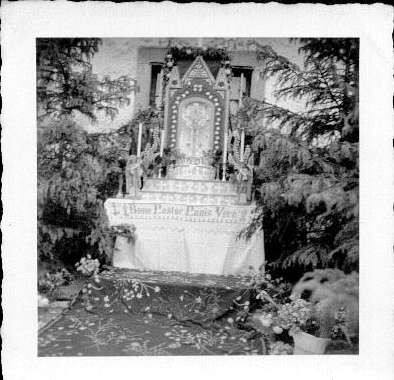
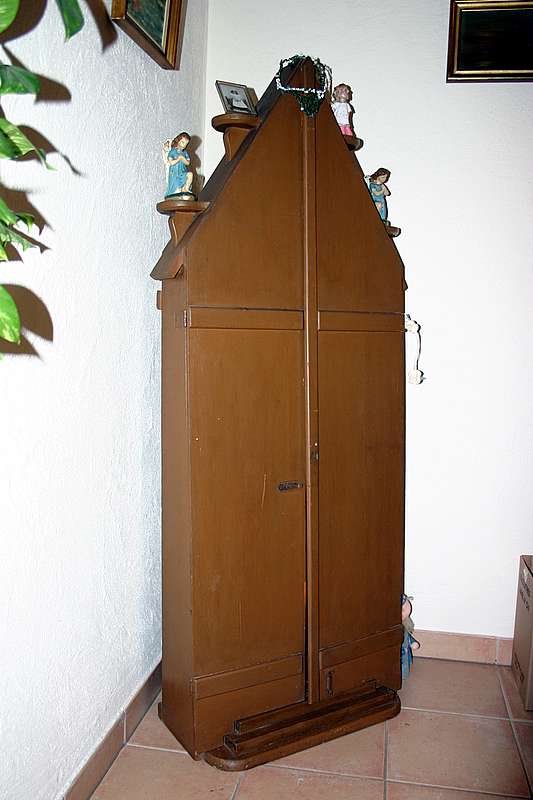
Traditional German Corpus Christi altar - photo from Ernst Mettlach who says he thinks the picture is from the 1950s.

In my Catholic parish in Wisconsin, the feast of the"Solemnity of the Body and Blood of Christ" will be observed on June 18. Most of us still think of this religious holiday as "Corpus Christi." It is not a Holy Day of Obligation in the United States, and it is now celebrated on the Sunday after Trinity Sunday.

However in many of the Federal States in Germany, including the Rheinland, Corpus Christi, known as Fronleichnam is still a solemn church holiday as well as a national holiday. It is celebrated on the Thursday following Trinity Sunday, a date that was chosen around the Thirteenth Century.

Fronleichnam Memories:

When he was growning up in Beurich (today part of the city of Saarburg) Ewald Meyer, author of a history of the village of Irsch, remembers Fronleichnam or Corpus Christi processions and the elaborate altars erected outside of the homes in his village, as illustrated by the photo above. As the Fronleichnam procession wound along the streets of the village, the village priest would bless each altar.

My German relative, Edeltrud Heiser, grew up in the village of Irsch. She says that when she was a child, the children in the Corpus Christi procession dressed in their best Sunday clothes. Little girls wore woven flower crowns of Ganseblumchen and Margarites and, if it was the year of their first Holy Communion, the girls would wear their white Communion dresses.


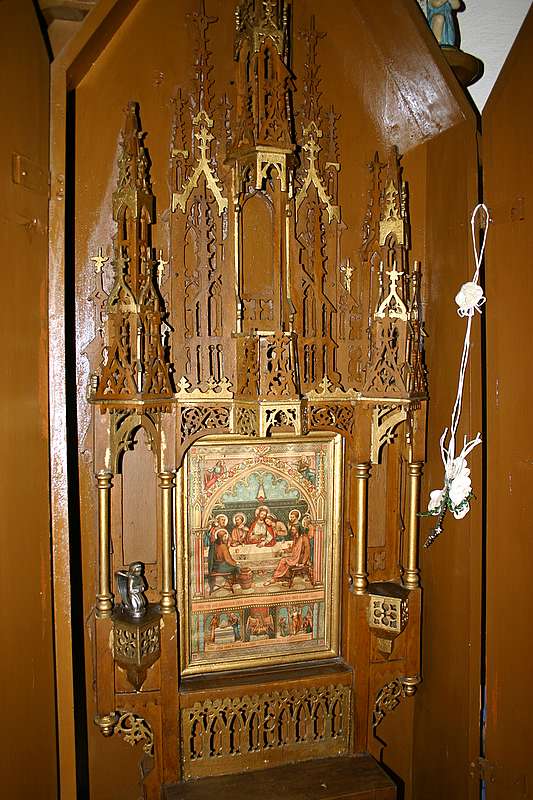
Ernst Mettlach also grew up in the Trier area. He is the fortunate owner of an elaborate Fronleichnam altar. He says, "I saved an old altar from the rubbish. It was decorated with flowers and placed at the feast of Corpus Christi (Fronleichnam in german) in front of the houses to honour Jesus Christ. There is still a procession today, but there are only a few house-altars left. Corpus Christi was an important day in the life of our ancestors."

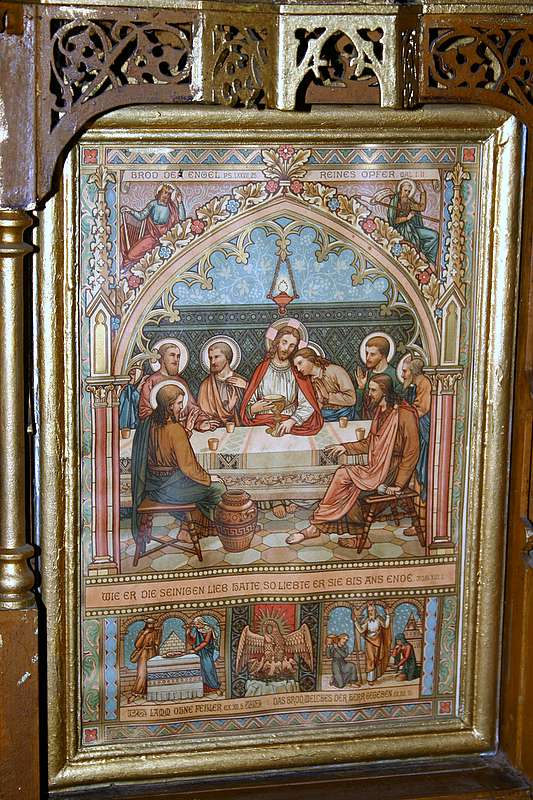
As you can see from these four photos, the Corpus Christi altar that Ernst rescued is a wooden cabinet, rather like a triptych, that opens to reveal a painting of Christ and his apostles at the Last Supper. Intricate wood carving frames this picture, giving the whole piece the aura of an elaborate cathedral altar.

Some Additional Information about Corpus Christi

The feast of Corpus Christi was established in 1246 in Liege Belgium after Julianna of Mont Cornillon, a nun and mother superior who had always held the Holy Eucharist in great regard, reported a vision through which she understood that Jesus lamented the absence of a particular feast in the Church's calendar focused on his sacramental presence on the altar. When the former archdeacon of Liege, Jacques Pantaleon, became Pope Urban IV, he adopted the feast. It was (and in many countries like Germany still is) celebrated on the Thursday after Trinity Sunday. The Eucharistic procession, while not mentioned in the early office and texts of the Catholic Church, came to be connected with Corpus Christi and, in time, the hallmark of the religious observance. In addition to its religious significance, the feast also came to have great social and commercial significance. (Catholic Encyclopedia)

Fronleichnams-fest is celebrated throughout Catholic Germany with processions through streets that are charmingly decorated with flowers and garlands of green. Crucifixes and pictures of Christ are prominently displayed from window ledges and the steps of cottages and village fountains. In many places people display bright hangings and spread carpets before their houses in honor of the Sacrament and of the large crucifix, both of which are carried through the parish. One of the most beautiful features of the processions is the group of children, dressed in white with flower chaplets on their heads and nosegays of fragrant blossoms in their hands. Girls and women in magnificent regional costume add further distinction to the joyous event. http://www.sacred-texts.com

Cologne in 1279 had the first recorded Corpus Christi procession. Not content to adore the Eucharistic Christ exposed in a monstrance inside the church, the people appealed to have a Host consecrated during the Mass carried through the streets to be adored. The practice caught on throughout all of Europe, where it was seen as the triumph of Christ the King. In some places, the procession would wind through a town and even into the countryside. In Germany, each of the four Gospels was sung and Benediction of the Blessed Sacrament took place in four spots, north, south, east, west as a plea for good weather. (From the website Angel Fire)

Sunday, April 08, 2012

Easter Tales: The Kläpperjungen - the Mirror in the Fountain

The Klapperjungchen Scupture


Easter is nearly here. For many people, it is both a religious holiday and a day when children receive little gifts given by some unusual benefactors such as rabbits (Germany) or the church bells coming from Rome (France). For the Catholics in Kreis Saarburg, this most important feast day of the Church year was preceded by Karfreitag (Good Friday) and Karsamstag (Holy Saturday), days on which bells were not heard in any religious service or observance. Thus, the church bells could not be sounded three times a day for the praying of the Angelus, in respect for the passion and death of Jesus Christ.

Maria Croon, in her book, Die Dorfstrasse, starts most of her chapters by describing things she sees from her window in the village, the customs and conditions that my ancestors knew well. On this particular Good Friday, she turns her attention to the sound of the Klapperjungen.

The Klapperjungen Come:

Each year, some older boys are chosen to lead a procession on the three days before Easter Sunday. They will remind the villagers, in lieu of the church bells which do not ring during this time, that a church service will soon begin or that it is time for the prayers of morning, noon, and evening. These Klapperjungen take their job seriously. They carry a heavy wood rasp, or Holzraspel, in their left hand and turn its handle with their right, making a sound, says Frau Croon, rather like 20 grinding coffee mills. After each stop along the way, they cry out "Heh Mettech." Not finding this phrase in my dictionaries, I'm guessing that this is dialect and might mean something on the order of "Hark, Matin time." 


The four leaders of the procession that Frau Croon is observing are strong for their age, the Pitt, Kläs, Klos and Häns. So are the other boys of similar age who are part of the official procession. However, a spontaneous procession walks behind them, for almost all of the children of the village come along, even those as young as two. The little ones don't have any kind of a rasp; they carry a "Klipp-Klapp" rattle which is made of light wood, a wooden shell which they shake. Always there are some of the youngest ones who stumble over stones, tumble over their own feet, or step into puddles and fall. But they get up again, usually howling over their mishap, wipe the dirt off their faces with any tears and nose "moisture" there, mostly smearing the Dreck very effectively as they struggle to catch up with the rest of the procession again.

The older Klapperjungen are annoyed by the unwanted "tail" of "Klippklapp-Buben and of girls. They would like to make frightful faces at them, trying to convince them to stop following along. However they control their annoyance because they know they are now grown up and dedicated servers of the Church and community - and also because their mothers, grandmothers and aunts are watching at windows and doors.

By Easter Sunday, the responsibilities of the Klapperjungen have ended, but it is decided by these Klapperjungen to do a bit extra. Very early Easter morning, on their own, they make a last round through the village to wake up the sleepers, calling out that the Savior is risen from the grave.

The Water Mirror in the Fountain


Zerf Frommersbach


The Klapperjungen are not the only early risers in the village, says Frau Croon. The young women may go quietly to the village water fountain to get Easter water, believing the superstition that if they wash their faces with this special water and also if they drink it, they will be made beautiful in the eyes of others. Also, if they take three joyful little jumps and then look closely into the water just as the sun's first rays appear, they will be able to see in the water a picture of their future.

On this Easter morning, one young woman, slender little Eva, head covered with a cloth and wearing red slippers, comes quickly and quietly to the fountain so that no one will see her. At the same time, a cow named Sarah with a crumpled horn, awakens earlier than usual and makes her way out of the barn door, through the front yard with its manure pile, and her children and grandchildren follow after her. But there is no hay or grain out for them so early in the morning so they head toward the fountain to find water. Most onlookers would not know why the cows are out so early, but Franz, their young owner had pushed them along this morning. Franz, you see, secretly loves Eva. He has often seen her go to the fountain, but has never had the courage to say something to her because someone is always nearby.

For the first time, Franz and Eva will be alone at the fountain. He has worked up the courage to speak to her, taking the cows along as an excuse for being there so early. He is in luck. Eva is standing at the fountain's edge.  The sun is just about to come up, putting gray-blue fingers of light into the dark sky. And as Franz comes after his herd, old Sara with the crumpled horn has put her tongue in the water. Eva is staring at the water mirror to determine her future and sees the face of a large cow with a crumpled horn as her fate. She gives a cry that strikes pain to Franz's breast and puts her hands over her face.  She cries, "No, no, no! I will not have horns!" Franz kneels next to her and gently pulls her hands from her face. "Can this be the picture for your future, Eva," he says, as they both stare at the water mirror which now reflects them together. "Yes, that is what I want," the flustered Eva replies. In that moment as the sun leaves its bed to climb to the heavens, Franz places a brightly-dyed goose egg in Eva's apron.  Eva finds she has much to say to Franz, and so t
he cows wander back to their shed alone


Sources:

Croon, Maria, "Die Dorfstrasse; eine bunte Heimatchronik," 1956/1989
Top Photo: http://www.fotocommunity.de/pc/pc/display/16620290


Sunday, July 24, 2011

A Postal Coach and a Wedding"

Postal Coach - Photo by Virginia Streit
So many customs and events in the life of our ancestors can be looked at in two ways.  There is the overview, which, in this blog, is what I have written about for the most part:  What were the wedding customs?  How were mail, cargo and crops transported from one place to another?  How did an application to emigrate go from hand to hand until the necessary permission was obtained.

But there is another way to look at such events.  And Maria Croon, who wrote what is now my "go to" book for sheer enjoyment while I learn, prying deeply into the everyday workings of her village.  For example, there is a commonalty in every wedding day in the small Kreis Saarburg villages.  The overview is the same.  But each life-changing commitment made by two young people of this long past time had its own special details; its own unique story that had led up to the moment when the bridal pair pledged their love for each other and became a married couple.

So I want to share one of Frau Croon's stories that delighted me and that focused on the courtship and mariage of a boy and a girl who met by chance and moved step by step to their wedding day.  I hope you will smile and enjoy the romance between Thais (Matthias) and Kathrinchen (young Kathrin).  It is a telling that puts a personal face on the traditions surrounding a rather ordinary village wedding, although not every girl marries a postcoach driver.

Thais is that postcoach driver, and as such, he is a minor (very minor) Prussian Government official.  His coach is gold with an official emblem painted on its door, identifying the vehicle as the possession of the Prussian Emperor.  Thais wears a uniform, a hat with a plume, and a leather shoulder belt that holds the horn used to announce that the mail coach has reached the edge of a village.  He often plays a tune in keeping with his exuberant and fun-loving nature.  In each town, he brings the postal coach, with its two strong white horses named Mine and Stine, to a halt in front of the local inn where the innkeeper receives a bag of letters and dispatches for the people of the town.

There is a special village on Thais' route, the one where pretty Kathrinchen lives.  The fountain in the village, the Markusbrunnen built in honor of St. Mark, boasts a wide jet of water that flows into the trough below.  The postcoach horses know where to find water in each village on their route so as soon as the mail bag is inside the Wirtshaus, Mine and Stine begin to pull at their harness, eager to get a drink and a short rest at the Markusbrunnen.

In this village, the team's respite will be substantial because young Kathrinchen has been listening for the postcoach horn and is off on her way to the Markusbrunnen with a large kettle of greens and a bucket to be filled with water - just in time to be seated at the edge of the trough when the horses of the postcoach arrive.

Seeing Kathrinchen, Thais jumps from his bench at the front of the coach, makes a courtly bow, and graciously offers to help her with her work.  He holds each and every leaf under the cascading water of the Markusbrunnen until blond, curly haired Kathrinchen takes it from him and carefully inspects and washes it yet again, five or six times, in her bucket of water.  She explains to Thais that her father is always most upset when he finds a snail or a bug in his salad; the young man is delighted that she must work so diligently and for such a long while.

Eventually Thais must leave the village.  The tune his horn plays is usually a familiar one about a young man who must leave his sweetheart behind.  Kathrinchen walks home with the scrupulously clean salad greens, sad because she will have to wait another long day before seeing Thais again.  Her aunt Kathrin caustically remarks, on one particular day,  that they will have the greens for dessert, since she and young Kathrin's father have already eaten the rest of the noon meal while they waited for Kathrinchen to return.

Time passes and one day, after the two young people have received conditional approval for their courtship, the parents of Thais, who live in the Hochwald, arrive in the village.  They are dressed in the Tracht (traditional festive costume) of their district and have come to inspect the home of the girl their son hopes to marry.  Kathrinchen's father, Herr Laux, and her aunt Kathrin are ready for this visit.  Kathrinchen has put up fresh white muslin curtains to which she has affixed gold dots and which are tied back with a blue ribbon.  Every pot, kettle, and frying pan has been scoured with sand until it glows.  The smell of pork ribs roasting permeates the air all along the village street.  Aunt Kathrin leads the tour of the house in which Thais, Kathrinchen, her father and her aunt will live after the wedding, pointing with special pride to the two cupboards, both sides of each cupboard tight full of linens.

Herr Laux becomes the guide as the visiting couple visit cattle stall and fodder storage area of the farmhouse.  There were two cows, one was a horned, strong beast and the other a calf.  A sow for breeding as well as two half grown pigs and two little piglets made up the rest of the livestock.  With pride in his possessions, Herr Laux observes to the visiting couple that since Kathrinchen is his only child, all this will be hers - nothing will be divided.  Thais' parents are pleased because they have six children, meaning their farm must be divided six ways.  However, they are quick to point out that they have one or two more cows than Herr Laux and that Thais has an important government position.  Not to be outdone, Aunt Kathrin observes that Kathrinchin too is a capable young woman and has always been at the head of her school class.

The meeting of the future in-laws having gone well, Thais and Kathrinchen are to marry in October. Thais would gladly have driven his bride-to-be to the wedding ceremony in the gold postal coach.  But Herr Laux firmly denied this request.  It was his little girl's very special day, and she was meant to walk exceedingly slowly along the road from the Laux house to the church, with the wedding guests behind her.  In this way there would be enough time for all to admire his lovely Kathrinchen, while her dead mother smiles from her place in heaven and gives her blessing.

So it was that there was much activity at the Laux house on the morning of the wedding as the guests milled about until all were were in their places and the procession could begin.  At the head of the procession was Kathrinchin on the arm of Thais' brother.  She wore a black silk dress, and a crown and veil adorned her blond hair.  Thais came next, walking with Kathrinchen's cousin.  Then came the relatives and wedding guests - first the single young people; then those who were married.  Many in this second group wore their own wedding day finery, somewhat dulled with age, and often stretched at the seams.

A little girl dressed in all white recited a poetic adage to begin the procession.  It was so sweet that many of the women wiped their eyes with their handkerchiefs as they heard the words.

The procession went first to the village hall for the civil ceremony, next to the cemetery to pray at the grave of Kathrinchen's mother, and finally to the church where the bride shed many tears as she and Thais knelt at the altar.  The wedding guests whispered to each other, "Kathrinchen weeps loudly; that means luck." If the eyes of the bride remained dry, her crying, it was said, would come during her marriage.

On leaving the church, the bridal couple found their way blocked by schoolchildren holding a chain across the road.  They recited:

"Your bride is pretty and fine,
therefore she shall be our prisoner. 
If you wish to have her back again, 
you must pay a lot of money."

After much negotiation, Thais and some of the other men contributed a suitable ransom for Kathrinchen as her young captors auctioned off her shoe.

In the afternoon, the wedding procession assembled again, and trod the village street once more, led by a Malerjab* wearing a wreath of Kuchen around his neck and with a brandy bottle tucked under his arm.  Every passerby got a piece of the Kuchen and a swallow of brandy.   The wedding guests followed him until they came to the house with its tables laden with every kind of cake and torte.  There was singing and merry tunes from a concertina or two, but all went suddenly still when Thais' horn played the tune with which he had teased and courted his Kathrinchin "Hopp, Kathrinchen, tanz mit mir."

Tanz!  It is the magic word and the young people can hardly wait until the musicians arrive in the village for the evening of dancing.  For a third time, the wedding procession forms and makes its way to  the Wirtshaus where the sound of Rhinelander melodies, waltzes, polkas and mazurkas float over the rooftops and into open windows all along the Dorfstraße.

A bucket of greens and a postcoach horn - unusual and endearing components for a successful courtship.

Compare the courting and wedding customs in neighboring villages for an enlarged picture of courting angst and wedding happiness.


*Malerjab could be the dialect word for the man who took charge of the wedding arrangements and saw to the entertainment of the guests?  Or perhaps he was just a man who enjoyed a wedding?


Source: Maria Croon, Die Dorfstrasse, Eine bunte Heimatchronik


Monday, October 03, 2005

Weddings, Normandy Style


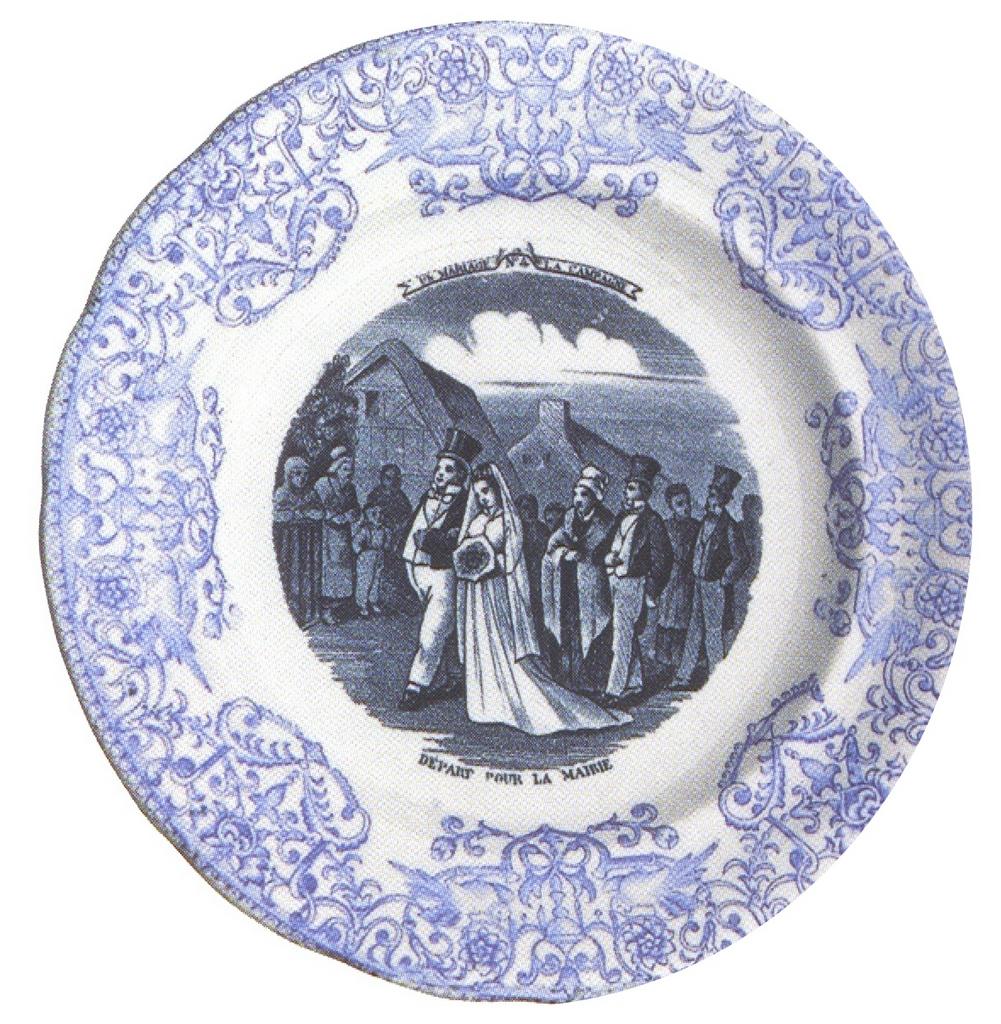
A decorative plate depicting a
scene from a wedding in
Normandy


What would courtship and a marriage ceremony held in 1849 Germany be like? That has been an nagging question for me in writing the story of my immigrant ancestors, Johann and Magdalena Meier.

Until 2004, none of the books or genealogical magazines I had read described a wedding in the Mosel/Saar area or any other area of Germany, despite the fact that it was a very important life event. By 2003 I was ready to go a bit afield. On a river cruise that followed the same route that Johann and Magdalena traveled to reach the port of Le Havre on their way to America, we docked at a village called Vernon. There, in a small bookstore, I found a book about Normandy in the 1890's. It contained a very long description (in French) of the marriage traditions and customs in Normandy's rural areas. Reasoning that parts of France and the Trier/Mosel region of Germany might have a number of similarities, I bought the book, and with the help of a friend who had studied French in college, I wrote down the courtship and wedding rituals.

Betrothal

In rural Normandy, courtship must proceed slowly, especially among country folk. Occasional sharing of a few words after church, an offer to help with a chore such as carrying a basket or bucket, then an evening at the party on the feast of the parish's patron saint or a strolling walk, until the day the suitor is ready to declare himself.

An older person acts as the matchmaker. If permission to marry is given, the engagement is announced. It is made official when the young man & members of his family are invited to a fine dinner at the home of the bride-to-be. It is also the occasion of the first gifts.

The bride prepares a trousseau but does not sew the wedding dress. This must be done by someone else to avoid misfortune. A few days before the wedding, the trousseau is transported with great pomp to the future home on a hand cart. In some places the cart is bedecked with ribbons. On the day before the wedding, the cooking utensils are taken.

The Wedding Day

Weddings were usually on Tuesday or Saturday. On the wedding day, the bride's crown is fitted with a small mirror set in a bezel and tied to the back of the wedding crown or headdress with a green silk cord. This is a symbol of virginity. After the marriage, it is removed and tied to the head of the bed.

While the groom dresses in a simple somber attire, guests are allowed to come to have something to eat and drink as they offer their presents. After the bride is dressed, the dressmaker attaches a cluster of orange blossoms to the lapel of the groom's jacket. Now the wedding procession is about to begin.

According to the distance to the mayor's office and to the church, the bride and groom either walk or go by horse-drawn carriage. Two violins go before, playing something "harmonious"; the bride on the arm of her father or in some places, the groomsman. The remainder of the guests walk behind. The civil ceremony at the mayor's office is short, the church ceremony being more important.

The bells ring out as the procession approaches the church. The husband places the ring on the finger of the bride. If the groom cannot get the ring easily over the knuckle, and the bride must finish it, it is then said that she will wear the pants in the family. After the ceremony, the newly married couple go to the sacristy to give a gift to the priest. Then they leave the church to the ringing of the bells. Sometimes sugared almonds or rice are thrown.

A painting by the artist Pierre Outin from the Musee des Arts et de l'Enfance in Fecamp which was used to illustrate the chapter also caught my attention. The costume of the bride and groom would indicate that the time period represented was the late 1700's. In the painting, the wedding party leaves the church and walks to the nearby cemetery where the bride places flowers on the grave of a loved one, probably her mother, as her new husband looks on. Standing back a bit from the couple is a gray-haired , sad-looking man, probably the bride's father.

The Celebration

The bridal procession reforms outside the church in order to walk to the home of the bridal couple, but usually the group is no longer solemn. There is joking, singing, even dancing. In families that are particularly well off, the people who have arrived at the home of the bride and groom go to the wardrobe to admire the trousseau, in which great pride is taken.

Some people who joined the procession that went to the church do not rejoin it after the ceremony. Instead they go to the public house to sing, dance and eat.

Now there is a wedding meal. The table is covered, usually with a white cloth and decorated with fresh flowers. At some time either during or right after this meal, the bride sings a song of thanks to her parents and confirms her separation from them. Then she sings to her husband and inlaws. The groom sings to his parents and also to his inlaws. A relative or parent of the groom sings to the bride. Sometimes others sing as well. After the songs, everyone dances until dawn.

On the first Sunday after the wedding, the priest welcomes the couple before mass and gives them their new place in the church.

(The preceding information is taken from the book, Il y a un siecle...la Normandie: La vie quotidienne des Normanands, by Hippolyte Gancel)
Want to Know More?
Since 2003, I have found descriptions of a Hunsrück village wedding as well as one of a rural wedding in Bavaria. Many elements of the three are so similar that I've decided to post them too and to draw upon them when I describe the February 14, 1849 wedding of my great-great grandparents that took place in the village church of Irsch, Saarburg, Rheinland. Look for Weddings, Hunsrück Style in my next posting.

Monday, November 14, 2011

On St. Martin's Day, Winter is Not Far Away

Saint Martin's Day Procession, Saarburg 2011


St. Martin's Day, November 11, marked, in former times, the start of winter. It was a day which affected the residents of each village in many ways. It was the time when interest and lease payments were due. This was the origin of the following farmers' saying, "Sankt Martin ist ein harter Mann für den, der nicht zahlen kann." ("Saint Martin is a hard man, for those who cannot pay.") It was a better day for the sheep herders and the servants who received their yearly pay on this day. The geese lost their heads, literally, at the beginning of winter, and the celebration of the feast included roast goose for those families that could afford it. "Sankt Martin ist ein guter Mann, er bringt die Bratgans uns heran," was another farmer's saying that represented St. Martin's Day (Saint Martin is a good man; he brings the roast goose to us).

By St. Martin's Day, the field work and the harvest were finished. I was surprised to learn that in earlier times, Advent began right after St. Martin's Day, with the eating of meat strictly forbidden during the entire period. Therefore, the roast goose eaten on the saint's feast day was the last meat that would appear on the table until Christmas Day and this must have greatly increased the enjoyment of the St. Martin's Day meal.

The custom of the St. Martin's procession is one of the few that is still observed in the current time, as the picture above shows. The children go out with colorful lanterns, following St. Martin on horseback, dressed as a Roman soldier, who leads the parade. At the end of the procession, a giant Martin's bonfire is lit and the children receive
Brezeln, a bread pretzel formed into distinctive symmetrical loops from a long strip of intertwined dough.


After St. Martin's Day, the hard work of the months of harvest came to an end and the cold winter months began. The soil began its yearly rest. Then farmers too could sit near the stove or the fireplace, rest, and enjoy a break from the heavy labor which would not start again until spring.

In the autumn, some of the fruits gathered had been mashed and put in oak barrels to ferment. In the winter came the time to distill or "burn" the fermented fruit into Schnapps. Many kinds were made. The cherries, Mirabel plums and Zwetsch plums made an especially fine Schnapps that would be served on special occasions and feast days. For every day, a Schnapps made of pressed apple peelings called "
Balesch" was a drink for workdays. A typical farmer would drink Balesch each morning after his breakfast. It was meant to protect against every kind of illness. If a person had a stomach ache, not the doctor but Balesch was the prescription.

When the weather was cold enough to freeze, the farm's pig was slaughtered for the family's winter food. Often the village butcher would come to the farm to make sure that no scrap of this valuable animal was wasted. The farmer's wife had already filled the large pig kettle with water and heated it on the fireplace. The pigs legs were bound together and the animal was dragged into a pile of clean straw. The butcher knelt down on the pig as it struggled to avoid the sharp pointed knife but in vain. The butcher made a cut from the throat to the heart and the farmer's wife caught the flowing blood in a large pan. Then the pig was covered in straw which was set on fire, burning the bristles from the pig's skin. The pig was pitch black as the fire was extinguished and his carcass was lifted on to the butchering table.  Any remaining bristles shave off and washed with the hot water that had been heating in the kitchen. It took more than one man to lift the pig's carcass and hang it on a ladder which leaned on the outer stable wall. The housewife then carefully cleaned the inside of the carcass, and it was left there until the rind or outer skin would harden with the cold.


The following day, the butcher returned, cutting the pig into pieces to be smoked, made into sausages or eaten fresh.  Even though the farmer's wife had previously felt compassion for the animal she had fed and tended throughout the year, now she could not but be happy as she thought about the tasty ham, bacon, fresh meat and sausage that she would put on the table for her family during the winter months.

Many cellars were made of stone which was an especially good place to store the winter supply of produce that was the result of months of hard work growing and harvesting it.  The stone construction helped keep the cellar at a temperature that was ideal for storage purposes all through the year. It had kept things cooler in the summer and now would be warm enough to avoid freezing the winter food supply. From November on, the cellar stored wine, potatoes and other root vegetable, and crocks of cut cabbage fermenting into Sauerkraut.

The farmer had felled trees and chopped wood for the fireplace in the first days of the winter season and stored it in a shed or shelter. The smaller branches of the trees were tied together into giant bundles. The smaller twigs were useful for quickly starting a fire on a cold winter morning.

All in all, the coming of winter was a time to be looked forward to for the hardworking farmers of the small villages in the Rhineland. For the farmers, there was now time to sharpen the tools that had been dulled from the cutting of crops or tilling the soil and to make any necessary repairs to the farm equipment. These were the hours when the father, mother, and children had opportunities to spend with each other in simple pleasures; when the men had the time to talk and have a drink together, when the women had no more field work and could sit to spin or knit, either alone or with a few women neighbors, and most of all it was a period when the children could once again look forward to the visit from St. Nikolaus and the wonderful celebration of Christmas.

I grew up on a small Wisconsin dairy farm and I remember winter's pleasures, especially seeing my father eating a leisurely supper because there was no hurry to get ready for the outdoor work of the next day. Those were times of family laughter and togetherness and is probably one of the reasons, unlike many other people in Wisconsin, I still look forward to the coming of winter and the memories that go with it.


Ollinger, Josef. Geschichten und Sagen von Saar und Mosel, 2005
Jean Morette.
Landlleben im Jahreslauf, 1983

St. Martin Photo by Josiane of Lorraine

Friday, September 02, 2005

Of Apple Wine, Cabbage, and Other Everyday Things


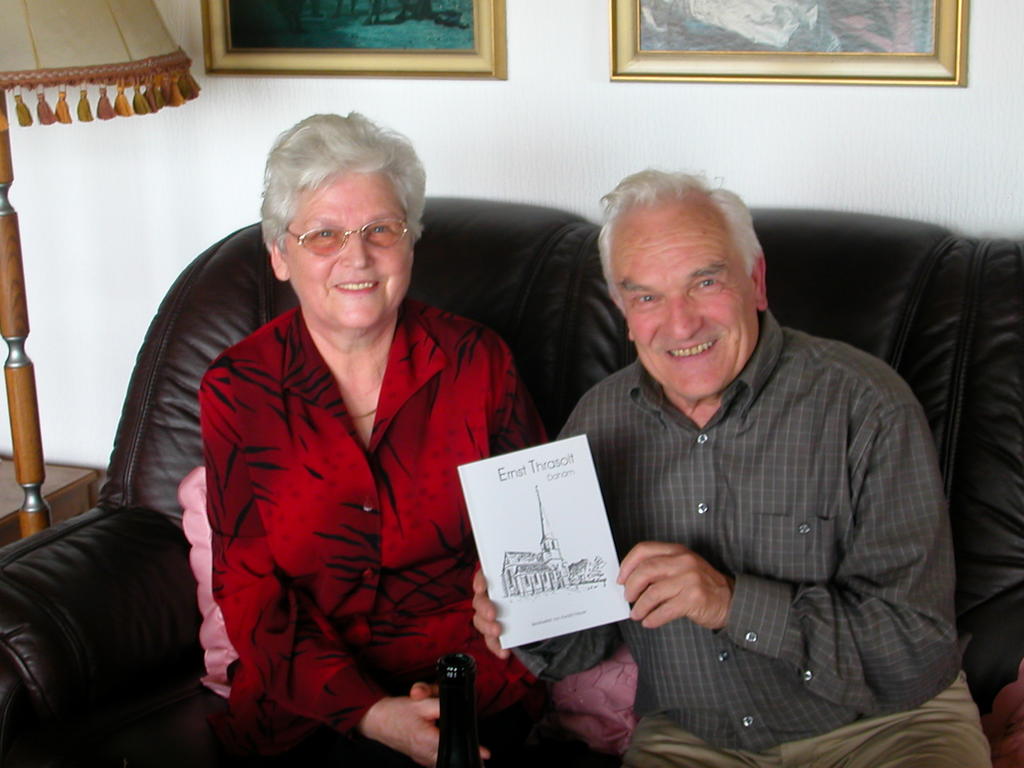
Helena and Ewald Meyer
at their home in Irsch


Imagine that you have been invited to the home of the author of a history of your ancestral village of Irsch
. His wife is seated nearby, and his son, who speaks English, has positioned himself where he can help if communication falters. Herr Ewald Meyer has just told you that he is available to be your tour guide for any place in the area that you wish to see, or your driver if you want to visit an archive to do research. Eyes sparkling with interest, he then asks, "Now, what is your heart's desire?"

That experience was overwhelming for me, especially since I wanted to know everything there was to know about Irsch and the surrounding countryside, see every place that my ancestors might have known, and speak fluent German as well as understand every word of German spoken to me. But that afternoon I chose to begin with the list of questions that I had jotted down as I wrote chapters in my novel. They were little questions, yet they were so important when you are trying to tell an ancestral story; the kind of questions I could answer for farm life in 1920-60 Wisconsin but which I knew nothing about for the Trier Saarburg area of 1820-1860.

Maybe Ewald and Helena Meyer were a bit surprised at how ordinary my questions were, but they answered them enthusiastically, and I took notes to the best of my ability to understand.

I began with, "What would the children call their parents? Were they Mama and Papa, Ma and Pa, Mutti and Vatti?" From them I learned that children in Beurich, where Ewald was born and in the Eifel Region, where Helena Meyer had grown up, called their parents Mutter and Vater or the less formal "Papp," and "Mamm".

Next I asked, "What kind of beds did they have? Herr and Frau Meyer said that the beds were rope tied. The mattress was usually stuffed with straw. There would be a Kisten, a cover filled with the feathers of geese or chickens. Sheets would be coarse linen, woven by hand. The pillows were stuffed with "Spreu", the hulls of the grains that were used to feed the cattle. (It took Arno's English and a drawing or two before I understood about Spreu). Three to four children shared one ordinary-sized bed.

The livestock kept by farmers in Irsch, as I expected, was similar to that found on a Wisconsin farm in the 1800's: pigs, cows, chickens, geese, horses, and oxen. Sheep too were raised in abundance in this region.

I asked how women did the laundry. The Meyers said that many women washed their clothes and bedding in the Grossbach, a small stream, as late as the 1920's or 1930's. (Later the landlord of the vacation apartment I had rented, Hans Dieter Jung, showed me a postcard picture of sheets spread out to dry on the banks of the Saar River after they had been washed there. It was my good luck to have found a landlord with an enormous collection of old postcards from the entire Saarburg area.)

We moved on to my questions about the houses, most of which were actually both house and barn under one roof. In earlier times there were straw roofs. Then in 1842 there was a terrible fire, and most of the village of Biest (today a part of Irsch) burned. The Prussian emperor forbad straw roofs after that time. So the roofs from that time on were made of tile (Ziegel) or slate. The kitchen floor would be of stone (probably sandstone), and in the older houses there were no hallways. One would enter the door from the street and be in the kitchen. The rest of the house was unheated in winter. The floors of the bedrooms would be of wood, and stamped lime was used for a cellar floor. There was a bake oven in the kitchen fireplace; meat could be smoked in the fireplace chimney. Or there might be a bake oven outside.

The bark of the oak trees in the area, known as Eichen Lohe, was used in the tanning industry. The farmers would strip the bark for the tanneries, and this was done when the trees were still quite young. Then two or three new shoots would come up and form even smaller trees, so that today there are no large oak trees in the area.

I had wondered if people drank both wine and beer in this region. People did drink some beer but wine was their usual alcoholic beverage. Each farmer had a few grape vines in cultivation and could make his own wine. In the autumn, Viez, an apple wine, was fermented from small, sour apples. (Note: Viez is still sold at farmers markets and at roadside stands today; it has actually gained popularity in the last several years. Its alcohol content varies, usually about six or seven percent. There is even a publicly proclaimed "Viezstrasse" or "Rue de Cidre" that runs between Saarburg and the Luxembourg border. The word "Viez" comes from Roman times [Lat. Vice = the second or deputy wine] and suggests this apple wine was drunk by the Roman occupiers as a replacement for genuine wine. In the Eifel, Hunsrück, Mosel Valley, and Trier the drinking container for Viez is a "Viezporz", a jug/jar made of white porcelain or stoneware, from which the name "Porz" is derived. In earlier times one stored the Viez in larger stoneware containers (Viezkrug). In the winter, people often drank their Viez warmed at the kitchen stove or fireplace. Source: http://adlexicon.de/viez.sthml)

Three meals were eaten each day. During the spring, summer, and fall, many of these meals were eaten in the fields; hilly fields that were far away from the farms. (On a drive with Herr Meyer, I saw that the fields of Irsch reach almost to the village of Oberzerf, about five miles away.) Probably it would be the grandmother who cooked at home while the adults and older children worked in the fields. The young children carried the lunch to the fields where the family was working.

The families purchased very little from shopkeepers because money was scarce. While they could make most things themselves or barter with neighbors, villagers always had to buy salt and sugar. Most of their food was grown in the garden or gathered from their trees: Potatoes, cabbage (Kappus in the Trier dialect), carrots, beets, celery, leeks, onion, lamb lettuce, beans, peas, kohlrabi, mirabel plums, pears, and many kinds of apples would be found in most gardens.

Clothing was mostly of linen or wool and work and bed clothes could usually be woven at home. However, families had to take the hides from their slaughtered animals to the tannery so that leather could be tanned for their shoes, then made by the village shoemaker.

Poor farmers had only cows to do the work normally done by a horse. Some farmers could afford oxen and the richest farmers had horses. Oxen or cows wore a head yoke when they pulled a plow or a wagon. Craftsmen like shoemakers, tailors, blacksmiths, etc., were better off financially than the average farmer.

In the meadows, growing wild or along the roadways, there were poppies, Kornblume (cornflowers) and Ganseblumchen (small white daisies). Edeltrud Heiser, a distant cousin, told me that children weave Kornblume and Ganseblumchen together to wear as a crown. She warned about the Brenn Nessel (stinging nettle), still remembering how much it hurt when she wandered into it as a child. Chicoree (chicory), which could be used in salads, Weiden Katzchen (meadow kittens, known to us as pussy willows), and Maiglöckchen (Little May bells/lily of the valley) were familiar to me but the Schnee Glockchen (snow bells) which flower in January were not. Deciduous trees in the area were oak, chestnut, and walnut. Hickory nut trees, a type of tree found in abundance when my ancestors came to St. John Wisconsin, have never grown in the Saarburg area.

Weddings were festive occasions, but Helena Meyer explained that there was not a wedding feast as we would know it. The food for the celebration was baked Kuchen of many kinds - Obst (fruit) Kuchen in summer and in winter, streusel, dried pear, or apple compote Kuchen. Most homes would have a small bake oven either in the kitchen or outside as a separate structure. But there was also a community bake oven which could handle many more loaves of bread (or Kuchen) and could be used when there was a special event, or if the family wanted to make a lot of loaves of bread at one time.

I asked about holidays, especially the celebration of Christmas. I was told that the people would always go to Midnight Mass at Christmas. If one priest was in charge of two or more parishes, people would walk to the principal or parish church where the Holy Mass would be celebrated. Even if the person were poor, there would be a Christmas tree with candles as well as baked and decorated figures. These would be given to the children as a gift.

Baptism was not celebrated in any special way in these small Catholic villages. As soon as possible after the child was born, usually the next day (there were no baptisms on Sundays or holy days) but sometimes on the same day if the child was born in the morning, the midwife - usually a family member there to assist the mother during the birth- and the godparents would take the child to the church to be baptized. The mother and father did not attend and the mother could not enter the church until nine days after the birth. (Rev. Leonard Barbian, Pastor of St. William Parish in Waukesha, says that from about 60 A.D., the church used running water or poured water three times over the head of the child - in the name of the Father, and of the Son, and of the Holy Ghost. At first the churches' baptismal fonts were sunken because most baptisms were of adults. But as time went on, the fonts were raised since children were baptized almost as soon as they were born)

During Holy Week, there was a procession on Karfreitag (Good Friday). It was a time when the church expressed its penitence and sorrow by foregoing music and bells. The children in the procession would use a large wooden noise-maker called a Raspeln, which looked almost like a small hurdy gurdy for an organ grinder. It had a handle connected to wooden gears inside a box. When the handle moved the gears, they ground together and there was a rasping noise that could be made rhythmic - rum--rum, rum-rum-rum, rum--rum, rum-rum-rum. Klappern or clappers were also used in the procession as well as to replace the altar bells would ordinarily be sounded at the consecration of the Sacred Host.

On Corpus Christi, a procession went through the streets of the village where each house had a small altar decorated in honor of the Body of Christ.

Musical instruments common to the area were harmonica, violin,and concertina (Ziehharmonika)

At the close of my first visit to the Meyer's home, we had coffee and Kuchen and then Herr Meyer drove me back to Saarburg, stopping along the way in his hometown of Beurig. Today it is part of the city of Saarburg but in the 1800's it was a separate village across the river from Saarburg. There were two things he thought I should see.

The first stop was a famous Pilgrim church of Our Lady. This is where people would come, making the stations of the cross as they approached. The last station was right outside the church on the church wall. Very close by on the corners of the streets leading to the church, there were bakers who sold their wares to the pilgrims who had been fasting and needed food after their pilgrimage was over. Herr Meyer told me that the pilgrims would put dried peas in their shoes as they started their journey to increase their penitence and petition. From about the 1600's until the time of Napoleon, there was a Franciscan cloister along side of the church where the brothers and priests lived, brothers on one side and priests on the other side of the cloister yard.

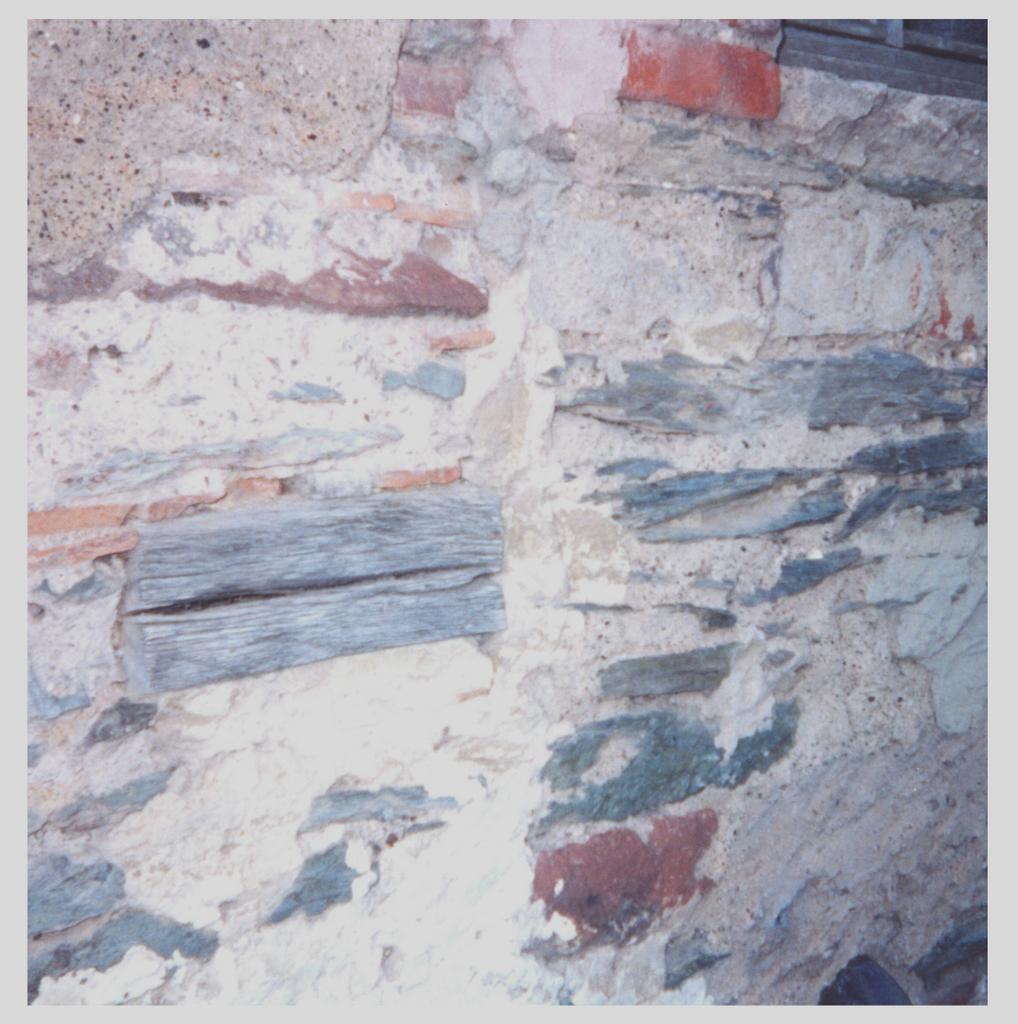
On our second stop, Herr Meyer showed me an old farm house. Up close, I could see that its thick walls were constructed of whatever materials had come to hand, including pieces of wood. (Few such buildings from the early 1800's exist in Irsch or Beurig. Both villages were heavily bombed and shelled during WWII.)


Old building in Beurig

Small window, upper right corner.
Stone and wood construction,
center left.


Our trip ended at the door of my vacation apartment. My head and notebook were filled with good information, and my stomach was soon to be filled with the remains of the Kuchen and Torte which Helena Meyer had sent as a dinner treat for me and my sister.

Books by Ewald Meyer:
Meyer, Ewald. Irsch/Saar: Geschichte eines Dorfes, ("Irsch/Saar: Story of a Village") 2002
Meyer, Ewald and Gehlen, Bernd. Beuriger Lese und Bilderbuch ("Beurich Reading and Picture Book") 2004
Thrasolt, Ernst. Hennerm Plou, ("Behind the Plow," poems and prose), translated from the Mosel-Frankischen dialect and edited by Ewald Meyer, 2000
Thrasolt, Ernst. Dahäm. Edited by Ewald Meyer, 2000

Thursday, November 24, 2016

A Time to be Thankful

St. Gervasius and Protasius Church in Irsch

There is always more to learn and to share with you.  I haven't done much of that during this past year. The reason my blog has been so inactive was my resolution to finish the book I am writing in 2016.  The end of 2016 is approaching quickly.  But there will not be any information about that until my December blog post.

Because of the holiday we celebrated today, Thanksgiving, I want to show a similar German custom that I had observed in Irsch and participated in when I rented an apartment in Saarburg.  I never thought there might be a historic explanation of either.  The German customs I took no notice of are a part of a celebration called Erntedankfest.

I would never have known there was more to the picture above if I had not read an article from the very useful "German Language Blog."  So I am thankful that "Erntedankfest German Thanksgiving" enlightened me to the historical aspects. The following comes directly from that blog post:

"First, the breakdown of the word. ‘Ernte’ means harvest, while ‘Dank’ comes from ‘Danke’, meaning thank you, and ‘Fest’ is German for festival or celebration. The word Erntedankfest therefore translates to ‘Harvest thank festival’. So Erntedankfest is a harvest festival where you express thanks for the food you have received throughout the year!"
"If you live in the USA, this will sound very similar to Thanksgiving. In the USA, Thanksgiving has become a secular holiday centred around food and family get-togethers – but in Germany it is still a rather religious occasion, centred around church services and giving thanks for the land-grown vegetation – the maize, corn, fruit and vegetables – that have fed everyone for another year."
"Erntedankfest is usually celebrated on the first Sunday in October, though this date can vary from region to region."
altar_erntedankfest_500hoch
Photo by jeurgen-tesch on flickr.com 
"Typically, the day includes a church service, a procession, the presenting of an Erntekrone (harvest crown), then food, drink and music, and an evening torchlight procession through the town. Church altars are decorated with wreaths, flowers and fruit, and Blasmusik (music played with brass/wind instruments) is played at these services and during the processions."


Closeup of the Entdenkfest altar in Irsch 
"Some towns and cities hold farmers’ markets selling fresh produce, and bring along their tractors or horses for the local people to see. It is basically a celebration of the land and of all things agricultural! There are also often lots of activities for kids at these Erntedankfest celebrations, so they are well worth getting involved with if you happen to be in Germany around late September/early October."
When I attended the "Golden Autumn" in Saarburg in 2010, and when I saw the mosaic made of vegetable materials in the church at Irsch, that was a piece of Germany's traditional Thanksiving, not just a an autumn entertainment or an interesting mosaic.  It was a traditional way of giving thanks to God for the bounty of the earth.

Friday, September 06, 2013

The Schultüte and the Ranzen Go to School

Early photo of boy with Schultüte and Ranzen

Wooden Ranzen School Satchel


School has just begun in Germany, and it seemed to me that a post about the Schultüte would be very timely. American school children, as well as most other school children outside of Germany are not familiar with the custom of the sugar cone Schultüte. In fact, the English language has no exact equivalent word for it, but the picture above will give you the idea of this "school bag." (Tüte means "bag" when translated literally; however the Schultüte was in the shape of a cone.)

After seeing some pictures of a young relative from the area near Saarburg, Schultüte in her arms and a shy smile on her face, I wanted to determine if the custom reached back to the time of my Kreis Saarburg great grandparents or, if not, just when and where did this custom originate.

To begin my search, I called up the German version of Google and found two good articles that answered many of my questions. One of the first things I learned was that German children of the 19th century did have my version of a school bag - something called a "Ranzen," a word that means satchel.   Not every child's family could afford a leather Ranzen and those who had them guarded them carefully. They were shaped like a small briefcase with backstraps. The Ranzen was the German school child's prize possession. The true Ranzen was leather except in areas where people were poor but wood was plentiful. A poor child from the Schwarzwald might have a Ranzen made of wood, as illustrated in the picture above.

I also learned that the beginning of the school year has been a special occasion since the middle ages, usually celebrated with a special church service and a procession to the school and/or the presentation of cookies baked in the shape of letters of the alphabet. It was a momentous event for these young children to take the first steps away from their parents' home into a school room.

In some parts of Germany, parents accompanied their child on the first day of school and stayed for a time, while the children became acquainted with each other and with the teacher. In other regions, the celebration of the first day of school took place in the home, often with godparents and other relatives present. It is my impression that, as the 19th century began, education was less highly valued than in the later days of the century. Parents, especially those who were struggling to put food on the table during the hard times in the 1840s and 1850s, were less than enthusiastic about a child being taken away from the work on the farm for several years.  Such might have been the case for some of my ancestors.  It is not likely that they had either Ranzen or Schultüte.

The Schultüte did not appear until the 19th Century. The first documented report of the cone-shaped Schultuete comes from the city of Jena in 1817, closely followed by reports from Dresden (1820) and Leipzig (1836). It caught on in popularity in the bigger cities first and spread eventually to the small towns and villages of northern Germany.  One source I read was of the opinion that the sugar cone Schultüte was a way of "sweetening" a young child's anxiety at beginning school.

About forty years after the acceptance of the Schultüte as a tradition in northern Germany, a book about the sugar cone tree was written for young children and even recommended by a teaching manual used in many schools. It was meant to be read to a child just before the little beginner started attending school. In this tale, a Schultüte'sugar cone tree began to sprout and grow in the school basement. It produced not fruit but cones with sugar cubes and candies.  It was time for the little ones to go to school when they were brave enough to go into the school's cellar and pick the tree's cones which had now matured and were filled with sweets.

There was also a difference in the Schultüte's first appearance in North Germany to the adoption of it in south and western Germany. The Schultüte was almost unknown in the Catholic part of Germany in the mid 1800s. In the Catholic areas, it is my guess that a blessing for the new little scholars and perhaps a procession from the church to the school took place, sometimes with and sometimes without parents and godparents on hand. One source says that in rural areas there was possibly a large "baked pretzel" for the whole class or small school day treats from the teacher to reasure newcomers on their first day.

After the introduction of compulsory education in all of Germany in 1871, the demand for sugar cones increased greatly and were very commonplace in north German schools as the first years of the 20th century began. By the 1930s, the Schultüte occasionally appeared in the schools of west and south but did not really become a custom until after WWII.

Today the custom has changed in that less and less sweets are appearing in the Schultüte, with more practical gifts such as crayons and pencils, small toys, CDs, books and even articles of clothing replacing them for the good health of the child.

My research about the origins and time period of the Schultüte revealed that none on my ancestors carried such a prize to their first day of school.  But I do hope they had a teacher who distributed small treats or let them share a pretzel.


Sources: 
Der Blumenbaum, vol. 26, no. 3
Der Blumenbaum, vol 23, no. 2
http://fanzone50.com/Oberstein/schultueteHistory.html
http://fanzone50.com/misc/Schultuete.html http://www.brauchwiki.de/Die_Schultüte
http://www.erster-schultag.de


Sunday, November 17, 2013

Giving Thanks and Celebrating Autumn in Kreis Saarburg

Irsch, St. Gervasius and Protasius Catholic Church in Autumn 2004
Irsch, St. Gervasius and Protasius Catholic Church in Autumn 2010


Potatoes, squash, apples, grapes


Halloween celebrated, we look forward to Thanksgiving in the United States, and Christmas is already here in if you believe shop windows, TV ads, and some radio and television stations.

In Kreis Saarburg, there are also celebrations but they seem to meld better into the autumn of the year.  Here are some that originated with our ancestors and are still a part of the excitement of early and late fall.

Giving Thanks For the Harvest 

Autumn customs in one of my Heimat villages come to mind at this time of year as the leaves fall and pumpkins, squash, root vegetables and winter apples appear in our American markets.  We use many of them for the feast of Thanksgiving, decking our tables with cooked or baked varieties.

An article I read in a German language book explained the thanksgiving of German farming communities of the past.  They thanked God for the harvest, whether good or bad, by sharing their crops with God who gave them.  This has been carried on for centuries, even to the present day.  God's table in the Church, is decorated with the produce of the current year.  There may be squash, cabbages and other large vegetables, but there are often dry seeds of all kinds: flax, rye, wheat, oats, barley, legumes of all kinds.  All are harvested from German soil, traditionally from the soil that surrounds the village where the church is located.

I had seen this kind of decoration on autumn trips to my ancestors' village church in Irsch, enchanted with the kind of workmanship I generally associate with the Rose Bowl parade.  The closeup pictures above and the one below show the elegance of the most commonplace of decorating materials and the time given to produce this kind of thanksgiving to God from the fruit of the land.


Giving Thanks for St. Martin, Happy Children, and Rabimmel, Rabammel, Rabumm

Over the past several years, I have explained many of the traditions associated with St. Martin's Day (also known as Martini) as well as the importance of his November Feast.  If you click on the St. Martin's Day label at the right of the post page, the many activities associated with the day as well as the history and social customs are described, including carrying hollowed out gourds or pumpkins lit with candles.  

The custom of this celebration is still alive and well in the villages around Saarburg and in that city itself.  Most of 2013's customs are much the same as in the 1800s, although the lanterns carried by the children as they parade in the street are made of fireproof material and lighted with safe candles of one kind or another.  The Irsch website page just recently announced the village's 2013 lantern parade:

"The St. Martin's traditional lantern procession in Irsch will take place on Saturday, 09.11.2013 (November 9, 2013).  The assembly place is the parish church of Irsch at 5:30 p.m.  It will begin with prayer and a short homily about the holy St. Martin. Then the lantern parade (about 6 p.m.) led by St. Martin (on horseback) will parade to the Irsch multi-purpose hall. Once there, the great St. Martin's bonfire will be ignited and the Martin Brezeln (St. Martin pretzels) will be given to the children.

The lantern parade will be accompanied by the music society of Irsch as well as the torch bearers of the volunteer fire department, who also provide for the safety of traffic management and the burning of the St. Martin fire.  All children and adults are welcome  Hot drinks and snacks will be sold. The net proceeds as in prior years will again be used for the cost of transporting Christmas packages to help the needy in such countries as Romania."

In the event that you would like to see a typical St. Martin's parade, you can watch the video called "Rabimmel, Rabammel, Rabumm." The German words are given as subtitles on each screen of this very traditional children's song.  Unfortunately the translation in English below does not rhyme.

I go with my lantern
And my lantern goes with me
Up above the stars are shining,
Down here we're shining.
The rooster, he crows; the cat meows.
Rabimmel, rabammel, rabumm.
The rooster, he crows; the cat meows.
Rabimmel, rabammel, rabumm.

I go with my lantern
And my lantern goes with me.
Up above the stars are shining,
Down here we're shining.
St. Martin, he marches on.
Rabimmel, rabammel, rabumm.
St. Martin, he marches on.
Rabimmel, rabammel, rabumm.

I go with my lantern
And my lantern goes with me.
Up above the stars are shining,
Down here we're shining.
Lantern light, don't go out on me!
Rabimmel, rabammel, rabumm.
Lantern light, don't go out on me!
Rabimmel, rabammel, rabumm

I go with my lantern
And my lantern goes with me.
Up above the stars are shining,
Down here we're shining.
A sea of light in honor of Martin.
Rabimmel, rabammel, rabumm.
A sea of light in honor of Martin.
Rabimmel, rabammel, rabumm.

I go with my lantern
And my lantern goes with me.
Up above the stars are shining,
Down here we're shining.
My light is out,
Rabimmel, rabammel, rabumm.
We're going home,
Rabimmel, rabammel, rabumm.


Giving Thanks for a Blog Recovered

Due to circumstances I do not understand, for two weeks I lost access to this blog.  When I tried to make a correction in one of the previous posts, Blogger refused to let me do it.  After a great deal of wasted time and several curt notes to Blogger, all ignored, I had the good luck to bumble back into possession.  I was so thankful.  But it made me realize that, had I not had that bumbling good luck, I could never have posted to this blog again.  It would have been necessary for me to start an entirely new blog. So if you are a regular reader, you would probably have concluded that I got tired of blogging and quit without a goodbye.  

There are two ways to find out if I have been forced to start a blog with a new name: Register as a follower of my blog, and I will be able to notify you about where to find my new posts.  Or you can use my e-mail address (which you can find by reading my profile) to e-mail me.  

In the meantime, I promise to try to keep "Village Life in Kreis Saarburg" posts of the future right here.

Happy Thanksgiving to all


Sources:
Die Martinsumzug, http://www.irsch-saar.de/irschnew.htm
English for Rabimmel, Rabammel, Rabumm, http://german.about.com/library/blmus_laternegeh.htm

'