Showing posts with label farming. Show all posts

Friday, November 20, 2015

Raising a Crop of Oak Bark


www.webwalking.lu


"She was tired by the time she reached the place where her father and brother we working.  They were cutting oak trees that had been stripped of their bark.  That bark was in high demand by the tanners in Saarburg.  Leni always thought the trees looked naked when she saw them after the Lohe harvesting had taken their bark."  HOUSE OF JOHANN, Chapter 13

On my first research trip in Kreis Saarburg, Ewald Meyer, the author of the book "Irsch/Saar; Geschichte eines Dorf" a history of Irsch, took me on several tours of that area.  When we neared a small forest of oak trees, Herr Meyer made a point of telling me that there were no tall oak trees in the Irsch area because, in earlier times, the bark of the oak trees was stripped off and sold to the tanneries along the Saar River.  The thought flashed through my mind but I didn't ask him how the trees managed to survive without their bark.  Little by little that year, I learned that it wasn't just squirrels who needed the oak trees.

Lohhecken, the oark hedges that formed a forest of small trees were not a natural creation. They existed because man had formed this type of forest in a very specific way to turn it into a cash crop. In the past, portions of these oak hedges were stripped of their bark and cut to the ground.  That explained how they survived without their bark.  They didn't!

The bark stripping was done each year, but in different parts of the oak forest.  A group of trees grew to the right size to be cut about every 20 - 30 years.  The bark was carefully stripped off of the trees. It killed the tree.   The underlying wood could be used for a great many needs of the villagers; either homemade items like buckets or benches or more highly finished pieces like cabinets, tables and chairs, etc. The thin branches could be used as firewood.  But it was the bark that was of primary importance.

The bark was sold to one of the eight tanneries in Saarburg along the Saar River.  They needed tannic acid, made from the bark of the oak trees, in the production of leather.  These tanneries did a good business in the production of high quality leather, much of that leather used for the boots of the Prussian military.  The farmers were paid for this bark, delivered by the load.

After the oak trees were cut, that field could be used for regular crops.  In the following two years, grains were planted in the section that had been stripped of its trees.  Rye was planted in the first year and harvested.  In the second year, the field was used to grow buckwheat.  By the third year, a new forest was beginning and the sweet broom thickets known as Ginster grew between the new trees.

Oak trees can put out new new growth from their stumps. Thus, the oak trees began to grow again -several new tree shoots would grow from the old root. This kind of growth went on for another  20 - 30 years.  By that time, the forest looked as it had when it was cut 20 years before, leaving new stumps and also the old stump from which the new ones had sprung.  There developed a thick coppice.

Oak bark was the cash crop that saw many a farmer through a bad growing year for their other crops. Since the majority of Lohhecken hedges were privately owned, a patchwork of small areas, all at a different age, dotted the farm lands.  The plants and animals sheltered by the hedges varied depending on the size of each part of the hedge, and which plants and animals needed more sun (small trees) or heavy shade (oak ready for bark stripping).

After about 200 to 250 years, the stumps had to be removed and replaced with new oak trees, or so says the article I read to find this information.  As the tanneries went out of business, the oak trees remained uncut and kept their bark, but after 100 some years, the trees are not as tall as one would expect from village forest land that is over 1,000 years old.

As Ewald Meyer said, there are no tall oak trees in the fields around Irsch.  Their tree ancestors gave their lives to help our ancestors survive.

Sources
https://de.wikipedia.org/wiki/Lohhecke
Saarburg, Geschichte einer Stadt: Band I, Im Strom der Zeiten.  Stadt Saarburg, 1991
https://www.webwalking.lu
www.naturpark.org/natur-kultur/waelder/.../lohhecken


Tuesday, September 29, 2015

The Harvest of Survival Food

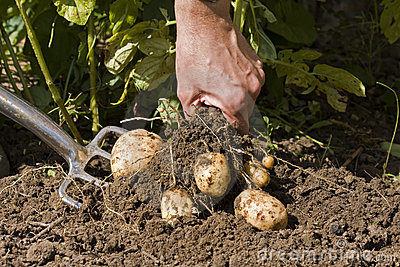
Digging potatoes
picture by dreamstime.com
Gathered cabbage
picture by Burpee.com

With September over, the autumn work on the farms in Kreis Saarburg in the 1800s was about to start. The successful harvest of two very important crops made the difference between a winter of sufficient food or of on-going hunger or even starvation.

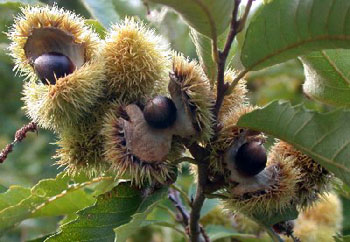
The late summer months brought to an end the farmers' work in hay and grain fields. Many of those fields already were harvested and then planted for the next year. Now it is time for the autumn crops to join the hay and grains which are already stored in the barn.  All ages of family members are cutting, digging, picking and gathering. The grapes hang heavy on their vines (I have been told that almost every farm in the Saar River Valley grew grapes for their own wine making), and they will be harvested. The chestnut tree catkins of the spring now have turned a strong rust red inside their spiny covers and can be gathered up for cooking or roasted as a winter treat. The nut also could be ground into a baking flour.  The youngest children gathered the nuts and any fruits like plums and pears that could be dried for use in the cold months.
Chestnuts

Some of the hardest work of the autumn is bringing in the potato crop, a labor that calls for rugged days of digging and bending to get that year’s yield into storage in a cool dark place so that the potatoes will last for the entire winter.  All the peasant farmers depended on the potatoes as a major winter food source.

In a good year sacks would stand full and thick throughout the whole field. Parents and the older children worked together in the potato field. Each worker dug the potato stock with a hoe or fork which loosened the plant from the ground.  Next the potato stock was grabbed with the free hand and pulled from the earth, the potatoes mostly hanging tight to it.

 Usually three baskets were used for sorting the newly dug potatoes that were pulled from the stock or picked up from the ground where they had fallen from the stock. The big, thick potatoes went into the first basket, the little ones or those that had been damaged by hoe or fork were thrown in the second basket and used as food for the pigs. The third basket held the medium sized potatoes which would be used as seed potatoes for planting in the spring. The half dry stocks of the potato plants were thrown aside to dry. Landless day workers helped with the harvest for a share of the crop of the larger farms. At noon the housewife or the grandmother prepared a noon meal. Most fields were far from their farmhouse and their meal was carried to the field for them. There was laughter and gossip to make the work more pleasant.  At the end of the day, the sacks were loaded into a wagon and unloaded, usually into the cool dark cellar.

It took about three days to finish the potato harvest. When the potato stocks had dried completely some days later, the young would make a high pile ready to be burned. The roasting of potatoes once the potato stocks were burning was one of the highlights of the year for the the young.  It seems to have been the equivalent of a giant marshmallow roast.  They scraped the potatoes and held them on the fire with pointed sticks. The potatoes roasted to a very white delicate texture inside. They were also very hot. There were many shouts because of slightly burned mouths and fingers during the night of the big potato fires.


Bonfire of potato stocks
In 19th century Germany and for centuries before that, cabbage played a major part in the winter food supply of peasant farmers and craftsmen. Cabbage was their only winter vegetable.  The German word for cabbage is Kohl but in the Saarburg Kreis dialect it was and still is known as Kappes.

Kohl/Kappes is a vegetable that, like the potato, could help keep families from starvation during a long winter. This plant did not require a lot of ground space relative to the size of the head of cabbage that could be harvested from it. Like potatoes, cabbage could be kept all through the winter. Unlike potatoes though, the cabbage had to be sliced into a large barrel and made into Sauerkraut, a fermented cabbage.

The entire family was involved in the process of making sauerkraut. Two of the most important people in preparing sauerkraut were the cabbage cutter and the stomper. The father of the family or, at times, a migrant worker who went from house to house during cabbage season, was usually the cutter. The cutter placed a long board with a cabbage shredder embedded in the center over two stools. He sat on the board and ran the cleaned head of cabbage over the shredder. The finely cut cabbage fell into the tub placed on the floor between the stools.


Krauthobel (cabbage shredder)
When the tub was filled, it was emptied into a well-cleaned barrel, and other ingredients like salt, sugar, herbs, sour apples, and herbs like dill were added. In wine producing areas like Kreis Saarburg, wine was also an important sauerkraut ingredient and made what was called Weinkraut. Each layer of cabbage added to the barrel was stomped, usually by young sons (or daughters) of the family whose feet and legs were washed thoroughly and then covered with stockings called Krauttretensocke (kraut stomping socks). When the last layer of cabbage was in the barrel and stomped, it was covered with a round piece of wood that fit tightly and it was held down by a stone. According to the recipe book, Das Leibgericht, (The Favorite Meal) by Hans Fischer, sauerkraut making began about November 1 and the kraut was ready to eat after about 4 weeks of fermentation.

One interesting side note. I read that in the Hunsruck area, the bridal meal had to include sauerkraut as one of the dishes served because it was considered to be lucky. It is my suspicion that the origin of this story came from necessity since most weddings were celebrated between Christmas and Lent, a time when the workload was light for all the families and when sauerkraut was the only vegetable available on the bride and groom's special day.


Sources
http://paleoleap.com/eat-this-chestnuts/
Christiane Becker, Die Hunsrücker Küche
Joseph Ollinger, Geschichten und Sagen von Saar und Mosel.
Hans Fischer, Das Leibgericht.
Der Blumenbaum, April, May, June 2002


Thursday, April 23, 2015

The Farmer's Coat of Arms

Village of Irsch, Kreis Saarburg, Hausmarken


Does your family have a coat of arms? Royal families had magnificent coats of arms since the middle ages and took great pride in them. Books on Heraldry can be studied to find out if you have an ancestor with a coat of arms and your family genealogy indicates royal blood.  Heraldry, according to the American Heritage Dictionary is "the profession, study, or art of creating, granting, and blazoning arms and ruling on questions of rank or protocol, as exercised by an officer of arms." For many years I believed that my ancestors, basically of the farming and laboring classes, would not have had a coat of arms and therefore could not be genealogically traced.

 It was only after I read the best-selling book "Roots" by Alex Haley, a black man descended from slaves, that showed that no matter how unknown and poor one's ancestors might be, there were ways to trace back to earlier ancestors.  People like me with peasant ancestry finally understood that there was a great difference between searching in a book about heraldry for a coat of arms or using books and old records to find the history of a family.  Everyone has genealogical roots.  Not too many people find that their ancestors also had a coat of arms.

However, the chart of figures above could be called the farmer's coat of arms. After tracing my ancestry to peasant farmers in the Rhineland, I was surprised that some landowning farmer did have a picture code that bore a resemblance to the heraldic coat of arms.  These coats of arms were without the colorful figures used by the aristocracy--bears, stallions, tigers, crowns, jeweled swords, etc.   In Kreis Saarburg, the farmers coat of arm's had nothing to do with royal blood, but everything to do with a type of land sharing known as the Gehöfershaft.

What is the meaning of Gehöfershaft? With my limited German, I still do not fully understand all the ins and outs of this complicated term which represents a manner of sharing a very large amount of land held in common. According to my research, in a Gehöfershaft, only small areas of land were privately owned, mostly valley meadows, which ensured the farmers a crop even in dry years. The rest of the land, especially land with hedges and oak trees was owned in common.  Gehöfershaft is a rare word that cannot be found in German dictionaries of today or even going as far back as the last century's dictionaries.  My American second cousin with whom I share Bavarian ancestry and who speaks fluent German, told me he had never heard this word and had no idea what it was.  Puzzling indeed, because if you go to a Kreis Saarburg village and visit their museum of historic objects like tools or cooking utensils, you may also be shown (if it has survived the years) the village's Rosenkranz (rosary) and given an explanation of what it was. And yes, the word "Gehöfershaft" will be used over and over in that explanation.

However, the Gehöferschaft method of land sharing exists in only a few areas of Germany, including Kreis Trier and Saarburg and also much of the Saarland. If your ancestors, like mine, were landowning farmers in these regions where the Gehöferschaft land system existed, they would have a specific house mark (Hausmark) for the farm.  The mark that identified their "Haus" (house and barn were in one building) was rather like the coat of arms used by royalty.  It plainly meant, "this possession is mine and here is its unique symbol that proves its descent."

In his book on the history of Irsch in Kreis Saarburg, Ewald Meyer writes that a basis for the long existence of the Gehöferschaft land-sharing system in Kreis Saarburg (until almost the 20th century) might just be the lingering survival of the house marks. In 1853 there were still a multitude of house marks, 137 in Irsch alone as shown in the chart above.  This means that 137 landed farmers had shares in (belonged to) the Gehöferschaft.

Originally Gehöferschafts rights were assigned to a farmer and identified by the Hausmark.  Research shows that these Hausmark identifiers are ancient kinship characters and were passed from father to oldest son.  After Napoleon changed the inheritance laws when he brought Kreis Saarburg into the French Republic, all the children of a family now were allowed to inherit an equal share of the family's possessions.  This law remained in force under Prussian rule.  It also complicated the Gehöfershaft/Hausmark system.  Originally, the shares of the Gehöfer land were equal in size/value.  With the introduction of the French law, the Gehöferschaft shares had to be sized into smaller sections and it was not always possible to keep the land share sizes completely equal.  Also new Hausmark symbols had to be created.

The Hausmark was not only used to show land boundaries.  It was also a property mark carved or painted on possessions or branded on animals.  The unique mark sometimes decorated a house's door lintel. They could be used on contracts and documents when the signers were illiterate.  Most of the marks consist of rune-like images. Letters are in the minority as you can see on the Gehöferschaft chart of Irsch in the illustration above.
Rosenkranz for the village of Schoden

The Gehöferschaft land shared in common were allocated by drawing lots. The lot numbers were engraved on wood-drilled beads, cubes, or tablets, which could be strung on a strap of leather and tied in a circular "Rosenkranz" in the same way as the beads on a rosary were strung and used for prayer (Rosenkranz is the word for rosary).  When it was time for a reallocation of the land shares, usually after about five years use by a farmer, the administrator of the Gehöferschaft would unstring the old Rosenkranz, drop the loose cubes or tablets into a hat or some other container, and the new division of land would again be drawn by lot.  As each land section cube was drawn from the hat, the new Hausmark was added by painting over or carving away the old symbol and painting on the new Hausmark.  Then the Rosenkranz was restrung. The Gehöferschaft community's administrator preserved the "Rosenkranz" until it was time for the next draw.

It was typical that any newly created house marks would show a strong resemblance to the original Hausmark of the family. It was usually a slight addition to the lines or characters of the first house mark in that family. Look at the each Hausmark in the chart above and see if you can find relationships among them. For instance, could there be a set of related family marks in row 5 where there is only one difference between square 2 and square 3. As you keep looking, you will see more possible linked house marks.

Unfortunately, emigrants lost their Hausmark when they sold their Gehöferschaft land before leaving for America so I don't know what the rune-like characters for the farmers Meier or Hauser or Rauls might have been.  But since I come from a family of hearty eaters, I think at least one of the Hausmarks might have resembled No. 87 above - a fork!

Sources:
Meyer, Ewald.  Irsch/Saar: Geschichte eines Dorfes.  2004
http://schoden.vg-hosting.de/index.php?option=com_content&view=article&id=79&Itemid=104


Wednesday, November 12, 2014

The Pig Herder

Bremen square gives a tribute to the pig herder


To try to hang on to my German vocabulary when I haven't had a chance to speak it or review a practice tape for some time, I picked up a book that is at least somewhat close to my reading level, Geschichten und Sagen von Saar und Mosel by Josef Ollinger. Once again, I learned something new and I wanted to share it with you.

The chapter I chose to read was full of facts about a job that Olinger says was considered one of the four most useful occupations in any Rhineland village. This is the order of their worth: Pastor, teacher, mayor, herder. The first three did not surprise me, but I had not known that a sheep, pig, goat or cow herder held such an important post. If you discovered that your ancestor was a pig herder, you might make the mistake of thinking his was a lowly position. To the contrary, herders were valuable and respected for what they did.  They were the farmers' insurance that their animals were cared for in a way that assured these assets would thrive. All of them depended on the herders to find good foraging spots for their animals and guarded them from any form of danger.  So important were these herders that they were entitled to special rent-free dwellings, "Hertenhaüsern" (herder houses), for themselves and their families. They were also provided with a small piece of land for a garden.

In the 19th century, especially the first half, all but very tiny villages had a herder for each kind of animal. Hence the occupation "sheep herder, goat herder, cow herder, pig herder" can be found in the pages of church baptismal records which usually list the occupation of the father of a newly baptized child. The occupation of herder was one that was often passed from father to son.

The work of the herder was seasonal. It was not unusual for the village teacher to take over the job of herder when school ended in March and the children went to work in the fields. The herder of pigs might supplement his income by doing the fall slaughtering for farmers who had raised a pig for a winter supply of smoked ham and sausage. For this service, the herder received a piece of the meat from each pig he slaughtered.

Many of the herders were gone by the late 1800s, choosing to migrate to the industries in nearby cities. But in the little town of Tunsdorf, which is in Saargau area near Kreis Saarburg, Nikolaus Adler, the son of the former pig herder, kept his job until 1959, when he retired. He felt great pride in the work he had done, especially because, in all the years he worked, he had never lost a pig.

Each year Adler started his work as a herder on March 17, the feast of St. Gertrude,  called St. Gertraud in most of Germany. This saint's' feast day was often associated with the coming of spring. Some examples of Gertraud lore: "A sunny Gertraud's day will bring the farmer happiness. If Gertraud's day is sunny, it is the gardener's delight. If it freezes on the Gertraud day, the land will need 40 more days to warm it enough for planting. If it freezes on Gertraud's day, all summer will be cool."  St. Gertraud's day somewhat resembles groundhog day in U.S.

In his book, Josef Olinger described this last herder of Tunsdorf as a daily presence, walking the village road with a horn he tied around his neck with a piece of rope. There were three different notes that he blew. One was used to signal the pigs to come out to him. At that horn note, pigs left their pens without coaxing and came through the farm yard into the road. From one end of the village to the other, new pigs joined those which had been called out earlier. If a farmer neglected to open their stall, his pigs would push and might break the pen's latch at the sound of that horn call. A different horn note alerted the farmers whose pigs were still in the stable. They knew it was time to open the pen latch rather than risk a broken stall. The third note was one that seemed to calm the pigs as they walked, assuring them that the herder was looking out for their well being.

Male pigs and boars did not leave their pens. They were fed a diet of table scraps and garden root vegetables, fattened as much as possible for the slaughter in the fall.  The sows and the young pigs ate from the meadows and woodlands. They could use their snouts to dig for food in the fields chosen by the herder. There was enough vegetation to sustain them during the summer months. A successful herder like Nikolaus Adler knew the best places for forage.  On hot days, he would look for a spot in the shade to keep the pigs tender skin from the burning sun.  He would try to get permission from the village forester who protected the government's woodland to allow the pigs to search for acorns and beechnuts that had dropped to the ground, a gourmet treat that the pigs loved.

Since pigs are not easy to keep together in a herd, Adler had two dogs that helped him round up a sow or young pig that went astray.  His dogs were rough mongrel types but devoted to their master and to the job for which he had trained them. Even a huge sow with formidable strength did not deter the dogs. One sharp bite to a sow's rump or leg, and the animal hurried to regain the safety of the herd.

In the evening, the herder brought the pigs back to their pens. The older pigs recognized the barn and stable which they had left that morning and trotted to it willingly without any help from the herder.  The very young pigs sometimes wanted to stray into the wrong farmer's pen.  Nikolaus Adler knew his pigs so well that there was never any mixup.  If a piglet strayed in the wrong direction, Adler would call to his dog, "Kastor, get me the little one" and the dog would sort the piglet out and bring it back for delivery to the proper barn. The number of pigs grew smaller until each was back in the pen where it belonged.

On Fetten Donnerstag, (Fat Thursday), which was the Thursday before the beginning of Lent,  Nikolaus Adler was paid, mostly in foodstuffs like meat, grain, sausage, and lard.  Each house that paid him also served him a glass of Schnaps.  I can only assume that the herder had a significant hangover, perhaps lasting until Ash Wednesday.

Photo: http://shannon313.files.wordpress.com/2010/07/img_3287.jpg

Wednesday, May 30, 2012

Thankful Thursday - The Wägelchen and Heilige Johannes


How many Groschen am I bid for these fine pieces?


In my February post, I talked about the auction of Johann and Magdalena Meier's "moveables"; how the auction was carried out, a few of the items that were sold, the amount of money that my great-great grandparents earned from the auction, and how, in the absence of banks as we know them, how a Jewish tradesman served as money lender, taking a risk on the ability of the buyers' readiness to pay him in a few months, with an interest charge added to the amount due. It was not unlike having a credit card.

I did not list all of the 168 transactions that took place on that late March day, for obvious reasons. But as I studied that list, I began to see that there were more bits of history to be gleaned and a few that touched my heart and made me thankful for my great-great grandparent' willingness to give up many of the things which were either close to their hearts or which had been acquired by endless days of work on their farm.

While it is possible to find information on the layout of a typical house and barn, it is more difficult to discover what was inside the structures that might have been unique to my emigrant ancestors. The auction adds so much color and realism to what lay behind closed doors of an especially meaningful farm home - in the barn where there were tools and equipment that were used again and again, in the storage areas where provisions that brought them through hard times as well as through winter, and in the living area where the cupboards and closets held many items used every day. Given the amount for which each item was sold, it is possible to know what the members of this farming community found most valuable. Some items that were purchased with Thaler; others with the more lowly Groschen (there were 33 Groschen to a Thaler). The items seem to have been sold in a way that would keep both men and women interested, mixing household goods with farm tools. To keep the crowd from leaving before all the items were auctioned, some of the highest priced and most highly prized goods were held to the last - the bags of potatoes, the tub of cabbage, barrels - with Trank/drink - and the wagons.

Sold from the barn area

Spades and axes; hammers, hay forks, scythes, rakes, flails, chains of varying lengths, a wedge and a small ax for splitting wood, a saw, knives and a whetstone to keep a sharp edge on tools used for cutting, a Fruchtwand which separated the grain seed from the hull, a flail, ladders of varying sizes, a winnowing fan - All of these things were sold from one to 28 Groschen.

More expensive were a rack-wagon which sold for 14 Thaler, a handcart sold for 6 Thaler, harnesses or Pferdegeschirr* earning approximately one-half to one Thaler each. A Hexelbank* brought in two Thaler. Several other items sold for a Thaler or more, but unfortunately the handwriting on these items is not readable.

Livestock:

Two of the cows that the Meiers owned had sold for 40 and 48 Thaler and had already been claimed by their new owners on the same day that the barnhouse and all the farmland were auctioned. That auction, with much higher bids, was held in February. The third cow, however, was needed for her milk until the family was only a few days away from leaving Irsch. Thus it was still in the Meier's barn on the day of the moveables auction. While the first two cows sold had brought in a few Groschen more than 40 Thaler, the winning bid for the remaining cow was only 25 Thaler and 6 Groschen Most likely this was due to which people attended the second auction, many of whom were not rich enough to buy more land.  They were also not able to bid as much for the last cow. The four geese were sold for varied sums from eight to 12 Groschen.

Sold from the living quarters:

I picture the doors of the cupboard open, the shelves bare as these items are auctioned bit by bit: a spoon, cake pan, tin kettle, three iron kettles, coffee grinder, crockery, pitcher, a plate (perhaps it was considered special by great-great grandmother Lena, since it was sold separately from other crockery).

From inside the kitchen or the Stube, furniture and larger pieces no longer stood in their usual places. On offer were chairs and benches, a stove, a straw basket. Is it possible it was one worn on the back for harvesting grapes? More likely it is one that carried a meal to the fields to to feed the hungry family when the Angeles bell of the church rang out. A bed and a bedstead (I don't know how these were different), a house stove, and a Laden, which my dictionary tells me is either a shutter or a shop) sold for Groschen; a cabinet or cupboard, sold for three Thaler, one of the more valuable items from the house.

Provisions Stored for Future Use:

For the stored potatoes, the winning bid was usually one Thaler  for 50 kilograms. Considering that a baking or cooking pan sold for about seven to ten Groschen, the potatoes to put in the pan were a valuable and expensive commodity and more important than most things man-made.  The potatoes were sold in bags weighing from five, two, or one Zenter (according to Wikipedia, one Zentner equaled about 50 kilograms) and seemed to sell at a price of one Thaler per Zentner of potatoes.  An empty barrel was worth about 27 Groschen, but the barrel with "Trank" or drink (wine or Viez?) was worth 10 Thaler and 15 Groschen to one buyer.  The tub of cabbage sold for over two Thaler.  There were also bundles of wood meant for fires in a fireplace or stove, and the harvested Lohrinde, which was the bark stripped from oak trees that could be sold to the tanneries in Saarburg.  The buyer gambled that some one tannery would pay more than the twelve Thaler he originally paid. 

Some Unique Surprises:

*A sail was one of the more surprising items on the auction list; perhaps the family story saying Johann Meier was a sailor is more accurate than I thought.  It was purchased by a sailor from Beurig (a sailor would often be a barge owner) for one Thaler and 12 Groschen.  A correction and proof of an assumption: I made a mistake in translating the word Seil; which is not a sail at all.  Instead it is a cord, rope or line which would have been used by the Halfen, men who controlled the horses pulling a barge against the current.  I had always suspected that Johann Meier sometimes worked as one of these Halfen, handling a team of horses on the trip between Saarburg and Serrig.  

*A resin pot - Resin or Rosin is added in small quantities to traditional linseed oil/sand gap fillers and used in building work. Players of bowed string instruments rub cakes or blocks of rosin on the bow hair so it can grip the strings and make them speak. While there is good reason to have such a pot as building material, I would like to believe that someone in the Meier family played the violin. I know that the grandchildren descendants born in this country had good voices and sang in harmony at parties.  Why not fantasize that one of their grandparents also played a "fiddle."

*Boxes of junk - Coming from a long line of pack rats, I have a "junk drawer" - doesn't everyone?  I also have a box here and there of stuff I might need in the future like old eyeglasses in case the three pair that actually have my current prescription might all be stolen by a thief with poor vision; a bunch of cassettes that already have something on them but could be used to tape something new; bunches of string in case I need to give tie support to every plant in my flowerbeds; and so forth.  I smiled when the auction list of my 2nd great grandparents included two boxes of Gerümpel, the German word for "junk." One box sold for two Groschen, the other for 12 Groschen (evidently the second box had a higher class of "miscellaneous" - or it was a bigger box).

*Two of the most touching pieces sold during the emigration process of Johann and Magdalena were "The Holy Johannes" and the Wägelchen. Both received a high bid of five Groschen, and I think that these two items in particular must have been difficult to part with. Holy Johannes may have been a picture or a small statue of the patron saint of Johann Meier, perhaps given as a gift to Johann at his baptism or first Holy Communion. The Wägelchen was some sort of a carriage for a baby, perhaps more like a small wagon than a decorated Victorian baby buggy one might picture.  Had all five children been taken to the fields or to a neighbor's farm in it?  For Magdalena it would be much easier to part with the crockery or an iron kettle, I think, than with these last two possessions. 

I wish one or the other of any of the auction pieces, but especially "The Holy Johannes" had come to America and been handed down to my generation.  But survival meant that only the practical pieces could be placed in the travel trunks and bundles.  On this thankful Thursday, I am so thankful that my ancestors had the courage to sell their unnecessary items to add to their resources for beginning a new life in a new land.

*A Pferdegeschirr is a harness, although the word gave me a moment of pause and a grab for a dictionary since Pferde means horses and Geschirr means some kind of crockery. My first thought was that this was dishware decorated with horses.
*a Hexelbank was a device that cut straw into small pieces.


Sources and Resources: 
1. Records from the Koblenz State Archive
2. The patience of Ewald Meyer for his many hours spent struggling with the translation of the German of yesteryear as written by a careless official.
3. The generosity of the researcher who remembered the family names which I had been seeking when searching for his own purposes
4. The great memory of a fellow genealogist who recalled that an article on resources in the Koblenz Archive had included my ancestral villages





Monday, November 14, 2011

On St. Martin's Day, Winter is Not Far Away

Saint Martin's Day Procession, Saarburg 2011


St. Martin's Day, November 11, marked, in former times, the start of winter. It was a day which affected the residents of each village in many ways. It was the time when interest and lease payments were due. This was the origin of the following farmers' saying, "Sankt Martin ist ein harter Mann für den, der nicht zahlen kann." ("Saint Martin is a hard man, for those who cannot pay.") It was a better day for the sheep herders and the servants who received their yearly pay on this day. The geese lost their heads, literally, at the beginning of winter, and the celebration of the feast included roast goose for those families that could afford it. "Sankt Martin ist ein guter Mann, er bringt die Bratgans uns heran," was another farmer's saying that represented St. Martin's Day (Saint Martin is a good man; he brings the roast goose to us).

By St. Martin's Day, the field work and the harvest were finished. I was surprised to learn that in earlier times, Advent began right after St. Martin's Day, with the eating of meat strictly forbidden during the entire period. Therefore, the roast goose eaten on the saint's feast day was the last meat that would appear on the table until Christmas Day and this must have greatly increased the enjoyment of the St. Martin's Day meal.

The custom of the St. Martin's procession is one of the few that is still observed in the current time, as the picture above shows. The children go out with colorful lanterns, following St. Martin on horseback, dressed as a Roman soldier, who leads the parade. At the end of the procession, a giant Martin's bonfire is lit and the children receive
Brezeln, a bread pretzel formed into distinctive symmetrical loops from a long strip of intertwined dough.


After St. Martin's Day, the hard work of the months of harvest came to an end and the cold winter months began. The soil began its yearly rest. Then farmers too could sit near the stove or the fireplace, rest, and enjoy a break from the heavy labor which would not start again until spring.

In the autumn, some of the fruits gathered had been mashed and put in oak barrels to ferment. In the winter came the time to distill or "burn" the fermented fruit into Schnapps. Many kinds were made. The cherries, Mirabel plums and Zwetsch plums made an especially fine Schnapps that would be served on special occasions and feast days. For every day, a Schnapps made of pressed apple peelings called "
Balesch" was a drink for workdays. A typical farmer would drink Balesch each morning after his breakfast. It was meant to protect against every kind of illness. If a person had a stomach ache, not the doctor but Balesch was the prescription.

When the weather was cold enough to freeze, the farm's pig was slaughtered for the family's winter food. Often the village butcher would come to the farm to make sure that no scrap of this valuable animal was wasted. The farmer's wife had already filled the large pig kettle with water and heated it on the fireplace. The pigs legs were bound together and the animal was dragged into a pile of clean straw. The butcher knelt down on the pig as it struggled to avoid the sharp pointed knife but in vain. The butcher made a cut from the throat to the heart and the farmer's wife caught the flowing blood in a large pan. Then the pig was covered in straw which was set on fire, burning the bristles from the pig's skin. The pig was pitch black as the fire was extinguished and his carcass was lifted on to the butchering table.  Any remaining bristles shave off and washed with the hot water that had been heating in the kitchen. It took more than one man to lift the pig's carcass and hang it on a ladder which leaned on the outer stable wall. The housewife then carefully cleaned the inside of the carcass, and it was left there until the rind or outer skin would harden with the cold.


The following day, the butcher returned, cutting the pig into pieces to be smoked, made into sausages or eaten fresh.  Even though the farmer's wife had previously felt compassion for the animal she had fed and tended throughout the year, now she could not but be happy as she thought about the tasty ham, bacon, fresh meat and sausage that she would put on the table for her family during the winter months.

Many cellars were made of stone which was an especially good place to store the winter supply of produce that was the result of months of hard work growing and harvesting it.  The stone construction helped keep the cellar at a temperature that was ideal for storage purposes all through the year. It had kept things cooler in the summer and now would be warm enough to avoid freezing the winter food supply. From November on, the cellar stored wine, potatoes and other root vegetable, and crocks of cut cabbage fermenting into Sauerkraut.

The farmer had felled trees and chopped wood for the fireplace in the first days of the winter season and stored it in a shed or shelter. The smaller branches of the trees were tied together into giant bundles. The smaller twigs were useful for quickly starting a fire on a cold winter morning.

All in all, the coming of winter was a time to be looked forward to for the hardworking farmers of the small villages in the Rhineland. For the farmers, there was now time to sharpen the tools that had been dulled from the cutting of crops or tilling the soil and to make any necessary repairs to the farm equipment. These were the hours when the father, mother, and children had opportunities to spend with each other in simple pleasures; when the men had the time to talk and have a drink together, when the women had no more field work and could sit to spin or knit, either alone or with a few women neighbors, and most of all it was a period when the children could once again look forward to the visit from St. Nikolaus and the wonderful celebration of Christmas.

I grew up on a small Wisconsin dairy farm and I remember winter's pleasures, especially seeing my father eating a leisurely supper because there was no hurry to get ready for the outdoor work of the next day. Those were times of family laughter and togetherness and is probably one of the reasons, unlike many other people in Wisconsin, I still look forward to the coming of winter and the memories that go with it.


Ollinger, Josef. Geschichten und Sagen von Saar und Mosel, 2005
Jean Morette.
Landlleben im Jahreslauf, 1983

St. Martin Photo by Josiane of Lorraine

Saturday, February 26, 2011

The Building That Was Left Behind

Getting near to hallowed ground in 2004

Every time I came to Irsch - from the 1980s to my last visit in fall of 2010 - I passed the place where my ancestral home once stood.  Part of it, greatly changed over time, was still there.   But I had no idea I was walking or driving past what was, for me, hallowed ground.   

I had asked about records that would show the location of Johann and Magdalena Meier's house many times over the years and was always told that those records no longer existed.  In a village that had seen severe destruction from the time of Napoleon to World War II,  I had to accept the idea that I would never know where my Meier (or Hauser, Schawel, or Weber) ancestors had actually lived.  

I also thought that I had exhausted the resources in the Koblenz Archive when I found great-great- grandfather Meier's and Hauser's emigration documents.  But that was definitely not the case.  That Archive has so much more to offer - if you know how to look.  A genealogy friend told me about a researcher friend in Germany who used the Archive documents regularly and about the possibility of additional records.  She encouraged me to write him and ask him if he would do a search for me when he next visited the Archive.  He graciously agreed.  That was in about July of last year.

Just back from my trip to Germany in September  and October 2010, I retrieved my mail and found a package full of documents from the Archive.  It had been sent by the German researcher.  There were Kataster maps of Irsch and Zerf, or what we here in Wisconsin would call plat maps.  There were also pages of tax lists.  They dated from approximately 1829.  The Kataster maps showed not only numbered land holdings, but also tiny sketches of each house in the village.  It was possible to see the shape and relative size of each dwelling including the barn-house where Johann and Magadalena, my 2nd great grandparents had lived just before they came to Wisconsin!

No. 4091- Barn House of Matthias Meier in 1829, future home of Johann Meier and Magdalena Rauls Meier
That was exciting but would not have been as much help without the tax documents which came with the maps.  The copies of tax lists gave the size of each land parcel by number, told what type of land it was, the name of the area in which it lay (Beim Holzapfel Baum, In Der Wolfshek),  and showed the tax rate for each piece of land, no matter how small.  I matched Kataster number to Prussian tax number, and found the pieces of land owned by my Meier and Rauls ancestors in 1828-9, including their dwelling.

Herr Ewald Meyer of Irsch, who has always been a wonderful help to me, is able to read the old German handwriting, and once more I counted on his aid.  I sent copies of the documents to him, knowing that he would be able to read the difficult handwriting on the tax lists and also hoping that there might be a place in Irsch and Zerf to keep this duplicate information as an example of what a wealth of family history information can be found at the Archive in Koblenz.

E-mails began to fly back and forth.  I learned that the Meier family had pasture land, two small garden plots (neither close to the house they lived in) some fallow land - 19th century Germany used the three field system at this time - and one small field of "wild land/hedges."  Herr Meier, analysing the total land ownership in 1829 of Matthias Meier, Johann's father, came to the conclusion that he was a "small farmer" known as a Kleinbauer.  He had barely enough land to feed his family and probably owned very little livestock -- perhaps a cow or two and a pig.  To pay the taxes on the land, most Kleinbauern like Matthias had to have a second way to make a living, perhaps as a small-time craftsman such as a tailor or barge puller.

I thought my knowledge of the area couldn't get any better than that - but it did.


Remains of the Barn House of Johann Meier today
As always, Herr Meyer went the extra distance - and then some.  Soon after he got my package of documents, I received e-mail pictures of the part of the dwelling - the storage barn and the stable - which exists today in highly remodeled form. It is owned by the family across the street, even though it stands wall to wall with the home of another Irsch resident.  The Fisch family uses the former home of my ancestors for storage of wood, tractors, and other equipment.  This remodel was done sometime after I visited Irsch in the 1980s.  Because of the German love of order and paperwork, there were documents which spanned the time of the first remodel in 1927 and, after a visit from Herr Meyer, Herr Fisch, the current owner, was willing to give them over for scanning.  You can imagine my excitement when the e-mail scans arrived in my mailbox. 

First the building of today.  Notice the wall without windows in the new storage building.  That was the length of the Meier family's living space - and the width of their quarters was about one-third of that length.  According to my calculations, there could hardly be more than three rooms on the first floor; and each room on the first and second floors would have been about 6 feet by 7 feet in size.   Have you ever felt your kitchen or bedroom was too small?  It is probably palatial by these standards.
Diagram of the Barnhouse of Johann Meier in Irsch

The three colors on the diagram indicate remodel plans by Michael Britten in 1927 (red) and the later remodel (green) by the neighbor across the street, Herr Fisch.

Also notice the size of the stall area and the storage barn, (Stall und Scheune) compared to the size of the family's living quarters.

There was also a diagram for the walls and roof of the house.  You can see that in the last remodeling of the barn area; that is, the stable and storage, the top of the roof was reshaped and now has the flatter roof one can see in the current photo taken in 2011.  Before that time, there was a second floor for the living quarters.  A little more than a year before they applied for permission to come to America, Johann and Magdalena Meier had five children, and it is likely that Johann's father Matthias and his unmarried uncle Michael also lived in the house with them.


view of the buildings from the main street


It seems that by 1927, the part of the structure that had been the living quarters was in very bad condition and at that time was rebuilt by Michael Britten and combined with the storage area.


The living quarters faced the side street off of the larger main road
The final site plan shows an unusual land pattern.  The land on which the Meier dwelling sat had been divided into three separate plots: house, stable, and storage areas - each have their own site number.  Did Johann and Magdalena have a difficult time selling their dwelling and barn before they left for America and divided the lot for a quicker sale?  Another idea to be considered for my novel.

The building that was left behind saw its worst time in 1945 because of its unfortunate location near the German defense line set up to stop the invading WWII Allied troops if they managed to cross the Saar River.
American GI walks where once Johann and Magdalena lived

History ebbs and flows, changing destruction into renewal, enmity into friendship and, with luck; it allows families, once divided by unhappy circumstance, reconnection in future generations.  I feel privileged to be part of such a reconnection.

Sources:
Landeshauptarchiv Koblenz, Kataster 001_Best.737 Nr.164 Bl.103 tif; Cataster 002_Best.737 Nr.164 Bl.103 tif;
Catastral-Steuer, Mutter-Rolle für die Catastral-Steuer der Gemeinde Irsch
Photo collection of Ewald Meyer, Irsch 


Thursday, March 04, 2010

Reading at the Breakfast Table


Breakfast table in Saarburg


Usually when I write a post, I pick a topic and try to collect all the material I've accumulated on that subject. Not this time! Why? Because recently I found some unused information from notes I took several years ago when I was exploring and gathering data from my Rhineland ancestors' original homeland.

Herr Ewald Meyer whom I often mention in my blog posts had loaned me some books from his own library; titles he thought would be helpful in my quest for local knowledge. The only drawback was that they were in German and reading them was very time consuming. So each morning, after I finished my breakfast, I would sit at the table in the pretty kitchen of my rental apartment, sip my remaining coffee, read/look up unknown words/take notes on things that interested me.

Of course, I no longer have these books. Herr Meyer wanted them back when I went home to Wisconsin and there was no way I could finish reading them. But they did have information that examined rural life in the Eifel, an area very similar to my ancestors' Kreis Saarburg villages. And even though the notes were pretty miscellaneous, I figured I could add them to the rest of my data at some later time.

Those notes turned up recently - at the bottom of a box that now holds a defunct Quick Pad Pro. Even such sparse facts deserve to be preserved in this blog. But either 1) they belong in a blog post I've already written, and current readers are unlikely to find them there or 2) they belong in a blog post that I have yet to write and probably never will. To my mind, two or three sentences on a subject do not a blog post make!

Rather than lose track of these hard-earned notes again, I'm posting them just as I took them. The blank box at the very top of the Blogger page allows both you and me to "word search" all the "mischmasch" I'm going to post as well as any other topic.


Notes from "Thin Leg with Crooked Horn; The History of the Eifel Cow, or the Long Road to the Butterhill"


Eifel cows were a reddish color. They had a small head, thin neck and fine short legs along with a high swinging tail. They were healthy, liebhaft, light on feet, fairly resistant to disease and didn't require much maintenance.

The stall for the cattle was usually a place with hardly any light, small windows, damp walls, and a strong odor of manure. Sometimes the same barn or stable area held the pig stall, and chickens. The floor was made out of limestone or sandstone plaster. Some straw was placed under each cow but that didn't prevent them from lying in their own waste at times because there was no place for urine to go. Barns were cold in in the Eifel. The manure was kept in the stall in winter to produce a little heat. As the manure was covered again and again with straw, a cow got closer and closer to ceiling. The outer door was not opened very much to keep heat in when it was cold. Another door to the barn led right into the hall in the Wohnhaus (house and barn were together) and the farmer could go into the barn from that hall without losing too much heat.

The feed for the cows (and also for people) was rye and oats as both grew very well in the Eifel. Then they began to plant potatoes as well. Potatoes had been planted at the edge of the Eifel since the 18th Century. But it was only known as animal food. Then, at the end of the 18th century, terrible poverty forced people to eat more of what the cows ate. The people found potatoes were good nourishment and could be made into many tasty dishes. And one could plant potatoes year after year without exhausting the earth.

Cows were an important part of farmer’s livestock but they were expensive to buy and to feed if they were to be productive. The land wasn’t always good for cow pasture so sheep were also important farm livestock. Sheep could eat just about anything and eat well.

The year 1816 was terrible. In the Eifel snow stayed until June and then fell again in November. The potates froze in the ground and lay under the snow. People again had to eat like the cattle - minus the potatoes. They gathered a type of walnut from trees that grew in the region and grind it for flour to bake bread. In spring, there were no potatoes to be used for the following year's planting so the next year was difficult too.

In Kreis Witlich and Prum, the oldest son got the majority of the land and the other sons were paid off with a very small sum. They had to stay unmarried and do things around the farm just to have bread and butter.

But in most of the Eifel and the Rhineland, everything was divided up among all the heirs of the family. The measure at this time was the “morgen ha” method, and it seems that using the "morgen ha," land could be divided into extremely small portions. Five Prussian morgen were equal to 1.27 ha or 12.700m2. A common soccer field is equal to 7.140m2. The average farmer didn’t have any more land than 1 ¾ of a football (soccer?) field for his whole family.

In the 19th century, there were good years when a farmer could produce enough to sell as well as to maintain his family. Unfortunately, usually that meant that all the other farmers were trying to do the same and so almost no money could be made. But they traded butter, eggs and cheese with tradesmen in the village for their wares.

Common cheese was cottage cheese. Butter milk or thinner milk was placed in crock or kettle and kept in a warm place. The fermentation process would start, and little clumps would form in it. To speed up this process you could warm it on the stove. It would take on a yellow color and be thick enough to cut with a knife. They would cut cheese into four parts and then they would put it into a sieve and cover it with a linen cloth. The thin milk came to the top and would be given to the calves to drink. About half an hour, salt, milk and carroway seeds were added and they let it finish. When it was ready one could have for several meals from it and eat it as bread covering. It also would be tasty with pickled beets and two pieces of bread. In the Eifel they made soft cheeses.


.

Notes from "Village Life in the Eifel."


In the Eifel the usual dress of the farmer was a blue linen smock, home sewn, used for the daily, often dirty jobs of his workday. It had a partially open front that tied at the neck. The "zipfel" or stocking cap, knit by the wife or Oma, was headwear.
The older farmhouses (1700s) were entered by the kitchen with all the rooms leading off of it. But by the 1800s, there was a hall or staircase that served as the first entrance. The sleeping rooms were above and simply furnished with an oak bed, straw mattress, home woven bed linen, a heavy featherbed, a cradle and a chest. The kitchen had a stone sink.
When a farmhouse was built, the custom was that the farmer drove in the first nail and for each blow needed, he had to provide one bottle of brandy. Before the carpenters began the work, the farmer must pound in the first nail. Once the roof beam was erected, the carpenters placed a decorated spruce tree on the top. The master carpenter then recited an old maxim or words of wisdom. Decorating the tree was from an old widespread belief that this was a magic defense. It should keep away lightening and hardship from the house and its inhabitants.
Quite a few sheep were kept as livestock by small farmers. Before the sheering, a farmer would dunk each sheep in a water pond. This was a way to clean the fleece so that when sheered the wool was clean. After its bath, each sheep would run around in the field to dry before the sheering.

Blacksmith work was mostly shoeing horses, oxen and cows – because each of those animals could pull a wagon or plow. The blacksmith also repaired the metal parts of wagons and wheelbarrows. He had many tools and often served as the veterinarian too, doing surgery with a little knife which he kept in his pocket.

Workday shoes in earlier days were handmade with pins and little nails. The Sunday shoes were made with better leather tops. This raw material came from the tannery; in villages without a shoemaker, sometimes traveling shoemakers stayed with customers in their house. Then on Sunday evenings all people in the village came together and the traveling Schuster would tell them the gossip from other villages along his path. Weeks before a holiday, the traders would come into the village and bring pots, pans, kettles, buckets and household articles because of the cleaning and cooking that would go on.

If you needed a table or a cabinet or a bench of wood, you might go to village carpenter who made these things. That was true especially of the big furniture pieces made of oak as well as doors on the cupboards and table tops.

My notes end here and so does this blog post.

Tuesday, April 08, 2008

Spring in the Saar Villages


Springtime in the Irsch of today.
Photo from www.irsch-saar.de

The first crocuses in my garden are showing, part of the reason my thoughts turned to the spring season as our ancestors knew it. When you are finishing your taxes, the allure of a spring day out in the open fields has an almost irresistable charm. Was it the same for the Meiers, the Rauls and the Hausers in their villages? What was spring like for them - a season to be longed for or one filled with work harder than most of us can imagine? Both those things, I believe.


Bird's eye view of the spring fields near Irsch. Photo from http://www.irsch-saar.de/

After the snow melted and the weather softened, it was time for planting. In the book, Hennerm Plou, the famous poet of the region, Ernst Thrasolt asks "do you hear the sap in the earth and the trees?' The farmer knew, from the smell of the air and wisdom of his father before him, that the plow should be made ready for the land.

According to the historians at the Roscheider Hof open air museum, the spring planting in the 19th century Saar and Mosel regions was, for the most part, still carried on the same way it had been for centuries.

Manure was spread on the fields before the plowing began. Then the soil was turned over with the plough. Most of the plows, called "Hackpfluge" were still made entirely of wood, fashioned by a cartwright. The farmer guided the plow pulled by a horse, an ox, or sometimes a cow, depending on the status of the farmer. Only the well-to-do farmers had a horse. The small-holdings farmers, the Kleinbauer, might have an ox or use cows both for field work and for milk.


Wooden plow in the collection of the Deutschen Historischen Museums, Berlin


Plowing with the Hackpflug left clods of earth which needed chopping and pulverizing by a harrow, a cultivating implement set with spikes. But on many farms, wife and children performed this labor instead - as well as removing stones turned up by the plow.

Once the land had been tilled, the seed could be sewn. This was done by means of a sewing cloth, which the planter carried on his front, rather like a half-apron. By pulling together the bottom edge of the sewing cloth with one hand and gripping it tightly, the farmer formed a cradle for the seeds. With his free hand, he would broadcast the seeds with a rhythmic motion as he walked the field. Common crops planted included oats, barley, wheat, potatoes, rye, clover and flax. Most farmers who lived near enough to the Saar to take advantage of the river climate also had a few vines for growing grapes.

Some seeds were planted using the horns of a cow or an ox. The tip of the horn was cut off so that the seeds could slowly come through. Different sizes of horns and how much of the tip of the horn was removed allowed for the planting of various sizes of seeds: beets, lettuce, and many other of the garden seeds could be dropped precisely using this method.

After the planting, the field was rolled flat with a heavy oak roller. This served two purposes. It pressed the seeds into the soil, and it would also flatten any remaining clumps of earth. This facilitated the swing of the scythe and made it easier and faster to cut the crops at harvest time


Spring along the Saar from direction of Beurig.

Although the plowing and planting was hard labor, it was not without its pleasures. The poet Ernst Thrasolt, who grew up in Beurig, just across the Saar River from the city of Saarburg, captures the joy of the farmer as the spring season arrives in a poem simply called "Spring."

The land is free!
Now we bring the plow from the shed.
Now it will go back and forth again and again.
Who would let his head hang?
See how clear is the sky!
An hour away the sound of the rushing Saar,
And the clods are so brown...

...behold the sun and the chaffinches and
the starlings and the larks and
the wagtails and the blackbirds and
the thrushes and all the rest.
Children, fetch the plow!

Around the village and in the meadows, the trees in bud would soon bloom. Ernst Mettlach who comes from a village about 10 kilometers from Trier says that in former times most farm fields had Streuobstwiese, literally "stray fruit meadows." In the pastures all over the region stood apple trees and other fruit trees as well. The "stray" trees had very high, knotty tree trunks. A traditional apple tree, says Ernst, looked like a very old man. (The modern orchard trees of today have very short trunks so it is easier to harvest them, but since no light reaches the ground, useful vegetation cannot grow beneath them). The Streuobstwiesen orchards gave space to a lot of animals and plants. These old orchards could be compared to a house where the ground floor was used by the cattle as pasture while the second floor produced fruit and gave space to birds like little owls.

Pear and plum trees blossomed too. One of the most important types of plum trees in the region is the Zwetschge. It is a tree that looks very similiar to the apple tree and very often grew in the Streuobstwiese orchard. When the trees were filled with blossoms in the later part of spring, apple, plum, and pear all together in some orchards, it looked like snow had fallen, for the ground was covered with white petals.

Edeltrud Heiser of Trier who grew up in Irsch remembers the apple orchard there and the spring wildflowers, including the the Maiglöckchen or May bells which we know as lilies of the valley.
Thus amid the hard work of spring, there was also beauty which was there for those who plowed and hoed and planted the land. It was the time of rain storms, rain showers and sun, of the brown, newly tilled soil brimming fresh green shoots and potential. Best of all, there was the long-term hope for the joy of a plentiful fall harvest.


Irsch on a spring evening. www.irsch-saar.de