|
| Village of Irsch, Kreis Saarburg, Hausmarken |
Does your family have a coat of arms? Royal families had magnificent coats of arms since the middle ages and took great pride in them. Books on Heraldry can be studied to find out if you have an ancestor with a coat of arms and your family genealogy indicates royal blood. Heraldry, according to the American Heritage Dictionary is "the profession, study, or art of creating, granting, and blazoning arms and ruling on questions of rank or protocol, as exercised by an officer of arms." For many years I believed that my ancestors, basically of the farming and laboring classes, would not have had a coat of arms and therefore could not be genealogically traced.
It was only after I read the best-selling book "Roots" by Alex Haley, a black man descended from slaves, that showed that no matter how unknown and poor one's ancestors might be, there were ways to trace back to earlier ancestors. People like me with peasant ancestry finally understood that there was a great difference between searching in a book about heraldry for a coat of arms or using books and old records to find the history of a family. Everyone has genealogical roots. Not too many people find that their ancestors also had a coat of arms.
However, the chart of figures above could be called the farmer's coat of arms. After tracing my ancestry to peasant farmers in the Rhineland, I was surprised that some landowning farmer did have a picture code that bore a resemblance to the heraldic coat of arms. These coats of arms were without the colorful figures used by the aristocracy--bears, stallions, tigers, crowns, jeweled swords, etc. In Kreis Saarburg, the farmers coat of arm's had nothing to do with royal blood, but everything to do with a type of land sharing known as the Gehöfershaft.
What is the meaning of Gehöfershaft? With my limited German, I still do not fully understand all the ins and outs of this complicated term which represents a manner of sharing a very large amount of land held in common. According to my research, in a Gehöfershaft, only small areas of land were privately owned, mostly valley meadows, which ensured the farmers a crop even in dry years. The rest of the land, especially land with hedges and oak trees was owned in common. Gehöfershaft is a rare word that cannot be found in German dictionaries of today or even going as far back as the last century's dictionaries. My American second cousin with whom I share Bavarian ancestry and who speaks fluent German, told me he had never heard this word and had no idea what it was. Puzzling indeed, because if you go to a Kreis Saarburg village and visit their museum of historic objects like tools or cooking utensils, you may also be shown (if it has survived the years) the village's Rosenkranz (rosary) and given an explanation of what it was. And yes, the word "Gehöfershaft" will be used over and over in that explanation.
However, the Gehöferschaft method of land sharing exists in only a few areas of Germany, including Kreis Trier and Saarburg and also much of the Saarland. If your ancestors, like mine, were landowning farmers in these regions where the Gehöferschaft land system existed, they would have a specific house mark (Hausmark) for the farm. The mark that identified their "Haus" (house and barn were in one building) was rather like the coat of arms used by royalty. It plainly meant, "this possession is mine and here is its unique symbol that proves its descent."
In his book on the history of Irsch in Kreis Saarburg, Ewald Meyer writes that a basis for the long existence of the Gehöferschaft land-sharing system in Kreis Saarburg (until almost the 20th century) might just be the lingering survival of the house marks. In 1853 there were still a multitude of house marks, 137 in Irsch alone as shown in the chart above. This means that 137 landed farmers had shares in (belonged to) the Gehöferschaft.
Originally Gehöferschafts rights were assigned to a farmer and identified by the Hausmark. Research shows that these Hausmark identifiers are ancient kinship characters and were passed from father to oldest son. After Napoleon changed the inheritance laws when he brought Kreis Saarburg into the French Republic, all the children of a family now were allowed to inherit an equal share of the family's possessions. This law remained in force under Prussian rule. It also complicated the Gehöfershaft/Hausmark system. Originally, the shares of the Gehöfer land were equal in size/value. With the introduction of the French law, the Gehöferschaft shares had to be sized into smaller sections and it was not always possible to keep the land share sizes completely equal. Also new Hausmark symbols had to be created.
The Hausmark was not only used to show land boundaries. It was also a property mark carved or painted on possessions or branded on animals. The unique mark sometimes decorated a house's door lintel. They could be used on contracts and documents when the signers were illiterate. Most of the marks consist of rune-like images. Letters are in the minority as you can see on the Gehöferschaft chart of Irsch in the illustration above.
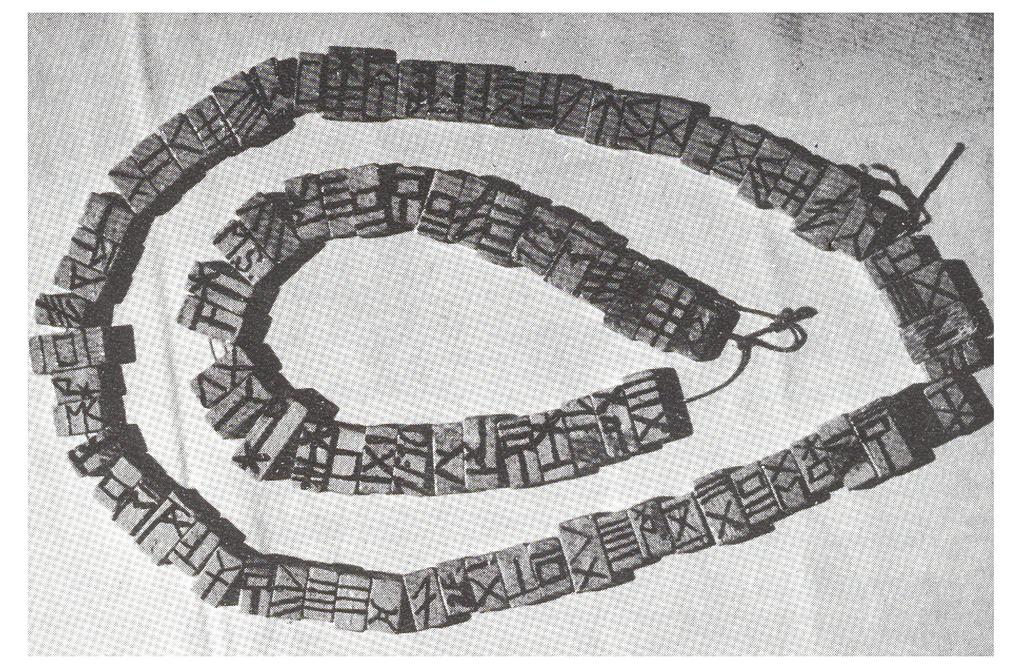
The Gehöferschaft land shared in common were allocated by drawing lots. The lot numbers were engraved on wood-drilled beads, cubes, or tablets, which could be strung on a strap of leather and tied in a circular "Rosenkranz" in the same way as the beads on a rosary were strung and used for prayer (Rosenkranz is the word for rosary). When it was time for a reallocation of the land shares, usually after about five years use by a farmer, the administrator of the Gehöferschaft would unstring the old Rosenkranz, drop the loose cubes or tablets into a hat or some other container, and the new division of land would again be drawn by lot. As each land section cube was drawn from the hat, the new Hausmark was added by painting over or carving away the old symbol and painting on the new Hausmark. Then the Rosenkranz was restrung. The Gehöferschaft community's administrator preserved the "Rosenkranz" until it was time for the next draw.
It was typical that any newly created house marks would show a strong resemblance to the original Hausmark of the family. It was usually a slight addition to the lines or characters of the first house mark in that family. Look at the each Hausmark in the chart above and see if you can find relationships among them. For instance, could there be a set of related family marks in row 5 where there is only one difference between square 2 and square 3. As you keep looking, you will see more possible linked house marks.
Unfortunately, emigrants lost their Hausmark when they sold their Gehöferschaft land before leaving for America so I don't know what the rune-like characters for the farmers Meier or Hauser or Rauls might have been. But since I come from a family of hearty eaters, I think at least one of the Hausmarks might have resembled No. 87 above - a fork!
Sources:
Meyer, Ewald. Irsch/Saar: Geschichte eines Dorfes. 2004
http://schoden.vg-hosting.de/index.php?option=com_content&view=article&id=79&Itemid=104
What is the meaning of Gehöfershaft? With my limited German, I still do not fully understand all the ins and outs of this complicated term which represents a manner of sharing a very large amount of land held in common. According to my research, in a Gehöfershaft, only small areas of land were privately owned, mostly valley meadows, which ensured the farmers a crop even in dry years. The rest of the land, especially land with hedges and oak trees was owned in common. Gehöfershaft is a rare word that cannot be found in German dictionaries of today or even going as far back as the last century's dictionaries. My American second cousin with whom I share Bavarian ancestry and who speaks fluent German, told me he had never heard this word and had no idea what it was. Puzzling indeed, because if you go to a Kreis Saarburg village and visit their museum of historic objects like tools or cooking utensils, you may also be shown (if it has survived the years) the village's Rosenkranz (rosary) and given an explanation of what it was. And yes, the word "Gehöfershaft" will be used over and over in that explanation.
However, the Gehöferschaft method of land sharing exists in only a few areas of Germany, including Kreis Trier and Saarburg and also much of the Saarland. If your ancestors, like mine, were landowning farmers in these regions where the Gehöferschaft land system existed, they would have a specific house mark (Hausmark) for the farm. The mark that identified their "Haus" (house and barn were in one building) was rather like the coat of arms used by royalty. It plainly meant, "this possession is mine and here is its unique symbol that proves its descent."
In his book on the history of Irsch in Kreis Saarburg, Ewald Meyer writes that a basis for the long existence of the Gehöferschaft land-sharing system in Kreis Saarburg (until almost the 20th century) might just be the lingering survival of the house marks. In 1853 there were still a multitude of house marks, 137 in Irsch alone as shown in the chart above. This means that 137 landed farmers had shares in (belonged to) the Gehöferschaft.
Originally Gehöferschafts rights were assigned to a farmer and identified by the Hausmark. Research shows that these Hausmark identifiers are ancient kinship characters and were passed from father to oldest son. After Napoleon changed the inheritance laws when he brought Kreis Saarburg into the French Republic, all the children of a family now were allowed to inherit an equal share of the family's possessions. This law remained in force under Prussian rule. It also complicated the Gehöfershaft/Hausmark system. Originally, the shares of the Gehöfer land were equal in size/value. With the introduction of the French law, the Gehöferschaft shares had to be sized into smaller sections and it was not always possible to keep the land share sizes completely equal. Also new Hausmark symbols had to be created.
The Hausmark was not only used to show land boundaries. It was also a property mark carved or painted on possessions or branded on animals. The unique mark sometimes decorated a house's door lintel. They could be used on contracts and documents when the signers were illiterate. Most of the marks consist of rune-like images. Letters are in the minority as you can see on the Gehöferschaft chart of Irsch in the illustration above.
 |
| Rosenkranz for the village of Schoden |
The Gehöferschaft land shared in common were allocated by drawing lots. The lot numbers were engraved on wood-drilled beads, cubes, or tablets, which could be strung on a strap of leather and tied in a circular "Rosenkranz" in the same way as the beads on a rosary were strung and used for prayer (Rosenkranz is the word for rosary). When it was time for a reallocation of the land shares, usually after about five years use by a farmer, the administrator of the Gehöferschaft would unstring the old Rosenkranz, drop the loose cubes or tablets into a hat or some other container, and the new division of land would again be drawn by lot. As each land section cube was drawn from the hat, the new Hausmark was added by painting over or carving away the old symbol and painting on the new Hausmark. Then the Rosenkranz was restrung. The Gehöferschaft community's administrator preserved the "Rosenkranz" until it was time for the next draw.
It was typical that any newly created house marks would show a strong resemblance to the original Hausmark of the family. It was usually a slight addition to the lines or characters of the first house mark in that family. Look at the each Hausmark in the chart above and see if you can find relationships among them. For instance, could there be a set of related family marks in row 5 where there is only one difference between square 2 and square 3. As you keep looking, you will see more possible linked house marks.
Unfortunately, emigrants lost their Hausmark when they sold their Gehöferschaft land before leaving for America so I don't know what the rune-like characters for the farmers Meier or Hauser or Rauls might have been. But since I come from a family of hearty eaters, I think at least one of the Hausmarks might have resembled No. 87 above - a fork!
Sources:
Meyer, Ewald. Irsch/Saar: Geschichte eines Dorfes. 2004
http://schoden.vg-hosting.de/index.php?option=com_content&view=article&id=79&Itemid=104