Showing posts with label Christmas Customs. Show all posts

Monday, December 28, 2015

SAINT SANTA CLAUS

Why St. Nicholas puts candy in boots and steals our hearts

Picture rom Deutsche Welle

Before I left on a trip to visit the Christmas markets of Bavaria and Austria in mid-December, I had hoped to have time to finish a Christmas holiday blog post.  Lacking packing organization, I got behind and had to put my good intentions aside.  Therefore, this post is appearing after December 6, the feast of St. Nicholas, and is even late for Christmas.  But the article in the blog I found for Germany's  Deutsche Welle broadcasting is so much fun and so full of information that it should be spotlighted, even if read in January.  There is always next year to be sure of a gift on St. Nicholas Eve and an understanding of how the saint became a kind of Santa Claus.

When I came across the above mentioned Deutsche Welle blog post, I was looking for information on what I should do to make sure St. Nicholas brought me something this year.  Because of our mixture of cultures in the United States, we have no hard-and-fast rules for St. Nicholas Eve. My ancestry is German, and I found the answer I wanted about the Germanic customs - although too late.

I also learned what kind of receptical (shoe, boot, etc.) the generous saint fills in other European countries. The title of the wonderful DW article is above their blog's picture ("Why St. Nicholas puts candy in boots and steals our hearts").  The explanation is so well written that I suggest you use this URL, http://www.dw.com/en/why-st-nicholas-puts-candy-in-boots-and-stole-our-hearts/a-18889948 to read a smile-producing account of the Saint who has been awaited by children for centuries.

I wonder if St. Nicholas will forgive my blog tardiness and give me another chance to share in his generosity next year?  What do you think?


Friday, December 12, 2014

Christkind Decorates the Christmas Tree

The Christkind Brings the Ice Apples to decorate the Christmas Tree
Wreath made with ice apples (Eisapëfl)

I've written on a Christmas topic ever since I began my blog posts. There are things that I am rather unsure about, especially the arrival of the Christmas tree in my ancestors' homes. It is almost like searching a genealogy. Just where was the original Christmas tree conceived and, over the centuries, when did that tree's descendants move to other countries, then cross the oceans and emigrate from Germany to the rest if the world?  Progress equals brick wall - I still have no idea if my great-great grandparents had a Christmas tree in the years before they emigrated. I like to think they did.

Some sources say that the Christmas tree developed from a pagan tradition which was adopted by Christians as a holy symbol. The custom does seem to have started in northern Germany and then spread south, having been a matter of contention between Lutherans and Catholics for a time.  That's not very specific, is it.

This year the book, "Inventing the Christmas Tree" came to my attention.  It didn't solve the puzzle for me, but I have chosen a few interesting facts about the Christmas tree and its decoration, although I'm no closer to knowing the exact date of the Christmas tree custom in Kreis Saarburg.

The Tree

Many of thee common folk, I read, had no separate parlor room for a Christmas tree and in 17th and 18th century many hung the tree from the rafters although it was hard to light the candles if the tree was hung upside down. This custom seems to have originated in Slavic countries, such as Poland.

For those Christmas trees that that were placed on the floor, a tree stand of some kind was needed. Some of the methods used for this were: a wooden cross painted green or covered with moss or stones where a hole had been drilled into the center of the cross pieces, a stool with a hole in it, a tub of water or a bucket with wet sand, In times of adversity.  Some wedged the trunk into the hub of a cartwheel or cut a rutabaga in half and drilled a hole to accommodate the tree. In the 1860s, cast iron stands became more common, shaped to resemble gnarled roots.

Decorating the Tree 

According to a story from the Lorraine region of France, a variety of apple is cultivated in France in the Alsace and Lorraine regions as well as in the Rhineland area of my ancestors. It is known as the Christ's apple (Christapfel) or ice apple (Eisapfel), and this fruit traditionally was used to decorate the Christmas tree since it was red and lasted well through the winter.

In 1858 a drought in the Alsace region caused the ice apple harvest to be lost. The famous glass blowers of the 18th and 19th century from Meisenthal in Lorraine took the opportunity to make red glass spheres of the same size that could be used on a tree instead of the apples.

It is also possible that the origin of such ornaments can be found in the Thuringian forest. There the craft of blown glass can be traced to the beginning of the seventeenth century, when immigrants from Bohemia built their first huts."

The Red Eisapfel

Origin: very old, widespread apple type from Germany
Other names: Heart apple, Christ apple, ice apple, red warrior
Uses: Eating, cooking, dried.
Fruit: Midsize to large, color gold-green, turning a dark red if left on the tree long enough. 
The taste is sweet as the apple ripens from October to January 

Whether you have a fresh tree covered in red glass balls or some other beloved decoration in your home this year, it is my wish that your Christmas is as filled with pleasure as those of old when the Christkind brought the Christmas tree and decorated it with red apples.

Sources:
Inventing the Christmas Tree by Bernd Brunner, 2011
Christmas in Alsace by Jean-Claude Colin and photos by Christophe Hamm
 www.oekopark-hertelsleite.de/wiese.htm
Pictures
Christmas in Alsace by Jean-Claude Colin and photos by Christophe Hamm
http://blackrainbownihon.blogspot.com

Tuesday, December 10, 2013

Christmas Markets of Today and Yesterday


Christmas Market in Stadt Saarburg

This December I was at a loss for an idea that reflected the Christmas Season in Kreis Saarburg.  After eight years of posts about Christmas customs in the Rhineland area of Germany, there wasn't much I hadn't tried to research.  Then I found an article that was brief yet concise, full of interesting details I had not known.  Thus the information that follows is taken from that source.  

In the spirit of the season of the Christmas market, I am including photos from markets which are near to Kreis Saarburg, even though one market is in Strasbourg, France.  After all, a Prussian general once referred to our ancestors as "painted French."  And at the time the Christmas markets developed, German and French citizenship could change from week to week.

The History of the Christmas Market

The centuries-old tradition of the Christmastime markets were joyful occasions for weary villagers and gave them something to look forward to on the long winter nights.  The first Christmas markets were held at a time when regular markets took place throughout the year. The first Christmas markets were little more than winter markets that lasted a couple of days. Instead of the colorful booths that are a part of Christmas markets in our time, traders in some cities just laid their goods out as best they could, sometimes even in the street.  

I found it surprising that as early as the 17th century, gift-buying at Christmas Markets had already become a usual thing.  There is something about the Christmas spirit that opens the heart and also, at times, the purse.

The usual place for the Christmas Market to be found was surrounding a city's church.  In larger cities, the main church was chosen in order to attract the most buyers when residents arrived for the services.  According to the writer of the article I am using as a basis for my post, a priest in Nürnberg in 1616 complained that he did not hold the afternoon service on Christmas Eve because no one attended.  They were waylaid by the Christmas market.

The same article says, "It is likely that the Christmas markets drew more visitors when religious reformer Martin Luther instituted new customs for Christmas.  Before Luther, the exchanging of presents took place on the saint days of St. Nicholas, December 6, or of St. Martin, on November 11.  It was Luther who suggested that children receive presents from “the Christ Child,” hence the name “Christkindlsmarkt” (Market of the Christ Child), a popular name for many Christmas markets especially in the south of Germany."

In the past, only local tradesmen were allowed to sell their wares at the city’s market, which led to the distinctive regional character of today’s markets.  Because in the past each region had its own customs and needs, Christmas markets have continued to focus their wares in that direction, giving each market a distinctive air.  They specialize in "local delicacies and traditional products." 

Beyond the commercial aspect of the markets, they have another function: a cheerful, high-spirited place for local residents to meet as well as a place to sell their homemade crafts, decorations, and ornaments.

The items in the Christmas market in each city are not all unique, or course. There are traditional German handicrafts that can be found at nearly every Christmas market.  There have to be nutcrackers, wooden figurines, straw stars and smokers as well as the iconic cookie tins, glass balls, toys, and tin tree ornaments.

Since most of us will not have a chance to tour these Christmas markets, here are some photos taken at regional Christmas markets by the photographers listed below:


Christskindl Market in Stadt Saarburg

At the Saarbrucken Christmas Market
'

Saarbrucken Market


Strasbourg's Famous Christmas Market

Strasbourg Market at night


Market is next to Strasbourg Cathedral still!

Strasbourg Market classic items


Delicious Bakery in Strasbourg


Trier Christmas Market closeup


Trier Christmas Market in the market square

The Joy of the Trier Christmas Market 

Merry Christmas Wishes from the Singleminded Offshoot!


Source: 
http://www.germany-christmas-market.org.uk/christmas_in_germany.htm

Pictures: 
Trier Volksfreund Täglischer Newsletter 
Josiane of Lorraine
City of Trier Webpage

Thursday, December 06, 2012

Christmas Traditions Cross the Ocean

My favorite Christmas Tradition


Over the past seven years of this blog, I have researched and shared many Christmas customs of the people who lived in Germany in the 19th century, especially those in the Rhineland. This year I wanted to write about the customs I can identify as German that carried over to my own family's Christmas.  Most of them originated in Catholic Germany, either the Rhineland (Dad), Bavaria (Mom) or the western edge of Bohemia (Mom and Dad).  I'm sure there are other traditions that are equally German and which I know nothing about, but these are the Christmas memories that were dear to us and which became part of our holiday customs, passed down when the ancestors immigrated to Wisconsin.  These German Christmas rituals were still a part of our observances approximately 100 years later.  At that time, when my sister and I were children, or as the Rhineland ancestors would have called us, "little mice", we had no idea that we were participating in preserved German Christmas traditions.
The First Sunday of Advent

The First Sunday of Advent was a very important part of the Christmas celebration in Germany's Catholic and Lutheran Churches in the nineteenth century. The German language word often used to describe Advent is vorfreude, literally "before joy," and that was what I remember about the Advent time when I was a child. The German Advent began on the first of the four Sundays before Christmas. During our childhood, about 100 years after our ancestors' immigration, Advent still maintained its importance. It was a time of anticipation, of getting ready for joy, for a celebration. There were no Christmas buffets, get-togethers, or holiday parties during this time.  Even weddings could not be held without express permission of the bishop of the Catholic diocese.  Nothing should take away the feeling of vorfreude.

The Advent wreath, I have learned, was much more common in the Evangelische (Lutheran) Church and the lighting of one, two, three, and finally the 4th candle was a religious observance for the children and the adults alike. The wreath had a place of honor in the home. That tradition did not follow my ancestors to the new land since they were Catholic but the Advent wreath is still very much a part of the Advent season in German homes. Only in the last several years have many American Catholics adopted the tradition of the wreath in the home; but it was not a part of our childhood Advent customs.

Hard Pfeffernuße also known as peppernuts
Christmas baking was a part of Advent in the 19th century. When it began, there would be much excitement as the aroma of cookies in the oven filled the air. The cookies were known as Plätzchen in Germany; a century later Christmas cookies were still being baked during our Advent time. They were sampled, sometimes more than necessary, but then they were put away in tins until Christmas arrived - just as in the German villages of one hundred years before.  In Germany of old, a large plate of the goodies baked during Advent was placed on a table in the Stube.  It was known as the Bunte Teller, the colorful plate of Christmas treats that was very much a part of Christmas Eve.  In our Christmas in Wisconsin, I don't remember a special plate of cookies near the tree, but the cookies did come out of the tins after Santa Claus had trimmed the Christmas tree.

To me, there is one recipe that the most nostalgic cookie - our mother's, grandmother's and Aunt Lillian's Christmas Pfeffernuße, all of which must have originated from the same recipe. They called these little, very hard cookies peppernuts, but they were not at all like the Pfefferrnuße that I have since purchased in German-based stores like Aldi or World Market.  There is very little history for the origin of either the soft or the hard variety of Pfeffernuße.   A Wikipedia article traces the hard variety to Germany, Denmark, and Holland.  I have also seen a web article that says the hard peppernuts were made by German Mennonites.  Discussing the question with friends, one remembered having the hard variety in the home of a neighbor of Bohemian descent.  Nowhere can I find a clue to the origin of the soft variety, made without nuts or pepper.  Recipes just say they are of German origin (something like saying hush puppies are native to North America). Our Dad especially enjoyed the hard peppernuts, and I've never come across them on anyone else's cookie platter. I had planned to share our mother's recipe but since there is no clue about oven heat, yield of batch, or how much flour to add to make the dough "real stiff," (and I've never tried to make them) you may be better off searching for the recipe, which has many variation.  Search for "Pfeffernusse, hard" on Google or Bing or trying the recipe given in the first comment on this blog post.  That one has measurements!

St. Nicholas Eve always falls during the Advent time and was celebrated in Germany, Holland, Belgium, and in the parts of France that are close to Germany's western border. I've written about the German customs in Nikolausabend/St. Nicholas Eve.  This custom partially remained a part of our family's Christmas tradition a century later. Both my sister and I believed in St. Nicholas when we were little, and were excited as darkness came on December 5.  Our Dad played the part of St. Nicholas. He didn't dress as the Saint and there was no Knecht Ruprecht. All Dad had to do was come to the front door, knock authoritatively, and shake the real sleigh bells that came from an old sleigh. We didn't want to go to the door; we waited until enough time had passed for St. Nicholas to be on his way elsewhere. Then we carefully opened the door and there was a paper bag with candy (chocolate and hard candies) and nuts.  I'm grateful that we were spared the experience of our Aunt Helen, who fainted when St. Nicholas came into the parlor at her grandparent's house.  I imagine St. Nicholas  (a friend of grandpa's) had never expected such a reaction.

Trimming the Christmas tree would never have occurred before December 24 in our ancestors' time - if they had a Christmas tree.  If your ancestors were middle class or royalty in Germany, undoubtedly there would have been a legally acquired Christmas tree waiting to be trimmed on the evening of December 24. However, even experts who have written about Christmas traditions seem unsure about who among the lower classes - farmers, craftsmen, day workers in smaller villages - had a legal Christmas tree. (Some people did cut them illegally in forest lands that were administered by a representative of the Prussian Government in the Rhineland).  One hundred years later, the Christmas tree (legally acquired) was an integral part of our Christmas in Wisconsin, even though our ancestors may not have been able to obtain one. Like its predecessors, it was never decorated until the evening of December 24.  If our ancestors did have a Christmas tree, the children were told it was decorated by the Christkind who may or may not have left gifts, depending on the part of Germany in which they lived.  Our Christmas tree was decorated by Santa Claus, and he left unwrapped Christmas gifts, not having time to do all that wrapping for all the children all over the world.

The Christkind vs. St. Nicholas. The Christkind who brought sweets or gifts, most historians believe, was an attempt by Martin Luther to put more emphasis on the birth of Christ rather than on St. Nicholas.  It was successful in the part of Germany that was Lutheran.  Gradually Catholic parts of Germany also adopted this idea of the Christkind without giving up the idea of St. Nicholas as a gift giver. Catholic Bavaria still uses an angel with golden wings to represent the Christ Child. However, the Rhineland, which I am primarily writing about, has kept the identity of their 19th century Christmas gift-bringer a secret from me. I must settle for a sentence often found in books on Christmas in Germany: "While some parts of Germany kept their belief in the Christkind, others maintained the St. Nicholas tradition until the middle of the 20th century." My sister and I received our Christmas gifts from Santa Claus and knew nothing of the Christkind.  Was this a Germanic tradition combined with an American poem called "A Visit from St. Nicholas" by Clement Moore.   Although the Christkind angel did not bring our gifts, we had an angel with golden wings at the very top of our Christmas tree. Today's Germany does have a Weihnachtsman (Christmas man). How the Christkind fits into their Christmas I don't quite understand, and also it is beyond the scope of this post.

Between December 26 and January 6 was the time when the Christmas cookies and candies were eaten. Christmas visits to relative and friends were made, and the Christmas baking was passed around.  About 100 years ago, it was a time when the villagers in German villages, most of whom were related at some level, exercised the Christmas tradition of Christbaumloben (Christmas tree praise) where people visited each other and complimented the decorated trees.  A shot of Schnapps was served by the owner of the tree.  In our childhood, we joined our parents in admiring the Christmas trees of our relatives and friends.  A mixed or soft drink replaced the Schnapps and later an informal meal of cheese, sausages, breads, pickles and a dessert was served, often the fourth meal of the day.

The celebration of Christmas lasted until The Feast of the Magi, sometimes called Three Kings Day.  The German customs that went with it did not last until our time.  Were they ever practiced in earlier times in the communities and the outlying farms in Wisconsin?  I don't know.  The tradition of marking the door lintels with chalk and blessing the house with holy water was unknown to our family 100 years later.  Our tradition was much simpler.  The youngest child went to the Christmas nativity scene, which was under the tree or on a table, and moved each of the Magi and the one camel to a position right in front of the manger.

Many of the Germanic traditions of my youth are disappearing.  Advent is now hardly observed except in churches; Christmas celebrations go on all during the month of December.  I miss the building excitement of a quiet Advent, and I also feel rather sad when I see a discarded Christmas tree, sometimes wrapped in plastic, out on the curb on Dec. 26.  Mine stays around much longer!

Advent Vorfreude and Merry Christmas wishes to all.

Sources:
Ollinger, Josef, Geschichten und Sagen von Saar and Mosel
http://en.wikipedia.org/wiki/Pfeffernüsse
http://www.mygermancity.com/german-christmas-traditions

Saturday, December 01, 2007

Christmas in the Kitchen


Savoring the aroma of Christmas baking and the Christmas dinner roasting - it is a part of Christmas for most of us. So it was for our ancestors in the Rheinland.

Plätzchen and other Weihnachtsgebäck

The "Adventskalender Lufthansa", published in 1986, was a Christmas gift from my aunt who loved the idea of German ancestor searching as much as I do. There is one glorious picture of Christmas cookies or candy for each day of December. On the reverse side of the picture, there are two recipes, one in German and one in English, for making traditional Christmas delicacies from many parts of Germany.

The introduction reads: "Everywhere in Germany, home baking is as much a part of the Christmas festival as are the brightly decorated Christmas tree and Father Christmas with his gifts for the children. Christmas baking reaches its high point when the children receive their gifts on the evening of 24 December. When the Christmas tree is brilliantly illuminated, the presents on the traditional table of gifts will include a colorful 'bunter Teller', a plate overflowing with all the fragrant cookies and cakes that have been baked in the weeks preceding the festive season." As you can see in the picture above, there is a large "24" on the last page of the calendar and a "colorful plate" of mouth-watering Christmas delights.

Whether in 1986 or 1868, Advent is/was the time for Christmas preparation. On an evening when the skies shimmered red in the Hunsrück, the children were told that "they are baking cookies (Plätzchen) in heaven." This baking was not to be done alone. God's children, especially the young ones, must help. Usually it was the grandmother who got the children busy, rolling out dough and shaping the Plätzchen for the oven. The children were happy as they worked because they knew that when the cookies came out of the oven, there would be a chance to sample. But the cookies were soon put in tins because they were to be eaten on Christmas eve and Christmas day.

There were many kinds of cookies baked in the Hunsrück. Most used simple ingredients that a farm family could produce through their own labor. Weihnachtsgebäck was a Christmas sugar cookie, very similar to the kind still made today. The dough was rolled thin and a glass, usually a wine glass, was used to cut out the cookie. It was pierced with a fork or needle to make a decorative pattern, then egg yolk was spread on it so that the cookie would bake golden brown. In a tightly closed can, these cookies would keep for a long time. Another was called a Honigküchlein, a little honey cookie that used sugar, flour, honey, eggs, and egg yolk. The flavor could be varied by using cinnamon or clove or ginger. By the end of November, the baking of Lebkuchen had begun. Nussküchlein or little nut cookies used butter, sugar, egg, hazelnuts, cinnamon, and flour. After the dough was mixed, it was cooled so that it could be shaped like very little Brotchen (rolls), spread with egg yolk and baked on a well-oiled pan.


In early times, the Christmas tree was decorated with the baked sugar cookies and with apples, nuts or straw handmade ornaments. In the Hunsrück, as well as many other parts of Germany, it was thought that on the holy eve of Christmas the animals in their stalls could talk with each other. It was a custom for farmers in the Hunsrück to put hay, rye, wheat, oats, barley, bread and water in front of the house door. They believed that if the water and fodder was given to the animals on Christmas morning, and if the bread was eaten dry by the farm family, sickness would be kept away for the rest of the year.


Christmas Day Goose

The traditional Christmas dinner for the Hunsrück farm family was a stuffed goose raised on the farm. The stuffing for the goose was made with butter, eggs, onion, wormwood, nutmeg, as well as the heart, liver, and stomach of the goose, apples and potatoes or shelled boiled chestnuts. After all the ingredients were chopped and mixed, the goose had to be washed. The feathers and fine little hairs were singed off. It was salted well inside and out and the filling was put in a hole in the stomach. When this hole was sewed shut with strong string, the goose was placed in a big iron pan. First it was laid on its breast for an hour of roasting and then the fat was drained and the goose was turned and roasted for another half hour. It was basted with water or beer a few minutes before the goose was removed from the oven to give it a good crust. A sauce or gravy, thickened with flour, was made from the drippings (the beer gave added extra color).

The kitchen was the heart of the 19th century home at most times, but especially during Advent and on Christmas Day.

Ratsch, Christian, Weihnachtsbaum und Blutenwunder, 2003
Adventkalender Lufthansa, 1986
Schabel-Becker, Christiane, Das Schinderhannes Kochbuch, self published,1985

Friday, January 13, 2006

Nikolausabend/St. Nicholas Eve


This song about the much anticipated arrival of Saint Nicholas comes from the Hunsrück area of Germany


In my post about some significant holidays in the Christmas season, I did not mention St. Nicholas Day, or «Nikolausabend», perhaps because it was so familiar to me. This was not a little known saint's day in my small, German-American town. On the evening of December 5, St. Nicholas always came. Dad would knock on the door and ring sleighbells. He didn't dress up as St. Nicholas because he knew I was too scared to go to the door when he knocked. I would quiver with a mixture of fear and excitement and pray that my mom would not open the door until the good saint had gone on his way. By the time Mom looked outside, St. Nicholas had disappeared, leaving a brown paper bag filled with candy on the doorstep.

Ernst Mettlach, who grew up in the Trier region, says that as a child, St. Nicholas eve, the "Nikolausabend" was a major event in the year. He left that comment about my "The Magi and More" post, telling me that he wished the feast of St. Nicholas had been included. Since Ernst provided me with some very good information and photos as well, and because "Nikolausabend" is such an important German holiday, I am writing about it as a separate post, rather than slipping it into my original post.


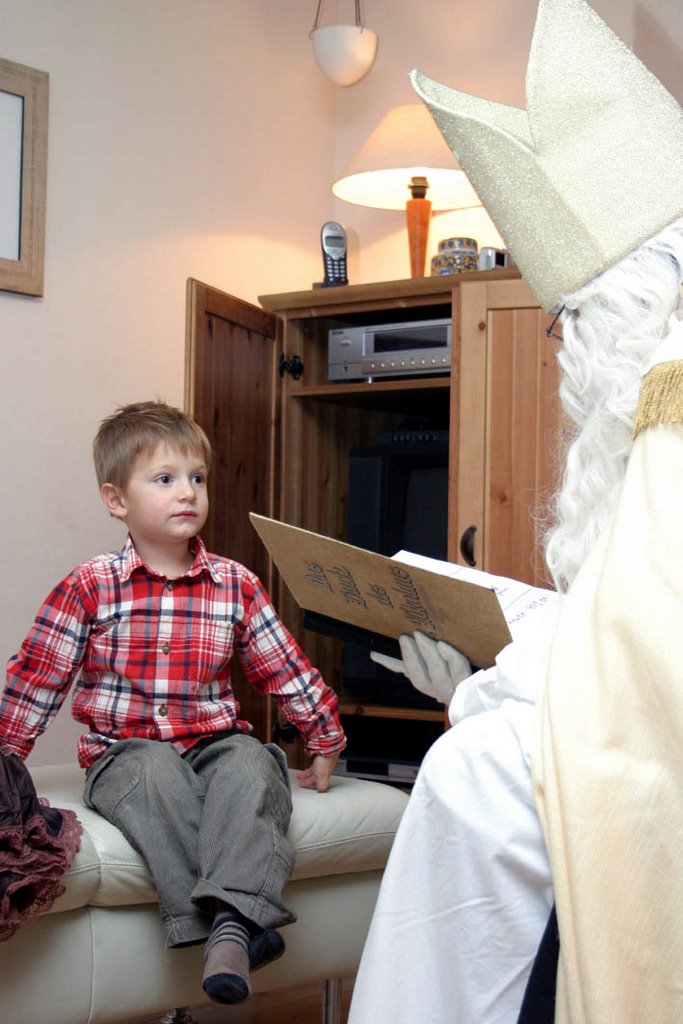
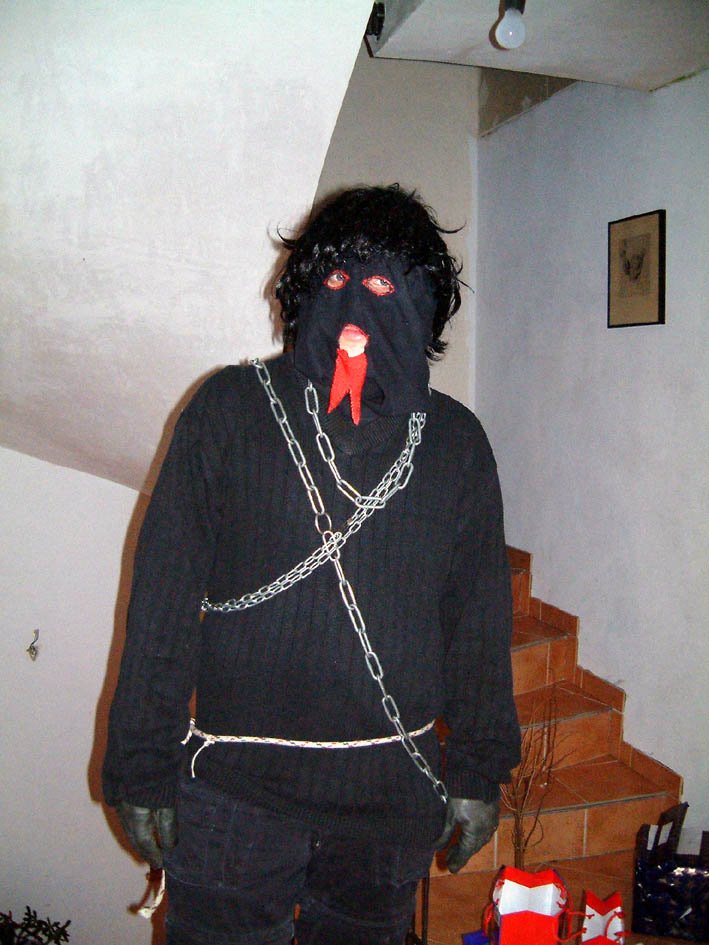
FROM ERNST: On the evening before 6th December, a man dressed as the holy bishop St. Nikolaus, sometimes accompanied by one or two angels, and the "Pelzebock", who is a fierce looking fellow dressed all in black, would go from house to house visiting the children. The "Pelzebock" - the word comes from the bible word Beelzebub (Mt 12,24, Mk 3,22, Lk 11,15), was a god of the Philistines. He is considered the highest demon or devil in the bible. (In other German regions the "Pelzebock" has names such as "Knecht Rupprecht," "Budelfrau", "Krampus", and "Pelznickel". The Pennsylvania Dutch in America called him "Belsnickel".)

The "Pelzebock" is the servant of Nikolaus, and the chains around his chest reassure the children that he is tamed. He carries a sack with presents and birch sticks inside. Usually he waits outside of the door and only comes in to hand out the presents. He has a big book in which are counted all the good and bad things the children have done throughout the year. Tradtionally, he brings a "Nikolausteller" ("Teller" is the German word for plate) or "Nikolaustuete" (a "Tuete" is a cone-shaped paper bag), filled with sweets, nuts and oranges, for each child. The children are asked to sing Nikolaus songs and recite Nikolaus poems.

SOME ADDITIONAL BACKGROUND:
"Der Nikolaus", as he is called in Germany, is said to have been the Bishop of Myra in Greece in about the 4th century. The historical Saint Nicholas was venerated in early Christian legends for saving storm-tossed sailors, defending young children, and giving generous gifts to the poor. Many of the stories about Saint Nicholas are of doubtful authenticity. One of the legends that grew up about him was that he helped a father and his three daughters who were too poor to have a dowry. The father was about to turn his daughters out on the street to make a living. The kindly saint, on three consecutive nights, entered their home in secret, leaving a gold ingot on the hearth so that each daughter could have a husband. In variations on the story, the saint dropped the gold down the chimney and it landed in the shoes on the hearth or in the stockings that the girls had hung near the chimney to dry. Over the centuries, these legends spread throughout Europe, emphasizing the saint's role as a traditional bringer of gifts on the eve of his feast day, Dec. 6. Martin Luther, hoping to put emphasis on the birth of Christ instead, initiated the custom of gifts brought by the "Christkind" (Christ Child) on Christmas Eve rather than the Nikolausabend gifts. But the saint, who was called Sankt Nikolaus in Germany and Sanct Herr Nicholaas or Sinter Klaas in Holland, prevailed as a gift giver, and the Nikolaus gift-giving tradition survived the Reformation. In Germany St. Nicholas is portrayed wearing a bishop's robes and the tall miter headdress. He carries a crozier, the hooked staff which symbolizes his office as a shepherd of men.

Saturday, July 23, 2005

A Visit to the Zerf Heimat Museum - Conclusion

The following section ends my information about the Zerf Heimatmuseum. It contains a description of miscellaneous artifacts not covered in the other posts. Just like the other entries I have posted, these artifacts may help paint a better picture of daily life in the village of Zerf and/or of the many other small villages near the Saar and Mosel rivers.

As I explained in my first post on the Zerf museum, the descriptions below without parentheses are my translations from the German language museum guide I received as a souvenir at the time of my visit. Anything in parentheses is additional information gleaned from other sources which I hope makes the original description a bit clearer.

Now back to the museum


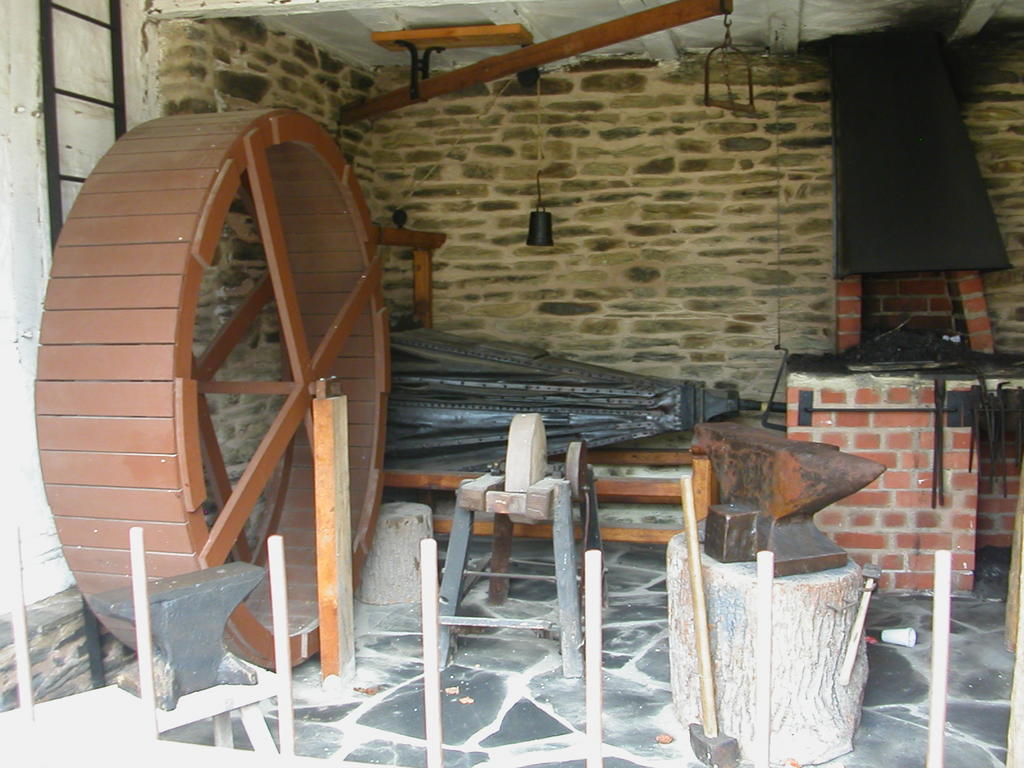
In the blacksmith's shop one can see the forge with the bellows, anvil, hammers, pliers, a bending machine for bending the eisenreifen (iron wheels) for the farm wagons. (According to the book, Serrig: Landschaft, Geschichte & Geschichtenby Klaus Hammächer, a dog could be trained to run inside the wheel shown in this picture. As he ran, he powered the bellows and the flame of the forge. The picture was taken at the Roscheider Hof open air museum near Konz)

Trumpets were used by Schweinehirt (swineherds). At the sound of the trumpet, the farmer opened the pig stalls and the Schweinehirt drove the pigs into the oak forests and guarded them there. In the evening the Schweinehirt brought them back with the trumpet signal. On the Feast of St. Martin (November 11) the Schweinehirt received a measuring beaker/cup full of grain for each pig under his care. (St. Martin's day was also the traditional time to prepare for winter by slaughtering pigs, geese, and other animals since they would soon be unable to forage for food and would have to be fed by the farmer)

The half Vierzel was a measuring instrument for grain. In former times the grain was not weighed; it was measured with this container. Four half Vierzel 'filled not too much and not too little' ( leveled?) equaled one hundredweight of corn, barley or wheat. Six half Vierzel made up a hundredweight of oats, because oats is finer. In earlier times, the teachers in the village were often also the swineherds, because there was no school in the summer (when the pigs could roam). School was held from St. Martin's Day to Easter.

One could distinguish cow, sheep and goat bells by the different tone qualities.

The small Nicholas bells were used by the adults to make the children aware of the feast day some weeks before it arrived. They rewarded the children's obedience by putting small gifts at the door on St. Nicholas Eve

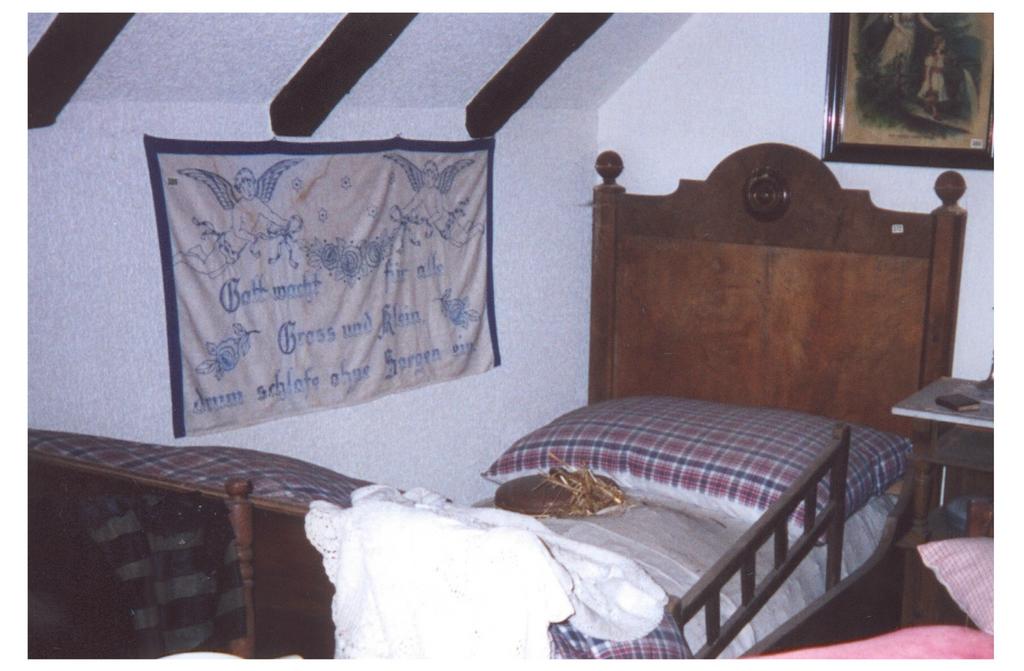
In the bedroom we see the straw filled mattress, the pillow filled with grain chaff, and the feather bed. (The villagers made use of almost any part of the crops that they grew, even in the bedroom. For instance, small pouches were filled with grape seeds and could be heated to ease pain, much as we can relax tight muscles by using the same sort of pouch and heating its "magic crystals" in a microwave. These grape seed pouches are still sold at the "Golden Autumn" festival and market in Saarburg)

The broad low-lying wooden box sled was, in former times, a popular plaything for the children during the long, snow-rich winters.

Kleppern (wooden clappers) and Raspeln (a rattle-like wooden device which rotated and made a rasping sound when shaken by its long handle) replaced the bells during Holy Week when bells could not be rung on Good Friday and Holy Saturday.

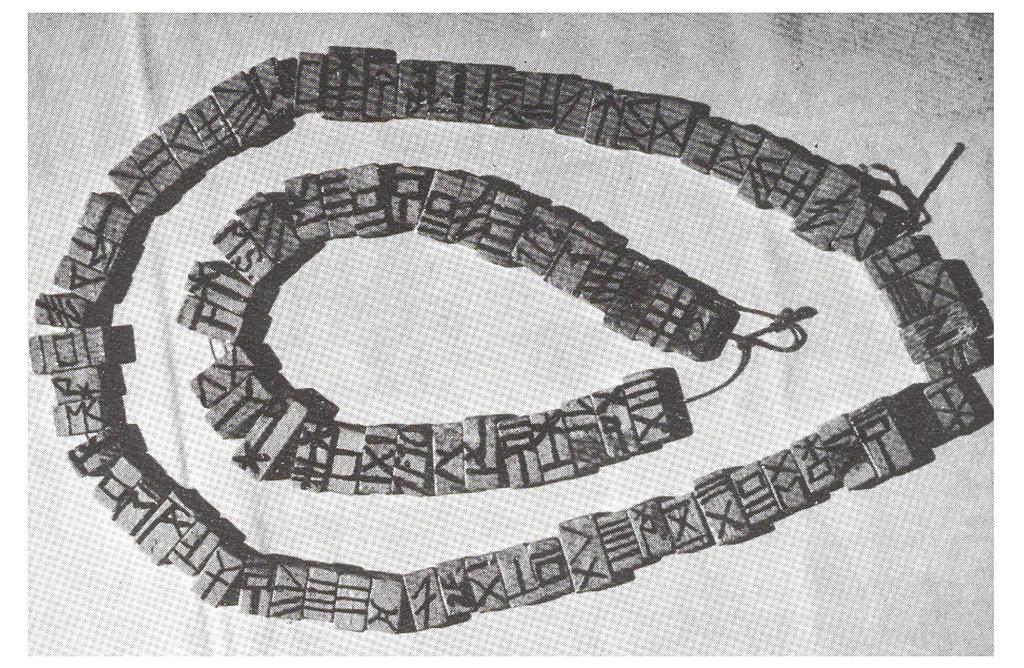
This is the Rosenkranz on which the house sign and hedge land identifiers for the Gehöfershaft were placed. These blocks were drawn in a lottery for distributing the Lohhecken among the farmers in the Gehöfershaft. (Above is a photo from Der Hochwaldort Zerf am Fuße des Hunsrücks, by Edgar Christoffel, c. 1981, Verlag W. Rassier, D5510 Saarburg. It shows wooden blocks with symbols which are rune-like rather than alphabetic characters. This Rosenkranz, the German word for rosary, served as a sort of plat map for the hedge lands which belonged to the entire community of land-owning farmers. In the Saar and Mosel region these landed farmers were usually referred to as a Gehöfershaft. A symbol identifying each section of the hedge lands, sections which were especially valuable for the oak tree bark stripped for tanning, was painted on one side of each small wooden block. Then a lottery was held. Each farmer in turn drew out a wooden block containing a hedge land symbol. His distinctive house mark could now be painted on the other side of the wooden block and the section was his to work until the next lottery was held. When the lottery was completed, the blocks were strung into the Rosenkranz and probably kept by the mayor of Zerf. In Zerf, this lottery took place every five years. The neighboring village of Irsch had a similar Rosenkranz, according to the book Irsch/Saar: Geschichte eines Dorfes, by Ewald Meyer).

The kitchen utensils and the farm equipment are described in Part 2 and Part 3, the other parts of this amazing visit to the past.