Showing posts with label pigs. Show all posts

Wednesday, November 12, 2014

The Pig Herder

Bremen square gives a tribute to the pig herder


To try to hang on to my German vocabulary when I haven't had a chance to speak it or review a practice tape for some time, I picked up a book that is at least somewhat close to my reading level, Geschichten und Sagen von Saar und Mosel by Josef Ollinger. Once again, I learned something new and I wanted to share it with you.

The chapter I chose to read was full of facts about a job that Olinger says was considered one of the four most useful occupations in any Rhineland village. This is the order of their worth: Pastor, teacher, mayor, herder. The first three did not surprise me, but I had not known that a sheep, pig, goat or cow herder held such an important post. If you discovered that your ancestor was a pig herder, you might make the mistake of thinking his was a lowly position. To the contrary, herders were valuable and respected for what they did.  They were the farmers' insurance that their animals were cared for in a way that assured these assets would thrive. All of them depended on the herders to find good foraging spots for their animals and guarded them from any form of danger.  So important were these herders that they were entitled to special rent-free dwellings, "Hertenhaüsern" (herder houses), for themselves and their families. They were also provided with a small piece of land for a garden.

In the 19th century, especially the first half, all but very tiny villages had a herder for each kind of animal. Hence the occupation "sheep herder, goat herder, cow herder, pig herder" can be found in the pages of church baptismal records which usually list the occupation of the father of a newly baptized child. The occupation of herder was one that was often passed from father to son.

The work of the herder was seasonal. It was not unusual for the village teacher to take over the job of herder when school ended in March and the children went to work in the fields. The herder of pigs might supplement his income by doing the fall slaughtering for farmers who had raised a pig for a winter supply of smoked ham and sausage. For this service, the herder received a piece of the meat from each pig he slaughtered.

Many of the herders were gone by the late 1800s, choosing to migrate to the industries in nearby cities. But in the little town of Tunsdorf, which is in Saargau area near Kreis Saarburg, Nikolaus Adler, the son of the former pig herder, kept his job until 1959, when he retired. He felt great pride in the work he had done, especially because, in all the years he worked, he had never lost a pig.

Each year Adler started his work as a herder on March 17, the feast of St. Gertrude,  called St. Gertraud in most of Germany. This saint's' feast day was often associated with the coming of spring. Some examples of Gertraud lore: "A sunny Gertraud's day will bring the farmer happiness. If Gertraud's day is sunny, it is the gardener's delight. If it freezes on the Gertraud day, the land will need 40 more days to warm it enough for planting. If it freezes on Gertraud's day, all summer will be cool."  St. Gertraud's day somewhat resembles groundhog day in U.S.

In his book, Josef Olinger described this last herder of Tunsdorf as a daily presence, walking the village road with a horn he tied around his neck with a piece of rope. There were three different notes that he blew. One was used to signal the pigs to come out to him. At that horn note, pigs left their pens without coaxing and came through the farm yard into the road. From one end of the village to the other, new pigs joined those which had been called out earlier. If a farmer neglected to open their stall, his pigs would push and might break the pen's latch at the sound of that horn call. A different horn note alerted the farmers whose pigs were still in the stable. They knew it was time to open the pen latch rather than risk a broken stall. The third note was one that seemed to calm the pigs as they walked, assuring them that the herder was looking out for their well being.

Male pigs and boars did not leave their pens. They were fed a diet of table scraps and garden root vegetables, fattened as much as possible for the slaughter in the fall.  The sows and the young pigs ate from the meadows and woodlands. They could use their snouts to dig for food in the fields chosen by the herder. There was enough vegetation to sustain them during the summer months. A successful herder like Nikolaus Adler knew the best places for forage.  On hot days, he would look for a spot in the shade to keep the pigs tender skin from the burning sun.  He would try to get permission from the village forester who protected the government's woodland to allow the pigs to search for acorns and beechnuts that had dropped to the ground, a gourmet treat that the pigs loved.

Since pigs are not easy to keep together in a herd, Adler had two dogs that helped him round up a sow or young pig that went astray.  His dogs were rough mongrel types but devoted to their master and to the job for which he had trained them. Even a huge sow with formidable strength did not deter the dogs. One sharp bite to a sow's rump or leg, and the animal hurried to regain the safety of the herd.

In the evening, the herder brought the pigs back to their pens. The older pigs recognized the barn and stable which they had left that morning and trotted to it willingly without any help from the herder.  The very young pigs sometimes wanted to stray into the wrong farmer's pen.  Nikolaus Adler knew his pigs so well that there was never any mixup.  If a piglet strayed in the wrong direction, Adler would call to his dog, "Kastor, get me the little one" and the dog would sort the piglet out and bring it back for delivery to the proper barn. The number of pigs grew smaller until each was back in the pen where it belonged.

On Fetten Donnerstag, (Fat Thursday), which was the Thursday before the beginning of Lent,  Nikolaus Adler was paid, mostly in foodstuffs like meat, grain, sausage, and lard.  Each house that paid him also served him a glass of Schnaps.  I can only assume that the herder had a significant hangover, perhaps lasting until Ash Wednesday.

Photo: http://shannon313.files.wordpress.com/2010/07/img_3287.jpg

Monday, November 14, 2011

On St. Martin's Day, Winter is Not Far Away

Saint Martin's Day Procession, Saarburg 2011


St. Martin's Day, November 11, marked, in former times, the start of winter. It was a day which affected the residents of each village in many ways. It was the time when interest and lease payments were due. This was the origin of the following farmers' saying, "Sankt Martin ist ein harter Mann für den, der nicht zahlen kann." ("Saint Martin is a hard man, for those who cannot pay.") It was a better day for the sheep herders and the servants who received their yearly pay on this day. The geese lost their heads, literally, at the beginning of winter, and the celebration of the feast included roast goose for those families that could afford it. "Sankt Martin ist ein guter Mann, er bringt die Bratgans uns heran," was another farmer's saying that represented St. Martin's Day (Saint Martin is a good man; he brings the roast goose to us).

By St. Martin's Day, the field work and the harvest were finished. I was surprised to learn that in earlier times, Advent began right after St. Martin's Day, with the eating of meat strictly forbidden during the entire period. Therefore, the roast goose eaten on the saint's feast day was the last meat that would appear on the table until Christmas Day and this must have greatly increased the enjoyment of the St. Martin's Day meal.

The custom of the St. Martin's procession is one of the few that is still observed in the current time, as the picture above shows. The children go out with colorful lanterns, following St. Martin on horseback, dressed as a Roman soldier, who leads the parade. At the end of the procession, a giant Martin's bonfire is lit and the children receive
Brezeln, a bread pretzel formed into distinctive symmetrical loops from a long strip of intertwined dough.


After St. Martin's Day, the hard work of the months of harvest came to an end and the cold winter months began. The soil began its yearly rest. Then farmers too could sit near the stove or the fireplace, rest, and enjoy a break from the heavy labor which would not start again until spring.

In the autumn, some of the fruits gathered had been mashed and put in oak barrels to ferment. In the winter came the time to distill or "burn" the fermented fruit into Schnapps. Many kinds were made. The cherries, Mirabel plums and Zwetsch plums made an especially fine Schnapps that would be served on special occasions and feast days. For every day, a Schnapps made of pressed apple peelings called "
Balesch" was a drink for workdays. A typical farmer would drink Balesch each morning after his breakfast. It was meant to protect against every kind of illness. If a person had a stomach ache, not the doctor but Balesch was the prescription.

When the weather was cold enough to freeze, the farm's pig was slaughtered for the family's winter food. Often the village butcher would come to the farm to make sure that no scrap of this valuable animal was wasted. The farmer's wife had already filled the large pig kettle with water and heated it on the fireplace. The pigs legs were bound together and the animal was dragged into a pile of clean straw. The butcher knelt down on the pig as it struggled to avoid the sharp pointed knife but in vain. The butcher made a cut from the throat to the heart and the farmer's wife caught the flowing blood in a large pan. Then the pig was covered in straw which was set on fire, burning the bristles from the pig's skin. The pig was pitch black as the fire was extinguished and his carcass was lifted on to the butchering table.  Any remaining bristles shave off and washed with the hot water that had been heating in the kitchen. It took more than one man to lift the pig's carcass and hang it on a ladder which leaned on the outer stable wall. The housewife then carefully cleaned the inside of the carcass, and it was left there until the rind or outer skin would harden with the cold.


The following day, the butcher returned, cutting the pig into pieces to be smoked, made into sausages or eaten fresh.  Even though the farmer's wife had previously felt compassion for the animal she had fed and tended throughout the year, now she could not but be happy as she thought about the tasty ham, bacon, fresh meat and sausage that she would put on the table for her family during the winter months.

Many cellars were made of stone which was an especially good place to store the winter supply of produce that was the result of months of hard work growing and harvesting it.  The stone construction helped keep the cellar at a temperature that was ideal for storage purposes all through the year. It had kept things cooler in the summer and now would be warm enough to avoid freezing the winter food supply. From November on, the cellar stored wine, potatoes and other root vegetable, and crocks of cut cabbage fermenting into Sauerkraut.

The farmer had felled trees and chopped wood for the fireplace in the first days of the winter season and stored it in a shed or shelter. The smaller branches of the trees were tied together into giant bundles. The smaller twigs were useful for quickly starting a fire on a cold winter morning.

All in all, the coming of winter was a time to be looked forward to for the hardworking farmers of the small villages in the Rhineland. For the farmers, there was now time to sharpen the tools that had been dulled from the cutting of crops or tilling the soil and to make any necessary repairs to the farm equipment. These were the hours when the father, mother, and children had opportunities to spend with each other in simple pleasures; when the men had the time to talk and have a drink together, when the women had no more field work and could sit to spin or knit, either alone or with a few women neighbors, and most of all it was a period when the children could once again look forward to the visit from St. Nikolaus and the wonderful celebration of Christmas.

I grew up on a small Wisconsin dairy farm and I remember winter's pleasures, especially seeing my father eating a leisurely supper because there was no hurry to get ready for the outdoor work of the next day. Those were times of family laughter and togetherness and is probably one of the reasons, unlike many other people in Wisconsin, I still look forward to the coming of winter and the memories that go with it.


Ollinger, Josef. Geschichten und Sagen von Saar und Mosel, 2005
Jean Morette.
Landlleben im Jahreslauf, 1983

St. Martin Photo by Josiane of Lorraine

Saturday, July 23, 2005

A Visit to the Zerf Heimat Museum - Conclusion

The following section ends my information about the Zerf Heimatmuseum. It contains a description of miscellaneous artifacts not covered in the other posts. Just like the other entries I have posted, these artifacts may help paint a better picture of daily life in the village of Zerf and/or of the many other small villages near the Saar and Mosel rivers.

As I explained in my first post on the Zerf museum, the descriptions below without parentheses are my translations from the German language museum guide I received as a souvenir at the time of my visit. Anything in parentheses is additional information gleaned from other sources which I hope makes the original description a bit clearer.

Now back to the museum


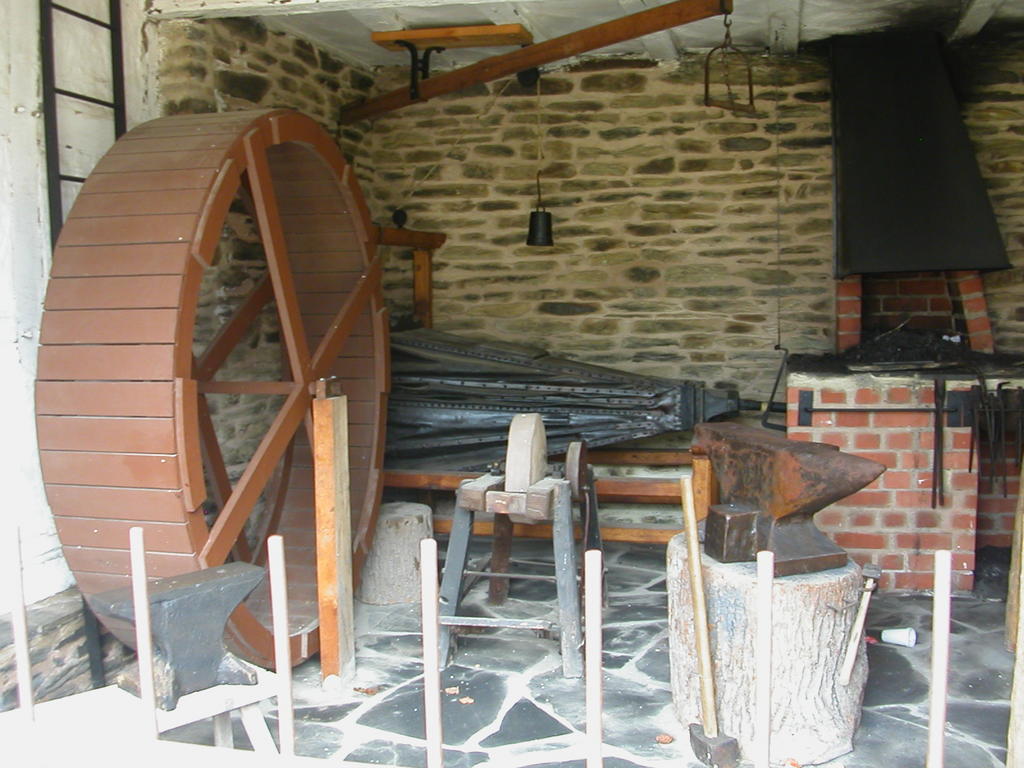
In the blacksmith's shop one can see the forge with the bellows, anvil, hammers, pliers, a bending machine for bending the eisenreifen (iron wheels) for the farm wagons. (According to the book, Serrig: Landschaft, Geschichte & Geschichtenby Klaus Hammächer, a dog could be trained to run inside the wheel shown in this picture. As he ran, he powered the bellows and the flame of the forge. The picture was taken at the Roscheider Hof open air museum near Konz)

Trumpets were used by Schweinehirt (swineherds). At the sound of the trumpet, the farmer opened the pig stalls and the Schweinehirt drove the pigs into the oak forests and guarded them there. In the evening the Schweinehirt brought them back with the trumpet signal. On the Feast of St. Martin (November 11) the Schweinehirt received a measuring beaker/cup full of grain for each pig under his care. (St. Martin's day was also the traditional time to prepare for winter by slaughtering pigs, geese, and other animals since they would soon be unable to forage for food and would have to be fed by the farmer)

The half Vierzel was a measuring instrument for grain. In former times the grain was not weighed; it was measured with this container. Four half Vierzel 'filled not too much and not too little' ( leveled?) equaled one hundredweight of corn, barley or wheat. Six half Vierzel made up a hundredweight of oats, because oats is finer. In earlier times, the teachers in the village were often also the swineherds, because there was no school in the summer (when the pigs could roam). School was held from St. Martin's Day to Easter.

One could distinguish cow, sheep and goat bells by the different tone qualities.

The small Nicholas bells were used by the adults to make the children aware of the feast day some weeks before it arrived. They rewarded the children's obedience by putting small gifts at the door on St. Nicholas Eve

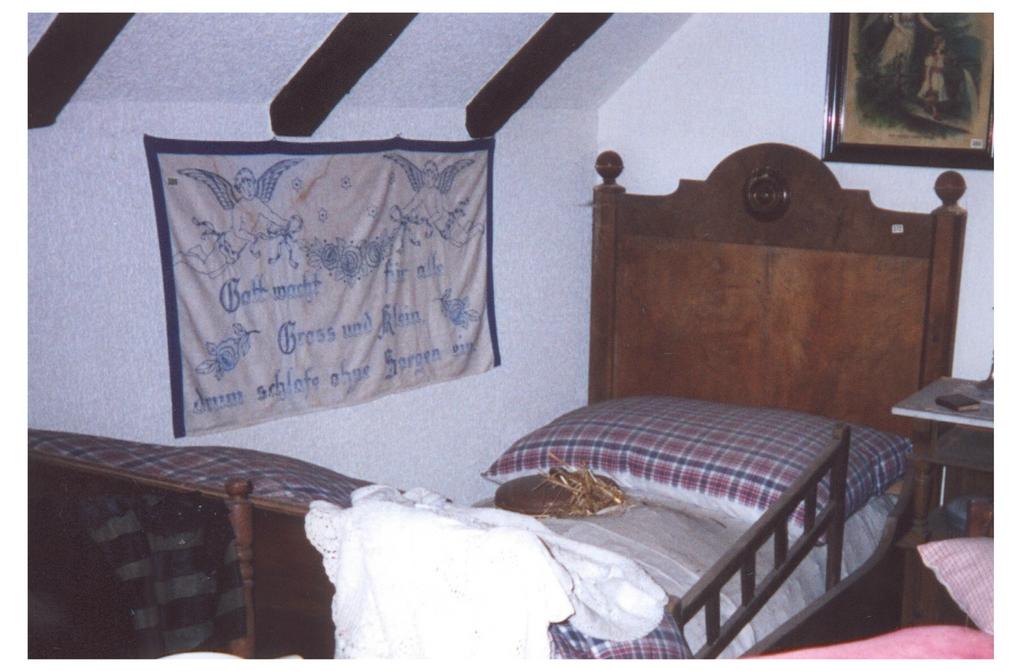
In the bedroom we see the straw filled mattress, the pillow filled with grain chaff, and the feather bed. (The villagers made use of almost any part of the crops that they grew, even in the bedroom. For instance, small pouches were filled with grape seeds and could be heated to ease pain, much as we can relax tight muscles by using the same sort of pouch and heating its "magic crystals" in a microwave. These grape seed pouches are still sold at the "Golden Autumn" festival and market in Saarburg)

The broad low-lying wooden box sled was, in former times, a popular plaything for the children during the long, snow-rich winters.

Kleppern (wooden clappers) and Raspeln (a rattle-like wooden device which rotated and made a rasping sound when shaken by its long handle) replaced the bells during Holy Week when bells could not be rung on Good Friday and Holy Saturday.

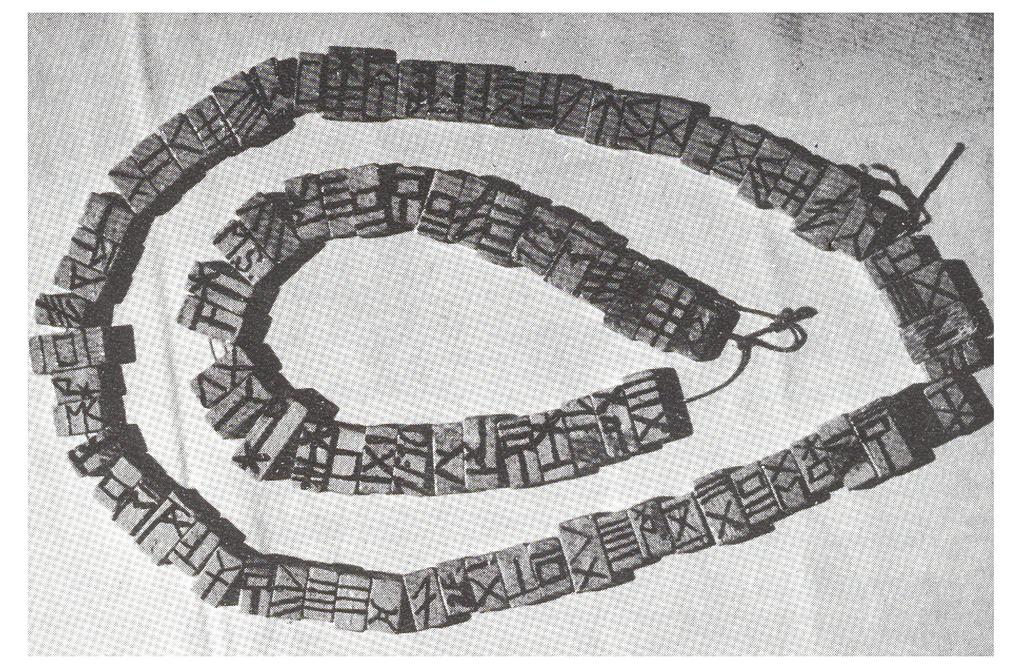
This is the Rosenkranz on which the house sign and hedge land identifiers for the Gehöfershaft were placed. These blocks were drawn in a lottery for distributing the Lohhecken among the farmers in the Gehöfershaft. (Above is a photo from Der Hochwaldort Zerf am Fuße des Hunsrücks, by Edgar Christoffel, c. 1981, Verlag W. Rassier, D5510 Saarburg. It shows wooden blocks with symbols which are rune-like rather than alphabetic characters. This Rosenkranz, the German word for rosary, served as a sort of plat map for the hedge lands which belonged to the entire community of land-owning farmers. In the Saar and Mosel region these landed farmers were usually referred to as a Gehöfershaft. A symbol identifying each section of the hedge lands, sections which were especially valuable for the oak tree bark stripped for tanning, was painted on one side of each small wooden block. Then a lottery was held. Each farmer in turn drew out a wooden block containing a hedge land symbol. His distinctive house mark could now be painted on the other side of the wooden block and the section was his to work until the next lottery was held. When the lottery was completed, the blocks were strung into the Rosenkranz and probably kept by the mayor of Zerf. In Zerf, this lottery took place every five years. The neighboring village of Irsch had a similar Rosenkranz, according to the book Irsch/Saar: Geschichte eines Dorfes, by Ewald Meyer).

The kitchen utensils and the farm equipment are described in Part 2 and Part 3, the other parts of this amazing visit to the past.