Showing posts with label rural vilages. Show all posts

Sunday, June 26, 2016

Family History Surprises

Once my 2nd great grandparent's farmhouse, (left front)
This is what it looked like at the end of WWII


As you may have noticed - at least I hope someone did - that I have not written a blog post for quite a long time.  It's time to explain.  A sciatica attack made sitting, difficult.   I just could not sit at a computer and capture ideas.

While I was recuperating, I got a communication that reminded me, once again, of the close bonds and relationships among people who lived in small villages like Irsch.  Many of us, who do not know each other and who are widely scattered all over the US or the world, could trace our roots to a small town in Germany and find big surprises.  (This might be an interesting idea for a genealogy television program.)

Here are three of my surprises.  Each one delighted me.

DOUBLE CONNECTION

A comment came from a reader who preferred to be anonymous so I won't quote it exactly.  But this person said that my ancestors, Johann and Magdalena Meier, sailed on the same ship, the Rattler, as her great grandfather, Jacob Fisch and his parent; and all settled in St. John, Calumet County, Wisconsin.  That was not a surprise to me.  But then she listed other surnames on her family tree.  One of those surnames, Probst, and their dwelling place in Calumet County, Wisconsin, matched another of my ancestors' names although my great grandfather John Probst had no relationship to Johann and Magdalena Meier.  The connection between the Meier and the Probst surnames came together when my mother said "I do" to my dad.  I didn't expect a comment about the Bavarian side of my family tree from a reader of my blog posts about the Rhineland.


The Meier House as it looks today


DOUBLE SURPRISE

When I decided to write a novel about my Rhineland ancestors,  Ewald Meyer of Irsch, Germany was a wonderful helper in my search for information about the customs and history of Irsch and other small villages in the area.  After a long search I finally learned the location of my Meier ancestors' home and property in Irsch in the years before they emigrated to America.

Herr Meyer went to that location and took photos of the building as it exists today.  He also learned that it was remodeled by a Herr Britten, another previous owner and again by Alfons Fisch.   Herr Meyer, as always, took an extra step.  He contacted Herr Fisch and explained my interest in the old Meier property.  To my surprise, the architectural plans for remodeling the Meier house still existed.  I have copies of them.

And one final surprise.  Herr Alfons Fisch is a direct descendant of Jacob and Magdalena Fisch who sailed to New York with Johann and Magdalena Rauls on the ship Rattler.  Herr Fisch has his residence right across the street from the former Meier property that now also belongs to him.

FAR REACHING IRSCH ANCESTORS

 Coincidence in Village of Irsch


Several years ago, I got an interesting e-mail about one of my blog posts, not from a family historian but because of a picture I had taken in Irsch and used in that post.  The couple who saw it wrote to me because it was the house of the husband's grandmother who still was living in that house.  They asked how I had come to know their "Oma Tilly."  Actually, I didn't know who lived in that house.  I was taking pictures to illustrate houses built wall to wall, and this was an excellent example.

We continued our e-mailing for awhile.  When the Oma (grandma) Tilly, whose maiden name was Weber, learned that my ancestors had immigrated to Wisconsin from Irsch, she asked, via her grandson, if any of my ancestors had the surname "Weber."  Yes, my 3rd great grandmother from Irsch was a Weber.  However Weber is a very common name, and I didn't know if there was any link between us.  That didn't faze Oma Tilly.  She said, "If they were Webers and they came from Irsch, we are related."  Her grandson and his wife got into the spirit and from that time on considered me their relative.  They even invited me to their 25th wedding anniversary anniversary celebration.  I was delighted to be asked and wish I could have gone.

Oma Tilly, age 93, and Bernie, her grandson
Are we really related?  I hope so.


Sunday, August 02, 2015

BRIDAL RIDE WITH A GUARDIAN ANGEL

The Brautfahrt

If you’ve been reading my blog posts for awhile, you know that I am very fond of the book “Die Dorfstrasse.” (“The Village Street”) by Maria Croon. It is filled with vignettes about the customs in a small German village; customs that have almost completely faded away in our time. But thanks to authors like Frau Croon, we, the descendants of the people of Kreis Saarburg, can learn about the traditions, rituals, unwritten rules, and observances of our ancestors who lived in small farming villages in the 1800s and early 1900s.

Today's post is a short sketch from the chapter "Die Brautfahrt," one of my favorites.  We are introduced to two young people, Veronica and Peter, but better known as Vron and Pitt.  It is the story of a special ride before they were married but already promised to each other.

Custom of the Bridal Ride and the Guardian Angel

As an old woman, Vron, the nickname for Veronica, works at her spinning wheel most evenings. One night her mind goes back to the time 50 years ago when she was a bride-to-be and about to go for the Brautfahrt. Her betrothed, Pitt, had hitched the horses to a small field-wagon and was about to help his Vronchen (little Vron) up to the front seat of the wagon.

Pitt's mother called to him.  He must take the Schutzenengel, (the guardian angel), with them on the journey to protect the reputation of this still unmarried couple.  The mother combed the tousled hair of Pitt's little sister, Resel.  Then she walked the little sister toward the wagon and seated her on the wagon's back seat, just behind the betrothed couple.  In two weeks time,  Resel would be Vronchen's sister in law, but today she had the responsibility of guardian angel.

Once they were underway, Pitt showed Vronchen his land as he held the reins and pointed the short whip this way and that, and directed the horse along narrow paths that ran alongside the fields.  Then they went back to the road and drove from village to village.  Vronchen came from a town some distance away, and this was her first look at the place that was to be her new home.

They had just passed a small village when they saw a stand of birch trees that almost formed a trellis above them. Pitt said it was a special bridal decoration he had created especially for his Vronchen.

 The next field was full of wild primroses, and the guardian angel shouted for them to stop.  She wanted to gather them.  She jumped from the wagon and began to collect an armload of the colorful blossoms.  While she picked the flowers, her brother had his mind on other things. He begged his Vronchen to give him a Schmatz (I think you can guess the meaning of that word).  As he teased and begged, Pitt paid little attention to holding the reins of the horse.  The animal started off, leaving the little guardian angel far behind before Pitt was able to retrieve the narrow straps and control the wagon again.  Little Resel ran after them, shouting for them to stop the wagon and scattering the flowers that she had gathered hither and yon.  The boulders and grass along the way were now graced with the flowers that fell from her arms.


Guardian angel with flowers
After that excitement was over, they drove through a village noted for the shop where especially fine spinning wheels were made.  The almost-bridegroom bought a well-made little spinning wheel for his bride to be and placed it in the back of the wagon next to the guardian angel.

Now it was lunch time, and they stopped at the inn where the Wirtin (woman innkeeper)  met them at the door.  She knew of the upcoming wedding and teased Pitt.  How had Schneiderpitt* managed to find such a special young lady to be his bride?  Veronica blushed bright red but said nothing.  Pitt twirled his mustache and enjoyed the banter and the praise of his Vronchen. Then the Wirtin went to the kitchen and brought out a large goose egg.  Vronchen said nothing as she  stared at it in wonderment. She could think of nothing to say.  The Wirthin told the young Veronica to put the egg in the bag she carried. Pitt explained to Vonchen that this was the custom in the town. If a person cames into the Inn and said nothing, the innkeeper must make a gift of a goose egg in order to please the guest enough to start the business transaction - the cost of either a meal or a place to stay for the night

goose egg
Vronchen had one glass of wine, her wagon driver two or three, and because of the guardian angel's important duty, she was given only a glass of raspberry water.  The innkeeper then served them a plate of bread and ham slices.  The horse, Braune, gladly ate his oats before they all left for home.

As they drove toward Pitt's home where his mother and the mother of Veronica were making wedding arrangements, Resel decorated Vronchhen's new spinning wheel with the primroses she had picked; then used the rest of the flowers to make a crown for her sister-in-law to be.  The movement of the wagon along the road eventually lulled the guardian angel to sleep.  Pitt put one arm around Vronchen's shoulder, and they rode home watching the stars and listening to the song of a cuckoo.

Fifty years later, Vron experienced the bridal ride as if it was yesterday while she sat spinning on the little spinning wheel purchased some 50 years before.


*Note for Clarifying Nicknames

It is necessary to know that in Kreis Trier and Saarburg, generation after generation of babies were named in honor of their godparents. It was the custom. Naturally there would soon be a surfeit of boys in a village who were named Peter or Johann or Michael or Nikolaus, etc. There would also be an abundance of girls named Anna Maria or Barbara or Susanna and so forth.  At first using nicknames to distinguish one child from another could solve the problem of duplicate names. But at the time Maria Croon writes about, nicknames were not definitive enough. In the case of the bridegroom Peter, his nickname Pitt was shared by many other boys.  When a father called for Pitt to stop playing and come home, there was a lot of confusion about which Pitt was being summoned.  One way to solve that problem was to say the surname first and then the nickname. It was necessary for the Papa to shout,”Schneiderpitt, come home at once; you are late for supper.”

Saturday, June 13, 2015

Spinnstubenfest in Kreis Saarburg

18th Century Flax Spinning Wheel 


In some areas of Germany, especially those close to the French border, there is a celebration known as Karnival, the equivalent of Mardi Gras. Now and also in the past, the week before Ash Wednesday had many special "fests" during the Karnival time. One of them, to the best of my knowledge, is no longer celebrated. Because of changing times and industrialization this fest is only remembered because of a narrative in memoirs or history books or examples at open air museum celebrations. This Fest took place on the Thursday evening before the beginning of Lent. It was known as Spinnstubenfest or, roughly translated, the Spinning-Wheel-Stube Celebration.  Fortunately, Maria Croon called my attention to this festivity in her book, Die Dorfstrasse (The Village Street).

Little is written about the many winter evenings that Kreis Saarburg women spent spinning. However, like a quilting bee in this country, the Spinnstubenfest could be a time for getting together with other village woman.  As they worked, they talked while spinning the thread for the family's clothes, sheets, or anything else that needed weaving.

Frau Croon describes one such night that was very special. On the evening of the Thursday before Lent, called Fettendonnerstag (Fat Thursday), the sound of women's shoes were heard tapping on the streets in her little town as evening fell. Every woman was dressed in Sunday best from head to toe.  The young women wore colored ribbons in their hair and most had shiny buckles on their shoes. Each woman carried a spinning wheel that was decorated with red and blue ribbons. The spinning wheels were freshly polished until they fairly gleamed.  Fettendonnerstag was the time for the spinning wheel celebration, the Spinnstubenfest.

A Spinnstubenfest was held in a home with a large Stube.  It lasted at least three hours.  In the first hour every Frau and Fraulein did her spinning, creating thread from wool or flax while they gossiped and told stories of current or older times.

In the second hour, the spinning wheels were put aside in another room and tables were set for coffee and eating such things as crumb cake or pear bread, made with the dried pears that were harvested in the summer.  I picture them in smaller groups: the older women exchanging recipes and laughing about the foibles of their husbands and children; the young women gossiping about any new romances in the village, including their own.

As the third hour arrived, tables were pushed back against the walls, and the men, single or married, were invited to come in for dancing.  Some of the men brought accordions, harmonicas or Teufelgei.   No German dictionary in my collection or on the internet has that last word, but I will make a guess that this was a dialect word for some kind of fiddle (Geiger) played fast as the devil (Teufel). A favorite dance tune was "Herr Schmidt, Herr Schmidt, What Brings the Maiden With" (exact word order of the German)

Late that evening, when the music and dancing was over,  the men "played the cavalier" and carried the spinning wheels for the ladies. While the very old and the very young slept, the rest of the village folk made their way home in the dark. The streets rang with their voices singing the old songs until one by one doors closed behind them and the streets were dark again.

Monday, June 30, 2014

The Family Table

Hunsruck garden at Roscheider Hof Open Air Museum


Dibbelabbes

Quark
Mauseohr Plant


Leckschmier


When I decided to write a novel about peasant life in a small village in the Saarburg region, I didn't expect to have trouble describing food. It didn't occur to me that I would have to figure out what might be on the table for each meal of the day and how it was prepared. What did the cupboards, pots and kettles hold? As it turned out, preparing the daily meals was one of the most difficult of daily tasks about which to find information. Recipes were an oral process, passed on from generation to generation.  Although I grew up on a small dairy farm, conditions in the United States in the 1950s bore little similariety to those in 1850 Kreis Saarburg, the year my ancestors lived on their farms. There was meat on our table almost every day, there were recipe books, there were grocery stores, and our garden was just a few steps from the back door.

How different it was for our ancestors. Meat, so much a part of our daily diet was a rarity for the peasant farmer. It was seldom seen when the family sat down to their daily meal. For the Kleinbauer (small farmer) and Taglohner (day worker), there would only be such a luxury on very special holidays such as Christmas and Easter. For the farmer who was a bit better off, meat might be eaten on other holidays or for an important celebration such as a wedding or a reunion of more distant relatives.  Pork or goose was usually served on those occasions - any leftover meat could be chopped and added to dishes that were usually meatless.

Other than holidays and weddings, what was on the table on ordinary days? As one book put it "It was the duty of the married woman to take care of the house, to look after the children, to help with work in the field, to milk the cow and feed the small animals each day. In addition she was responsible for putting three meals a day on the table for the hungry mouths of her family. This could be the most difficult obligation of all, especially because most farms were small, the farmers poor, and crop failures common." How did the Hausfrau manage to feed a hungry, hardworking family?

Even though meat was rarely seen on the table, animals provided food in other ways. Geese might end up in roasting pans at Christmas; but before that happened, they produced eggs for main dishes when cooked, one of the ingredients in a kettle with many other parts or in a dough to be baked, when raw.

Peasant farmers with land of their own would own one or more cows since farmers rarely had horses for field work. They used their cows as draft animals to pull wagons and plows. At the same time, the cows provided valuable food while working the fields. There was milk for the cooking kettle, baking pan and the drinking mug. (Bit of trivia - in Germany mugs used for daily meals had no handles until the late 1800s).  Given their use as draft animals to pull plows and wagons, a cow's milk production would be much more limited than the dairy cows of today's farmer, but even so, milk was one of the most valuable of foods. Cow's milk provided a nutritious drink, cream for baking, or was mixed with vinegar and sugar (honey was the poor man's sugar) and used as a dressing for fresh greens. What was left after a day's use became a homemade cheese.

In the book "Essens-Zeiten" which can be translated as "Of EatingTimes," one hundred years of table scenes are pictured and explained. In the text for one of those pictures I found several paragraphs that summarize the work of a peasant woman who was also responsible for growing, gathering, preserving and preparing the food from the garden as well as knowing how to supplement it with wild greens and berries from the woodlands and fruit from the trees of the village apple orchard or the plum, pear, and peach trees that were part of some farms. The mild climate also meant that grape vines grew easily.

The garden was the place where the farmer's family turned in good times and bad. Field harvest times when the wife's help was needed in the fields was also the time that the produce of the garden was ripening. The children and those older relatives who no longer could labor in the farm fields were still able to work in the garden and teach the younger children how to plant, hoe, weed, and gather produce. Often the elderly grandmother and grandfather, with the help of the children, were responsible for the majority of the garden work.

Contrary to my American perception, the Kreis Saarburg gardens were not always close to the barnhouse. It might be a mile or more walk to care for and gather this food. Getting to and from the garden took time away from the other work that had to be done. Those lucky enough to have their garden on the barnhouse property would place it on the sunny side of the house. A good location was a matter of concern. The first land that a day worker or craftsman would buy, when he earned enough money to own a piece property, was chosen with the understanding that there must be a good place for a garden which would hold plants that could be wintered: cabbage, bush beans, turnips, carrots, onions, leeks, peas, and lentils. Every little corner of the garden was used.  Potatoes were not planted in the garden; they were a field crop, feeding both humans and animals.

The planting and harvesting of root vegetables from the garden saved many families during famine years. In 1790, according to one writer of the time, in Germany the potato was eaten every day in some kind of recipe. Even the poor had their daily potatoes, some with a bit of meat and most without. Steckruben or turnips were another staple, especially in the Eifel region of the Rhineland. In the book "Essens Zeiten which I mentioned above, an elderly resident says "Oh my, turnips, always turnips" for the meals.  Often all the peasants had to sustain them were potatoes or turnips. Soup was made with some flour, water, broth, and salt. Other root vegetables that saw families through harsh winters were beets, and carrots.

Herbs for seasoning and healing plants were common in the gardens. Even though space for growing food was of primary importance, most village families understood that ornamental plants like wallflowers, pansies, larkspur and field roses should be planted for the color and happiness they brought and planted those as well to have something for the soul.

Although it may seem that our ancestors in the Rhineland area had very poor nutrition, they did their best to vary their diets when spring and summer arrived. After a long winter of only root vegetables, it must have been a delight for them to have freshly picked food on the table. There were just-gathered vegetables, greens, and fruit in those summer months. It seems they were also somewhat aware of the health value of uncooked field greens because, as one book told me, they believed the dandelion leaves helped to fight off the fatigue of winter. The best months for gathering dandelion greens were April and May. One picked the dandelion if possible in the outermost edges of meadows, being sure that the heart of the plant was still looking yellowish. The taste of the leaves is somewhat bitter but savory in much the way radicchio is in our own summer salads. The leaves of certain other field plants added additional taste and volume to the spring and summer season's dinner. Another popular field green was the Mauseohrsalad (mouse ear salad), also called field salad.  It is still eaten in Germany today.

As soon as they were able, the children took on a share of the work. The girls learned how to cook at an early age by "doing." Recipe books would have been laughed at and they were far off in the future. These women and girls knew when they had added enough water or stirred the batter long enough to have it "look right."  Most cooks measured with their eyes, not with measuring cups.

Sugar was not readily available to peasant farmers but honey was. When a villager was in possession of a woven basket and some broom flower branches as a cover, he possessed his very own sugar factory. A bee shed could be made by pushing four long stakes into the ground, and a slanted roof covered with Ginster (yellow broom) placed on top; woven straw baskets were used as hives underneath. Broom grows wild all over Kreis Saarburg to a height of 3 to 5 feet and produces numerous long, straight, slender bright green branches, tough and very flexible. The bright yellow fragrant flowers are large, in bloom from April to July, attracting the bees.

Some Popular Recipes for the Tables of Kreis Saarburg 
(The dialect recipe's name comes first; then the more common German name)

I found these recipes in the book "Die Hunsrücker Küche" by Christiane Becker who inherited them from her grandmother. The book uses many dialect words in the instructions so I have done my best to give you an idea of the dish, at least listing the ingredients in popular recipes of the Hunsrück and Saar Valley of Kreis Saarburg.

Dibbelabbes or Schales (potato dish) This is a traditional dish of potatoes and onions in both the Saarland and the Rhineland. Dibbelabbes made of 4 lbs of potato, two or three eggs, salt, pepper, a tablespoon of flour, 3-4 onions and bacon striped with fat. Nadia Hassani (in her cookbook "Spoonfuls of Germany") has this piece of information on the origin of this interesting dish: "...a potato dish known as Dibbelabbes in Saarland is known as Schales or Scholet in the Rhineland Palatinate. Its origin she says, goes back to the Jewish Sabbath dish Cholent, a stew that was prepared on a Friday and remained on the stove during the Sabbath, when Jewish religious law forbids food preparation."  This was a recipe that held well and could also be taken to the field for a noon lunch.

Löwenzahn Salat (Dandelion Salad) was made using some sour milk, 2 hard boiled eggs, one small onion, one bunch of chives, 6 tablespoons of vinegar, 3 of cooking oil, and be sprinkled with salt, pepper and grated garlic.

Mauseohr salat (Mouse ear field salad, )  Field greens, often those shaped like mouse ears with a dressing of sour cream, salt, pepper, one onion, a bunch of chive, six tablespoons of vinegar and 3 tablespons of oil.

Kappessupp or Kohlsuppe (cabbage soup) The first ingredient was a legume, like peas or beans or lentils, cooked for one and a half hours and then set aside. Then green cabbage was cut in small strips and cooked in meat broth with peeled potatoes. Meat was added only for a special day or if the work of the day was to be very strenuous. The mixtures of the legumes and cabbage together in soup was a typical midday meal.

Rappsupp (No translation from dialect found) This soup could be made quickly and could be found on the table when the women of the house were helping with the harvest or on a busy washday. Vegetable or meat broth was cooked with finely grated raw potatoes and cream or egg yolk. Rapp is one of the dialect words no dictionary or Google translator could define.

Käsjer, Quark or Handkäse (homemade cheese)  The cows' milk could be used as a light cream, skimmed for the rest of the liquid, and used to make butter, a sauce for the fresh greens or an whipped cream for desserts. The rest of the milk, minus the cream that had been skimmed could be used to made hand cheese or Quark by separating the thickening milk from the whey. Both were used to feed the family. Quark, when finished, is a soft cheese that tastes like a mix of cream cheese, cottage cheese and sour cream. Since it's very mild, it takes on the flavors of the other ingredients you use it with and can be either sweet or savory.  The Molke or whey was a drink full of vitamins and minerals and could be compared to drinking buttermilk.

Leckschmier, Zwetschgenmus or Latwerge (plum or pear preserves)
.  I needed some translation help for this Hunsrück and Saar favorite   One recipe in English on the web called for 5 kg plums or pears; 1 kg sugar; cinnamon; anis; pounded cloves; and a little ginger.  The washed, pitted fruits are gradually added in a cast-iron pot and boiled together with the spices. It is important that mass with a wooden spoon to stir constantly to the bottom of the pot so that the Leckschmier does not burn. After 4-5 hours of cooking, the mass has become stiff and thick. It is filled in a well pre-heated stone pot after cooling, with a cloth cover and stored in a cool place. On freshly baked bread, thick coated with good butter, Leckschmier tastes especially good.

Einsäuern im Spezialgärtopf was a version of what we know as Sauerkraut.  It was and is common in the United States and recipes abound on the internet so I have not included the ingredients.  Crocks of this long lasting sour cabbage could be found in the barnhouse each winter.

Gefillte Krummbeere or Gefüllte Kartoffeln (Potato Pancakes) One recipe that made its way from the Rhineland to my family's table and is still a favorite is potato pancakes.   My mother never measured anything - I confess I need a recipe to feel secure about the amount of grated potato to be mixed with onion, flour, and egg.   My mother's were always the best.

There are many more recipes in the little cookbook I have been trying to decipher, but I have made a small start at painting a word picture of the family table, and it has been challenging but also enlightening.

If your ancestry is German, do you have a favorite recipe from the family table of yesteryear?


Sources:
German Foods.org
Christiane Becker, Die Hunsrücker Küche, 1992
Jean Morette, Landleben im Jahreslauf, 1983
Freilichtmuseum Roscheider Hof Konz Museum Guide, 2001
"Essens-Zeiten," eifeler Tisch-Szenen aus 100 Jahren 2002

i

Monday, August 13, 2012

The Land Auctions in Irsch in 1861

Meadowland in Irsch
The fields around Irsch

A wine hill

Kataster Map with Meier House


The morning of February 22, 1861 was a momentous one for me and for all of the present-day descendants of Johann Meier and Magdalena Rauls Meier.  That day determined our nationality for the next 150 years.

Although there had been an application to emigrate legally executed earlier in February, and although there would be an auction of farm and household items in March (as described in my post of February, 2012), the selling of the land a farmer owned was the day that the emigration decision was cast in stone. Now there was no turning back for Johann and Magdalena because at the end of the day they no longer had fields in Irsch to support their survival during the coming year. By the time the sun set on February 22, other farmers were in possession of their land and the very barnhouse that had been their home since their marriage on February 14, 1849.

It is amazing to me that,  in that small village of Irsch sometime during the first three months of 1861, the auctions of five families took place.  They would join Johann and Magdalena on the same ship that would sail from Le Havre about the beginning of April. It is obvious that a monumental division was continuing.  The buyers of all of these auctioned fields may have considered the idea of emigration but decided against it.  The farmers buying the Meier's land, which would mean a mortgage to be paid, were clinging to their homeland.  In spite of ever-lurking hardships, they were setting their roots more deeply into the soil of the only place most of them had ever known . They would be the ones to continue their way of life of the old country.  The sellers were uprooting themselves, determined to have a better life for their families, although it meant leaving everything and everyone they had ever known; a change of allegiance and of customs that were as yet unknown to them.

The Land Holdings of Johann and Magdalena Meier:

The auction of the land owned by Johann and Magdalena Meier began at 10 a.m. on the morning of February 22, 1861 and ended at 3 p.m. In was held on the premises belonging to Mathias Peter Britten. It is more than likely that this was the Peter Britten who is listed in the Catholic church registers as a farmer, ship-puller, and innkeeper and that the inn's taproom was the setting for the sale.   There were two witnesses, Theordor Ney who was a house painter/whitewasher in Beurig; and Johann Becker who was a field guard in Irsch.  The official in charge of the auction was again notary Waringer of the almost "unintelligible handwriting".

There were two classes of land to be sold--the land which the Meiers owned outright, and the land which was part of the Irsch Gehöferschaft. The Gehöferschaft holdings were either meadows or Lohhecken/oakbark hedgerows. Lohhecken, to the best of my understanding, came from (scrub?) oak trees growing in the wild, the bark of which could be stripped and then sold to the tanneries along the Saar river in Saarburg or Beurig.

The other pieces of land which Johann and Magdalena Meier offered for sale consisted of farmland where crops were sowed, cultivated and harvested; garden land which could be used by the family to grow the produce which would see them through the year; wildland; a wine hill for growing grapes; Wande (steep hillside) land; forest land; and a woodlot.

As I have explained in the post, "Village Roads and Fields", a farmer's fields might be miles from his barnhouse.  The possession of adjacent fields was uncommon in the Rhineland in the 19th century. Areas called "Flur" had descriptive names that identified the approximate location of each strip of land owned by a farmer in a particular section of the village. Ewald Meyer, in his history of the village of Irsch, says the names of the "Fluren" were usually related to landforms, names of local farms, woodlots, etc. That is, a farmer might have his clover planted in a land section called "By the Stone Cross" and his potatoes in a strip of land known as "Above the Trier Way." The auction bidders as well as the official conducting the auction would officially be accepting the land boundaries described in the Kataster, which was the land map and tax register document used by the Prussian Government to identify the owner and boundaries of each parcel of land and assign tax responsibility to each landowning resident.

The conditions read out for the sale of the land and building being auctioned were, in many ways, similar to those for the "moveable objects" as explained in my February post.  In addition, there were warnings that the buyer was getting the land as described in the Kataster register, regardless of any unknown errors in it. The land buyer would be responsible for one third of the purchase price of property, with interest, on November 11 of 1861, 1862, and 1863. The interest rate was five per cent yearly. However the taxes for the land would not become the responsibility of the new owner until January 1, 1862. There was also a penalty for late payment and provisions for default of payment. The new owner also had to pay the cost of recording the new ownership on the Government's land Kataster.  A few of the other conditions listed defeated both my ability to read German and the power of "Google Translate."  All of the conditions were read aloud before the actual auction started.

The Land Auction Begins:

When the auctioneer was ready to begin the actual selling, the field description was read out.  The bidding was then open and when the gavel fell awarding the lot, the same description was read again to the buyer to make sure that he understood both what he was buying and the cost. If the buyer was satisfied that all was correct, he signed his name. These handwritten signatures varied from very clear to downright impossible to read. (Picture the hurried scrawls of many doctors, business people and public officials).   It was rare to find an "X" or some other mark in place of a signature. Most of the adults in Irsch must have had at least elementary schooling by 1861.

The auction document gives no indication of how the bidding on each field was brought to a close, but a fellow genealogist, who also has an auction document for her family from the Rhineland area near Koblenz, shared an interesting detail. At the point at which an auctioneer heard a significant silence, a candle would be lit. This candle would burn for only one minute before it went out. The auctioneer would then light another one-minute candle. The same procedure was repeated with the third candle. Hearing no other offer before the third candle flickered out, the land was officially declared sold to the last bidder.  The auction officials in the Koblenz area were definitely sticklers when it came to assuring that everyone had the same amount of time to think over a further bid!

When the auction record for the land of Johann and Magdalena Meier was placed on file for me to see 151 years later,  it contained the following kinds of information for each piece of land.

*the number of the land lot in the Flur - Lot 1647

*the name of the Flur - hinterm Keltergarten (behind the Kelter garden)

*the size of the piece of land - 16 Ruthen, 60 feet

*the owners of the fields that bordered the field being sold - Nikolaus Fuhs-Klein and Johann Schuh

*the buyer and his residence - Anton Schuh, Irsch village

*the amount paid for the piece of land - 20 Thaler

*the signature of the buyer - signed in his own handwriting

When the auction ended, the total land sale had earned 1,269.15 Thaler for Johann and Magdalena.

The Auction of the Land and the Dwelling On It:


Property 4091 consisted of a "Wohnhaus" a place for the family to live, for the animal stalls, and for storage of crops.  It was located in the middle of the village with a land area size of 10 Ruthen and 10 feet.  Bordering it were the dwellings of Anna Hauser, "unreadable" Feilen, and the main street. (I've noticed that a number of people had the first or last name of "unreadable," due to the poor handwriting of notary Warigner.)

The highest bid for the house, barn, and stables (all under one roof) was 320 Thaler, a combined bid from two Irsch farmers, Nikolaus Fuhs and Mathias Konter.  This was somewhat unusual.  It begs the question of why.  Was the current barnhouse then divided into two dwellings or was it shared in some other way by the two winning bidders?

Auction of the cows

After all of the land had been purchased, the auction was declared over at 3 p.m. and the auction of the animals began.  It was in the same location, the inn of Mathias Peter Britten, and the same official and witnesses were present.  There were three cows in the stalls of Johann Meier; however,  one cow was held back and would not be sold until the moveable property auction of March 22. This exception made sure that the Meier children would continue to have milk to drink until all the family's possessions were sold.

One cow was sold for 40 Thaler to Mathias Lehnert-Schreiner, A farmer in Irsch.  The second cow brought 48 Thaler, more than many of the land pieces.  The new owner was Nikolas Reiter,  a farmer from neighboring Beurig.  The auction ended at 4 p.m.

After the Auctions Ended:

On the same day that the auction was held, the rights to land and property were transferred to the Jewish merchant Simon Wolff.  The money from the buyers of that land was not due in full until November of 1863, and the Meier's left Irsch to go to America in March, 1861.  Ewald Meyer who did the translating of the auction documents says that this Jewish moneylender from Wawern loaned back the money minus interest to the Meiers based on the anticipated land payments that would be made.

There is no written explanation that tells me whether Johann, Magdalena, and their children were able to stay on in their barnhouse. Technically, they no longer owned it. But I think staying in it is very possible since their movable possessions would not be sold until the following month at the "movables" auction. Also, the winning bidders had not yet paid any money for the property and would not owe for taxes until 1862. Johann Meier had made the expenditure for the taxes on land and buildings in 1861 from his own pocket.

In the following four weeks, it must have been a peculiar feeling for Johann and Magdalena to hear their neighbors and friends talking of their planting plans for the coming year in the farm fields, some that had once belonged to Johann, his father and his grandfather.


NOTES: An unmarried uncle, Michael, must have lived with Johann and Magdalena and their family because he was going to America with them and sold his land too. His auction was held the next day, February 23.

The notary seems to have used square units: Fuß (feet), Ruthen, and Morgen. In Prussia, one square Ruthe was 14.18 square meters and one square Fuß (foot) was .092 Square meters.  One Morgen was 2553.22 square meters.

Sources:
Aussenstelle of the Landeshauptarchiv in Neuwied - Rommersdorf, Rheinland.
Meyer, Ewald, Irsch/Saar: Geschichte eines Dorfes
Translation of Auction Documents of Joseph Thielmann and Katharina born Henn by Walter Petto and Ulriich Thielmann, 
Translation of Auction Documents of Johann Meier and Magdalena born Rauls by Ewald Meyer.
Pictures from www.Irsch/Saar.de; Kathy, the Single-minded Offshoot, and Annette Schwickerath of Trier

Saturday, June 30, 2007

Village Roads and Fields


Wall-to-wall dwellings in Irsch, Kreis Saarburg, 2004

Before I began my research on the social history of my native villages in the Trier region, I mistakenly pictured the farms of my ancestors as replicas of the farms outside of the village of Sherwood, Wisconsin where I grew up. In Sherwood there were a few shops, a church, school, and the houses of the people who were not farmers. In the outlying countryside, there were farms. Each farm had a house, a barn and some outbuildings. These buildings were surrounded by farm fields and woodlots belonging to each farmer. Farm houses were at a considerable distance from each other with open fields between each dwelling.

It was quite a surprise when I learned that the 19th century villages in the Trier/Saarburg region of Germany, as well as those across the border in Luxembourg and in the French province of Lorraine were nothing like the typical Wisconsin farm with its 40 or 80 or 120 acres surrounding the farm buildings. In Irsch or Zerf or in any small farming village in the Mosel/Saar region, the farm was as much a part of the village as the church or the Gasthaus.

Along the Road

The Bauernhaüser, which I can best describe as “barnhouses," were constructed so that both the family and the livestock could live together under one roof, the family on one side of the building and the livestock on the other. In many of the villages, these barnhouses formed a row on both sides of the road, built wall to wall. This made access to the street possible only through the front of the house. Typically, each barn house would have a garden at the back of the house, which was reached by way of the back door. The garden was fenced, usually with a low wall made of stones or twigs and branches, woven into a secure fence. The land behind a barnhouse might belong to any one of the residents of the village.

The distance between each row of houses was fairly wide. The middle part of that space served as the road, and the free space between the road and the front of each barnhouse was a place for stacks of firewood, tools, equipment used for field work, and the manure pile. This may seem strange until one remembers that a farmer's land was not at the back of his own house. He had to transport his tools as well as his natural fertilizer to fields that were sometimes as much as five miles away.


The space at roadside was also an extension of each farm’s living space, where the housewife sat on a stone or wood bench and cleaned her vegetables or mended clothes. The children not in school played here during the day, dodging the poultry that ran free. In the evening the men and women rested from the day’s work in their multi-purpose yard. The people of the village would often chat with their neighbors until darkness began to fall. This was the signal to go inside and to bed; there was another day of hard work to come at the first light of morning.

According to author Edgar Christoffel, in Zerf the village road was convex, and there were many rough spots. Such a combination caused horses to stumble with some regularity. After dark, the residents of Zerf were also likely to slip and fall as they walked along.

The village's streets were not canalized to handle heavy rainfalls and sewerage. The street and yards turned into mud, and puddles formed from the runoff of the manure piles. When the farmers drove their cattle out into the pastures each morning, cow dung covered the road with a gray-green carpet. In a wet summer, the manure piles did not dry out completely so that there was usually an unpleasant odor in the street.

It is no surprise that most people wore sturdy wooden shoes for work and walking on the road. These wooden work shoes were never worn in the living areas of the barnhouse. In the kitchen or the “Stube” (a combination living room, eating area, and in some regions also the master bedroom) wooden work shoes were exchanged for clogs, thus keeping the dirt of the roads outside.

The Fields

As I have explained, a farmer's fields might be miles from his barnhouse; nor was the possession of adjacent fields common in the 19th century. Areas called "Flur" had descriptive names that clarified the approximate location of each strip of land worked by a farmer in a particular section of open land. Ewald Meyer, in his history of the village of Irsch, says the names of the Fluren were usually related to landforms, local farms, woodlots, etc. That is, a farmer might have his clover planted in a field "by the stone cross" and his potatoes in a strip of land "below the Bodem house." The land registers called Kataster were officially recorded in high German but often mangled by local dialect. (Thus it can be difficult to translate the names of the Fluren and I haven't tried.)

Some Zerf Fluren were: Bei Paleschhaus, Bei Schneidershaus, Hinter Raulshaus, Die Forsthofen gegen Schuttershaus. Some Irsch Fluren were: Beim Apfelbaum, Hinter Baurenhaus, Bodemsgarten, Beim Pützborn, Bey der Schleifmühlen.

"A man can step out his front door and see if his grain is ripe for the cutting" That would probably be how a German immigrant farmer would describe the convenience of his newly purchased and planted farm land in Wisconsin. His house may have been of logs and as yet poorly furnished. But what a luxury to see one's own fields from the doorstep rather than walking miles to assess when the flax field would be ready for harvest. On the other hand, perhaps his wife would say, "This is a lonely place where I cannot call to my neighbor if I need a little help or want a bit of gossip."

SOURCES:
*Morette, Jean. "Landleben im Jahreslauf." Saarbrücker Druckerei und Verlag, 1983
*"Freilichtmuseum Roscheider Hof Konz Museum Guide." self-published, 2001
*Christoffel, Edgar. Der Hochwaldort Zerf Am Fusse Des Hundrücks Landschaft; Geschichte, Kultur; Gegenwart. Saarburg, Verlag W. Rassier, 1981
*Meyer, Ewald. Irsch/Saar; Geschichte eines Dorfes. Geminde Irsch, 2002
*Alles unter einem Dach? Die Hauslandschaft in der deutsch-franzoesisch-luxemburgischen Grenzregion.
Hauskundliches Roscheider Hof, Mai 2000

Tuesday, July 26, 2005

A Visit to the Zerf Heimat Museum - Kitchen

Top - Wicker trays, Trockernhurten, for drying greens and fruit
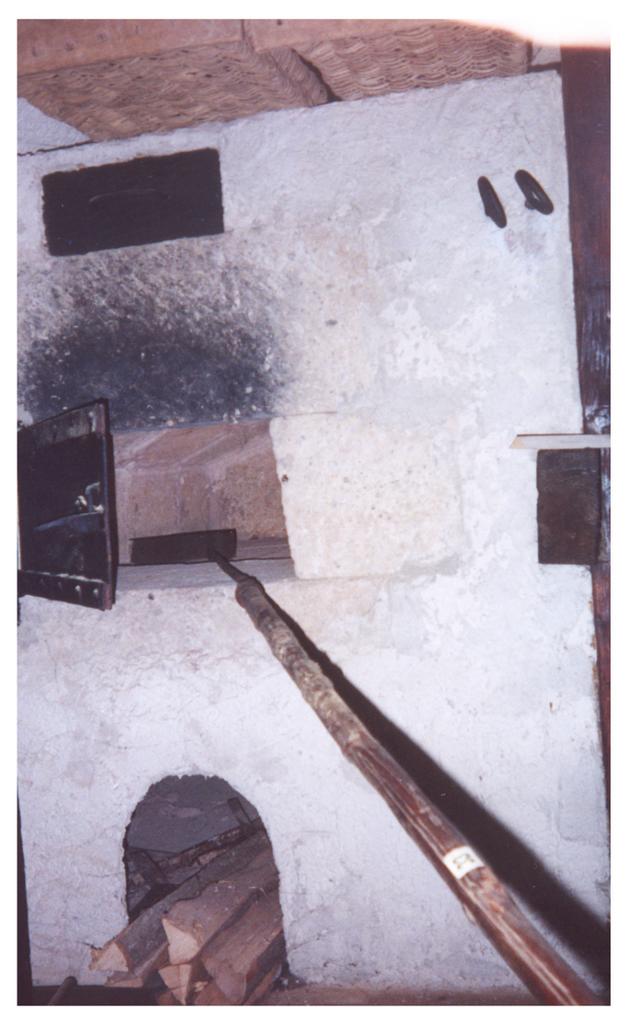
Middle - Bake oven door with Kiss rake


"In the corner is a complete bake oven, in which bread was baked in former times. The glowing ash was pulled out of the hot oven with the Kiss (a long-handled type of rake). With the Brotschiess (literally this is a bread shooter), the loaves of dough were quickly pushed into the oven and the finished bread pulled out with the same device. Once the oven was empty, the Trockernhurten (a woven drying rack) went in. On it might be greens for soup, little plums, or apples and pears cut in strips for drying."

"In the Muhle (a bread trough which could also be covered and used as a table), the bread dough was prepared for baking. If the dough had risen, it was put into the Kurbeln (a woven, round basket) and covered with a white linen cloth and left to rise for approximately10 hours. In former times they said the 'bread must steam'. When the Muhle was emptied, any remaining dough was scraped together and formed into a ball. This dough had to be kept at a place in the room where the temperature was always the same. It was covered with a white linen cloth and fermented for the next 10 days. That became the Sauerteig (leaven) for the next bread"


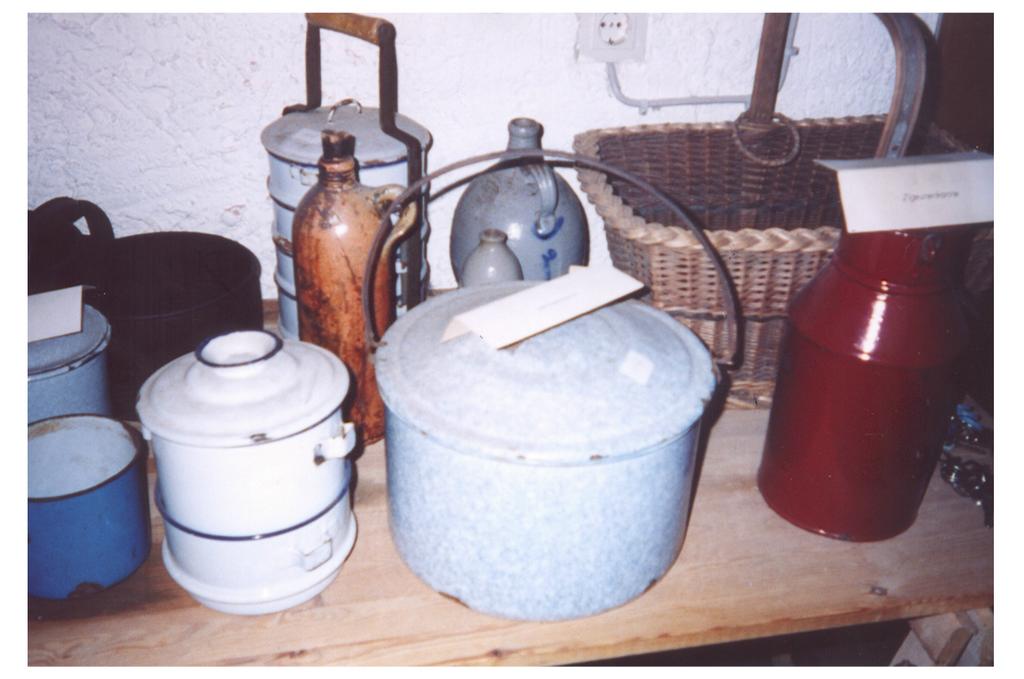
Henkelmänner


"Here are various Henkelmänner (lunch buckets). In former times during the potato and grain harvest, the meal was taken to the workers in the field in these Henkelmänner. There is a difference between the normal Henkelmänn and the Marmittchen (taken from the French word for a pot called the Marmit). The Marmittchen consists of several small pots stacked one above the other. This made it possible to transport and keep several meals divided. In the large Henkelmänn there was only an Eintop (a single pot). In the Fresskorb" (lunch basket), children brought an afternoon lunch (bread and so forth) to the fields after school. Coffee was carried in the Zigeunerkanne or gypsy jug. The popular homemade drink, Viez, was kept cool in the Viezbombel made of stoneware."

"In the farm kitchen, the floor is made of stone, usually this was sandstone. The open chimney is above the hearth. The cast-iron pot hangs on a rod that can be raised or lowered depending on the amount of heat needed. Ham, bacon and sausages were smoked in the open chimney."