Showing posts with label wedding. Show all posts

Thursday, July 05, 2012

Early Posts Remembered


Wedding  Document from Hunsruck


Barge Stop on the Saar

Zerf farm life shown in village museum -
horn planters
Saarburg mill stream

On June 24 I celebrated an anniversary of sorts - my 7th full year of written posts for "Village Life in Kreis Saarburg". That means that this blog post begins year eight! When I wrote that first post, seven years seemed an impossibly long time to continue my project; now it seems impossible that the time has gone so fast. As these early posts are probably the most neglected, it seems fitting to bring them to the forefront again as part of my personal anniversary observance and as examples of ways to learn family history from less used sources.

My very first post on this blog was about Easter customs in the Hunsrück area of Germany. I bought a small recipe book, self-published, in a bookstore and it was a treasure. In searching for traditional recipes my ancestors might have enjoyed, i found not only recipes for Easter dinner, but also a gold mine of information about the traditions that went along with the recipes. For instance, children began to gather moss from the forests about two weeks before Easter so that they would have enough for a soft nest. The night before Easter, the moss nests were carefully placed in the garden, thus inviting the Easter Hase to lay its eggs there. But what if it rained on the evening of Easter Saturday? The children brought the nests inside and placed them in the kitchen, using a little willow basket to help keep the moss in nest-shape form. Recipe books can be a great source of information! 

My next four posts were written about a visit to a small village museum in Zerf, Germany. This dusty little museum was crammed full of farm implements, furniture for the living spaces, tools, baskets and buckets carried to the fields, harnesses for the ox, horse, or cow. There was even a reconstructed stone bake oven. That museum was the labor of love of one man in the village. When he died, the museum was kept closed unless one applied for permission to see it. The mayor kept the key in his office. Luck was with me when I visited because a local resident procured my entry. I had a guided tour from the mayor and his wife, and was given a guide to items in the museum. Because they knew I was coming, the mayor's wife had hand typed it especially for me. Through the blog, I was able to share that guide, along with the pictures I took, since much of what was inside that large room would be very similar to other village museums all over Germany. And there are many almost-forgotten museums in every state in the United States. When visiting the places where ancestors lived for a time, it is wise to ask if there is an almost forgotten museum. One of my favorite souvenirs of that day in Zerf was the tiny wooden peg I was given. Such pegs were used in place of a nail by the shoemaker when constructing the sole of a shoe.

I wrote three posts about wedding customs. My little Hunsrück recipe book - mentioned above - had the ingredients for traditional dishes served at a wedding meal in a location near Kreis Saarburg, Germany. It also included some traditional Hunsrück wedding customs in addition to the recipes for wedding dishes. On two other visits to Europe, I had stumbled across books that included the wedding lore of Normandy and weddings in Bavaria. So I included two other posts as a comparison to the Hunsrück wedding celebration. It was interesting that very far-flung areas had many baptism, marriage and death ceremonies and customs that were similar, something good to know when one is unable to find the "perfect" social history of the ancestors' town. A lot of the birth, marriage and death rituals in other parts of Germany, especially if the same religion was practiced, can be described (with proper notation) when writing a family history. There is more chance of being right than being wrong.

The history of Saarburg, Germany, which is the equivalent of a county seat in the US, was the subject of another early post. A German city which is designated a Kreis is one where the officials, who were a step above the local mayors, had offices and where most of the residents of the small villages had to travel when legal matters complicated their lives. The growing middles classes were likely to live in the Kreis or county seat in the 19th century. There were also owners of mills, tanneries, inns, and a great number of shopkeepers, since a city that could call itself a Kreis was a market town for cattle, produce, etc. My ancestors, I am sure, made a trip or three to Saarburg, sometimes to buy what they could not barter in their small village; or to sell produce. After the market closed for the day, there was an opportunity for the visiting villagers to observe the way of life in the "big city"- in what to them must have been a place of fascination. While there may not be that special book about your ancestors villages, there undoubtedly is some published information about the county seat or a larger city nearby, whatever it was called.

My grandmother had told me that her grandfather was a sailor, a story I dismissed as fictitious until I grasped the concept that a sailor did not necessarily sail on the ocean. The men who transported cargo in the unglamorous barges going up and down the Saar River were also sailors/seamen. The craftsmanship and ability necessary to build and sail the barges was greatly respected in Saarburg and the neighboring villages. It was a proud profession passed down from one generation to another, and it is doubtful that grandma's grandfather, Johann Meier, came from one of these families. But was he a hired "sailor" or one of the Halfen? As if to lend credence to Grandma's story, Johann still owned his own coil of rope, the kind used for pulling the barges, which he sold to a sailor from Beurig before leaving for America. It's always wise to take family stories with a grain of salt, but don't overlook the kernel of truth in the process. 

Some people believe that local customs have to be learned from the people who lived at the time. With today's quick-changing technology, it may seem that memories of the way life was lived told by parents or grandparents can't help much in recreating the lifestyle of great-grandparents and their parents. It's easy to forget that customs changed much more slowly even 50 years ago, and that a parent or relative or even a careful listener of one's own generation may have a head filled with details and tales a genealogist has never heard. All you have to do is ask. That's why I recorded every detail that Ewald Meyer and his wife Helena described about earlier times in their village of Irsch. Sometimes we were discussing customs from their lifetimes (more than a hundred years later than the period at which my great-great grandparents had lived there). It didn't take me long to realize that, from their reminiscing, I could learn about traditions which were observed in much earlier times. Using those notes, I wrote the blog post, "Of Apple Wine, Cabbage, and Other Everyday Things."

Yes, I've learned a lot about the Rhineland villages of my ancestors right from the beginning of my posting. Organizing my information well enough to make it clear to a reader often showed me anomalies that I would have missed otherwise, and even better, new thoughts occurred that put me on the track of more and more resources. Some of those documents and pictures I had never dreamed I would hold in my hands. And writing this post about my 2005 posts shocked me too. It reminded me how quickly I forget; how much I've already forgotten. Thank goodness for celebrating anniversaries!

Sunday, July 24, 2011

A Postal Coach and a Wedding"

Postal Coach - Photo by Virginia Streit
So many customs and events in the life of our ancestors can be looked at in two ways.  There is the overview, which, in this blog, is what I have written about for the most part:  What were the wedding customs?  How were mail, cargo and crops transported from one place to another?  How did an application to emigrate go from hand to hand until the necessary permission was obtained.

But there is another way to look at such events.  And Maria Croon, who wrote what is now my "go to" book for sheer enjoyment while I learn, prying deeply into the everyday workings of her village.  For example, there is a commonalty in every wedding day in the small Kreis Saarburg villages.  The overview is the same.  But each life-changing commitment made by two young people of this long past time had its own special details; its own unique story that had led up to the moment when the bridal pair pledged their love for each other and became a married couple.

So I want to share one of Frau Croon's stories that delighted me and that focused on the courtship and mariage of a boy and a girl who met by chance and moved step by step to their wedding day.  I hope you will smile and enjoy the romance between Thais (Matthias) and Kathrinchen (young Kathrin).  It is a telling that puts a personal face on the traditions surrounding a rather ordinary village wedding, although not every girl marries a postcoach driver.

Thais is that postcoach driver, and as such, he is a minor (very minor) Prussian Government official.  His coach is gold with an official emblem painted on its door, identifying the vehicle as the possession of the Prussian Emperor.  Thais wears a uniform, a hat with a plume, and a leather shoulder belt that holds the horn used to announce that the mail coach has reached the edge of a village.  He often plays a tune in keeping with his exuberant and fun-loving nature.  In each town, he brings the postal coach, with its two strong white horses named Mine and Stine, to a halt in front of the local inn where the innkeeper receives a bag of letters and dispatches for the people of the town.

There is a special village on Thais' route, the one where pretty Kathrinchen lives.  The fountain in the village, the Markusbrunnen built in honor of St. Mark, boasts a wide jet of water that flows into the trough below.  The postcoach horses know where to find water in each village on their route so as soon as the mail bag is inside the Wirtshaus, Mine and Stine begin to pull at their harness, eager to get a drink and a short rest at the Markusbrunnen.

In this village, the team's respite will be substantial because young Kathrinchen has been listening for the postcoach horn and is off on her way to the Markusbrunnen with a large kettle of greens and a bucket to be filled with water - just in time to be seated at the edge of the trough when the horses of the postcoach arrive.

Seeing Kathrinchen, Thais jumps from his bench at the front of the coach, makes a courtly bow, and graciously offers to help her with her work.  He holds each and every leaf under the cascading water of the Markusbrunnen until blond, curly haired Kathrinchen takes it from him and carefully inspects and washes it yet again, five or six times, in her bucket of water.  She explains to Thais that her father is always most upset when he finds a snail or a bug in his salad; the young man is delighted that she must work so diligently and for such a long while.

Eventually Thais must leave the village.  The tune his horn plays is usually a familiar one about a young man who must leave his sweetheart behind.  Kathrinchen walks home with the scrupulously clean salad greens, sad because she will have to wait another long day before seeing Thais again.  Her aunt Kathrin caustically remarks, on one particular day,  that they will have the greens for dessert, since she and young Kathrin's father have already eaten the rest of the noon meal while they waited for Kathrinchen to return.

Time passes and one day, after the two young people have received conditional approval for their courtship, the parents of Thais, who live in the Hochwald, arrive in the village.  They are dressed in the Tracht (traditional festive costume) of their district and have come to inspect the home of the girl their son hopes to marry.  Kathrinchen's father, Herr Laux, and her aunt Kathrin are ready for this visit.  Kathrinchen has put up fresh white muslin curtains to which she has affixed gold dots and which are tied back with a blue ribbon.  Every pot, kettle, and frying pan has been scoured with sand until it glows.  The smell of pork ribs roasting permeates the air all along the village street.  Aunt Kathrin leads the tour of the house in which Thais, Kathrinchen, her father and her aunt will live after the wedding, pointing with special pride to the two cupboards, both sides of each cupboard tight full of linens.

Herr Laux becomes the guide as the visiting couple visit cattle stall and fodder storage area of the farmhouse.  There were two cows, one was a horned, strong beast and the other a calf.  A sow for breeding as well as two half grown pigs and two little piglets made up the rest of the livestock.  With pride in his possessions, Herr Laux observes to the visiting couple that since Kathrinchen is his only child, all this will be hers - nothing will be divided.  Thais' parents are pleased because they have six children, meaning their farm must be divided six ways.  However, they are quick to point out that they have one or two more cows than Herr Laux and that Thais has an important government position.  Not to be outdone, Aunt Kathrin observes that Kathrinchin too is a capable young woman and has always been at the head of her school class.

The meeting of the future in-laws having gone well, Thais and Kathrinchen are to marry in October. Thais would gladly have driven his bride-to-be to the wedding ceremony in the gold postal coach.  But Herr Laux firmly denied this request.  It was his little girl's very special day, and she was meant to walk exceedingly slowly along the road from the Laux house to the church, with the wedding guests behind her.  In this way there would be enough time for all to admire his lovely Kathrinchen, while her dead mother smiles from her place in heaven and gives her blessing.

So it was that there was much activity at the Laux house on the morning of the wedding as the guests milled about until all were were in their places and the procession could begin.  At the head of the procession was Kathrinchin on the arm of Thais' brother.  She wore a black silk dress, and a crown and veil adorned her blond hair.  Thais came next, walking with Kathrinchen's cousin.  Then came the relatives and wedding guests - first the single young people; then those who were married.  Many in this second group wore their own wedding day finery, somewhat dulled with age, and often stretched at the seams.

A little girl dressed in all white recited a poetic adage to begin the procession.  It was so sweet that many of the women wiped their eyes with their handkerchiefs as they heard the words.

The procession went first to the village hall for the civil ceremony, next to the cemetery to pray at the grave of Kathrinchen's mother, and finally to the church where the bride shed many tears as she and Thais knelt at the altar.  The wedding guests whispered to each other, "Kathrinchen weeps loudly; that means luck." If the eyes of the bride remained dry, her crying, it was said, would come during her marriage.

On leaving the church, the bridal couple found their way blocked by schoolchildren holding a chain across the road.  They recited:

"Your bride is pretty and fine,
therefore she shall be our prisoner. 
If you wish to have her back again, 
you must pay a lot of money."

After much negotiation, Thais and some of the other men contributed a suitable ransom for Kathrinchen as her young captors auctioned off her shoe.

In the afternoon, the wedding procession assembled again, and trod the village street once more, led by a Malerjab* wearing a wreath of Kuchen around his neck and with a brandy bottle tucked under his arm.  Every passerby got a piece of the Kuchen and a swallow of brandy.   The wedding guests followed him until they came to the house with its tables laden with every kind of cake and torte.  There was singing and merry tunes from a concertina or two, but all went suddenly still when Thais' horn played the tune with which he had teased and courted his Kathrinchin "Hopp, Kathrinchen, tanz mit mir."

Tanz!  It is the magic word and the young people can hardly wait until the musicians arrive in the village for the evening of dancing.  For a third time, the wedding procession forms and makes its way to  the Wirtshaus where the sound of Rhinelander melodies, waltzes, polkas and mazurkas float over the rooftops and into open windows all along the Dorfstraße.

A bucket of greens and a postcoach horn - unusual and endearing components for a successful courtship.

Compare the courting and wedding customs in neighboring villages for an enlarged picture of courting angst and wedding happiness.


*Malerjab could be the dialect word for the man who took charge of the wedding arrangements and saw to the entertainment of the guests?  Or perhaps he was just a man who enjoyed a wedding?


Source: Maria Croon, Die Dorfstrasse, Eine bunte Heimatchronik


Sunday, November 20, 2005

Weddings, Bavarian Style


The Hochzeitlader, "Der Blumenbaum, Jan., Feb., Mar., 2005


After a brief interruption for Martini I’m back to the subject of 19th century wedding customs, this time those of Bavaria. (Upon rereading that sentence, it sounds as if I've been having some liquid refreshment. Actualy, there is another kind of "martini" which is described in my previous post.)

Background
In 1984 I went to Eastern Bavaria with a second cousin on my mother’s side of the family to visit the little villages where our Probst ancestors had lived. When I dragged cousin Allen into a bookstore in the city of Regen, I gravitated toward a book with pretty pictures titled, Der Landkreis Regen: Heimat im Bayerischen Wald, and didn’t worry about the content. At that time the only German I knew was “Der Bleistift ist auf dem Tisch” (The pencil is on the table). An opportunity to read that phrase did not occur very often. But as so often has happened to me when I am on German soil, I had the good luck to pick a book with fantastic information in it.

As soon as I learned to read some German, I realized I had brought home a detailed word picture of life in Eastern Bavaria as well as a pretty picture book. In 1858, Bavaria’s King Maximilian II ordered the district medical officer in each Landkreis (administrative district) to send him an account of his subjects. It was to contain a description of their physical attributes, their clothes, their housing, the way they earned their living, even their customs and celebrations. Here was a king with an uncommon curiosity about the people he ruled.

A number of these written manuscripts were preserved and stored in the Bayerischen Staatsbibliothek (Bavarian State Library) in Munich. The reports about the Eastern Bavarian districts of Viechtach and Regen were translated by Dr. Reinhard Haller in a chapter called “Ethnographische Beschreibung der Landgerichte Viechtach und Regen aus den Jahren 1858-1860.” The report contained words that no longer exist in regular German dictionaries, which made me unsure of my translation. Help arrived in the form of an article in “Der Blumenbaum,” the magazine published by the Sacramento German Genealogy Society. An article about marriage customs in the mountains of Bavaria, “A Wedding in the Mountains,” was an English language description of very similar customs to the ones I was struggling to understand. In addition to the text, it reproduced pictures from a little book called “A Hochzeit im Gebirg.”

The Engagement
As in the Hunsrück, the prospective bridegroom came to look over the property of the bride’s father and, if his proposal was accepted, the bride-to-be cooked her first meal for him. In Bavaria, this dish was called “Schmarrn”, a popular Bavarian specialty that is a cross between a pancake and an omelet. When it is cooked, it is cut up and sprinkled with powdered sugar.

Soon after the second announcement of the marriage banns were called in the church, the Hochzeitslader or wedding inviter began his rounds with the bridegroom. All the relatives had to be invited, and the father of the groom might travel along to make sure none of the distant relatives or acquaintances were missed. The Hochzeitlader’s hat was decorated with rosemary and a cluster of flowers. On his left arm he wore a circle of artificial flowers, and he carried a Hochzeit ramrod (the rod used to push down gunpowder into old-fashioned weapons). To show its peaceful purpose for this occasion, it was decorated with many colorful silk ribbons.


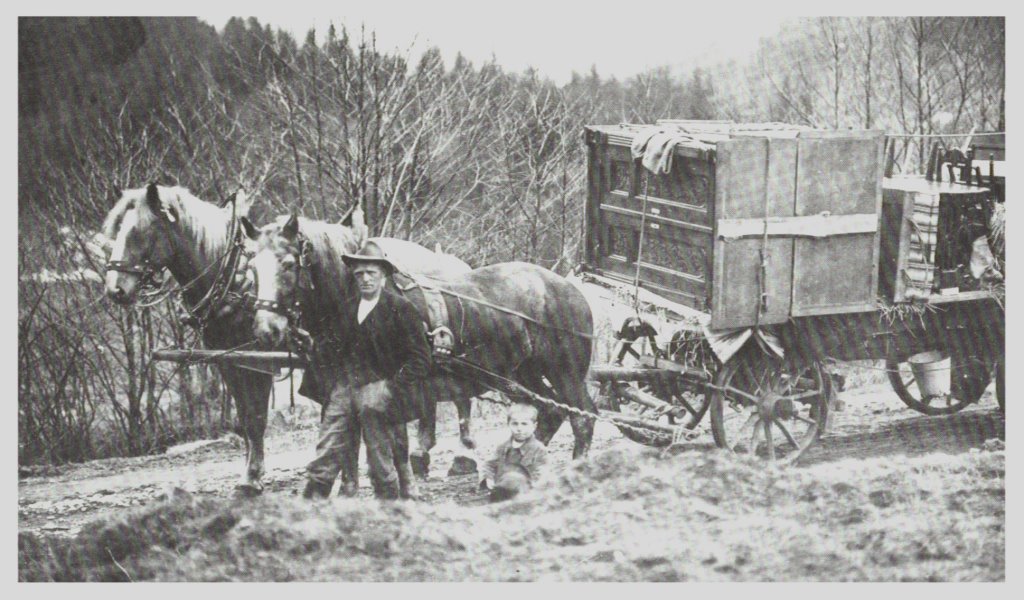
Kammerwagon (bedroom wagon) photo, Der Landkreis Regen in alten Ansichten

Shortly before the wedding ceremony, the bride’s possessions had to be transported to her new home. This was done with as much public display as possible, especially if the bride’s family was well to do. A wagon, loaded with furniture, linens, and whatever finery the bride was bringing to her home, was driven slowly through the village, giving everyone a chance to observe and comment.

The Wedding Day
The wedding itself usually took place in the late morning. As in Normandy and in the Hunsrück, there was a procession to the church, sometimes with musicians leading the way. The equivalent of today's bridesmaid and best man led the bride to the altar.

After the religious ceremony, the entire party made its way to the Gasthaus which, according to the article in “Der Blumenbaum,” was almost always located close by the church. Here a family would provide as fine a meal as their financial situation would allow. Those who were invited but who could not attend because of infirmity or farm duties were not overlooked. They received food packets, sent with friends or relatives and often wrapped in the women’s scarves.

After the wedding meal, it was time for the Hochzeitlader to perform his duties as master of ceremonies. The bride and groom usually sat at a special table that was covered with a white cloth. With them would be the Ehrenvater and Ehrenmutter. These were very honored guests, often a godparent or a grandparent of the bride or groom. The Hochzeitlader called the guests one by one to the table, announcing them with a polite phrase or sometimes a comic insult. There might be an appropriate flourish by the musicians as the family name was called, and guests were called in the order of their relationship to the bridal couple. Once at the table they would drink from the glasses of the bride and the groom and lay down the Mahlgeld, a contribution toward the expense of the meal as well as a wedding gift. Sometimes a well-to-do farmer would make a show of sprinkling just a few coppers or silver pennies in front of the bride and groom. As he turned away from the table he would surreptitiously slide his hand into his pocket, turn back to the table with his fist full of valuable Taler, pleased with his little joke.

When it is time for the dancing to begin, the newly married couple had the first dance. The Hochzeitlader was again in charge, deciding who, in turn, would be next to come to the dance floor. And he decided when it is time for the guests to go home. When he told the band to play the Rausschmeisser (literally translated it would be called "The Bouncer"), a piece of music that was known to everyone as the tune which ended the dancing, the celebration was over.

Thursday, October 27, 2005

Weddings, Hunsruck Style


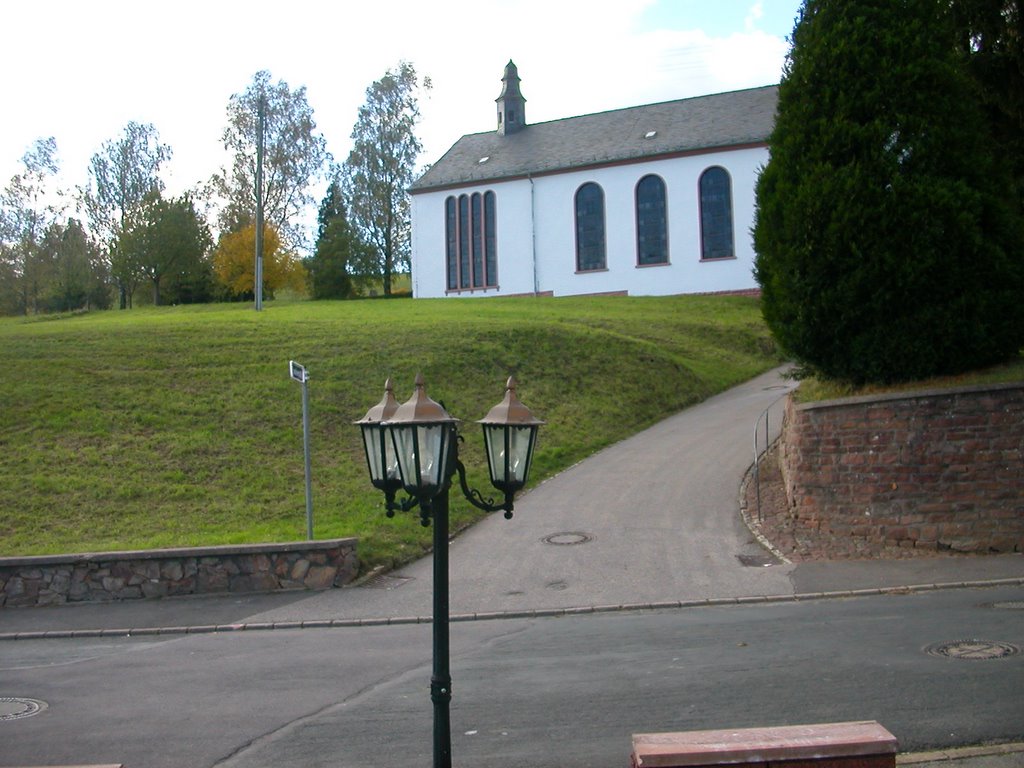
Chapel in Oberzerf


The Hunsrück mountain range is east of the Mosel and Saar rivers. These mountains, though not nearly as high as the Alpine ranges of Germany, do have elevations that are over 700 meters (about 2,300 feet high). There are many small villages in the Hunsrück; Oberzerf, my great-great grandmother's birthplace, lies in a valley at "the foot of the Hunsrück." (Der Hochwaldort Zerf am Fusse des Hunsrücks by Edgar Christoffel, Verlage W. Rassier, Saarburg 1981).

If you've read, "Weddings, Normandy Style," my previous post, you will notice both differences from and similarities to the Hunsrück country wedding which I am about to describe. I found these customs in the book, Die Hunsrücker Küche, Rezepte und Bräuche meiner Heimat, (The Hunsrück Kitchen, Recipes and Customs of my Native Land) self published by Christiane Becker in 1998.

Courtship and Engagement

Until the turn of the century, the rural suitor and the wedding agent were an essential part of the courtship process in the Hunsrück area. When a country lad was ready to marry, he would take along with him a sort of godfather to help him when in his courtship of a prospective bride. So when two men wearing white silk scarves appeared in a village on a Sunday, everyone knew why they had come. They would first unobtrusively scout the house and the outer buildings of the prospective bride's family. Only then would the talking get under way. If the suitor had good luck with his proposal, he and his "godfather", in accordance with custom would be invited to eat fried eggs and Schinkenspeck (fatty ham?). However if bread and cheese with Schnaps was offered, then both men knew that the suitor had been rejected.

Once the wedding offer had been accepted, the old custom of Hillich was sometimes celebrated. The "Freiersmann" or wedding agent would give the young couple a speech about the importance of the vows they were about to take. The bridegroom to be would then place a coin in the hand of his future bride which was called, not surprisingly, "Handgeld," that is, hand money. There followed a Hillich feast. In the 17th century, this meal became so sumptuous that the Catholic church took action against it. So in later times the Hillich meal was much more modest. Bread, butter, cheese, wine and beer were served.

On the three Sundays before the wedding, the couple's upcoming nuptials were "called" during the church service. It was an announcement to everyone in the congregation and probably also a protection for the young woman, making sure that her prospective husband was free to marry. Notices announcing the wedding had been nailed to the doors of the community bakehouse and the village hall. All of the relatives and neighbors had to be invited. So a "Hochzeitsbitter," was employed to invite wedding guests. He usually dressed in the kind of clothes one would wear for a feast. His hat was decorated with laurel and rosemary and he carried a brandy jug. After he spoke a wedding invitation, he poured out a small glass of brandy and offered it. He would receive a slice of bread in return.

The Wedding Day

On the wedding day, the Hochzeitsbitter received the guests at a breakfast of bread and brandy in the wedding house. The bridal couple would then leave for the civil ceremony at the registry office (probably in the town hall) which was required by law and preceded the wedding at the church. Often some kind of obstacle would be placed in the way of the wedding procession, perhaps a chain, a pole, or a ladder. This obstruction could only be bypassed by the payment of a ransom. As a reward for the payment of this "Trinkgeld," (literally "drink money), the men fired their guns, making a loud racket. This noise was meant to drive away the angry spirits which were said to be especially dangerous during happy times. In earlier times, fiddlers accompanied the bridal couple on the way to the church. As they walked along, the bridal couple delighted the youngsters by throwing small coins.

After the wedding, it was time for food. Although the people of the Hunsrück ate very plain food most of the time, a wedding feast was an exception. A cow or a pig was usually slaughtered for the wedding meal. In earlier times, each guest made a contribution to the cost. For the noon meal there might be a beef soup with egg and noodles, pork which was either cooked or roasted, beef with horseradish, bratwurst sausages, sauerkraut or white beans. As the author of the little book of recipes and customs says, "It was a plentiful table."

Monday, October 03, 2005

Weddings, Normandy Style


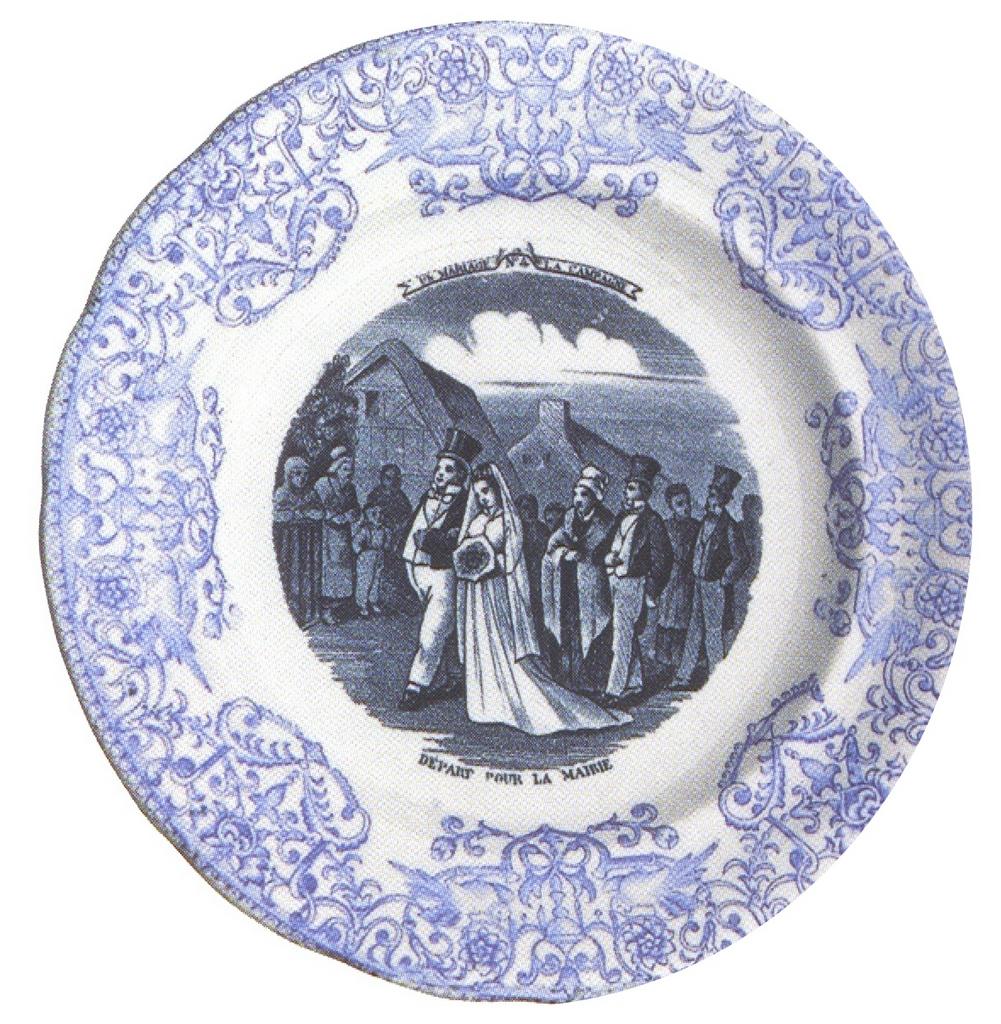
A decorative plate depicting a
scene from a wedding in
Normandy


What would courtship and a marriage ceremony held in 1849 Germany be like? That has been an nagging question for me in writing the story of my immigrant ancestors, Johann and Magdalena Meier.

Until 2004, none of the books or genealogical magazines I had read described a wedding in the Mosel/Saar area or any other area of Germany, despite the fact that it was a very important life event. By 2003 I was ready to go a bit afield. On a river cruise that followed the same route that Johann and Magdalena traveled to reach the port of Le Havre on their way to America, we docked at a village called Vernon. There, in a small bookstore, I found a book about Normandy in the 1890's. It contained a very long description (in French) of the marriage traditions and customs in Normandy's rural areas. Reasoning that parts of France and the Trier/Mosel region of Germany might have a number of similarities, I bought the book, and with the help of a friend who had studied French in college, I wrote down the courtship and wedding rituals.

Betrothal

In rural Normandy, courtship must proceed slowly, especially among country folk. Occasional sharing of a few words after church, an offer to help with a chore such as carrying a basket or bucket, then an evening at the party on the feast of the parish's patron saint or a strolling walk, until the day the suitor is ready to declare himself.

An older person acts as the matchmaker. If permission to marry is given, the engagement is announced. It is made official when the young man & members of his family are invited to a fine dinner at the home of the bride-to-be. It is also the occasion of the first gifts.

The bride prepares a trousseau but does not sew the wedding dress. This must be done by someone else to avoid misfortune. A few days before the wedding, the trousseau is transported with great pomp to the future home on a hand cart. In some places the cart is bedecked with ribbons. On the day before the wedding, the cooking utensils are taken.

The Wedding Day

Weddings were usually on Tuesday or Saturday. On the wedding day, the bride's crown is fitted with a small mirror set in a bezel and tied to the back of the wedding crown or headdress with a green silk cord. This is a symbol of virginity. After the marriage, it is removed and tied to the head of the bed.

While the groom dresses in a simple somber attire, guests are allowed to come to have something to eat and drink as they offer their presents. After the bride is dressed, the dressmaker attaches a cluster of orange blossoms to the lapel of the groom's jacket. Now the wedding procession is about to begin.

According to the distance to the mayor's office and to the church, the bride and groom either walk or go by horse-drawn carriage. Two violins go before, playing something "harmonious"; the bride on the arm of her father or in some places, the groomsman. The remainder of the guests walk behind. The civil ceremony at the mayor's office is short, the church ceremony being more important.

The bells ring out as the procession approaches the church. The husband places the ring on the finger of the bride. If the groom cannot get the ring easily over the knuckle, and the bride must finish it, it is then said that she will wear the pants in the family. After the ceremony, the newly married couple go to the sacristy to give a gift to the priest. Then they leave the church to the ringing of the bells. Sometimes sugared almonds or rice are thrown.

A painting by the artist Pierre Outin from the Musee des Arts et de l'Enfance in Fecamp which was used to illustrate the chapter also caught my attention. The costume of the bride and groom would indicate that the time period represented was the late 1700's. In the painting, the wedding party leaves the church and walks to the nearby cemetery where the bride places flowers on the grave of a loved one, probably her mother, as her new husband looks on. Standing back a bit from the couple is a gray-haired , sad-looking man, probably the bride's father.

The Celebration

The bridal procession reforms outside the church in order to walk to the home of the bridal couple, but usually the group is no longer solemn. There is joking, singing, even dancing. In families that are particularly well off, the people who have arrived at the home of the bride and groom go to the wardrobe to admire the trousseau, in which great pride is taken.

Some people who joined the procession that went to the church do not rejoin it after the ceremony. Instead they go to the public house to sing, dance and eat.

Now there is a wedding meal. The table is covered, usually with a white cloth and decorated with fresh flowers. At some time either during or right after this meal, the bride sings a song of thanks to her parents and confirms her separation from them. Then she sings to her husband and inlaws. The groom sings to his parents and also to his inlaws. A relative or parent of the groom sings to the bride. Sometimes others sing as well. After the songs, everyone dances until dawn.

On the first Sunday after the wedding, the priest welcomes the couple before mass and gives them their new place in the church.

(The preceding information is taken from the book, Il y a un siecle...la Normandie: La vie quotidienne des Normanands, by Hippolyte Gancel)
Want to Know More?
Since 2003, I have found descriptions of a Hunsrück village wedding as well as one of a rural wedding in Bavaria. Many elements of the three are so similar that I've decided to post them too and to draw upon them when I describe the February 14, 1849 wedding of my great-great grandparents that took place in the village church of Irsch, Saarburg, Rheinland. Look for Weddings, Hunsrück Style in my next posting.