Showing posts with label farm garden. Show all posts

Tuesday, September 29, 2015

The Harvest of Survival Food

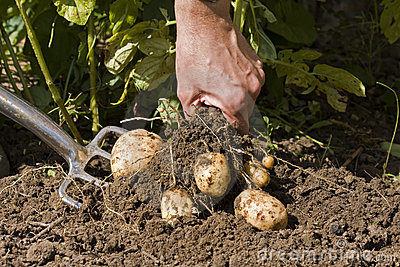
Digging potatoes
picture by dreamstime.com
Gathered cabbage
picture by Burpee.com

With September over, the autumn work on the farms in Kreis Saarburg in the 1800s was about to start. The successful harvest of two very important crops made the difference between a winter of sufficient food or of on-going hunger or even starvation.

The late summer months brought to an end the farmers' work in hay and grain fields. Many of those fields already were harvested and then planted for the next year. Now it is time for the autumn crops to join the hay and grains which are already stored in the barn.  All ages of family members are cutting, digging, picking and gathering. The grapes hang heavy on their vines (I have been told that almost every farm in the Saar River Valley grew grapes for their own wine making), and they will be harvested. The chestnut tree catkins of the spring now have turned a strong rust red inside their spiny covers and can be gathered up for cooking or roasted as a winter treat. The nut also could be ground into a baking flour.  The youngest children gathered the nuts and any fruits like plums and pears that could be dried for use in the cold months.
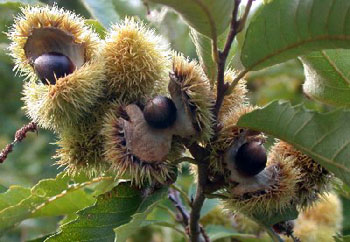
Chestnuts

Some of the hardest work of the autumn is bringing in the potato crop, a labor that calls for rugged days of digging and bending to get that year’s yield into storage in a cool dark place so that the potatoes will last for the entire winter.  All the peasant farmers depended on the potatoes as a major winter food source.

In a good year sacks would stand full and thick throughout the whole field. Parents and the older children worked together in the potato field. Each worker dug the potato stock with a hoe or fork which loosened the plant from the ground.  Next the potato stock was grabbed with the free hand and pulled from the earth, the potatoes mostly hanging tight to it.

 Usually three baskets were used for sorting the newly dug potatoes that were pulled from the stock or picked up from the ground where they had fallen from the stock. The big, thick potatoes went into the first basket, the little ones or those that had been damaged by hoe or fork were thrown in the second basket and used as food for the pigs. The third basket held the medium sized potatoes which would be used as seed potatoes for planting in the spring. The half dry stocks of the potato plants were thrown aside to dry. Landless day workers helped with the harvest for a share of the crop of the larger farms. At noon the housewife or the grandmother prepared a noon meal. Most fields were far from their farmhouse and their meal was carried to the field for them. There was laughter and gossip to make the work more pleasant.  At the end of the day, the sacks were loaded into a wagon and unloaded, usually into the cool dark cellar.

It took about three days to finish the potato harvest. When the potato stocks had dried completely some days later, the young would make a high pile ready to be burned. The roasting of potatoes once the potato stocks were burning was one of the highlights of the year for the the young.  It seems to have been the equivalent of a giant marshmallow roast.  They scraped the potatoes and held them on the fire with pointed sticks. The potatoes roasted to a very white delicate texture inside. They were also very hot. There were many shouts because of slightly burned mouths and fingers during the night of the big potato fires.


Bonfire of potato stocks
In 19th century Germany and for centuries before that, cabbage played a major part in the winter food supply of peasant farmers and craftsmen. Cabbage was their only winter vegetable.  The German word for cabbage is Kohl but in the Saarburg Kreis dialect it was and still is known as Kappes.

Kohl/Kappes is a vegetable that, like the potato, could help keep families from starvation during a long winter. This plant did not require a lot of ground space relative to the size of the head of cabbage that could be harvested from it. Like potatoes, cabbage could be kept all through the winter. Unlike potatoes though, the cabbage had to be sliced into a large barrel and made into Sauerkraut, a fermented cabbage.

The entire family was involved in the process of making sauerkraut. Two of the most important people in preparing sauerkraut were the cabbage cutter and the stomper. The father of the family or, at times, a migrant worker who went from house to house during cabbage season, was usually the cutter. The cutter placed a long board with a cabbage shredder embedded in the center over two stools. He sat on the board and ran the cleaned head of cabbage over the shredder. The finely cut cabbage fell into the tub placed on the floor between the stools.


Krauthobel (cabbage shredder)
When the tub was filled, it was emptied into a well-cleaned barrel, and other ingredients like salt, sugar, herbs, sour apples, and herbs like dill were added. In wine producing areas like Kreis Saarburg, wine was also an important sauerkraut ingredient and made what was called Weinkraut. Each layer of cabbage added to the barrel was stomped, usually by young sons (or daughters) of the family whose feet and legs were washed thoroughly and then covered with stockings called Krauttretensocke (kraut stomping socks). When the last layer of cabbage was in the barrel and stomped, it was covered with a round piece of wood that fit tightly and it was held down by a stone. According to the recipe book, Das Leibgericht, (The Favorite Meal) by Hans Fischer, sauerkraut making began about November 1 and the kraut was ready to eat after about 4 weeks of fermentation.

One interesting side note. I read that in the Hunsruck area, the bridal meal had to include sauerkraut as one of the dishes served because it was considered to be lucky. It is my suspicion that the origin of this story came from necessity since most weddings were celebrated between Christmas and Lent, a time when the workload was light for all the families and when sauerkraut was the only vegetable available on the bride and groom's special day.


Sources
http://paleoleap.com/eat-this-chestnuts/
Christiane Becker, Die Hunsrücker Küche
Joseph Ollinger, Geschichten und Sagen von Saar und Mosel.
Hans Fischer, Das Leibgericht.
Der Blumenbaum, April, May, June 2002


Monday, June 30, 2014

The Family Table

Hunsruck garden at Roscheider Hof Open Air Museum


Dibbelabbes

Quark
Mauseohr Plant


Leckschmier


When I decided to write a novel about peasant life in a small village in the Saarburg region, I didn't expect to have trouble describing food. It didn't occur to me that I would have to figure out what might be on the table for each meal of the day and how it was prepared. What did the cupboards, pots and kettles hold? As it turned out, preparing the daily meals was one of the most difficult of daily tasks about which to find information. Recipes were an oral process, passed on from generation to generation.  Although I grew up on a small dairy farm, conditions in the United States in the 1950s bore little similariety to those in 1850 Kreis Saarburg, the year my ancestors lived on their farms. There was meat on our table almost every day, there were recipe books, there were grocery stores, and our garden was just a few steps from the back door.

How different it was for our ancestors. Meat, so much a part of our daily diet was a rarity for the peasant farmer. It was seldom seen when the family sat down to their daily meal. For the Kleinbauer (small farmer) and Taglohner (day worker), there would only be such a luxury on very special holidays such as Christmas and Easter. For the farmer who was a bit better off, meat might be eaten on other holidays or for an important celebration such as a wedding or a reunion of more distant relatives.  Pork or goose was usually served on those occasions - any leftover meat could be chopped and added to dishes that were usually meatless.

Other than holidays and weddings, what was on the table on ordinary days? As one book put it "It was the duty of the married woman to take care of the house, to look after the children, to help with work in the field, to milk the cow and feed the small animals each day. In addition she was responsible for putting three meals a day on the table for the hungry mouths of her family. This could be the most difficult obligation of all, especially because most farms were small, the farmers poor, and crop failures common." How did the Hausfrau manage to feed a hungry, hardworking family?

Even though meat was rarely seen on the table, animals provided food in other ways. Geese might end up in roasting pans at Christmas; but before that happened, they produced eggs for main dishes when cooked, one of the ingredients in a kettle with many other parts or in a dough to be baked, when raw.

Peasant farmers with land of their own would own one or more cows since farmers rarely had horses for field work. They used their cows as draft animals to pull wagons and plows. At the same time, the cows provided valuable food while working the fields. There was milk for the cooking kettle, baking pan and the drinking mug. (Bit of trivia - in Germany mugs used for daily meals had no handles until the late 1800s).  Given their use as draft animals to pull plows and wagons, a cow's milk production would be much more limited than the dairy cows of today's farmer, but even so, milk was one of the most valuable of foods. Cow's milk provided a nutritious drink, cream for baking, or was mixed with vinegar and sugar (honey was the poor man's sugar) and used as a dressing for fresh greens. What was left after a day's use became a homemade cheese.

In the book "Essens-Zeiten" which can be translated as "Of EatingTimes," one hundred years of table scenes are pictured and explained. In the text for one of those pictures I found several paragraphs that summarize the work of a peasant woman who was also responsible for growing, gathering, preserving and preparing the food from the garden as well as knowing how to supplement it with wild greens and berries from the woodlands and fruit from the trees of the village apple orchard or the plum, pear, and peach trees that were part of some farms. The mild climate also meant that grape vines grew easily.

The garden was the place where the farmer's family turned in good times and bad. Field harvest times when the wife's help was needed in the fields was also the time that the produce of the garden was ripening. The children and those older relatives who no longer could labor in the farm fields were still able to work in the garden and teach the younger children how to plant, hoe, weed, and gather produce. Often the elderly grandmother and grandfather, with the help of the children, were responsible for the majority of the garden work.

Contrary to my American perception, the Kreis Saarburg gardens were not always close to the barnhouse. It might be a mile or more walk to care for and gather this food. Getting to and from the garden took time away from the other work that had to be done. Those lucky enough to have their garden on the barnhouse property would place it on the sunny side of the house. A good location was a matter of concern. The first land that a day worker or craftsman would buy, when he earned enough money to own a piece property, was chosen with the understanding that there must be a good place for a garden which would hold plants that could be wintered: cabbage, bush beans, turnips, carrots, onions, leeks, peas, and lentils. Every little corner of the garden was used.  Potatoes were not planted in the garden; they were a field crop, feeding both humans and animals.

The planting and harvesting of root vegetables from the garden saved many families during famine years. In 1790, according to one writer of the time, in Germany the potato was eaten every day in some kind of recipe. Even the poor had their daily potatoes, some with a bit of meat and most without. Steckruben or turnips were another staple, especially in the Eifel region of the Rhineland. In the book "Essens Zeiten which I mentioned above, an elderly resident says "Oh my, turnips, always turnips" for the meals.  Often all the peasants had to sustain them were potatoes or turnips. Soup was made with some flour, water, broth, and salt. Other root vegetables that saw families through harsh winters were beets, and carrots.

Herbs for seasoning and healing plants were common in the gardens. Even though space for growing food was of primary importance, most village families understood that ornamental plants like wallflowers, pansies, larkspur and field roses should be planted for the color and happiness they brought and planted those as well to have something for the soul.

Although it may seem that our ancestors in the Rhineland area had very poor nutrition, they did their best to vary their diets when spring and summer arrived. After a long winter of only root vegetables, it must have been a delight for them to have freshly picked food on the table. There were just-gathered vegetables, greens, and fruit in those summer months. It seems they were also somewhat aware of the health value of uncooked field greens because, as one book told me, they believed the dandelion leaves helped to fight off the fatigue of winter. The best months for gathering dandelion greens were April and May. One picked the dandelion if possible in the outermost edges of meadows, being sure that the heart of the plant was still looking yellowish. The taste of the leaves is somewhat bitter but savory in much the way radicchio is in our own summer salads. The leaves of certain other field plants added additional taste and volume to the spring and summer season's dinner. Another popular field green was the Mauseohrsalad (mouse ear salad), also called field salad.  It is still eaten in Germany today.

As soon as they were able, the children took on a share of the work. The girls learned how to cook at an early age by "doing." Recipe books would have been laughed at and they were far off in the future. These women and girls knew when they had added enough water or stirred the batter long enough to have it "look right."  Most cooks measured with their eyes, not with measuring cups.

Sugar was not readily available to peasant farmers but honey was. When a villager was in possession of a woven basket and some broom flower branches as a cover, he possessed his very own sugar factory. A bee shed could be made by pushing four long stakes into the ground, and a slanted roof covered with Ginster (yellow broom) placed on top; woven straw baskets were used as hives underneath. Broom grows wild all over Kreis Saarburg to a height of 3 to 5 feet and produces numerous long, straight, slender bright green branches, tough and very flexible. The bright yellow fragrant flowers are large, in bloom from April to July, attracting the bees.

Some Popular Recipes for the Tables of Kreis Saarburg 
(The dialect recipe's name comes first; then the more common German name)

I found these recipes in the book "Die Hunsrücker Küche" by Christiane Becker who inherited them from her grandmother. The book uses many dialect words in the instructions so I have done my best to give you an idea of the dish, at least listing the ingredients in popular recipes of the Hunsrück and Saar Valley of Kreis Saarburg.

Dibbelabbes or Schales (potato dish) This is a traditional dish of potatoes and onions in both the Saarland and the Rhineland. Dibbelabbes made of 4 lbs of potato, two or three eggs, salt, pepper, a tablespoon of flour, 3-4 onions and bacon striped with fat. Nadia Hassani (in her cookbook "Spoonfuls of Germany") has this piece of information on the origin of this interesting dish: "...a potato dish known as Dibbelabbes in Saarland is known as Schales or Scholet in the Rhineland Palatinate. Its origin she says, goes back to the Jewish Sabbath dish Cholent, a stew that was prepared on a Friday and remained on the stove during the Sabbath, when Jewish religious law forbids food preparation."  This was a recipe that held well and could also be taken to the field for a noon lunch.

Löwenzahn Salat (Dandelion Salad) was made using some sour milk, 2 hard boiled eggs, one small onion, one bunch of chives, 6 tablespoons of vinegar, 3 of cooking oil, and be sprinkled with salt, pepper and grated garlic.

Mauseohr salat (Mouse ear field salad, )  Field greens, often those shaped like mouse ears with a dressing of sour cream, salt, pepper, one onion, a bunch of chive, six tablespoons of vinegar and 3 tablespons of oil.

Kappessupp or Kohlsuppe (cabbage soup) The first ingredient was a legume, like peas or beans or lentils, cooked for one and a half hours and then set aside. Then green cabbage was cut in small strips and cooked in meat broth with peeled potatoes. Meat was added only for a special day or if the work of the day was to be very strenuous. The mixtures of the legumes and cabbage together in soup was a typical midday meal.

Rappsupp (No translation from dialect found) This soup could be made quickly and could be found on the table when the women of the house were helping with the harvest or on a busy washday. Vegetable or meat broth was cooked with finely grated raw potatoes and cream or egg yolk. Rapp is one of the dialect words no dictionary or Google translator could define.

Käsjer, Quark or Handkäse (homemade cheese)  The cows' milk could be used as a light cream, skimmed for the rest of the liquid, and used to make butter, a sauce for the fresh greens or an whipped cream for desserts. The rest of the milk, minus the cream that had been skimmed could be used to made hand cheese or Quark by separating the thickening milk from the whey. Both were used to feed the family. Quark, when finished, is a soft cheese that tastes like a mix of cream cheese, cottage cheese and sour cream. Since it's very mild, it takes on the flavors of the other ingredients you use it with and can be either sweet or savory.  The Molke or whey was a drink full of vitamins and minerals and could be compared to drinking buttermilk.

Leckschmier, Zwetschgenmus or Latwerge (plum or pear preserves)
.  I needed some translation help for this Hunsrück and Saar favorite   One recipe in English on the web called for 5 kg plums or pears; 1 kg sugar; cinnamon; anis; pounded cloves; and a little ginger.  The washed, pitted fruits are gradually added in a cast-iron pot and boiled together with the spices. It is important that mass with a wooden spoon to stir constantly to the bottom of the pot so that the Leckschmier does not burn. After 4-5 hours of cooking, the mass has become stiff and thick. It is filled in a well pre-heated stone pot after cooling, with a cloth cover and stored in a cool place. On freshly baked bread, thick coated with good butter, Leckschmier tastes especially good.

Einsäuern im Spezialgärtopf was a version of what we know as Sauerkraut.  It was and is common in the United States and recipes abound on the internet so I have not included the ingredients.  Crocks of this long lasting sour cabbage could be found in the barnhouse each winter.

Gefillte Krummbeere or Gefüllte Kartoffeln (Potato Pancakes) One recipe that made its way from the Rhineland to my family's table and is still a favorite is potato pancakes.   My mother never measured anything - I confess I need a recipe to feel secure about the amount of grated potato to be mixed with onion, flour, and egg.   My mother's were always the best.

There are many more recipes in the little cookbook I have been trying to decipher, but I have made a small start at painting a word picture of the family table, and it has been challenging but also enlightening.

If your ancestry is German, do you have a favorite recipe from the family table of yesteryear?


Sources:
German Foods.org
Christiane Becker, Die Hunsrücker Küche, 1992
Jean Morette, Landleben im Jahreslauf, 1983
Freilichtmuseum Roscheider Hof Konz Museum Guide, 2001
"Essens-Zeiten," eifeler Tisch-Szenen aus 100 Jahren 2002

i

Wednesday, January 24, 2007

From Field and Garden


Wattle fence at Rosheiderhof Open Air Museum

In the Trier region, a very old tradition survives to this day. Every year at Mariä Himmelfahrt on August 15 (the feast of the assumption of Mary into heaven), herbs of many kinds are formed into a bouquet or spray. They are brought to the parish church, where they are blessed. For that reason the Feast of Assumption is often called "Krautwischtag" or, literally translated,"herb bunch day." After the blessing, the herbs are brought home to decorate the family crucifix or taken into the stable to prevent illness of the cattle.

This custom indicates how important the herbs and plants of gardens and fields were to our ancestors, the farmers and villagers who lived in the region. Those who emigrated must have taken special care to bring many of their seeds with them to the new country.

*HERB TREASURES ALONG THE HIGHWAYS AND BYWAY


The Johanniskraut (Hypericum perforatum), St. John's Wort is a very common native, wild plant in the Trier region. It is a powerful herb which is anti-inflammatory, astringent and antiseptic. The mature plant has blossoms that leave the fingers red when rubbed. These blossom are placed in olive oil in a dark glass jar. It makes a very effective lotion for burns or it can be cut and dried to make a herbal tea. In alternative medicine it is considered a remedy for depression.


Beifuß or mugwort (Artemisia vulgaris), is also a very common regional plant. It grows along roadsides. Although it is considered a weed, people sometimes use it to spice greasy meat dishes such as the traditional St. Martin's Day goose. It contains Thujol, a stimulant similar to camphor.

Closely related and also common is Wermut or absinth wormwood (artemisia absinthium). It is used to produce a typical Eifel region liquor called "Badralsem." It is not distilled; instead the herb is soaked in alcohol. The resulting liquor is very bitter, and it is drunken as a digestive.

Often found growing together with Artemisia is the Rainfarn or common tansy (Tanacetum vulgare). It was thought to be useful in deworming cattle or, as late as 1931, as a brew for expelling worms in children.


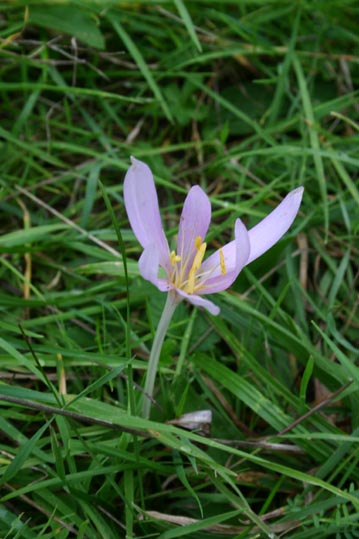
As would be expected, not every flowering herb along the road or in the meadows of the Trier region could be used in cooking or healing. The Herbstzeitlose which is commonly called the autumn crocus (Colchicum autumnale), grows wild. It's pretty appearance masks its highly poisonous nature. The settlers were, I'm sure, glad to leave it behind.


*A FEW CULTIVATED TREASURES OF YESTERDAY - AND TODAY


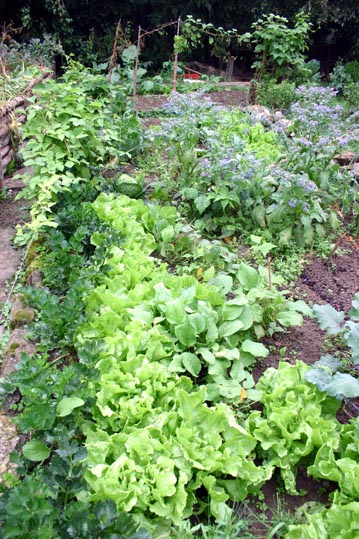
Almost every house in our ancestors' villages would have a garden, what is called the farmer's garden or "Bauerngarten." It represented a part of the owner's living space. It combined both practicality and beauty. Its vegetables were vital basic nutrients and by growing medicinal plants such as elderberry (for feverish colds), arnica for open wounds, peppermint and camomile for digestive problems, it became an apothecary as well.

Wattle fences (rods or stakes interlaced with twigs or branches) to protect the "Bauerngarten" had been in use since the Middle Ages and were common up until the late 19th century. Neither nails nor wire were needed in order to make such a garden fence. At the Rosheiderhof Open Air Museum in Konz, (picture at top of post) there is an example of such a fence made of twisted hazel sticks. The fence served to keep out grazing animals and chickens which ran freely around the village. Some gardens might have paths covered with tanning bark (oak bark) which kept down weeds because of the bark's high acid content.


The Ringelblume or Pot Marigold (Calendula officinalis)
was always found in the farm garden. It is used to produce a salve against wounds of all sorts as well as being decorative.

The Möhre/Karotte or carrot (Daucus carota subsp. sativus) has many names in Germany. In the Trier region it is called Möhre or Muart in dialect.

The Lauch or leek (Allium porrum) is eaten as vegetable or used as a spice. It was planted beside the carrots to protect them from bugs and mice.

The native bean of the region is the Ackerbohne or fava bean (Vicia faba). It is called Dicke Bohne in the Trier region, It has a very distinctive flavour and is a typical food in the region. In Luxemburg, smoked pork with broad beans or "Judd mat Gardebounen" is a national dish.

The Garten- or Stangenbohne (Phaseolus vulgaris) was an immigrant from America. This common bean was brought to Europe by the Spanish in the 16th century and became widespread in the region. The Schnippelbohnensuppe (cut bean soup) is a traditional dish in the region.

The Schnittlauch or chive, (Allium schoenoprasum) was and still is widely used in cooking. In the regional dialect it may be called bratzel or bretzel. Other herbs of the Bauerngarten: Bohnenkraut/Summer savory (Satureja hortensis), Dill (Anethum graveolens), Lorbeer/Bay laurel (Laurus nobilis), Kamille/German Chamomille (Matricaria recutita).


Sources:
Ernst Mettlach
Mrs. M. Grieve. "A Modern Herbal", 1931
Blumenthal, Bernd. "Museum Guide: Freilichtmuseum Roscheider Hof," 2001

Tuesday, November 28, 2006

Once Upon a Tree

Blackthorn or Schlehdorn
 Eberesche or European Rowan
Late autumn was the time of the year when our ancestors, especially the women of the villages in the Trier, Saarburg, and Hochwald regions, were preparing for winter. Before the cold and snow descended on the Saar Valley and the Hochwald, each family had to ready itself for the months when there would be no more available fruits, vegetables, or herbs in the gardens, orchards, or on the open land and the hillsides. They would preserve whatever was available to them, both for sustenance, for pleasure, and for healing.

In this post and in another to follow, the trees, bushes, plants and herbs - both cultivated and wild - that were so familiar to our ancestors, take center stage once again. Their vegetation helped our ancestors make their way through the winter season when the land was barren.

The Generous Trees and Bushes of the Trier/Saar Region

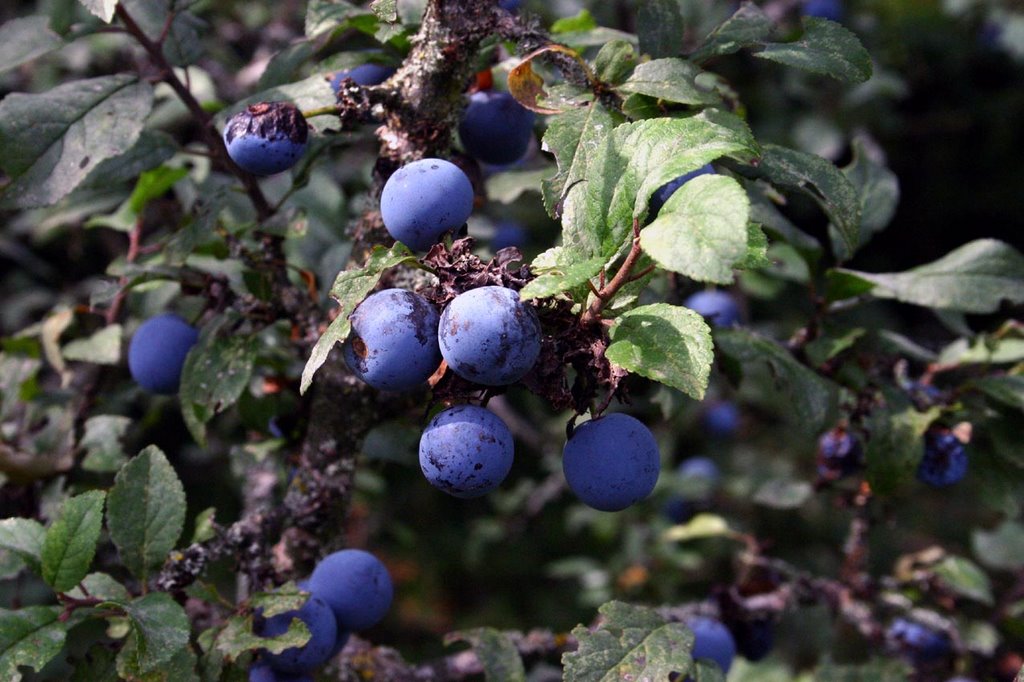
*The blackthorn or Schlehdorn is a very important plant in the Trier region and is primarily used for distilling a famous schnapps, for marmelade and for medical purposes. The blackthorn grows wild in the hedges that protect the fields from wind. The berry, called a sloe or Schlehe in German, is small and so sour and acerbic that you can`t eat it as it is. The berries sweeten somewhat after a winter freeze. The bush is well fortified by thorns; harvesting the sloes could be painful as well as slow work.

*The elderberry or Schwarzer Holunder is a native plant to the Trier area. It was considered a holy tree by the ancient Germans. It grows wild, sometimes as a bush, sometimes as a tree over 30 feet high. It has beautiful, luxuriant white flowers which turned into berries by autumn. (If you dip the blossoms in a pancake-type dough and fry them, then sprinkle them with surgar and cinnamon, you have a delicious treat). In the autumn, the berries would be gathered and used to make a syrup (sometimes mixed with apple) for drinks, marmalade or jelly. The syrup was also used as a cough medicine. Last but not least, elderberry liquors could also be made from the berries. An old farmers' saying in the Hochwald: "A man takes off his hat for the Holunder."

*The  Eberesche or European Rowan(Sorbus aucuparia), which is known in Germany as the Eberesche, or Vogelbeere, was very common to the region and often grew, as does the elderberry, in the hedges that enclose the fields. The berries are edible, but too sour to eat raw. In years gone by, it would have been used for making a Vitamin-C-rich marmalade. In some parts of Germany the berries were distilled. But now the berries are mostly a food for the birds rather than a source of food for hungry households.

*The beach nut tree, Buche, was another important tree in days of old. The beach nut or Buchecker was food for the pigs that were driven into the forests in summers past. During bad times, the beach nut was human food as well, and the oil of the nut could be pressed out of it.

*The walnut tree(Juglans regia) was well known; it grew everywhere. Every farm had its walnut tree in days past. This tree was brought to the region by the Romans.

*The *sweet chestnut (Castanea sativa) was also brought by the Romans. The edible chestnut, called Keste (fruit and tree) in dialect, did not grow everywhere; but could be found around the city of Trier or anywhere there was red sandstone. The chestnuts were gathered and then roasted or cooked. (They are very good partnered with sweet Viez or the new, sweet wine). During times of famine the sweet chestnut was used as an ersatz flour.


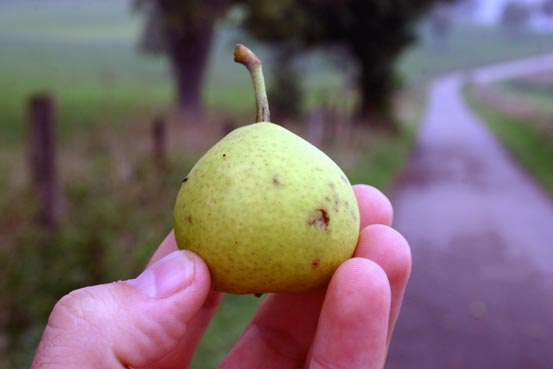
*The Sievenicher Mostbirne" is a very traditional tree of the region. Its fruit cannot be plucked from the tree and eaten as a fresh fruit because it is very sour. But the pears can be used for distilling and when mixed with quinces, the Sievenicher Mostbirne makes flavorful, delicate jellies and marmalades.


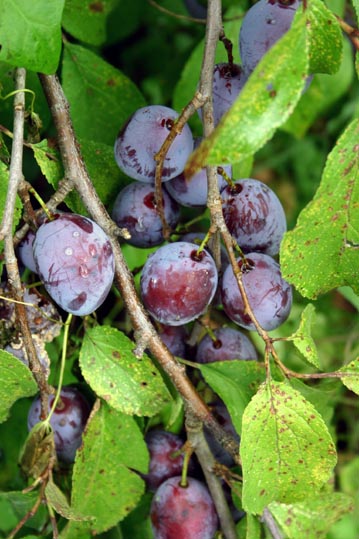
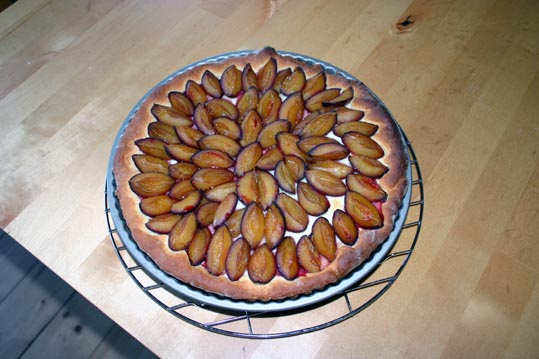
*The Zwetschge (Prunus domestica subsp. domestica), is very important in the region. In the Trier dialect it is Quetsche, in English a damson, which is a small, purple plum.  The tree on which it grows looks quite similiar to the apple tree and very often occupies the same orchard. The damson is distilled, giving a schnapps called Quetschenwasser. A delicate marmelade or mush is produced from it, spiced with anise seed and cinnamon. In autumn, when the plums are harvested, they are the used to make a delicious coffee-type cake which is very typical for the Trier region and is called "Quetschekooch" in dialect.


Cakes made with yeast are traditional for the region and no autumn goes by without Zwetschgenkuchen. Here is a recipe from Ernst Mettlach, and my effort at converting the measurements to the US system:

You need Zwetschge plums cut in fourths or, if they are small, in half.
20 grams yeast (3/4 oz)
250 grams flour (scant 9 oz.)
100 mililitres Milk (about an oz.)
1 egg
60 grams melted butter (about 2 oz.)
50 grams sugar (1.8 oz)
a little salt.
Sieve the flower into a bowl and form a hole in the flour. Put the yeast in the hole and sprinkle a spoon full of sugar on it, then add 2 or 3 spoons full of lukewarm milk. With floured hands, mix into a dough and let then let it rest for 15 minutes. Mix the egg and the rest of the sugar until its foamy. Add the salt, the rest of the milk and the butter. Knead everything together and let it again rest for 20 minutes. Then knead it again, roll it out on a board covered with flour, put in a cake form and wait 20 minutes more. Then lay the plums on the dough, and put the "Quetschekooch" in a pre-heated oven (350 degrees Fahrenheit) and bake it for about 45 minutes. If the plums are sour, sprinkle them with sugar. Serve with whipped cream.

The *cherry tree; and *the mirabelle plum tree were also found throughout the region.

Information from Ernst Mettlach and from the book "Die Hunsrücker Küche" by Christiane Becker