Friday, May 31, 2013

From 1861 Irsch Kreis Saarburg to 1863 St. John Wisconsin

The Old Home
Photo from www.Irsch/Saar.de


The New Land
If you read posts on this blog regularly, you will recognize the name of the author of today's post which I have translated into English - Ewald Meyer. Herr Meyer has written two books, one about the village in which he now lives, Irsch; and one about the village in which he was born, Beurig. Those two villages are about a mile apart. So Ewald Meyer definitely has a wealth of information on the history of these two villages in Kreis Saarburg. 

Herr Meyer and his wife Helena have become good friends who continue to help me with my research whenever I need some elusive information on life in Kreis Saarburg or translation from the old German scripts. To my surprise, this month Ewald Meyer wrote a piece about Irsch's Germans in America for the Irsch monthly on-line newsletter. The family he described just happen to be my great-great grandparents, Johann Meier and Magdalena Rauls and their children. He wrote in German so, although I was bursting with pride and wanted to share my delight, I could not refer my friends or my blog's readers to a URL. Therefore I did my best to translate his article as my blog post for this month.

With apologies for any translation mistakes I make with my self-taught German, this is my attempt to share the May Irscher Newsletter article writtem by Herr Meyer to be read by the residents of Irsch, Kreis Saarburg, Rhineland, Germany."

GERMANS IN AMERICA 
by Ewald Meyer 

"During the colonization period of the United States of America, Germans were the largest non-English-speaking population. Around 1900, Wisconsin had about 2 million inhabitants, 710,000 of whom were of German descent. 

After publishing a list in 2002 of emigrants to the United States in the "Irsch Chronicle" on the Irsch Homepage, descendants of Irsch immigrants to the U.S. finally had an answer to their questions about the German home of their ancestors, "Where is Irsch in the former Prussia?" From then on, continuing to this day, a flood of requests for information have been received over the Internet. Visitors from overseas who are looking for their ancestors are not rare in Irsch. 

A particularly strong connection exists between a woman from Waukesha, Wisconsin and our family. For the time being, she has intensively researched the history of the emigration of her great-great grandparents: John Mayer (Meier, Meyer, Maier) from Irsch and Magdalena Rauls from Oberzerf. She is writing a book about them. In advance of that, extensive information on the project is contained in her versatile blog about Irsch, indexed on the Irsch-Saar website and called "Village Life in Kreis Saarburg, Germany" It is under the "Documents" link. To date, she has traveled to Germany four times and now calls our country "my old homeland."

In April 1861 her great-great grandparents with their family and some other families from Irsch started on their way to Le Havre. After receiving the naturalization permit, the 35-year-old John Mayer and his 33-year-old wife Magdalena Rauls Meier with their 10-year-old son Mathias; the 7-year-old daughter, Anna; the son, Johann 2; Michael,10 months old; and a 50-year-old uncle left for America on board the sailing ship "Rattler." A total of 197 passengers were crowded into it, including yet more families and people from Irsch. Thirty-two days after a perilous voyage across the Atlantic, they reached the Port of New York on 9 May 1861. 
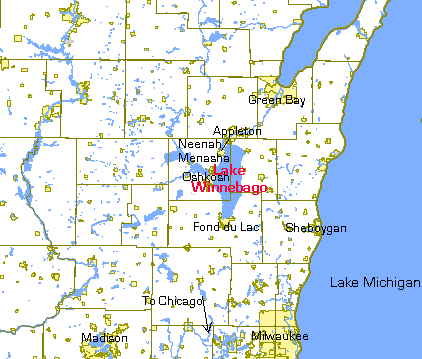
At length they settled in St. John, Wisconsin where already by 1856 some former immigrants from Irsch had joined a few others in this near wilderness in northern Calumet County. Possibly among them were John Mayer's sister Anna, born on February 26, 1829 and brother Michael, two years younger. The early years of the settlers were marked by hard work to convert the forest land into fertile farmland. Today, St. John in Woodville Township is located between Lake Winnebago and Lake Michigan in one of the most fertile farmlands in Wisconsin.

Since the settlers were almost all Catholic, in 1862 they established a parish church built of wooden logs. Between 1862 and 1869, the parish was run by the pastor from another village called Hollandtown (because it was first settled by emigrants from Holland). He came once a month to celebrate the Mass and the sacraments. In 1865 a new church was built because the log church was now too small for the church members. It was consecrated by the Archbishop of Milwaukee and dedicated to St. John the Baptist. The old log church became the first school building for St. John. The children of the settlers of St. John were taught by Theresa Wolf, a German Catholic who had, with her parents, immigrated a short time before. In 1870 Father Anton Leitner became the first priest of the parish.

 The parish of St. John celebrates its 150th anniversary this year on three Sundays in May, after re-establishing the original stones in the old part of the cemetery and doing extensive renovation and restoration work on the church. The Centenial festival committee was led by Joe Kees and his sister, two descendants of an early Irsch immigrant, Michael Kees, their great-great grandfather. The religious belief that originated with the St. John founders is still conserved and living today.

St. John the Baptist Church, St. John, Wisconsin
St. Gervasius and Protasius Church in Irsch
Photo from www.irsch/saar.de


Ewald Meyer, Germans in America,  htpp://www.irsch/saar.de


Sunday, April 28, 2013

"America Letters" and a Wisconsin Catholic Church


This year the small village of St. John, Wisconsin will celebrate the 150th Anniversary of its parish church, established in 1862 and dedicated to St. John the Baptist.  Since this is a blog about the life and customs of villagers in Kreis Saarburg Germany and the small villages of Irsch, Zerf/Oberzerf, it may seem strange that I am writing a post about an American Catholic church.  But this is not just any Wisconsin Catholic community and church.  It became the new home for a very significant  chain emigration from the village of Irsch to the village of St. John.

I want to write about a generally unknown and uncelebrated early settler, perhaps the earliest person of all to take his family and leave Irsch, Kreis Saarburg, and settle in St. John, Town of Woodville, Calumet County, Wisconsin.  Unfortunately, he has somehow been missed when, over the years, the storis of this settlement have been written

There is another reason for writing this post beyond the identity of the man who is probably the first settler of St John.  It is also a great example of the effect on emigration from Germany of the “America Letters,” as mail from the United States came to be called.   When such letters crossed the ocean to be read by the relatives and villagers of the old homeland, many people who had been doubtful about leaving now dared the trip across the Atlantic to a strange country.  At least one of those letters, long lost, surely came from a resident of Irsch who settled in a place he liked and told others in his German village about it.

I was not paying any attention to the St. Gervasius and Protasius church records of Philip Thomas and his family when I searched for my Irsch ancestors.  I was trying to figure out why Johann and Magdalena Meier had chosen to live in tiny St. John,Wisconsin.  They had selected this remote area of Wisconsin to be their home for the rest of their lives.   Other emigrants from Irsch did the same thing.  It was good farming land, of course.  But why this farm land?  

There was one reason that seemed likely.  Someone in the group of families from Irsch who became the first link in the chain of emigrants from the village of Irsch, sailed in March of 1861 to settle in St. John.  Someone must have had a relative who would be waiting for them, I reasoned, someone who had given advice on how to make the trip based on experience.  In other words, a former Irsch resident who was writing "America letters."

I searched the centennial books created for the St. John Parish anniversatries in 1962 and in 1987 to find a name that was not on the list of residents, as recorded by the immigration officials in Saarburg, who had traveled to Wisconsin in 1861 and 1862,  These people were listed as the very first emigrants from Irsch.  But I doubted.  Like Adrian Monk, the quirky but amazing detective on one of my favorite TV mysteries, I tried to find motives and clues others did not recognize; someone who had arrived before 1861, who had not been listed in the records of the time (the careful filing of documentation only started about 1860-61) and who was now hiding in plain sight, waiting to be discovered. 

I started with the 1860 Federal Census of the United States for the Township of Woodville in Calumet County.  This was in the days before so many records were digitized and available on the Internet.  I stuck my head into a dunce-cap microfilm reader at the library and scanned the Town of Woodville census line by line.  I believed I would recognize a family surname from Irsch.  I had spent so much time reading and rereading the microfilms of St. Protasius and Gervasius Catholic Church at LDS branch libraries that I had most of them memorized.  It was as if I myself had been born in that town and could say, “Yes, that’s an Irsch name all right.”  I had to search the census twice but on the second try, I found a name I thought might be the one I was looking for: a farmer named Philip Thomas, born in Prussia.  He had a wife and children and, as I thought, all had been baptized in Irsch.

Philip Thomas was born in 1808 in Beurig.  He was a Landwirt (a farmer who owned land) in the village of Irsch, married to Anna Britten of Irsch.  Philip was 48 years old, hardly the time a man might have been expected to leave the village he had resided in for so many years and make a harrowing trip.  Why did he do it?  His good luck in raising several children beyond the time of most danger for early death, worked against his staying in the Heimat.  He had four sons and two daughters.  His land holdings in Irsch, probably not very large, would by law be divided into six parts after his death, both sons and daughters inheriting.  This was a law imposed on the area when they were a part of France and never changed after Prussia took power.  Like so many emigrants, lack of land for the children to inherit and survive was most likely the motivating factor for Philip Thomas' decision to leave Irsch.

The Philip Thomas family arrived in the United States in June 1856 according to Philip's first papers in which he swore his intent to become a citizen of the US, and renounced the emperor of Prussia.  The Calumet County courthouse is where he filed his petition for citizenship on 1 April 1859.  In July 1860, the US Federal Census of Wisconsin lists him with $1,800 in real estate and $250 in personal estate in the Town of Woodville, Calumet County Wisconsin.

Philip’s wife, Anna, was the sister of one Heinrich Britten who still lived in Irsch.   The two families probably maintained contact through letters.  Philip would have described the availability of good, low-priced farming land with lots of trees that would leave the soil rich once the land was cleared.  It would also would provide logs for houses and barns. Evidently Heinrich began planning to take his family to Calumet County to join his sister and brother-in-law,  sharing the content of these America letters as well as his plans with his neighbors.  These families, including the family of Johann and Magdalena Meier, my 2nd great grandparents, decided to emigrate as a group.  In March 1861 they began their travel together from Irsch to the Port of Le Havre in France on their way to join the Thomas family.

I cannot produce any letters that Philip Thomas sent back to Irsch.  My evidence, I know, is circumstantial, but similar letters are recorded in a book called News from the Land of Freedom: German Immigrants Write Home, edited by Walter D. Kamphoefer, Wolfgang Helbich, and Ulrike Sommer.
  
I think I may, with my circumstantial evidence, get Philip Thomas and his family noted among the first settlers from Irsch to St John.


Saturday, March 30, 2013

Palm Branches, Pussy Willows, Boxwood and More


Pope Benedict with palm branches familiar to us


Boxwood "palm" branches on a pole
Pussy willows on Palm Sunday

It is a common mistake of mine.  I assume the way we in Wisconsin do things now (or did those things in the early years of my life) must be the way they are/were done in the European countries so many of our ancestors came from.  I remember my Palm Sundays, standing in church while the Priest said prayers of blessing over the palm branch I held tightly.  My palm branch looked just like the one carried by Pope Benedict in the picture above.  When I came home, my mother showed me how to braid (I am still not good at this) or curl the fronds.  The branch was placed behind the crucifix on my bedroom wall, to be replaced in one year by a new one.  End of story.

So  I had no plan to do a blog post about Palm Sunday because I assumed most readers would have a familiarity with such a palm branch.   Then I had an e-mail from a friend who lives in France near the German border.  She told me that her youngest granddaughter, who is five+, was anxiously looking forward to her first Palm Sunday service, which she would attend with her aunt. My friend said she herself was planning to spend the day before Palm Sunday with her granddaughter whom she loves dearly.  She would take her some boxwood from her own yard.  Obviously this was a different experience than the one which a child in an American Catholic Church would have.

A French website was able to shine some light on the use of palms versus boxwood:

The Gospel of St. Matthew says that the disciples were cutting branches from the trees and strewed the road (Mt. 21/8). These branches were probably olive branches.  Species of tree branches used today are varied. Palm branches are carried in processions in some regions like the southern provinces of Spain and those of Portugal. In most French departments, they have been replaced by boxwood.  In some, like Provence, the branches of laurel and olive trees are carried.  They use olive branches in Italy and parts of Spain. In England, they carry goat willow; in Holland, holly.  In Poland willow twigs symbolize rebirth and resurrection. Germany and Alsace often form a plant which is on a wooden rod adorned with boxwood and/or other branches and decorations.

It became clear to me that many people who come to church on Palm Sunday already have their hosanna branch, whatever the type, firmly in hand.

That brought into question what people in the land of my ancestors did with their "palms" after they were blessed.  A book with the title (translated) "Stories and Legends from the Saar and Mosel" by Josef Ollinger answered that question in more ways than I had ever thought possible.  Most of these beliefs and customs were from olden times in the small country villages.

The blessed branches were a  protection against sickness, crop failure, and disaster and were reverenced in many ways during the course of a year.  Villagers in farming communities in the Mosel and Saar would make use of the pieces/ twigs of the blessed branches, possibly on the same day that the "palm" branches had been blessed:

*A piece was placed over the house door to protect the family.

*Each crucifix in the home had a piece of the "palm" branch behind it to protect the house from sickness and disaster.

*The small holy water founts in each room held a little piece of a "palm" branch.

*Another small piece was taken to the cellar to prevent spoilage of the vegetables that were kept there.

*In the stable, the stalls of the animals had pieces of "palm" to protect them from sickness.

*The part of the barn where equipment was kept and the grains were stored received a piece of "palm" branch to protect from lightening and fire.

*A part of the blessed "palm" was burned in in the oven so that the smoke going to heaven would protect the house from lightening.

*A piece of palm was inserted in each field in the land belonging to the farmer, in order to beg God to give a good harvest.

*Young men put a piece of "palm" on their hat;s young girls wore a piece at their breast.  The author doesn't say this, but it seems that palms might have been considered a help in finding a sweetheart.  It also occurs to me that a sprig of boxwood or pussy willow would be the most attractive form of "palm" to wear.

*It was believed that if a "palm" leaf was chewed and swallowed, it would protect against a fever.

*When someone died, the hands of the deceased were folded holding a rosary and a "palm" branch.

*In the cemetery, if the grave had a holy water holder to bless the grave of the deceased, a piece of blessed "palm" would be included.

Some might call all of these customs mere superstitions of an uneducated class of people.  To me it shows the humility of people close to the earth and aware of their dependence on something much greater than themselves.

Sources:
http://92.catholique.fr/faq/fetes_rameaux_liturgie.htm
Ollinger, Josef, "Geschichten und Sagen von Saar und Mosel, CONTE Verlag, 2005


Thursday, February 28, 2013

A Place For Small Things


A very small book on wine from my favorite Saarburg bookshop and a wine cup from Irsch, the home of my Great-great grandparents 
A "must purchase" at Saarburg's Golden Autumn celebrarion


The shelves where my bits and pieces reside

On many visits to Germany and especially Kreis Saarburg, I have brought home a heart full of extraordinary memories, a head full of vivid impressions and often also a suitcase with large envelopes or folders filled with materials from an ancestral search which had been singularly successful. I have never been able to return home from a trip to Germany (or anywhere) without souvenirs as well.* Due to space limitations of my luggage and the strength of my back, the souvenirs were usually small things that reminded me of a happy occasion or something special I had seen. I treasured them and put them on my dining room table as soon as I unpacked and for a time, there they stayed.

After a few days I looked at them less and knew it was time to find a permanent place for them. So often, they did not fit together in a lovely grouping.  They were usually rather small and could not stand alone.  Should I pack them away?  I knew that I would want to see them now and then and be reminded of the Alte Heimat. Fortunately, I have a very large, glass-door bookcase in my dining room.  On two of the shelves I keep a few books in German and my German treasures. When I want to see my memories, they are in the best of all possible places.


Bits and Pieces for Your Ancestral Information "shelf."

This blog post is not about my souvenirs although you may be wondering by now.   It is about something that strikes me as very similar. As I write my blog posts, I will come across "lovely or curious small things" that remind me of my little souvenirs. Each is a piece of information not large enough to make a whole post. But there will be times when I, and hopefully you, will want to look at one of these little gems because it is uncommonly important to your understanding of an ancestor's way of life or because a surprisingly few sentences will sometimes be as full of information as an entire chapter in a book or a full-blown post on this blog.

The Ice Saints
This short piece of information explained a phrase I'd heard since I was a child.  One of my aunts who loved to garden always talked about the "iceman days" in spring.  I had no idea this was a Germanic piece of history.  The belief that the killing frost days in May came from the old homeland.  Sometimes only three, sometimes five saints with feast days in May were known as the "Eisheiligen" or Ice Saints.:  May 11, the feast of St. Mamertus, May 12 the feast of St. Pankratius, and May 13 the feast of St. Servatus.  Two other Saints are often added to the Eisheiligen - May 14, the feast of St. Bonifatius and May 15, the feast of St. Sophie.  The tradition seems to have been confined to northern and middle Europe, especially the areas in and around France, Germany, and later, Sweden.  Most often, the number is three, but some places also add Saint Boniface and Saint Sophia (as "Cold Sophie") to the original trio.  So beware planting before the feast of "Cold Sophie" even if the feast of Saint Boniface is a beautiful warm day.

Schneeglöckchen
These are little flowers that bloom earlier than any other plant in Germany. Snowdrops, the very early forest wildflowers of spring, are poisonous but beautiful. Schneeglöckchen means little snowbells in German, ("littlesnowbells"), the three words written as one, something very common in the German language The plant is native to a large area of Europe, stretching from the Pyrenees in the west, through France and Germany to Poland in the north, Italy, Bulgaria, Northern Greece, Ukraine, and European Turkey. It usually pokes it head through snow around the spring equinox although it can sometimes be found as early as late February. The flowers were probably the first welcome sign to our ancestors that spring was on the way.

Mosellied
In the year 1846, the Casino in Traben-Trarbach on the Mosel, came into being.  It was a rather elite club for gentlemen.   At times it was even frequented by Prince Wilhelm of Prussia.  The board members of the Casino, with a goal of saving and enhancing the culture of the area, decided an anthem should be composed to celebrate the Mosel River.  A wagon load of Mosel wine would be given to the winning entry.  A total of 171 entries were received.  Under a point system devised by the board, the song, "The German Rhine Bride," was chosen.  It told of the meeting of the Rhine and the Mosel (at Koblenz) as a wedding of the two great rivers.   It was the submission by Julius Otto of Dresden; the melody composed by his father.  The load of Mosel wine (1,350 bottles) went off to Saxony. As time passed, it was obvious that the song was not being accepted by singing societies. The text was too dry, some said.  Others thought the song was too long.  After a year, the casino jury met again and chose another song,"In many German lands" or more simply, Mosellied (Mosel Song).  The song was rehearsed by the glee club "Liederkranz" of Trier and spread like wildfire among the singing societies along the Mosel.  The new anthem's text was written by Theodore Reck and the music was composed by the Trier cathedral's organist Georg Schmitt.  It did become the anthem song for the Mosel and is still sung today.  Unfortunately, the wine stayed in Dresden. 

The Postal Coach
In the 19th century, Zerf had the service of a postal coach as did most of the small villages.   It also was available to carry passengers, but riding in it was no pleasure. Few people used this method of transportation because of the discomfort and lack of space inside, the hard wheels and thin padding of the seats. Every bump and pothole would be felt. The coach was hot and dusty in summer and cold and wet in winter. The horses were changed periodically and one of such places was Zerf, probably at the Gasthaus there. In addition to the discomfort of the ride, most of the inhabitants of Zerf and Oberzerf did not have enough money to pay for a trip, even one as short as a visit to Saarburg. Traveling on foot, or a journey by horse and wagon were the usual ways for a villager to travel to the Kreis Stadt, the equivalent of a county seat in the USA.

Stress Exclamation 
In moments of severe frustration or anger, I have been told that my Kreis Saarburg ancestors might have blurted out "Majosebetha," a combination of Maria (the Virgin Mary), Josef (St. Joseph) and Elisabetha (St. Elizabeth).  The exclamation is sometimes still used today.


*On my first visit to Irsch, I met my distant relatives and came home with a gift of three bottles of Riesling wine made from the choice green grapes grown in Irsch. I carefully packed the bottles in my carry-on luggage, and I prayed that there was no law that would prohibit me from entering the country with them. If U.S. Customs had not let me into the US with that wine, I think I might have stayed outside of the baggage claim area asking everyone in line for passport check if they had a corkscrew. 


Monday, January 28, 2013

The Nursing Madonna of Beurig


This amazing Madonna in its Catholic pilgrim church was unknown to me until 2002 when Ewald Meyer brought me from his home in Irsch to Beurig to visit it. That was a trip of about one mile. Herr Meyer had grown up in Beurig, which in former centuries, (sometimes only 88 people) would rightly have been considered a tiny village. As early as the 16th century, however, the church in this small vilage was as much a pilgrimage site as Lourdes, Fatima, and Santiago de Compostela. It was visited by numerous pilgrims from neighboring countries. All of my Rhineland ancestors must have known this pilgrimage site, visited it, most likely as part of a village pilgrimage, and been awed by it (The hardship of their pilgrimage was not impressive as most lived within 10 miles of it). Ewald Meyer, as a resident of Beurig, regarded the pilgrim church and the Madonna that it was built to protect as a source of pride for the village of his birth. A few years ago he wrote an extensive chapter about it in the book, Beuriger Lese- und Bilderbuch.

On the day we visited, Herr Meyer described, in German, the interior of the church and the location and size of the former Franciscan abbey. That order of priests and monks had been put in charge of the pilgrimage church in the 17th century. My German was not good enough to understand a lot of the detail in his explanation. But I did understand and laugh when he called my attention to a corner across from the entrance to the church. It was, he said, the former location of a bakery, because the pilgrims had been fasting and were very hungry when their pilgrimage was over. Those bakers understood how to select a good market place for their breads.

I really didn't appreciate the significance of the Beurig Madonna during that first visit. She was dwarfed by the fine late Gothic-style church built for her. I knew she was venerated and that some people were said to have experienced miracles through her intercession after they completed a pilgrimage to this site. I didn't look closely at the statue, carved by an unknown artist, on that first visit, and I completely missed something rarely seen on any statue of the Virgin Mary - her uncovered breast, about to give nourishment to her child, Christ, as he looked up into her face.  The statue is small in proportion to the tall altar piece in which she rests.

The Nursing Madonna

According to legend, the statue of the nursing Madonna - in Latin called "Madonna lactans" - was discovered by a miller’s apprentice. He found the wooden figure in the branches of an oak tree, which was being propelled downstream during a flood of the Saar River. This is said to have happened in the year 1304, which is also regarded as the first year of pilgrimage. The moment the villagers heard the story, they flocked to visit this miraculous Gnadenbild (image of the Virgin and Child).

A printed brochure once distributed to visitors to the pilgrimage site explained the story with a variation as follows: A miller's lad was making his way home through the Kammerforst (a woodland at the border of Beurig) when the evening church bells rang out. The bell known as "the angel of the Lord" rang out and was answered by a heavenly voice that led the boy to the statue, which was in the branches of an oak tree.

The representation of the nursing Virgin seems to refer to the Gospel of Luke (11:27) "Happy the womb that bore you and the breasts you sucked." However, this representation was not considered proper with the Catholic Church authorities of the times. Very early on it was "veiled" so that only the head of the baby could be seen. The rest of the child's body and the entire body of the Virgin Mother were covered in a very ornate dress of silk. From 1512 until 1955, the Madonna of Beurig looked very similar to other religious statues of the Madonna.

The restoration of the original icon was done in 1955 under Pastor Weber.  It was the first time in almost 500 years that a Beuriger congregation would see the original grace and expressiveness of the Virgin Mother's image in "unclouded beauty," with her right arm holding the infant as safely as if he sat on a throne. The intimate relationship between mother and child is evident and touching as I discovered in my second visit to the Madonna side chapel.

Mary's crown was not a part of the figure until the early 20th Century.  Retired Mayor Nicholas Ritzler wrote in 1912 in his History of the Castle and Town Saarburg: "A proof of the high veneration for the Beuriger Madonna gave rise to the solemn coronation a few years ago..." His description is probably based on the Jubilee pilgrimage of 1907.

The Pilgrims

Pilgrims came immediately after they heard the news of the discovery of the miraculous image. The first pilgrimage chapel was a small building of clay and wood. In 1330 a Marian society was established, which continued in existence until 1803. In 1479 the wooden chapel was replaced by a small stone church, but this too soon proved too small for the crowds. An impressive pilgrimage church was built between 1512-16.

At the start of the 17th century, pilgrimages to Beurig continued to increase. The parish priest was overwhelmed by looking after all the pilgrims. To provide him with support, in 1609 the Franciscans of the Cologne Order took over pastoral care of the pilgrimage/pilgrims and between 1615-28 they built an abbey with a place for the pilgrims to be housed during a short stay. The Franciscans remained in Beurig until 1803. This was a time when Napoleon ruled; he had pushed the border of France all the way to the left bank of the Rhine. This abbey as well as most others within France were abolished as part of Napoleon's secularization of all Catholic Church properties. After the departure of the Franciscans, the pilgrimages ceased, the abbey assets were auctioned off by the French, and the church was gifted by Napoleon to the village in Beurig as their parish church. Around the middle of the 19th century the concept of Beurig as both a parish and a pilgrim church was re-established; and pilgrimages came to life again.


Postcard showing the Madonna chapel and the veiled Madonna

Sunday, January 20, 2013

When the Name's the Same

Elizabeth Hauser and Mathias Meier are
my great-grandparents born in 1850 in Irsch.
He called her Lis; she called him Theiss


When I decided to write a novel about my Kreis Saarburg ancesters, I perceived a real problem almost immediately. My 2nd great-grandmother and her sister were both named Magdalena, and there was no good way to distinguish between them. The practice of naming the child after the godparent of the same sex resulted not only in two Magdalenas in the Rauls family but also two brothers named Mathias as well.

How was I going to distinguish which child in the Rauls family I was writing about? I considered Magdalena the older and Magdalena the younger. Or Mathias, (1818) and Mathias (1822). Those options did interfere a gread deal with the smooth flow of the story. For example: "Magdalena the older took the butter dish from the cupboard and handed it to Magdalena the younger." Or "Mathias (1822) bent to retrieve the dish while Mathias (1818) used his fingers to mop up all of the butter that had fallen from the plate." It was indeed a conundrum to be solved.

Many genealogist friends suggested I use the middle name, since that was commonly done in their ancestors' parts of Germany. However, in Kreis Saarburg, for whatever reason, there is rarely any church record showing that the newly baptized inhabitant of the village had a middle name. Perhaps that would have been frowned upon - a bit like stepping out of their class and imitating their betters. Was this some part of the sumptuary laws for the region of Kreis Saarburg?

I decided that using derivative names for my characters was the way to proceed, and I asked Ewald Meyer to give me those derivatives in the old Mosel Frankisch dialect, which he did. Also, he included information about the feast day of the Saint to whom each baptismal name pertained. He reminded me that in earlier centuries, children celebrated their Saint's name day, not their birthday.

Here are the derivative names and feast days for the majority of my Kreis Saarburg ancestors:

Matthias: (The Apostle who took the place of Judas. The grave of the Apostle Mathias is believed to be in Trier.)
The feast day of St Matthias/Matthew is the 21st of September.
The dialect names derived from Matthias are Mattheis, Theiss, Thias, Maeddi, Mattes, Mathes, Maddy, Matz, Maetz


Johann/John: (I have a problem here, since we have both St. John the Apostle and St. John the Baptist to consider)
The feast day of St Johann/John the Apostle is the 27th of Dezember, the feast day of St. John the Baptist is the 24th of June.
The dialect names derived from Johann are : Hanni, Häns, Hansi

Nikolaus/Nicholas:
The feast day of St. Nicholas of Myra is the 6th of December. The dialect names of St. Nikolaus: Kläs, Kloas, Nikla, Nekla,

Peter/Simon Peter
The feast day of St. Peter is the 29th of June (Peter and Paul)
The dialect names derived from Peter are Pitter, Pitt

Michael
The feast day of the Archangel Michael is the 29th of September
The dialect names derived from Michael are Michel, Mechel

Heinrich/Henry
The feast day of St. Henry, Holy Roman Emperor, is the 13th of July
The dialect names derived from Heinrich are Heinz, Reckes

Gerhard
The feast day of the Holy Gerhard of Cologne is the 23rd of April.
The dialect name derived from Gerhard is Gerd

Phillipp
The feast day of the Apostle Phillipp is the 11th of May
The dialect name derived from Phillipp is Fips

Magdalena/Magdalene:
The feast day of Mary Magdalene who stood under Christ's cross is the 22nd of July.
The dialect names derived from Magdalena(also in high German) are Magda, Lena, Leni, Lenchen

Anna:
The feast day of Saint Ann, the mother of Mary is the 26th of July
The dialect names derived from Anna are Ann, Annchen, Änni

Elizabeth:
The feast day of St. Elizabeth, the mother of St. John the Baptist, is the 5th of November.
The dialect names derived from Elizabeth are Lisbeth, Lissi, Lis, Ella, Elli

Margaretha;
The feast day of St. Margarete of Antioch is the 20th of July.
The dialect names derived from Margaretha are Margret, Gret, Gre’it, Gretel, Gredel,

Maria: (A name so beloved that from the 18th century on, the name of Mary was often given as the second name of male children, such as Carl Maria von Weber)
The feast day of the Holy Name of Mary is the 12th of September
The dialect names derived from Maria are Márie, Mari`, Ria, Merri

Susanne:
The feast day of St. Susanne, martyr, is the 11th of August
The dialect names derived from Susanna are Suss, Sanni, Sannchen

Agnes:
The feast day of St. Agnes, martyr, is the 21nd of January
The dialect name derived from Agnes is Angnes

Helena:
The feast day of St. Helena, mother of the Emperor Constantine, is the 18th of August
The dialect names derived from Helena are Lena, Leni, Lenchen, Len, Hella, Helene


I chose to send only the above names to Herr Meyer since they are the most prominent in our family tree. There are many more names and their derivatives in the Mosel Frankisch dialect as well as in other dialects. Possibly you will never need to know them because you don't have two or more living children with the same name in the same family. But there are other reasons for being aware of derivatives. A knowledge of derivative names might help one realize that Grandmother Lena was not Magdalena, but rather Helena; or that an ardent list transcriber made an assumption that the record keeper had put the names in the wrong column. Take the very unusual derivative name for Heinrich, which is Rekes. The transcriber helpfully switched the order because the surname happens to be identical to a given name. Pity the genealogist who is searching for Heinrich Adam on a passenger list but is unable to find him because he is transcribed as Adam Rekes. Talk about a brick wall!


Postscript: even though I had not asked for a derivative summary of my name, Herr Meyer included a great many short and pet forms for Katarina: Kaija, Kaja, Kari, Karin, Karina, Karen, Kareen, Katalin, Kate, Käte, Käthe, Kathy, Karna.  The feast day of St. Katharine of Alexandria is the 25 of November.


Thursday, December 06, 2012

Christmas Traditions Cross the Ocean

My favorite Christmas Tradition


Over the past seven years of this blog, I have researched and shared many Christmas customs of the people who lived in Germany in the 19th century, especially those in the Rhineland. This year I wanted to write about the customs I can identify as German that carried over to my own family's Christmas.  Most of them originated in Catholic Germany, either the Rhineland (Dad), Bavaria (Mom) or the western edge of Bohemia (Mom and Dad).  I'm sure there are other traditions that are equally German and which I know nothing about, but these are the Christmas memories that were dear to us and which became part of our holiday customs, passed down when the ancestors immigrated to Wisconsin.  These German Christmas rituals were still a part of our observances approximately 100 years later.  At that time, when my sister and I were children, or as the Rhineland ancestors would have called us, "little mice", we had no idea that we were participating in preserved German Christmas traditions.
The First Sunday of Advent

The First Sunday of Advent was a very important part of the Christmas celebration in Germany's Catholic and Lutheran Churches in the nineteenth century. The German language word often used to describe Advent is vorfreude, literally "before joy," and that was what I remember about the Advent time when I was a child. The German Advent began on the first of the four Sundays before Christmas. During our childhood, about 100 years after our ancestors' immigration, Advent still maintained its importance. It was a time of anticipation, of getting ready for joy, for a celebration. There were no Christmas buffets, get-togethers, or holiday parties during this time.  Even weddings could not be held without express permission of the bishop of the Catholic diocese.  Nothing should take away the feeling of vorfreude.

The Advent wreath, I have learned, was much more common in the Evangelische (Lutheran) Church and the lighting of one, two, three, and finally the 4th candle was a religious observance for the children and the adults alike. The wreath had a place of honor in the home. That tradition did not follow my ancestors to the new land since they were Catholic but the Advent wreath is still very much a part of the Advent season in German homes. Only in the last several years have many American Catholics adopted the tradition of the wreath in the home; but it was not a part of our childhood Advent customs.

Hard Pfeffernuße also known as peppernuts
Christmas baking was a part of Advent in the 19th century. When it began, there would be much excitement as the aroma of cookies in the oven filled the air. The cookies were known as Plätzchen in Germany; a century later Christmas cookies were still being baked during our Advent time. They were sampled, sometimes more than necessary, but then they were put away in tins until Christmas arrived - just as in the German villages of one hundred years before.  In Germany of old, a large plate of the goodies baked during Advent was placed on a table in the Stube.  It was known as the Bunte Teller, the colorful plate of Christmas treats that was very much a part of Christmas Eve.  In our Christmas in Wisconsin, I don't remember a special plate of cookies near the tree, but the cookies did come out of the tins after Santa Claus had trimmed the Christmas tree.

To me, there is one recipe that the most nostalgic cookie - our mother's, grandmother's and Aunt Lillian's Christmas Pfeffernuße, all of which must have originated from the same recipe. They called these little, very hard cookies peppernuts, but they were not at all like the Pfefferrnuße that I have since purchased in German-based stores like Aldi or World Market.  There is very little history for the origin of either the soft or the hard variety of Pfeffernuße.   A Wikipedia article traces the hard variety to Germany, Denmark, and Holland.  I have also seen a web article that says the hard peppernuts were made by German Mennonites.  Discussing the question with friends, one remembered having the hard variety in the home of a neighbor of Bohemian descent.  Nowhere can I find a clue to the origin of the soft variety, made without nuts or pepper.  Recipes just say they are of German origin (something like saying hush puppies are native to North America). Our Dad especially enjoyed the hard peppernuts, and I've never come across them on anyone else's cookie platter. I had planned to share our mother's recipe but since there is no clue about oven heat, yield of batch, or how much flour to add to make the dough "real stiff," (and I've never tried to make them) you may be better off searching for the recipe, which has many variation.  Search for "Pfeffernusse, hard" on Google or Bing or trying the recipe given in the first comment on this blog post.  That one has measurements!

St. Nicholas Eve always falls during the Advent time and was celebrated in Germany, Holland, Belgium, and in the parts of France that are close to Germany's western border. I've written about the German customs in Nikolausabend/St. Nicholas Eve.  This custom partially remained a part of our family's Christmas tradition a century later. Both my sister and I believed in St. Nicholas when we were little, and were excited as darkness came on December 5.  Our Dad played the part of St. Nicholas. He didn't dress as the Saint and there was no Knecht Ruprecht. All Dad had to do was come to the front door, knock authoritatively, and shake the real sleigh bells that came from an old sleigh. We didn't want to go to the door; we waited until enough time had passed for St. Nicholas to be on his way elsewhere. Then we carefully opened the door and there was a paper bag with candy (chocolate and hard candies) and nuts.  I'm grateful that we were spared the experience of our Aunt Helen, who fainted when St. Nicholas came into the parlor at her grandparent's house.  I imagine St. Nicholas  (a friend of grandpa's) had never expected such a reaction.

Trimming the Christmas tree would never have occurred before December 24 in our ancestors' time - if they had a Christmas tree.  If your ancestors were middle class or royalty in Germany, undoubtedly there would have been a legally acquired Christmas tree waiting to be trimmed on the evening of December 24. However, even experts who have written about Christmas traditions seem unsure about who among the lower classes - farmers, craftsmen, day workers in smaller villages - had a legal Christmas tree. (Some people did cut them illegally in forest lands that were administered by a representative of the Prussian Government in the Rhineland).  One hundred years later, the Christmas tree (legally acquired) was an integral part of our Christmas in Wisconsin, even though our ancestors may not have been able to obtain one. Like its predecessors, it was never decorated until the evening of December 24.  If our ancestors did have a Christmas tree, the children were told it was decorated by the Christkind who may or may not have left gifts, depending on the part of Germany in which they lived.  Our Christmas tree was decorated by Santa Claus, and he left unwrapped Christmas gifts, not having time to do all that wrapping for all the children all over the world.

The Christkind vs. St. Nicholas. The Christkind who brought sweets or gifts, most historians believe, was an attempt by Martin Luther to put more emphasis on the birth of Christ rather than on St. Nicholas.  It was successful in the part of Germany that was Lutheran.  Gradually Catholic parts of Germany also adopted this idea of the Christkind without giving up the idea of St. Nicholas as a gift giver. Catholic Bavaria still uses an angel with golden wings to represent the Christ Child. However, the Rhineland, which I am primarily writing about, has kept the identity of their 19th century Christmas gift-bringer a secret from me. I must settle for a sentence often found in books on Christmas in Germany: "While some parts of Germany kept their belief in the Christkind, others maintained the St. Nicholas tradition until the middle of the 20th century." My sister and I received our Christmas gifts from Santa Claus and knew nothing of the Christkind.  Was this a Germanic tradition combined with an American poem called "A Visit from St. Nicholas" by Clement Moore.   Although the Christkind angel did not bring our gifts, we had an angel with golden wings at the very top of our Christmas tree. Today's Germany does have a Weihnachtsman (Christmas man). How the Christkind fits into their Christmas I don't quite understand, and also it is beyond the scope of this post.

Between December 26 and January 6 was the time when the Christmas cookies and candies were eaten. Christmas visits to relative and friends were made, and the Christmas baking was passed around.  About 100 years ago, it was a time when the villagers in German villages, most of whom were related at some level, exercised the Christmas tradition of Christbaumloben (Christmas tree praisewhere people visited each other and complimented the decorated trees.  A shot of Schnapps was served by the owner of the tree.  In our childhood, we joined our parents in admiring the Christmas trees of our relatives and friends.  A mixed or soft drink replaced the Schnapps and later an informal meal of cheese, sausages, breads, pickles and a dessert was served, often the fourth meal of the day.

The celebration of Christmas lasted until The Feast of the Magi, sometimes called Three Kings Day.  The German customs that went with it did not last until our time.  Were they ever practiced in earlier times in the communities and the outlying farms in Wisconsin?  I don't know.  The tradition of marking the door lintels with chalk and blessing the house with holy water was unknown to our family 100 years later.  Our tradition was much simpler.  The youngest child went to the Christmas nativity scene, which was under the tree or on a table, and moved each of the Magi and the one camel to a position right in front of the manger.

Many of the Germanic traditions of my youth are disappearing.  Advent is now hardly observed except in churches; Christmas celebrations go on all during the month of December.  I miss the building excitement of a quiet Advent, and I also feel rather sad when I see a discarded Christmas tree, sometimes wrapped in plastic, out on the curb on Dec. 26.  Mine stays around much longer!

Advent Vorfreude and Merry Christmas wishes to all.

Sources:
Ollinger, Josef, Geschichten und Sagen von Saar and Mosel
http://en.wikipedia.org/wiki/Pfeffernüsse
http://www.mygermancity.com/german-christmas-traditions

Friday, September 14, 2012

Catholic Choirs - A Joyful Noise Unto the Lord

The Door of Faith at St. Gervasius and Protasius Catholic Church in Irsch

Hymn: Holy God, we praise You


If you are writing a novel and you know your main character, your great-great grandmother, came from a long line of Catholics and that she and your great-great grandfather passed that Catholic faith on to their descendants to the present day, you might wonder if part of her Catholic heritage included a love of singing her prayers that she exercised by being a part of a church choir.  Were there Catholic church choirs in the villages in which she lived, or did the congregation of those churches just sing together to honor their Lord and God? In earlier times, how did the villagers of Oberzerf and Irsch "make a joyful noise unto the Lord" and in what form?"

I went to the history books written about the villages of my Rhineland ancestors to search.  Local histories of Zerf, Irsch, and Serrig, where the Catholic church was the heart of each village, satisfied my mind that the Catholic church choirs of the time existed and were made up of both men and women. They certainly existed during the 19th century, the time period when Magdalena Rauls Meier worshipped in the churches of Saint Laurentius (Zerf), Saint Wendalinus (Oberzerf), and Saints Gervasius and Protasius (Irsch) 

The Catholic Churches in Zerf and Oberzerf.

The St. Laurentius Catholic church choir did exist in the late 18th and the 19th century.  Since Oberzerf is about a mile away, it  had a smaller chapel and was called a daughter church.  It was dedicated to St. Wendalinus.  The school in Zerf was an integral part of the Catholic church of that village, and the teacher also served as a sexton for the church in order to earn extra money for himself and his family. Caspar Goetten (1770) probably played the organ as part of his sexton duties, and he is described in the old records as a Vorsänger, that is, someone who stood before the congregation and directed the singing of a choir or the congregation. It is also likely that Lehrer Goetten trained a group of school children as a choir. After Caspar Goetten no longer taught, his son Nikolaus (1813) served as teacher and choir leader. He had, it seems, a number of supporting adult singers to help when more complicated choral music was required for the mass. This was not a choir with the stature and organization of modern times, but its men and women who wanted to use their voices to pray probably did practice regularly so they could sing the Latin songs and responses together as a choir.  The school children, male and female, sang together at services as well.

Nikolaus Trapp took over as teacher and organist in Zerf from 1837-1856 at the end of which time he was transferred, at his request, to the newly built school in Oberzerf. Herr Trapp also brought together the choir group in Zerf, which was the larger of the two churches.  The teacher who replaced Herr Trapp in Zerf was a Herr Diné. He assisted Herr Trapp from about 1846 on, and he took the organist position in 1885 when Herr Trapp was no longer teaching. But he had helped Nikolaus Trapp as an organist and church choir director before that time, perhaps in Oberzerf. Evidently, the choir was a very important part of the Zerf Catholic church's liturgy.

The Catholic Church at Serrig

The first evidence of a St. Martin Catholic church choir in Serrig is documented in 1789 in the church administrative records. A payment of four Thaler to Christophel Tressel from Irsch to serve as the choir leader of the church in Serrig was recorded. In 1790, Herr Tressel was again paid four Thaler to direct the Serrig choir of "Sänger und Sängerinnen," which means that both male and female singers were part of the choir group that sang for the Holy Mass in the Serrig Catholic church.

By 1827 Serrig was a full-fledged parish church which was no longer dependant on the church at Irsch. The choir must have continued because the pastor of the new independent parish asked the Diocesan authorities for a clarification about the singing of songs during services. The answer received was that the choir only should continue to sing the Latin Mass and hymns; the congregation could join in the singing of any songs that were written for the German language. Almost always these would have been sung at the end of the mass

The Catholic Church in Irsch

In Irsch the Catholic Saints Gervasius und Protasius church choir was founded in 1780. The first choir director was the same Christoph Tressel who trained the choir in Serrig. This teacher and sexton was assigned the job of working with the choir as an additional part of his duties. The history of Irsch written by Ewald Meyer does not indicate whether women as well as men sang in the choir. But the information on the church choir of Serrig, once the "daughter" church of the larger "mother" church of Irsch, most likely could be applied to Irsch as well, since the choir director was the same person and he trained a male and female choir in Serrig.

Yes, I believe my great-great grandmother had the opportunity to sing in both the choir of Zerf, the village a short way from where she grew up; and in Irsch, her home village after her marriage.

Hymn singing by the congregation during the service was not that common in the Catholic churches of the 19th and 20th centuries because of the Latin liturgy. Many of the hymns from the 1700 and 1800s were written in the vernacular, the common language of the people; but they were sung during the church service mostly by Germany's Lutheran congregations. During the Catholic masses, the choir sang in Latin and the congregation was silent, only listening to the music. Their time to sing was almost always after the Mass liturgy was concluded; and the people had been told, in Latin, that the mass had ended and they should go in peace.

In the illustration above you see the German words for the hymn I knew as "Holy God We Praise Thy Name." When I was growing up (before the changes of Vatican II) this hymn was sung at the end of mass by the congregation in the Sacred Heart Church in Sherwood Wisconsin at the end of especially celebratory Masses. It was my favorite hymn, there was something so powerful and prayerful about it that made it very special to me and, of course, I could understand the words which were in English.

GROSSER GOTT, WIR LOBEN DICH (translation)
Holy God We Praise Thy Name 
Holy God, we praise Thy Name;
Lord of all, we bow before Thee!
All on earth Thy scepter claim,
All in Heaven above adore Thee;
Infinite Thy vast domain,
Everlasting is Thy reign.

Hark! the loud celestial hymn
Angel choirs above are raising,
Cherubim and seraphim,
In unceasing chorus praising;
Fill the heavens with sweet accord:
Holy, holy, holy, Lord.

Holy Father, Holy Son,
Holy Spirit, Three we name Thee;
While in essence only One,
Undivided God we claim Thee;
And adoring bend the knee,
While we own the mystery.

I hope that the final hymn sung by my great-great grandparents on the Sunday before they left Irsch in order to emigrate to Ameria was "Grosser Gott wir loben Dich" and that it was sung again in the new country when their log cabin church at St. John, town of Woodville, Calumet County, Wisconsin was used for the first time.

Notes:
1) "Grosser Gott wir loben Dich" is a beautiful classic Catholic hymn, used by the Church for more than two centuries. The words are attributed to Ignaz Franz, in Maria Theresa’s Katholisches Gesang Buch (Vienna: circa 1774) and it was translated from German to English by Clarence A. Walworth, 1858. The English translation is not literal; it was adjusted to maintain the rhyme.

2) In honor of the "New Year of Faith 2012-2013," proclaimed by Pope Benedict XVI, the blog "Catholic Gene" is hosting a “Doors of Faith” celebration online. Bloggers are asked to share their own or their ancestors faith experiences. This is my contribution. On October 11, The Catholic Gene will share some of the websites that are participating

Sources:
Der Hochwaldort Zerf am Fuße des Hunsrücks, by Edgar Christoffel
"Die Geschichte des Kirchenchores 'Cäcilia' Serrig,"in the chapter "Serrig: Landschaft Geschichte und Geschichten" by L. Thinnes, from Serrig; Landschaft Geschichte & Geschichten by Klaus Hammächer et al.
Irsch/Saar: Geschichte eines Dorfes by Ewald Meyer
Photo from http://www.irsch-saar.de/bildmat.htm

Monday, August 13, 2012

The Land Auctions in Irsch in 1861

Meadowland in Irsch
The fields around Irsch

A wine hill

Kataster Map with Meier House


The morning of February 22, 1861 was a momentous one for me and for all of the present-day descendants of Johann Meier and Magdalena Rauls Meier.  That day determined our nationality for the next 150 years.

Although there had been an application to emigrate legally executed earlier in February, and although there would be an auction of farm and household items in March (as described in my post of February, 2012), the selling of the land a farmer owned was the day that the emigration decision was cast in stone. Now there was no turning back for Johann and Magdalena because at the end of the day they no longer had fields in Irsch to support their survival during the coming year. By the time the sun set on February 22, other farmers were in possession of their land and the very barnhouse that had been their home since their marriage on February 14, 1849.

It is amazing to me that,  in that small village of Irsch sometime during the first three months of 1861, the auctions of five families took place.  They would join Johann and Magdalena on the same ship that would sail from Le Havre about the beginning of April. It is obvious that a monumental division was continuing.  The buyers of all of these auctioned fields may have considered the idea of emigration but decided against it.  The farmers buying the Meier's land, which would mean a mortgage to be paid, were clinging to their homeland.  In spite of ever-lurking hardships, they were setting their roots more deeply into the soil of the only place most of them had ever known . They would be the ones to continue their way of life of the old country.  The sellers were uprooting themselves, determined to have a better life for their families, although it meant leaving everything and everyone they had ever known; a change of allegiance and of customs that were as yet unknown to them.

The Land Holdings of Johann and Magdalena Meier:

The auction of the land owned by Johann and Magdalena Meier began at 10 a.m. on the morning of February 22, 1861 and ended at 3 p.m. In was held on the premises belonging to Mathias Peter Britten. It is more than likely that this was the Peter Britten who is listed in the Catholic church registers as a farmer, ship-puller, and innkeeper and that the inn's taproom was the setting for the sale.   There were two witnesses, Theordor Ney who was a house painter/whitewasher in Beurig; and Johann Becker who was a field guard in Irsch.  The official in charge of the auction was again notary Waringer of the almost "unintelligible handwriting".

There were two classes of land to be sold--the land which the Meiers owned outright, and the land which was part of the Irsch Gehöferschaft. The Gehöferschaft holdings were either meadows or Lohhecken/oakbark hedgerows. Lohhecken, to the best of my understanding, came from (scrub?) oak trees growing in the wild, the bark of which could be stripped and then sold to the tanneries along the Saar river in Saarburg or Beurig.

The other pieces of land which Johann and Magdalena Meier offered for sale consisted of farmland where crops were sowed, cultivated and harvested; garden land which could be used by the family to grow the produce which would see them through the year; wildland; a wine hill for growing grapes; Wande (steep hillside) land; forest land; and a woodlot.

As I have explained in the post, "Village Roads and Fields", a farmer's fields might be miles from his barnhouse.  The possession of adjacent fields was uncommon in the Rhineland in the 19th century. Areas called "Flur" had descriptive names that identified the approximate location of each strip of land owned by a farmer in a particular section of the village. Ewald Meyer, in his history of the village of Irsch, says the names of the "Fluren" were usually related to landforms, names of local farms, woodlots, etc. That is, a farmer might have his clover planted in a land section called "By the Stone Cross" and his potatoes in a strip of land known as "Above the Trier Way." The auction bidders as well as the official conducting the auction would officially be accepting the land boundaries described in the Kataster, which was the land map and tax register document used by the Prussian Government to identify the owner and boundaries of each parcel of land and assign tax responsibility to each landowning resident.

The conditions read out for the sale of the land and building being auctioned were, in many ways, similar to those for the "moveable objects" as explained in my February post.  In addition, there were warnings that the buyer was getting the land as described in the Kataster register, regardless of any unknown errors in it. The land buyer would be responsible for one third of the purchase price of property, with interest, on November 11 of 1861, 1862, and 1863. The interest rate was five per cent yearly. However the taxes for the land would not become the responsibility of the new owner until January 1, 1862. There was also a penalty for late payment and provisions for default of payment. The new owner also had to pay the cost of recording the new ownership on the Government's land Kataster.  A few of the other conditions listed defeated both my ability to read German and the power of "Google Translate."  All of the conditions were read aloud before the actual auction started.

The Land Auction Begins:

When the auctioneer was ready to begin the actual selling, the field description was read out.  The bidding was then open and when the gavel fell awarding the lot, the same description was read again to the buyer to make sure that he understood both what he was buying and the cost. If the buyer was satisfied that all was correct, he signed his name. These handwritten signatures varied from very clear to downright impossible to read. (Picture the hurried scrawls of many doctors, business people and public officials).   It was rare to find an "X" or some other mark in place of a signature. Most of the adults in Irsch must have had at least elementary schooling by 1861.

The auction document gives no indication of how the bidding on each field was brought to a close, but a fellow genealogist, who also has an auction document for her family from the Rhineland area near Koblenz, shared an interesting detail. At the point at which an auctioneer heard a significant silence, a candle would be lit. This candle would burn for only one minute before it went out. The auctioneer would then light another one-minute candle. The same procedure was repeated with the third candle. Hearing no other offer before the third candle flickered out, the land was officially declared sold to the last bidder.  The auction officials in the Koblenz area were definitely sticklers when it came to assuring that everyone had the same amount of time to think over a further bid!

When the auction record for the land of Johann and Magdalena Meier was placed on file for me to see 151 years later,  it contained the following kinds of information for each piece of land.

*the number of the land lot in the Flur - Lot 1647

*the name of the Flur - hinterm Keltergarten (behind the Kelter garden)

*the size of the piece of land - 16 Ruthen, 60 feet

*the owners of the fields that bordered the field being sold - Nikolaus Fuhs-Klein and Johann Schuh

*the buyer and his residence - Anton Schuh, Irsch village

*the amount paid for the piece of land - 20 Thaler

*the signature of the buyer - signed in his own handwriting

When the auction ended, the total land sale had earned 1,269.15 Thaler for Johann and Magdalena.

The Auction of the Land and the Dwelling On It:


Property 4091 consisted of a "Wohnhaus" a place for the family to live, for the animal stalls, and for storage of crops.  It was located in the middle of the village with a land area size of 10 Ruthen and 10 feet.  Bordering it were the dwellings of Anna Hauser, "unreadable" Feilen, and the main street. (I've noticed that a number of people had the first or last name of "unreadable," due to the poor handwriting of notary Warigner.)

The highest bid for the house, barn, and stables (all under one roof) was 320 Thaler, a combined bid from two Irsch farmers, Nikolaus Fuhs and Mathias Konter.  This was somewhat unusual.  It begs the question of why.  Was the current barnhouse then divided into two dwellings or was it shared in some other way by the two winning bidders?

Auction of the cows

After all of the land had been purchased, the auction was declared over at 3 p.m. and the auction of the animals began.  It was in the same location, the inn of Mathias Peter Britten, and the same official and witnesses were present.  There were three cows in the stalls of Johann Meier; however,  one cow was held back and would not be sold until the moveable property auction of March 22. This exception made sure that the Meier children would continue to have milk to drink until all the family's possessions were sold.

One cow was sold for 40 Thaler to Mathias Lehnert-Schreiner, A farmer in Irsch.  The second cow brought 48 Thaler, more than many of the land pieces.  The new owner was Nikolas Reiter,  a farmer from neighboring Beurig.  The auction ended at 4 p.m.

After the Auctions Ended:

On the same day that the auction was held, the rights to land and property were transferred to the Jewish merchant Simon Wolff.  The money from the buyers of that land was not due in full until November of 1863, and the Meier's left Irsch to go to America in March, 1861.  Ewald Meyer who did the translating of the auction documents says that this Jewish moneylender from Wawern loaned back the money minus interest to the Meiers based on the anticipated land payments that would be made.

There is no written explanation that tells me whether Johann, Magdalena, and their children were able to stay on in their barnhouse. Technically, they no longer owned it. But I think staying in it is very possible since their movable possessions would not be sold until the following month at the "movables" auction. Also, the winning bidders had not yet paid any money for the property and would not owe for taxes until 1862. Johann Meier had made the expenditure for the taxes on land and buildings in 1861 from his own pocket.

In the following four weeks, it must have been a peculiar feeling for Johann and Magdalena to hear their neighbors and friends talking of their planting plans for the coming year in the farm fields, some that had once belonged to Johann, his father and his grandfather.


NOTES: An unmarried uncle, Michael, must have lived with Johann and Magdalena and their family because he was going to America with them and sold his land too. His auction was held the next day, February 23.

The notary seems to have used square units: Fuß (feet), Ruthen, and Morgen. In Prussia, one square Ruthe was 14.18 square meters and one square Fuß (foot) was .092 Square meters.  One Morgen was 2553.22 square meters.

Sources:
Aussenstelle of the Landeshauptarchiv in Neuwied - Rommersdorf, Rheinland.
Meyer, Ewald, Irsch/Saar: Geschichte eines Dorfes
Translation of Auction Documents of Joseph Thielmann and Katharina born Henn by Walter Petto and Ulriich Thielmann, 
Translation of Auction Documents of Johann Meier and Magdalena born Rauls by Ewald Meyer.
Pictures from www.Irsch/Saar.de; Kathy, the Single-minded Offshoot, and Annette Schwickerath of Trier