Showing posts with label Trees. Show all posts

Saturday, May 10, 2014

An Old May Custom - the Maibaum


The Maibaum in Konz, Kreis Saarburg


In choosing a blog post for each month, I want to share some history or custom that is mostly unknown here in the United States. If I have a good amount of time to work on the post, I will start a subject I know is going to take time because of the need to translate, research, etc. At other times, with the deadline ticking away, I choose an easier topic. Is it Murphy's Law that those are the posts that usually are the most difficult. To date, I have mostly been undefeated in maintaining my "once a month" posting, even with surprise obstacles, but this time I have failed. With my intended blog post for the end of April still in disarray, it is clear that "This may take some time," as my computer used to tell me.

This is not the subject I had intended to write about.  Luckily I received my monthly e-mail copy of the "Irscher Newsletter" in the midst of my frustration and found a topic I thought readers might find interesting. The Newsletter is a monthly report from my home village on club meetings, school concerts and any other special festivities. For the first time since I've been receiving it - over 10 years now - this thought struck me. If my great-great grandparents had not emigrated, I might still live in Irsch and some of the old customs, now mostly unknown to me, might be a part of my life, changed somewhat, but still there - as illustrated in the May 2014 Irscher Newsletter.

I began to investigate the custom of the Maibaum or May Tree. 

The Irsch, Kreis Saarburg, Maibaum


 Maibaum, Irsch, Kreis Saarburg, 72 ft high
May Day is still an important celebration in my ancestral village. According to the Irscher Newsletter, this year's Maibäume (May tree) "shone in original splendor." A large tree was cut down and put in place by men of the Volunteer Fire Department.  It is sturdily  braced because Maibäume have the tendency to fall on buildings and parked cars if not well supported (as articles in the Trier Volksfreund newpaper told me).  

The Irsch tree was approximately 22 meters (72 feet) high, one of the highest Maibaum in Irsch in recent years. When the tree trunk was in place, it was graced with a decorated wreath which had been trimmed with flowers and bands of colorful ribbons by the school children of the village. On May 1, as part of the Maibaum celebration, the children of the Irsch daycare center sang and danced around the tree to welcome spring together with their families and many other villagers.

The Newsletter elaborated no further but usually the May 1 festivities are followed by partaking of good food and, of course, a lot of Maibowle (May Punch) and Maiwein (May Wine)"

But there is another very old May Day tradition in the Rhineland.  May was and still is a time of courtship and romance. This also was not reported in the Irscher Newsletter. It really is not quite appropriate for newsletter articles as you'll understand as you read on.

The Origins of the Maibaum Celebration

The Maibaum custom was originally part of an old tradition called Mailehenbrauch. This was a form of village matchmaking dating back to the 17th century. It involved "loaning" the unmarried young women of the village to the bachelors for a certain period," folklorist Alois Döring says. "All of the unmarried young women in the village were auctioned off to the unmarried young men and each pair became a May couple," Döring continues. "Whoever paid the highest price was the May King and he had the corresponding May Queen."

But there were very specific rules attached. Each May groom was required to put up a tree decorated with colorful ribbons for his May bride as part of this custom. And this tradition is still observed in many Rhineland villages until today, possibly in Irsch too.

The Maibaum Customs Today

For young, unmarried men, the tradition of the romantic Maibaum has shifted somewhat more toward the fun of an excursion into the woods. This being ecologically conscious Germany, there are often special lots which grow young birch trees for this purpose. A young tree can be purchased and chopped down while enjoying some good Maibock (May Bock) beer with friends who are engaged in the same activity. In some rural regions of the Rhineland the girl still finds a Maibaum in her yard or on her doorstep. And pity the girl whose yard is unadorned. No young woman in Irsch would want that item of news printed in the village newsletter.

I found an article by a freelance writer, living in the Rhineland who did interviews with today's young women about the continuation of the old Maibaum custom and their reactions to it.

"When the girls look out the next morning, many ask themselves: who brought it?" That's how it was for 30-year-old Anke Baldus, when she got her first May tree 15 years ago. "You first had to have a huge girlfriends meeting," she says. "Then it was off to the village to ask people: who was at what May celebration. Who saw whom and could have transported a May tree like that?"  Anke has again received a Maibaum that year - from her husband.

Imagine - it’s early morning on the first day of May and a young woman peeks out from her front door. There it is! She sees what she’s been hoping for. Tied to a light pole outside her home is a tall, skinny birch tree with crepe paper chains and a heart with her name on it hung from its branches. 

To me it resembles the anxiety of "Prom" time in the United States. Will I be asked to the prom, wonders the US girl. Will I have a Maibaum outside my house on May 1 is the worry of the Rhineland girl.

One young woman's wish came true
As one writer said, "In other parts of the world, women might long for jewelry or flowers from their admirers. In the Rhineland, girls dream of waking up to a decorated birch tree on the first of May."

Bavaria's Maypole

Bavaria also celebrates May 1, erecting a maypole and placing it in the city square.  Some are constrcted very much like the Maibaum; others are much more ornate.  There is celebrating with dancing, singing, and drinking a specially brewed beer.  

Part of this whole tradition is that one village tries to steal the maypole from the neighbours. If they succeed with the theft, the safe return of the maypole is up for negotiation with ransoms involving copious quantities of beer and food. Some "Burschenvereine" (translates to something like "young guys' club") have specialized in stealing the maypoles that are most closely watched by the strongest security. Maypole stealing is governed by a pretty strict code of conduct: sawing or damaging the maypole in any way is absolutely frowned upon as is a non-payment of the ransom.   

Since I have ancestors from Bavaria as well as the Rhineland, where would I choose to celebrate May 1 next year?  Either would be fun, but the Rhineland customs have stolen my heart; whereas the Bavarian Maypole might itself be stolen.  Sorry Bavaria, the Maibaum comes with romance as well as celebration and will be there on May 2.

Sources:
http://www.bavaria.by/maypole-day-in-bavaria-germany
http://www.dw.de/may-day-tradition-in-the-rhineland/a-4220017
Karin Christensen, Of Maypoles and May Bock
http://germanfoods.org
http://www.dw.de/germany-an-unusual-way-to-express-love/a-2608908


Tuesday, November 28, 2006

Once Upon a Tree

Blackthorn or Schlehdorn
 Eberesche or European Rowan
Late autumn was the time of the year when our ancestors, especially the women of the villages in the Trier, Saarburg, and Hochwald regions, were preparing for winter. Before the cold and snow descended on the Saar Valley and the Hochwald, each family had to ready itself for the months when there would be no more available fruits, vegetables, or herbs in the gardens, orchards, or on the open land and the hillsides. They would preserve whatever was available to them, both for sustenance, for pleasure, and for healing.

In this post and in another to follow, the trees, bushes, plants and herbs - both cultivated and wild - that were so familiar to our ancestors, take center stage once again. Their vegetation helped our ancestors make their way through the winter season when the land was barren.

The Generous Trees and Bushes of the Trier/Saar Region

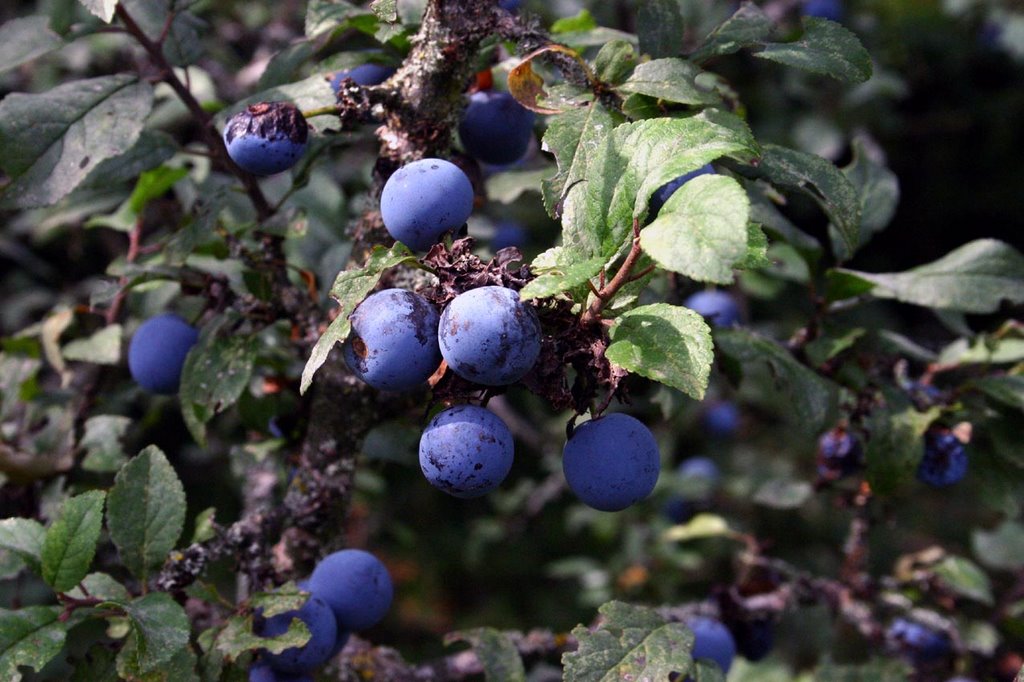
*The blackthorn or Schlehdorn is a very important plant in the Trier region and is primarily used for distilling a famous schnapps, for marmelade and for medical purposes. The blackthorn grows wild in the hedges that protect the fields from wind. The berry, called a sloe or Schlehe in German, is small and so sour and acerbic that you can`t eat it as it is. The berries sweeten somewhat after a winter freeze. The bush is well fortified by thorns; harvesting the sloes could be painful as well as slow work.

*The elderberry or Schwarzer Holunder is a native plant to the Trier area. It was considered a holy tree by the ancient Germans. It grows wild, sometimes as a bush, sometimes as a tree over 30 feet high. It has beautiful, luxuriant white flowers which turned into berries by autumn. (If you dip the blossoms in a pancake-type dough and fry them, then sprinkle them with surgar and cinnamon, you have a delicious treat). In the autumn, the berries would be gathered and used to make a syrup (sometimes mixed with apple) for drinks, marmalade or jelly. The syrup was also used as a cough medicine. Last but not least, elderberry liquors could also be made from the berries. An old farmers' saying in the Hochwald: "A man takes off his hat for the Holunder."

*The  Eberesche or European Rowan(Sorbus aucuparia), which is known in Germany as the Eberesche, or Vogelbeere, was very common to the region and often grew, as does the elderberry, in the hedges that enclose the fields. The berries are edible, but too sour to eat raw. In years gone by, it would have been used for making a Vitamin-C-rich marmalade. In some parts of Germany the berries were distilled. But now the berries are mostly a food for the birds rather than a source of food for hungry households.

*The beach nut tree, Buche, was another important tree in days of old. The beach nut or Buchecker was food for the pigs that were driven into the forests in summers past. During bad times, the beach nut was human food as well, and the oil of the nut could be pressed out of it.

*The walnut tree(Juglans regia) was well known; it grew everywhere. Every farm had its walnut tree in days past. This tree was brought to the region by the Romans.

*The *sweet chestnut (Castanea sativa) was also brought by the Romans. The edible chestnut, called Keste (fruit and tree) in dialect, did not grow everywhere; but could be found around the city of Trier or anywhere there was red sandstone. The chestnuts were gathered and then roasted or cooked. (They are very good partnered with sweet Viez or the new, sweet wine). During times of famine the sweet chestnut was used as an ersatz flour.


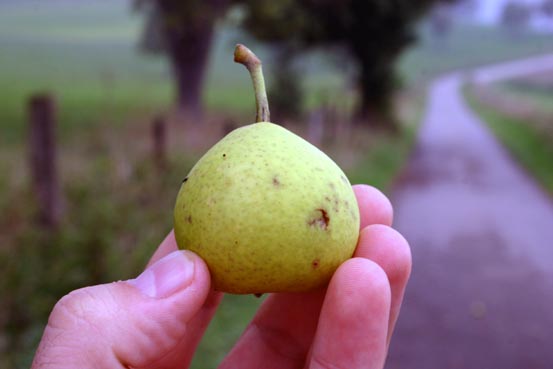
*The Sievenicher Mostbirne" is a very traditional tree of the region. Its fruit cannot be plucked from the tree and eaten as a fresh fruit because it is very sour. But the pears can be used for distilling and when mixed with quinces, the Sievenicher Mostbirne makes flavorful, delicate jellies and marmalades.


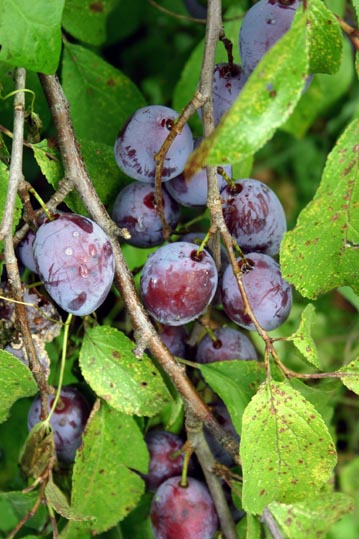
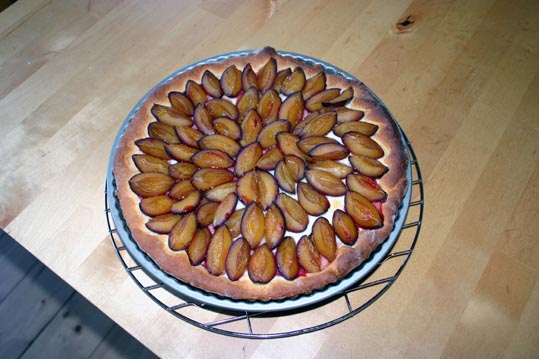
*The Zwetschge (Prunus domestica subsp. domestica), is very important in the region. In the Trier dialect it is Quetsche, in English a damson, which is a small, purple plum.  The tree on which it grows looks quite similiar to the apple tree and very often occupies the same orchard. The damson is distilled, giving a schnapps called Quetschenwasser. A delicate marmelade or mush is produced from it, spiced with anise seed and cinnamon. In autumn, when the plums are harvested, they are the used to make a delicious coffee-type cake which is very typical for the Trier region and is called "Quetschekooch" in dialect.


Cakes made with yeast are traditional for the region and no autumn goes by without Zwetschgenkuchen. Here is a recipe from Ernst Mettlach, and my effort at converting the measurements to the US system:

You need Zwetschge plums cut in fourths or, if they are small, in half.
20 grams yeast (3/4 oz)
250 grams flour (scant 9 oz.)
100 mililitres Milk (about an oz.)
1 egg
60 grams melted butter (about 2 oz.)
50 grams sugar (1.8 oz)
a little salt.
Sieve the flower into a bowl and form a hole in the flour. Put the yeast in the hole and sprinkle a spoon full of sugar on it, then add 2 or 3 spoons full of lukewarm milk. With floured hands, mix into a dough and let then let it rest for 15 minutes. Mix the egg and the rest of the sugar until its foamy. Add the salt, the rest of the milk and the butter. Knead everything together and let it again rest for 20 minutes. Then knead it again, roll it out on a board covered with flour, put in a cake form and wait 20 minutes more. Then lay the plums on the dough, and put the "Quetschekooch" in a pre-heated oven (350 degrees Fahrenheit) and bake it for about 45 minutes. If the plums are sour, sprinkle them with sugar. Serve with whipped cream.

The *cherry tree; and *the mirabelle plum tree were also found throughout the region.

Information from Ernst Mettlach and from the book "Die Hunsrücker Küche" by Christiane Becker