Monday, May 28, 2007

Life in a Wine Village


Irsch fountain with murals honoring its wine heritage


In 1984, with hardly any knowledge of German beyond "Der Bleistift ist auf dem Tisch" ("The pencil is on the table"; a phrase that doesn't come up very often), I wandered into a bookstore in Saarburg. I was looking, as always, for a book that might tell me how people in Irsch, Zerf, and Serrig had lived in the 19th century. I figured that if I found something written in German, I would somehow work out a way to have it read to me. But without being able to read titles, it was almost impossible to find what I wanted. I asked a clerk who spoke a little English for help. At first she shook her head, indicating the store had nothing. Then she consulted with another clerk, and they went to a shelf where the children's books were kept. She came back with a children's book translated from French into German. In addition to the text, it had wonderfully descriptive line drawings of farm life in a village in Lorraine. I was doubtful. "Would life in this French village be similar to village life here?" I asked. Both clerks gave me an "I can't believe she said that" look, and one of them replied with a smile, "Well it's just right over there across the border." I bought the little volume and, to use an overused but apt cliche, it really is worth its weight in gold.

The book, "Landleben im Jahreslauf" by Jean Morette takes the young reader through the four seasons of the year, with the corresponding work on the farm during those seasons. The time period is the second part of the 19th century. There was a description of the wine harvest, and I have decided to make such an important part of life in the region the topic for this post.

Along with the clear and concise description from the children's book I've described, I've also included material from the guidebook which is published by the staff of the Roscheider Hof Museum in Konz, to try to formulate a good picture of the importance of viticulture in the villages along the Saar, and in the Lorraine region of France as well.

A translation from the children's book, "Landleben in Jahreslauf" by Jean Morette

At one time, wine was one of the biggest sources of income of Lothringen (Lorraine). The Romans had brought the grape vines from Italy and planted them along the Lothringen slopes. In the Middle Ages wine accounted for the affluence of the Lothringen settlements; it was sold to Flanders and Germany.

The grapevines grew along all the slopes of the Mosel, the Meurthe, the Seille, the Saar and the Maas Rivers. They thrived on the sunny side of the slopes, protected from the north wind, and the fog from the river also protected those vines that grew in and near the towns. Wine growing was rather difficult, because the grapevines were tender and affected by weather conditions and by a great number of diseases. The frost in the winter and also in the spring, the rain when the vines were in bloom and hail during any part of the growing season could spoil the harvest.

During the entire year, the wine hills required a great deal of work and care: shortly before the beginning of winter, the hills had to be plowed. They had to be hoed many times in summer. Stakes for the vines had to be set in and then, in off season, pulled out again and piled up in bunches. In winter and summer the vines had to be cut; in spring the branches bound to the stakes.

In October the time came for the wine harvest. The wine farmer sent messages to friends and relatives, in order to recruit hands to pick the grapes and carry the containers filled with them.

When the village clock rang in the morning, the workers started out with baskets and panniers . Each person started in one of the rows and with much skill cut the grapes from the vine and filled one basket after another. The full baskets were emptied into the pannier. The panniers were emptied again into the tubs on the wagons that were parked at the wayside.


A closeup of one of the Irsch murals. A worker wears a yoked pannier

After days of hard work, the harvest, which the wine farmer and his family had worried about the entire year, was about to end. The grapes could be brought to press and one batch after another could be crushed. The press was gigantic; like a overgrown nutcracker...

The sweet wine "must" (juice of the grapes which have been pressed) flowed in steams into earthenware basins or wooden tubs. In time the flow became weaker. When it seemed the last drop was pressed out of the grapes, the men shoved a strong beam under the press and turned the screw with all their strength one more time. They pressed so hard that not one little drop of the grape must escaped them.

From the Guidebook, "Freilichtmuseum Roscheiderhof, Konz."

At the open-air museum at Roscheider Hof, there is a carefully constructed wine growing exhibit which explains the history of vineyards along the Moselle, Saar, and Ruhr Rivers. The following information is from the guidebook and from information printed on a signboard near the exhibit.

It was the Romans who introduced grape vines to the Belgian and German provinces. Grapes have been grown continuously on the Moselle and the Saar for about 2,000 years. The Riesling grape that is characteristic today, however, was not the dominant variety of grape cultivated there until the 18th century. Up to that point there were various varieties of grapes, including the Müller-Thurgau, the Silvaner that is called Rivaner in Luxembourg, and the Elbling, which is still grown on the German banks of the upper Moselle. The Elbling is the grape used as the basis for making Sekt, the German version of Champagne.

Due to the steep slopes of the Saar, wine growing has always been very difficult. However, thanks to the hours of intense sun and the type of soil which absorbs the heat, high quality wines could be produced. Nonetheless there was always the risk in spring that late ground frosts would damage the vines already in bloom. For this reason small heaters were placed in the vineyard, fueled with wood or coal in order to keep the cold frosty air near the ground in motion.


The tools used for working in the vineyards in earlier times are shown in one of the parts of the exhibit. From left to right the staking axe for sharpening and hammering in the vine stakes; double pronged hoes for working the soil in the vineyard; mattock for weeding; hoes for planting vines; trenching hammer with head for trenching and smashing up bigger stones; trenching hammer with "tap" for digging up roots but also for trenching; trenching hammer with large tap; small and large trenching hammers; and the "pick" for cutting furrows.

In the new vineyards, the slate ground had to be broken up with the trenching hammer. Workers used their tools for both "digging" and "moving" the soil. Digging deeply and turning the soil over was done in the spring. Moving or loosening up the surface of the soil was done in the early summer to prevent weeds from growing. Stable manure was the basis of any vineyard fertilizer. Tubs and sleds were used and are sometimes still used to take it out, mostly in the winter from January to March. The manure was spread with a pitchfork along the rows of vines and then dug in with the hoe.


Traditionally the grape harvest was woman's work. The women pinched off the ripe grapes with their bare fingers. Harvesting shears only became necessary in the 20th century with the advent of new graft stock. The grapes, once picked, were put in paniers which were sometimes like baskets worn on the back. Often they had a slanting base because of the steep slopes. Once the baskets were full they were emptied into tubs which were carried by the men. These tubs were so heavy once they were full that they sometimes were raised with a crank frame so that the bearer could get them on his shoulders. The tubs were woven from willow or bramble runners and sealed with pitch.

Once the grapes had been harvested they were crushed either on the slopes of the vineyard or at home in the grape crusher and then taken to the wine press without delay. The grape "must" (juice of the grapes which have been pressed) was separated in the press from the solid parts, known as the "marc" or "pomace." The must was taken straight to the cellar from the wine press. The Romans pressed their grapes in the vineyard. The oldest preserved wine presses date back to the Middle Ages and are similar to the Roman ones in design. They are so-called beam wine presses which worked on the principle of leverage. Because of their typically long horizontal beams, they were housed in special buildings called press houses.

Hungarian beam press reproduction www.skanzen.hu


Roscheiderhof Museum photo of a screw press


Screw presses worked with spindle pressure. They took up considerably less space, which was an advantage.
The spindles were originally made of wood and often unable to withstand the high loads they were subjected to. Turning the wood spindles required a lot of strength. This meant screw presses only began to predominate in the 19th century after the industrial revolution made more effective iron screw presses available.

The next time you have a glass of wine from the vineyards of the Rheinland, appreciate!

Morette, Jean. "Landleben im Jahreslauf", Saarbrücker Druckerei und Verlag, 1983
"Freilichtmuseum Roscheider Hof Konz Museum Guide", self-published, 2001

Tuesday, May 01, 2007

When Life Began


In my last post, I wrote about some of the Normandy/Kreis Saarburg customs and superstitions at the end of life. At the beginning of life, there were also unfamiliar customs which were observed and firmly held superstitions which are little known in our own day.

The book I'm using to describe birth customs, LA NORMANDIE, is the one I used in the last post. In detail, it describes the life of a woman of Normandy from the time she conceived a child until a few weeks after the birth. Since death and burial customs were so similar in Normandy and Kreis Saarburg, I believe the same must be true for the pregnancy and birth stage of life.

In Normandy, and probably in Kreis Saarburg, the pregnant woman had to be extremely cautious for the months that she carried her child in her womb. Dangers were difficult to avoid if the the old wives' tales were believed.

What were these beliefs? Here is a sample:

*Don’t look at ugly things. If you look at the lame, the hunchback, the dwarf, or anyone with a disfigurement, then your newborn may be disfigured or have physical deformities. Try to look only at beautiful people." This superstition, according to the LA NORMANDIE's author, Hippolyte Gancel, often caused marital jealousy. (And pity the woman who had an ugly husband)

*Have nothing to do with the itinerants who come with bears, monkeys, apes or other hairy beasts.

*Avoid hare and fish or the child may have a harelip or brain deformities.

*Do not to look on the dead, sit up with the dead, or sprinkle the dead person with holy water so that your child will not be born dead.

*Do not raise yours arms too often or the umbilical cord may wrap around the baby's neck and strangle it at birth, nor should you hold a child on your lap.

*You must not give in to any intense craving for berries (strawberries, currants, raspberries) or the child will have a birthmark on its body.

At the first labor pains, the midwife was called. Doctors were only called in case of disaster, and probably they were not available at all in the small villages. Upon arriving the midwife started the heating of a generous quantity of water at the fireplace. She pushed the men, young children, and even the husband out of the room. Pious figures were hung where they could be seen from the laboring woman's bed.

The mother did not usually give birth in bed but on a table which was covered with hemp sacking cloth that was placed near the fireplace. Or the woman might sit at the foot of the bed for the delivery.

Immediately after the birth and the announcement of the sex, the midwife separated the infant from the mother and cut the umbilical cord. When the placenta was expelled, the cord and placenta were buried, often at the foot of a rosebush. In Normandy, noted for its dairy products, the new child was rubbed with fresh butter. One or two drops of the mother's first milk were placed on the baby's eyes to prevent opthalmia. If the baby was a girl, her nipples were pinched so that when she became a mother, she would be able to nurse her baby without difficulty. The mother was helped into her bed and the baby was placed in a basket or a cradle. The cradle was usually lined with a sack filled with the hulls of oats. The baby, most often, was wrapped in linen in the fashion of a mummy to protect against colic and deformed legs. It received only sugar water the first day or two after birth. Then it was nursed. Cradle confinement went on for 10-12 months, with the baby being taken from the cradle only three times a day unless there was a grandmother living with the family.

After the birth, by Catholic Church decree, the new mother was forbidden many activities for about three weeks. However cleaners and housemaids were allowed to work sooner - in nine days. During this time, the woman was judged impure and could not show herself in public. She did not cut bread since it was believed it would not last if she touched it. She could not handle the milk because it would turn sour. She could not touch any meat for fear it would spoil. She could not pull water from the well because the water might become contaminated.

Finally the woman was allowed back into society after a ceremony of ritual cleansing, called churching. In Normandy the mother, accompanied by the midwife, went to the church for the act of purification. The midwife brought a loaf of bread that she had made especially for the occasion. The mother knelt in the last pew. There was a “low mass” and then the priest performed the churching ritual. After he blessed the mother, he blessed the bread and took off the first small piece. Some of the blessed bread was given to family and friends who were present. A small piece was kept forever; supposedly that piece would never mold.

The idea of women being thought "unclean" until purified may seem discriminatory and sexist to those of us born in later centuries. But the superstitions and the church ceremony probably helped mothers regain much needed strength before they returned to house and field work. In the book "German Women in the Nineteenth Century," W.R. Lee cites statistics to show that infant mortality was highest in those area where the mothers returned to agricultural labor within days after birth. Breast feeding when the mother was engaged in field work was sporadic at best. Yet breast feeding was far healthier for the infant than a diet of unpasteurized cow's milk. In addition, infants often were brought to the fields while the mother worked, whatever the weather conditions might be. Even three weeks at home, restricted to quiet activities, was a help to both mother and child.

And now to my own mother's belief in one of these Normandy superstitions. Mom had been told that one should not look at unpleasant things while she was pregnant. So she took special care to avoid a particular man in our tiny Wisconsin village. This man, "Little Mike," was a little person who in those days was called a midget. One day, as Mom went up the concrete steps of the town's general store, Little Mike came out of the store and moved directly into her path. Of course, she had to look at him. Many years later, she confessed to me how silly she felt because she had believed that superstition. She laughed as she explained how she unwrapped my blanket fearfully in those first moments that she held me in her arms. She had to see how long my legs were.

Just to satisfy your curiosity, I am 5' 6" tall - but I do have rather short legs!

Sources:
GERMAN WOMEN IN THE NINETEENTH CENTURY, edited by John C. Fout, c.1984.
LA NORMANDIE: LA VIE QUOTIDIENNE DES NORMANDS, by Hippolyte Gancel, n.d.

Thursday, April 05, 2007

When Life Ended


Photo from Ernst Mettlach


Three weeks ago a very good friend of mine died at age 87 after a few days of hospitalization. As I took part in her memorial service which was attended mainly by those of us who had had the good fortune to know her and which was carefully arranged by a local funeral home, I found myself thinking about the many differences between the funeral customs of our European ancestors and of those of our own day. From what I had learned from a book, LA NORMANDIE: LA VIE QUOTIDIENNE DES NORMANDS, by Hippolyte Gancel, a death in small Normandy village in France was a community affair, involving almost everyone in a final ceremony commemorating the life of one of their own. I knew it was much the same for the people living in small towns and villages in the Trier region.

The friend who had just died had helped me to translate sections of the book by Monsieur Gancel, including the section which described death and burial in rural France in the 19th century; and since she was a partial inspiration for this post, let's start with that information:

In Normandy, when an illness was judged to be very serious, the priest was called, and he gave the last rites of the Catholic Church. Then there was a period of intense anxiety while the sick person hung between life and death. A crucifix was put on a small table or chair along with a plate filled with water that had been blessed as part of the Easter rituals. Resting in in was a sprig of the palm branch which was blessed on Palm Sunday.

If death occurred, the eyes of the deceased were closed. One last prayer was said and then the burial preparations began. The pendulum of the clock was stopped. The windows were shuttered or curtains pulled. The blessed candle was replaced with a tallow candle or perhaps a pair of wax candles. The mirrors were covered, and the photographs of anyone who had died were turned to the wall. If the farm had bees, black crepe was attached to the hive and left there until the mourning period was over.

Someone went to notify the priest so that after the ringing of the bells for the angelus prayers, the bell could be tolled. According to the number, sounds, and duration of the tolling, the age, sex and station of the person was made known. The knell continued to sound after each angelus until the burial. (The angelus was rung from the church at 6 a.m., 12 p.m. and 6 p.m.)

From the time of death until the funeral, relatives, neighbors and friends sat with the body of the deceased. They received visitors. On a table they had a crucifix and a plate of holy water, again with a piece of the blessed palm in it. Those who watched were always provided with food and drink. Each night collective prayer again united relatives, friends, and many neighbors. Sometimes the priest or the sacristan participated, bringing the parish crucifix.

The morning on which the funeral was to take place, the joiner who had made it came to close the bier. The coffin was placed on two chairs and the instruments of blessing were placed at its foot.

The usual custom was for the parish priest to come to the dead person’s home along with all who were to assist in the burial. A cortege was organized. At its head a children’s chorus member carried a bell and rang it before each house. A parish official carried the draped cross, followed by the priest and then by the children of the choir, one of whom carried a lighted lantern symbolizing the eternal life of the deceased. Several meters behind, the coffin was carried on the shoulders of men called pall bearers or porters. If the bier had to be carried some distance, they would relieve one another and pauses were provided at houses along the way where chair were put out to receive the bier. The porters were offered something to drink.

I had sent a description of the Normandy traditions to Ernst Mettlach who lives in Germany to see if he knew anything of Trier area funeral customs of the 19th century. As he has so often, he provided me with just the right information. He took the time to contact knowledgeable experts about burial customs; and they confirmed that the customs of Normandy were similar to those of the German regions, with a few regional exceptions from place to place. For instance, in the German Eifel region, the body in the coffin was always directed with the head toward the cemetery to make the farewell easier for the soul and to prevent the soul from desiring to return to the living.

Ernst, of course, also asked his mother about death and burial customs of her time; and she told him of the death of his great-grandfather and her grandfather, Wilhelm. Soon after Wilhelm died, she said, the neighbours and relatives came, washed him, and dressed him in his best clothes. His eyes and mouth were closed to make him look peaceful; and the eyes and mouth had to be held in place with a bandage until rigor mortis set in. His hands were crossed as if in prayer, and so that a cross or a rosary could be placed in them. The windows were opened so his soul could fly to heaven. Ernst's mother said that the mirrors were not covered and the clock was not stopped as in Normandy. She also remembered that she changed the socks of her Grandpa each day. She said she still remembered the smell of the lavender in the room. When all was prepared, a vigil known as a wake was kept for Wilhelm for three days. He lay in the bedroom in the upstairs of the home. Almost all of the village assembled; it was a thing of respect. Those who kept the vigil sang and prayed, and the men drank Viez and Schnapps.

On the funeral day, the coffin was placed in front of the house and was then brought in a procession through the whole village. The house was decorated as you can see in the picture above. The crucifix was very important; it was a special crucifix called a "Versehkreuz" in the Trier region. Every household had such a crucifix, and it was only used for burials. "Verseh" comes from the verb "versehen", which means "to provide". Two blessed candles stood left and right of this cross, along with a small bowl with blessed water and a palm sprig. (The crucifix in the picture was handmade by Ernst's grandfather, and it is now in the possession of his mother. It was again used during the burial of her mother and father.)

Today as well as in the past, the church bell rings in the German villages to announce a death just as it used to do when I was growning up in my small farming village in Wisconsin. I remember counting as the bell tolled, hoping for many tolls. That would mean it was someone old who, after a long and good life, had died; it was not a young person who had not really lived to accomplish his or her dreams.

In our time we speak of the need for closure after a death but find it hard to achieve it. Our ancestors may not have known that word, but they certainly knew how to go about it.

Sources:
LA NORMANDIE: LA VIE QUOTIDIENNE DES NORMANDS, by Hippolyte Gancel
Ernst Mettlach

Friday, March 02, 2007

When Did They Have...?


Clock with hour hand only, Rouen, France


When I'm trying to imagine the daily lives of my ancestors, there is a regularly occurring stumbling block. For lack of a better term, I'll call it "when-itis." As I begin to write about one of the wealthy farmers in the village proudly displaying his pendulum clock to impress my great-great grandfather, I'm suddenly wary. When was the pendulum clock invented? Would such a clock have been available for purchase in the 19th century? Nagged by doubts, I have two choices. I can spend awhile checking the Internet and reference books. Or I can write that the wealthy farmer showed my great-great grandfather his new ox.

An article in "Der Blumenbaum," the quarterly magazine of the Sacramento (California) German Genealogical Society was a happy find. It gave a timeline, going back to the first century AD, of important events, including many inventions. This list will eliminate a few guesses for me. I will be able to use that pendulum clock idea after all.

1284, the first wearable eyeglasses were invented in Italy.

1300's, the first mechanical clocks appeared, like the massive one-handed clock which still tells the hour in Rouen in Normandy.

1400's, playing cards became popular in Europe.

1500's, Latin began to decline as the language of books, in favor of the vernacular. The German practice of decorating Christmas trees was well established.

1565, the potato, which originated in the Americas, was introduced to Europe.

1580's, pockets in trousers were introduced.

1600's, toothbrushes were becoming common in Europe.

1608, the telescope was developed.

1632, the slide rule was invented

1639, what is thought to have been the first Christkindlmarkt took place in Nürnberg

1656, the pendulum clock was invented.

1660's, the first regularly published newspapers appeared in Germany and England.

1670, clocks with second hands were developed.

1709, the pianoforte was invented.

1760, the first jigsaw puzzle was created.

1783, hot air balloons appeared and this led to the first manned flight.

1791, a process for producing cheap soap was invented.

1800's, there was a widespread use of pocket watches and more general concern for punctuality.

1800's, multi-tined forks were becoming common.

1802, an improved strain of sugar beets was used to produce sugar for the first time.

1805, self-igniting matches were invented (but were extremely dangerous until friction matches were developed in 1827)

1806, gas lighting was introduced in European cities; and carbon paper was invented.

1817, in German, Karl von Drais invented the Laufmaschine, a forerunner to the bicycle.

1820, cloth began replacing leather for book casings.

1829, the first reliable locomotive was developed, marking the beginning of commercial railroads.

1835, the first German railroad ran from Nürnberg to Fürth, approximately four miles.

1840's, brass bands became popular in Germany.

1843, a London artist printed the first Christmas cards.

1849, the safety pin was patented.

1850, telegraphic cable connection was laid across the English Channel.

And last but certainly not least (for someone who can't imagine life without them) potato chips were created in Saratoga Springs, New York in 1853.

SOURCE: "A Timeline for Americans of German Descent," DER BLUMENBAUM, Vol. 24, No. 3, pp. 130-136

Wednesday, January 24, 2007

From Field and Garden


Wattle fence at Rosheiderhof Open Air Museum

In the Trier region, a very old tradition survives to this day. Every year at Mariä Himmelfahrt on August 15 (the feast of the assumption of Mary into heaven), herbs of many kinds are formed into a bouquet or spray. They are brought to the parish church, where they are blessed. For that reason the Feast of Assumption is often called "Krautwischtag" or, literally translated,"herb bunch day." After the blessing, the herbs are brought home to decorate the family crucifix or taken into the stable to prevent illness of the cattle.

This custom indicates how important the herbs and plants of gardens and fields were to our ancestors, the farmers and villagers who lived in the region. Those who emigrated must have taken special care to bring many of their seeds with them to the new country.

*HERB TREASURES ALONG THE HIGHWAYS AND BYWAY


The Johanniskraut (Hypericum perforatum), St. John's Wort is a very common native, wild plant in the Trier region. It is a powerful herb which is anti-inflammatory, astringent and antiseptic. The mature plant has blossoms that leave the fingers red when rubbed. These blossom are placed in olive oil in a dark glass jar. It makes a very effective lotion for burns or it can be cut and dried to make a herbal tea. In alternative medicine it is considered a remedy for depression.


Beifuß or mugwort (Artemisia vulgaris), is also a very common regional plant. It grows along roadsides. Although it is considered a weed, people sometimes use it to spice greasy meat dishes such as the traditional St. Martin's Day goose. It contains Thujol, a stimulant similar to camphor.

Closely related and also common is Wermut or absinth wormwood (artemisia absinthium). It is used to produce a typical Eifel region liquor called "Badralsem." It is not distilled; instead the herb is soaked in alcohol. The resulting liquor is very bitter, and it is drunken as a digestive.

Often found growing together with Artemisia is the Rainfarn or common tansy (Tanacetum vulgare). It was thought to be useful in deworming cattle or, as late as 1931, as a brew for expelling worms in children.


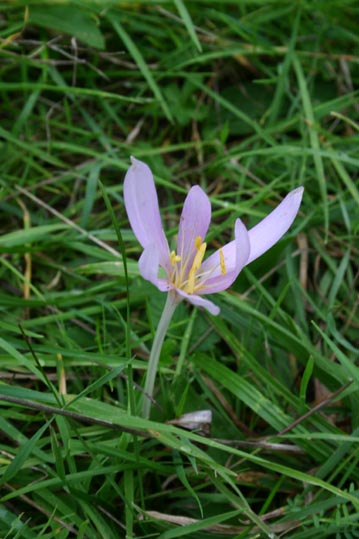
As would be expected, not every flowering herb along the road or in the meadows of the Trier region could be used in cooking or healing. The Herbstzeitlose which is commonly called the autumn crocus (Colchicum autumnale), grows wild. It's pretty appearance masks its highly poisonous nature. The settlers were, I'm sure, glad to leave it behind.


*A FEW CULTIVATED TREASURES OF YESTERDAY - AND TODAY


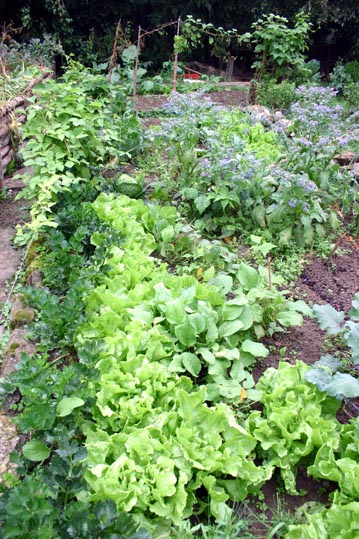
Almost every house in our ancestors' villages would have a garden, what is called the farmer's garden or "Bauerngarten." It represented a part of the owner's living space. It combined both practicality and beauty. Its vegetables were vital basic nutrients and by growing medicinal plants such as elderberry (for feverish colds), arnica for open wounds, peppermint and camomile for digestive problems, it became an apothecary as well.

Wattle fences (rods or stakes interlaced with twigs or branches) to protect the "Bauerngarten" had been in use since the Middle Ages and were common up until the late 19th century. Neither nails nor wire were needed in order to make such a garden fence. At the Rosheiderhof Open Air Museum in Konz, (picture at top of post) there is an example of such a fence made of twisted hazel sticks. The fence served to keep out grazing animals and chickens which ran freely around the village. Some gardens might have paths covered with tanning bark (oak bark) which kept down weeds because of the bark's high acid content.


The Ringelblume or Pot Marigold (Calendula officinalis)
was always found in the farm garden. It is used to produce a salve against wounds of all sorts as well as being decorative.

The Möhre/Karotte or carrot (Daucus carota subsp. sativus) has many names in Germany. In the Trier region it is called Möhre or Muart in dialect.

The Lauch or leek (Allium porrum) is eaten as vegetable or used as a spice. It was planted beside the carrots to protect them from bugs and mice.

The native bean of the region is the Ackerbohne or fava bean (Vicia faba). It is called Dicke Bohne in the Trier region, It has a very distinctive flavour and is a typical food in the region. In Luxemburg, smoked pork with broad beans or "Judd mat Gardebounen" is a national dish.

The Garten- or Stangenbohne (Phaseolus vulgaris) was an immigrant from America. This common bean was brought to Europe by the Spanish in the 16th century and became widespread in the region. The Schnippelbohnensuppe (cut bean soup) is a traditional dish in the region.

The Schnittlauch or chive, (Allium schoenoprasum) was and still is widely used in cooking. In the regional dialect it may be called bratzel or bretzel. Other herbs of the Bauerngarten: Bohnenkraut/Summer savory (Satureja hortensis), Dill (Anethum graveolens), Lorbeer/Bay laurel (Laurus nobilis), Kamille/German Chamomille (Matricaria recutita).


Sources:
Ernst Mettlach
Mrs. M. Grieve. "A Modern Herbal", 1931
Blumenthal, Bernd. "Museum Guide: Freilichtmuseum Roscheider Hof," 2001

Thursday, December 07, 2006

Christmas in the Hunsrück


A popular version of the Christkind


Oberzerf, the home village of my Rauls ancestors was at the edge of the Hunsrück region in what was then Kreis Saarburg. Since my great-great grandmother, Magdalena Rauls, was born on December 25, I have a special interest in the Christmas customs of her village in 1827. The closest I have come so far is the small book called, "Die Hunsrücker Küche," (Hunsrück cooking) by Christiane Becker. Along with recipes for traditional Christmas treats, there is a description of some of the Christmas customs of the Hunsrück of the last century.


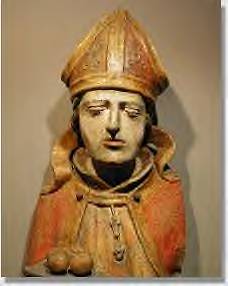
A figure of St. Nicholas from the 13th century


But first, a little history. The eve of the feast of St. Nicholas on Dec 6 was originally the time when children in German-speaking regions received gifts. Saint Nicholas was clothed in a bishop's red robe, somewhat like today's Santa Claus or Weihnachtsman. On his head was a miter, and he carried the staff of a bishop of the Catholic Church. Martin Luther urged his followers to stop this custom which had such strong Catholic church connections. The Christ child, he preached, gave the greatest gift to mankind, and children should receive presents from him on the day that commemorates his birth. The change began in the northern regions where the majority of the population was Lutheran, but by the nineteenth century, even in the Catholic regions, the Christkind brought gifts on Christmas eve. However St. Nicholas retained his popularity in the Catholic areas, continuing to bring presents on St. Nicholas eve. (There is more information on the celebration and customs of St. Nicholas eve in my archived post from January 2006).

Literally translated, the word "Christkind" means Christ child. However, in the 19th century, the Christkind was not represented by a babe in a manger but rather by an angelic figure with golden wings and long blond hair. In some parts of Germany, especially Bavaria, teenage girls clothed in white dresses and wearing golden wings played the Christkind, but customs varied. Christiane Becker, author of "Die Hunsrücker Küche," describes the Christkind custom in the small village of Götzeroth in the Idarwald as follows: On Christmas eve, the Christkind, face covered with a veil, went from house to house, accompanied by the "Stabbegloose", two figures in black clothes and hats. Both carried a staff and hid their black painted faces behind a beard of flax. The raccous sounds of staffs and bells were eagerly awaited by the children because the trio were bringing gifts. The Stabbegloose would push their boisterous way into each house in the village, followed by the Christkind. As a reward for their turbulent visit, they were rewarded with money or, in earlier times, with Kuchen. The actual visit of the Christkind was done in fewer and fewer places as the 19th century progressed, and today such a custom is a rarity.

Baking for Christmas was done during the season of Advent. At sunset in December when the sky was a shimmering red, there was an old saying in the Hunsrück: "The Christkind is baking sugar cookies." The women and children of the family were busy making familiar Christmas recipes. The aroma from the kitchen, which had been turned into a virtual bake shop, permeated the whole house. Naturally, there was quite a bit of tasting of the Zuckerblätjer, as the cookies were called in the Hunsrück dialect. But the Zuckerblätjer soon disappeared into cans and glass jars, to await Christmas eve. There were nut cookies, Lebkuchen, spritz cookies, cinnamon wafers, and chocolate balls in the recipe box of Becker's grandmother.

Except in rare exceptions like the one mentioned above, the Christkind was not seen by the children. He brought the gifts and trimmed the Christmas tree behind a locked door in the good room of the home, aided by parents and sometimes also by grandparents and relatives. The curious children waited impatiently for the door to open, but by the time the Christmas bells were rung and the door was flung wide, the Christkind had gone.

Tuesday, November 28, 2006

Once Upon a Tree

Blackthorn or Schlehdorn
 Eberesche or European Rowan
Late autumn was the time of the year when our ancestors, especially the women of the villages in the Trier, Saarburg, and Hochwald regions, were preparing for winter. Before the cold and snow descended on the Saar Valley and the Hochwald, each family had to ready itself for the months when there would be no more available fruits, vegetables, or herbs in the gardens, orchards, or on the open land and the hillsides. They would preserve whatever was available to them, both for sustenance, for pleasure, and for healing.

In this post and in another to follow, the trees, bushes, plants and herbs - both cultivated and wild - that were so familiar to our ancestors, take center stage once again. Their vegetation helped our ancestors make their way through the winter season when the land was barren.

The Generous Trees and Bushes of the Trier/Saar Region

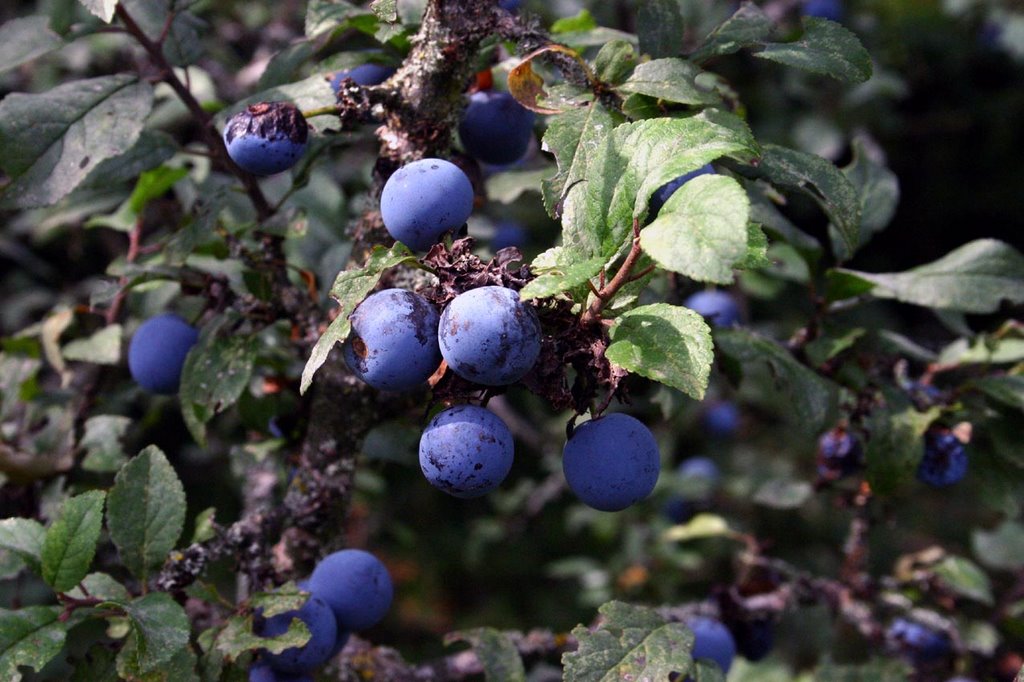
*The blackthorn or Schlehdorn is a very important plant in the Trier region and is primarily used for distilling a famous schnapps, for marmelade and for medical purposes. The blackthorn grows wild in the hedges that protect the fields from wind. The berry, called a sloe or Schlehe in German, is small and so sour and acerbic that you can`t eat it as it is. The berries sweeten somewhat after a winter freeze. The bush is well fortified by thorns; harvesting the sloes could be painful as well as slow work.

*The elderberry or Schwarzer Holunder is a native plant to the Trier area. It was considered a holy tree by the ancient Germans. It grows wild, sometimes as a bush, sometimes as a tree over 30 feet high. It has beautiful, luxuriant white flowers which turned into berries by autumn. (If you dip the blossoms in a pancake-type dough and fry them, then sprinkle them with surgar and cinnamon, you have a delicious treat). In the autumn, the berries would be gathered and used to make a syrup (sometimes mixed with apple) for drinks, marmalade or jelly. The syrup was also used as a cough medicine. Last but not least, elderberry liquors could also be made from the berries. An old farmers' saying in the Hochwald: "A man takes off his hat for the Holunder."

*The  Eberesche or European Rowan(Sorbus aucuparia), which is known in Germany as the Eberesche, or Vogelbeere, was very common to the region and often grew, as does the elderberry, in the hedges that enclose the fields. The berries are edible, but too sour to eat raw. In years gone by, it would have been used for making a Vitamin-C-rich marmalade. In some parts of Germany the berries were distilled. But now the berries are mostly a food for the birds rather than a source of food for hungry households.

*The beach nut tree, Buche, was another important tree in days of old. The beach nut or Buchecker was food for the pigs that were driven into the forests in summers past. During bad times, the beach nut was human food as well, and the oil of the nut could be pressed out of it.

*The walnut tree(Juglans regia) was well known; it grew everywhere. Every farm had its walnut tree in days past. This tree was brought to the region by the Romans.

*The *sweet chestnut (Castanea sativa) was also brought by the Romans. The edible chestnut, called Keste (fruit and tree) in dialect, did not grow everywhere; but could be found around the city of Trier or anywhere there was red sandstone. The chestnuts were gathered and then roasted or cooked. (They are very good partnered with sweet Viez or the new, sweet wine). During times of famine the sweet chestnut was used as an ersatz flour.


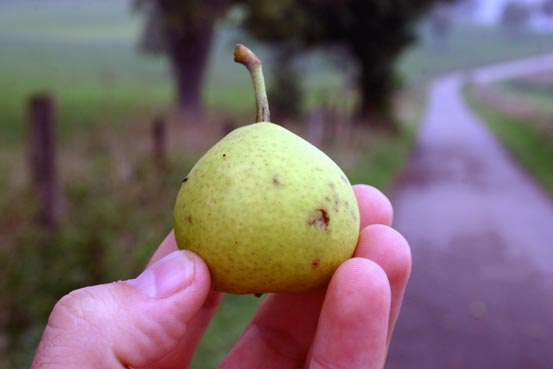
*The Sievenicher Mostbirne" is a very traditional tree of the region. Its fruit cannot be plucked from the tree and eaten as a fresh fruit because it is very sour. But the pears can be used for distilling and when mixed with quinces, the Sievenicher Mostbirne makes flavorful, delicate jellies and marmalades.


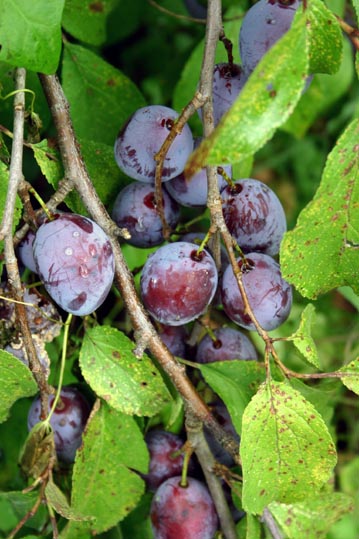
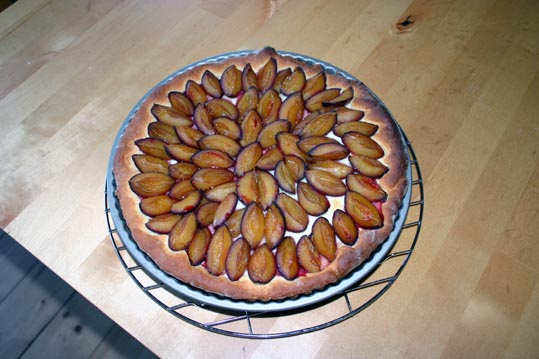
*The Zwetschge (Prunus domestica subsp. domestica), is very important in the region. In the Trier dialect it is Quetsche, in English a damson, which is a small, purple plum.  The tree on which it grows looks quite similiar to the apple tree and very often occupies the same orchard. The damson is distilled, giving a schnapps called Quetschenwasser. A delicate marmelade or mush is produced from it, spiced with anise seed and cinnamon. In autumn, when the plums are harvested, they are the used to make a delicious coffee-type cake which is very typical for the Trier region and is called "Quetschekooch" in dialect.


Cakes made with yeast are traditional for the region and no autumn goes by without Zwetschgenkuchen. Here is a recipe from Ernst Mettlach, and my effort at converting the measurements to the US system:

You need Zwetschge plums cut in fourths or, if they are small, in half.
20 grams yeast (3/4 oz)
250 grams flour (scant 9 oz.)
100 mililitres Milk (about an oz.)
1 egg
60 grams melted butter (about 2 oz.)
50 grams sugar (1.8 oz)
a little salt.
Sieve the flower into a bowl and form a hole in the flour. Put the yeast in the hole and sprinkle a spoon full of sugar on it, then add 2 or 3 spoons full of lukewarm milk. With floured hands, mix into a dough and let then let it rest for 15 minutes. Mix the egg and the rest of the sugar until its foamy. Add the salt, the rest of the milk and the butter. Knead everything together and let it again rest for 20 minutes. Then knead it again, roll it out on a board covered with flour, put in a cake form and wait 20 minutes more. Then lay the plums on the dough, and put the "Quetschekooch" in a pre-heated oven (350 degrees Fahrenheit) and bake it for about 45 minutes. If the plums are sour, sprinkle them with sugar. Serve with whipped cream.

The *cherry tree; and *the mirabelle plum tree were also found throughout the region.

Information from Ernst Mettlach and from the book "Die Hunsrücker Küche" by Christiane Becker

Tuesday, October 24, 2006

The Apples of the Kaiser


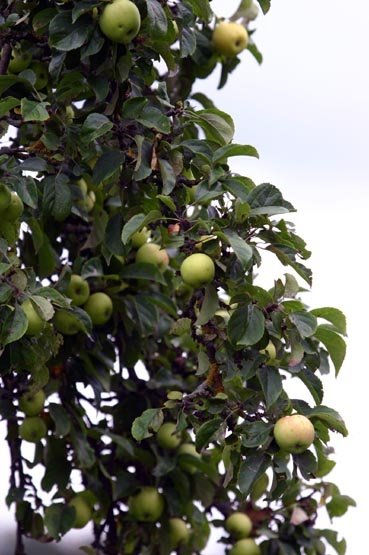
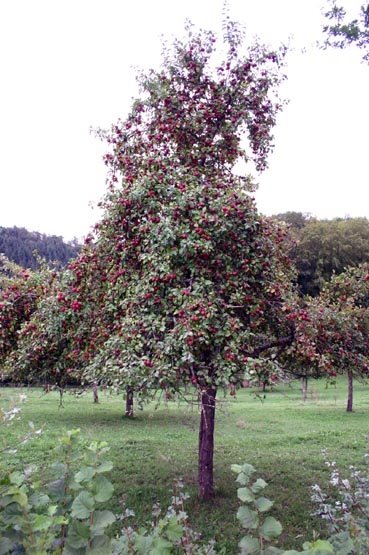
Apple Trees in Aach


Once there was a nine-year old boy who lived in a small village near the Saar River. One day he decided to steal from the Kaiser's orchard. He made his way to the orchard and was gathering up apples when he heard someone coming. Quick as lightening, he flattened himself under a bench and hid. When he peeked out of his hiding place, he saw that the Kaiser himself was looking for him. "Where is that young rascal? I'll give him a beating when I catch him," the Kaiser threatened and shook his fist. After the Kaiser gave up the search, the boy jumped up and ran home as fast as his legs would carry him.

Many years later, Mathias Meier, my great-grandfather, told this story to his grandchildren. They were second generation Wisconsinites and at least one of them, Aunt Rose, was very impressed. She always remembered the tale; and when I began asking questions about the Meier family history, she told it to me.

I smiled to myself when I heard this story. Irsch had less than 1,000 residents in the late 1850's, and I didn't think that Kaiser Wilhelm had time to check all of the small apple orchards in Prussia, not even occasionally. Great-grandpa was a pretty inventive storyteller, I said to myself.

Over the years I became curious about the orchard in Irsch and the kind of apple that great grandpa was trying to steal. I asked my Trier relative, Edeltrud Heiser, if she remembered an apple orchard in Irsch when she was growing up. "Oh yes," she said. She told me that the orchard still stood in Irsch when she was a child but is gone now. But she couldn't remember what kind of apples grew in it. So I started to tell her the story about great-grandpa and the Kaiser's apples. "That's it," she said, before I could finish the tale. "My father said there were 'Kaiser apples'."

So whether great-grandpa was an imaginative story teller, or whether Aunt Rose didn't quite understand that the apple was the "Kaiser" and a local caretaker was the one who tried to give little Mathias a beating, I'll never know.

I e-mailed the story of the Kaiser's apples to Ernst Mettlach who grew up in the Trier area. As usual, he had a wealth of information and was very generous about sharing it. When I got his return e-mail, I knew that I had a great topic for a new post (with his permission, of course).

Ernst said it is highly unlikely that the German Emperor had his own orchards in the Saar region, since his capital city was Berlin. And if he had an orchard, it would have been guarded not by the emperor himself but by his hussars.

He told me that there are several varieties of apple named after a Kaiser. In the past there was hardly an orchard without a "Kaiser Wilhelm" or a "Kaiser Alexander" apple tree. Therefore these two types of apples probably became known just as "Kaiser" or "Kaiserapfel".


The "Kaiser Wilhelm apple is a big, round apple, quite pretty to look at. It is not an eating apple; it is used for cooking. This apple wasn't common in the Trier area until about the last third of the 19th century. Since the Meier family left Irsch in 1861, the "Kaiser Wilhelm apple was probably not the kind my great-grandpa coveted when he made his foray into the orchard.

The Kaiser Alexander apple, said Ernst, goes back to the 18th century. It may have been imported from the Ukraine in Russia, since Alexander was the name of so many Russian Czars. The tree is known for its ability to survive in harsh climates and was often planted in the higher parts of the region, for example in the Saargau, high above the Saar Valley. It was a tasty eating apple, harvested in September and lasting in storage until December. To me, this kind of apple seems to be the most likely object of great-grandpa's hankering.

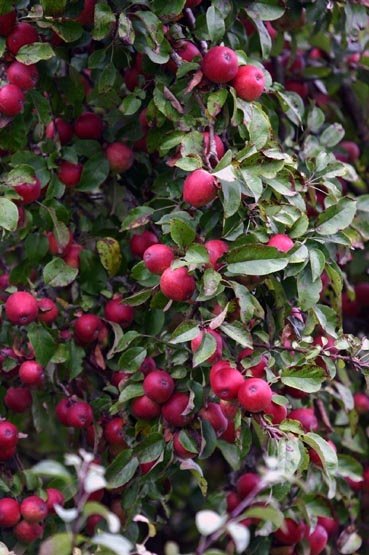
Ernst gave me additional information about the regional apples and orchards. He says that in the 1930s more than 130 different apple species were cultivated around Trier. There were sweet, sour, bitter, big, small, soft, hard, red, yellow, orange or flamed apples. There was an apple for every purpose, for eating, distilling, baking, cooking or making cider. The apple was the bread-and-butter fruit of the Trier region and more important than wine. Today, most species are gone. But in his mother's time, the apple trees stood so dense that in springtime, when the apple trees were blooming, it looked like snow had fallen. The apple was so important that some villages have it in their coat of arms, and there are poems and songs about the apple. There was no village without apple trees.

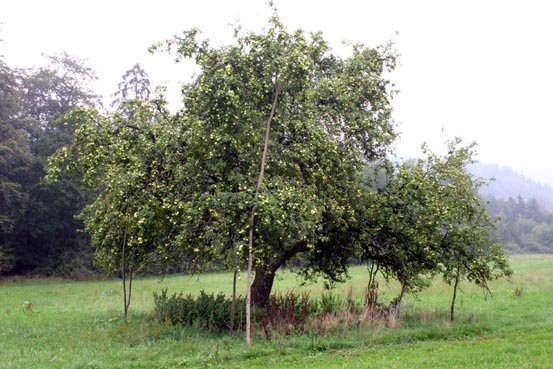
In the past, the apple trees grew in what was called the "Streuobstwiese" (literally a 'straw fruit meadow'). All over the region, apple trees and other fruits like plums, etc. grew in these special pastures. The apple trees had very tall, knotty tree trunks; a traditional apple tree looked a bit like a very old man. The Streuobstwiesen gave habitat to a lot of species of animals and plants, and they were very typical in the region. The orchard floor was used by the cattle as pasture, the trees produced fruit and gave refuge to several species of birds like little owls (Athene noctua).

Most orchards were cleared when farming was industrialzed. In the 80s, the European Union paid money for every acre cleared of trees. Less than one-third of the traditional apple trees survived. Today people are recognizing that the apple tree is part of the region's culture; and they are beginning to save the traditional orchards.


Weisser Trier Weinapfel


Roter Trier Weinapfel


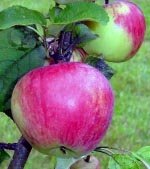
An old farmer from Aach, the village where Ernst's mother's family comes from, refused to cut down his old apple trees. The most traditional apples in his orchard are the "Roter Trier Weinapfel", and the "Weisser Trierer Weinapfel". The Weisser Trier is said to be the closest relative of the European wild apple (malus sylvestris). Both the red and the white varieties are used to make "Viez, the regional name for hard cider. The apples are small, hard  and very sour. They are sometimes called "Holzapfel", "Roter Trierer", "Weisser Trierer" or simply "Viezapfel".

If you've been drinking red wine as a heart-disease prevention method (or just for the pleasure of it), here is something to think about. Ernst says that one liter of the region's traditional homemade apple cider contains 3,500 milligrams of flavonoids. One liter of red wine contains around 280 milligrams!

Friday, September 22, 2006

The Life & Death Wanderings of King Johann of Bohemia


The Neumünster in Luxembourg City


In my last post, I told the story of the 1838 river trip which brought the earthly remains of Blind King Johann of Bohemia from the Mettlach porcelain factory of one Herr Bach to the Klause at Kastel, a masoleum built by the Prince Regent of Prussia. In this post, I want to explain why the bones of King Johann, who was born in Luxembourg, reigned as King of Bohemia, and who died in France, came to be in the keeping of a manufacturer in Germany.

The Travels of the Living King Johann

John of Luxemburg was born in 1296, the son of the German Emperor Henry VII. He married Elisabeth, the heiress of Bohemia and became its king in 1310. According to many accounts, he never felt at home in his new kingdom. He had enemies among the Bohemian nobility who worked against him and, a man noted for his bravery in battle, he was very much an absentee king. He never learned the language, spent most of his time at war, and allowed the country to be ruled for a time by local barons. Nevertheless it was said, "Nothing can be done without the help of God and the King of Bohemia". Bohemia was one of the most important kingdoms in Europe. John's banner, with three feathers and the motto, "Ich dien" (I serve) was that of the Bohemian kings.

After the death of his wife Elizabeth, Johann married a French princess and made France his home, leaving his son Charles to oversee the governing of Bohemia. Gradually Johann lost his sight; and by the time of the Battle of Crecy, he was completely blind. In spite of his blindness, he joined with the French in their battle against the English, binding the horses of two of his best knights to his own horse, one on his left side and one on his right side, commanding them to charge so that he, himself, might have a chance to strike blows at the enemies of France. In spite of 50 other knights protecting this odd threesome on horseback, the blind king was killed on the battlefield on August 26, 1346, along with most of his knights. Legend says that when Johann was killed, his banner was picked up by Edward, the Black Prince, then Prince of Wales. That is why, ever since, "Ich dien" has been a part of the crest of the Prince of Wales.

King Johann's Travels Continue After His Death

1. The victor of Crecy, Edward III of England, allowed the fallen Johann to ceremoneously lie in state. The embalmed heart and his entrails were housed in the Dominican Cloister Montargis, where the sister of the Bohemian king, the queen Maria of France was entombed.

2. The King's bones were taken in a ceremonious procession to the Benedictine Abbey at Altmünster in Luxembourg where his son Carl, now the King of Bohemia, erected a monument to his father.

3. In 1542 Francis 1 of France invaded Luxembourg and the outer defences of the city had to be strengthened which meant tearing down the Altmünster in order to better protect the city. The Benedictines took the bones of King John, in a simple wooden casket, to the cloister of the Franciscans in the upper city, and there the blind king's remains rested behind the high altar.

4. By about 1604, the rebuilding of the Benedictine Abbey was started at a new location in the old city, and when it was finished, the remains of King Johann were brought back to this "Neumunster." A discovery was made when his casket was opened. The wooden shrine behind the altar in the Franciscan Abbey had gone unprotected for so long that the theft of Johann's skull had occurred.

5. A report spread that the Earl of Blankenheim in the Eifel had the skull of the Bohemian king, it having been brought to him. The Benedictines wrote many letters requesting the return of the skull. After they were unsuccessful, the Regent of the Netherlands, the Duchess Isabella, interceded with a letter of her own, and in 1630, the Earl of Blankenheim finally agreed to return the skull to its rightful resting place.

6. When the French under Marshall Crequi invaded Luxembourg again in 1684, the Benedictine Abbey was destroyed. But once again the bones of King John went with the Benedictines to a place of refuge in the upper city.

7. The Benedictine Neumunster Abbey again was rebuilt, and King Johann's remains were brought once more to the lower city and given a place of honor.

8. At the outbreak of the French Revolution, fearful of looting by the soldiers who were threatening Luxembourg, the monks of the Neumünster hid the remains of the blind king in the home of a baker who had a sort of a cave under his roof which allowed for a thick wall of this house to be built into a cliff. The Neumunster Abbey was secularized and eventually used as a military hospital and a jail, among other things.

9. The baker was unsure that the location of the remains would stay protected in their cave so he took them outside of the city (some sources say that the baker gave this assignment to the Mayor or Luxembourg when the baker was on his deathbed) to Septfontaines where Jean-Baptiste Boch, owner of the earthenware factory took them under his protection.


The bend in the Saar at Mettlach

A former abbey, now the porcelain factory for Villeroy and Bach in Mettlach


10. Boch's son moved the factory to Mettlach in Germany, and the remains of the Blind King went with him, resting, for more than 40 years, in an attic bedroom.

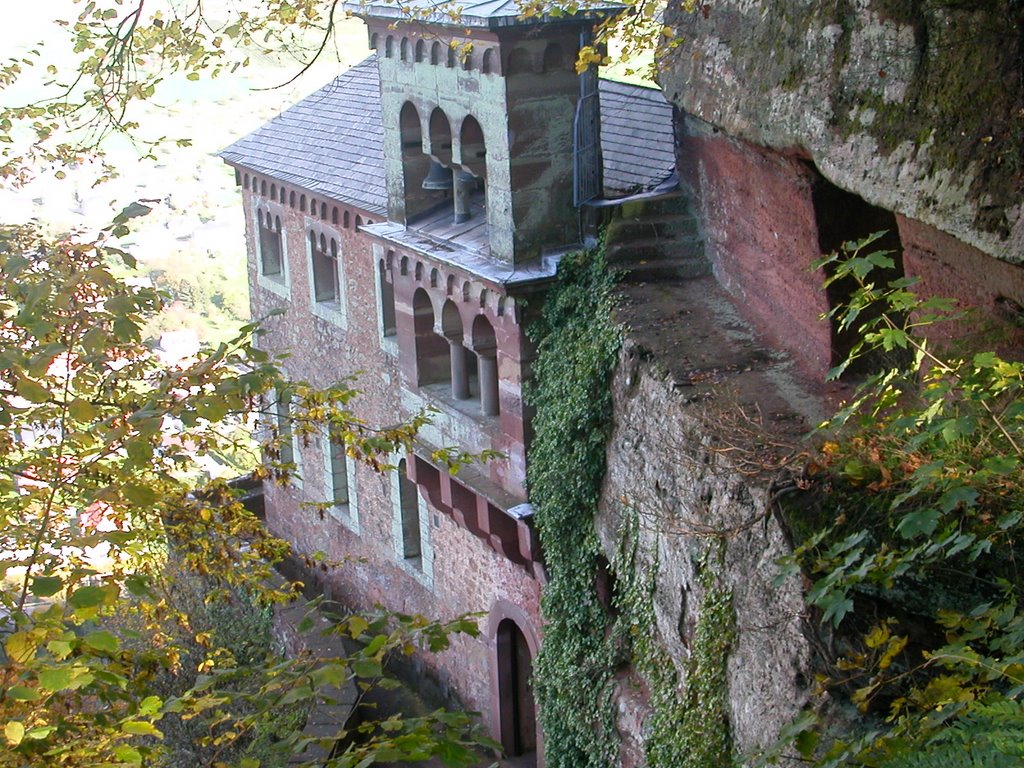
11. Frederick William IV of Prussia commissioned Karl Friedrich Schinkel to build the Klause, a neo-Gothic chapel, on a high peak near Kastel. The Klause overlooked the Saar River, almost like one of the medieval castles along the Rhine. On August 26, 1838, King Johann's casket was placed in the Klause


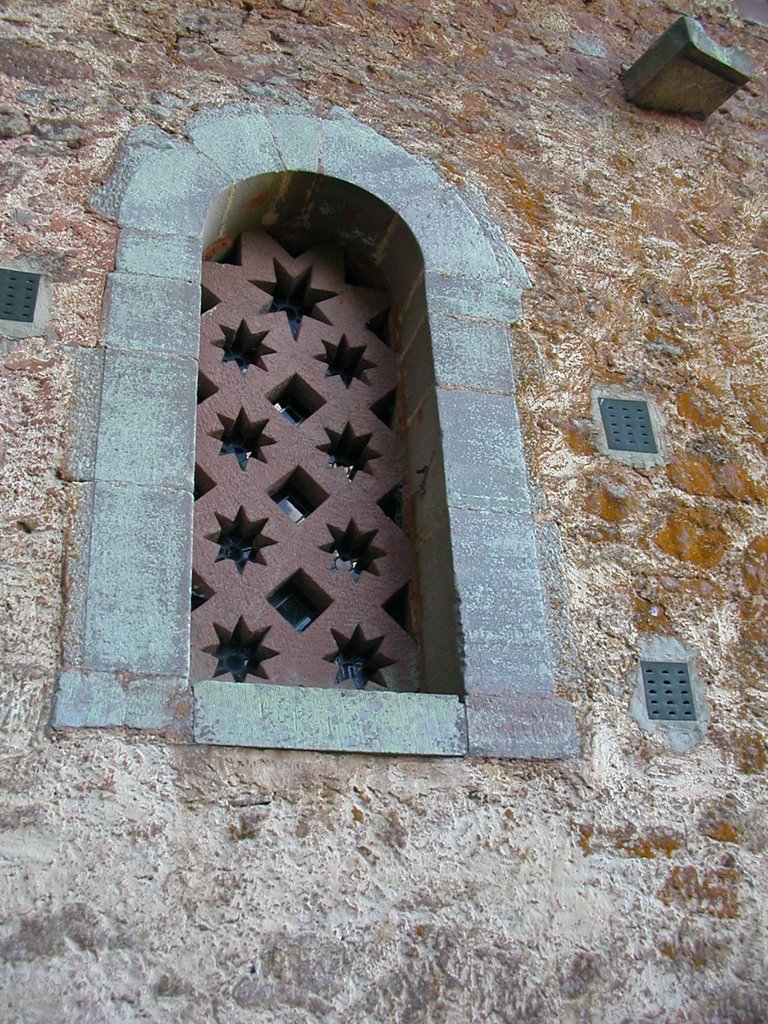
A window of the Klause


12. It should come as no surprise that after World War II, Luxembourg asked that their famous king's remains be returned to Luxembourg and the request was honored. Once again, King Johann's bones were moved to a new resting place.

After eight centuries, have the bones of King Johann finally stopped their wandering? Only time will tell.

Sources
www.wikipedia.org
www.operapedia.org
Hammacher, Klaus. Serrig: Landschaft, Geschichte und Geschichten
Centre Culturel de Rencontre Abbaye de Neumünster: http://www.ccrn.lu/EN/abbaye_histoire.php?ID=211&LA=EN

Saturday, August 26, 2006

The Blind King Comes to the Klause

The Klause Commissioned by Crown Prince Friedrich William IV

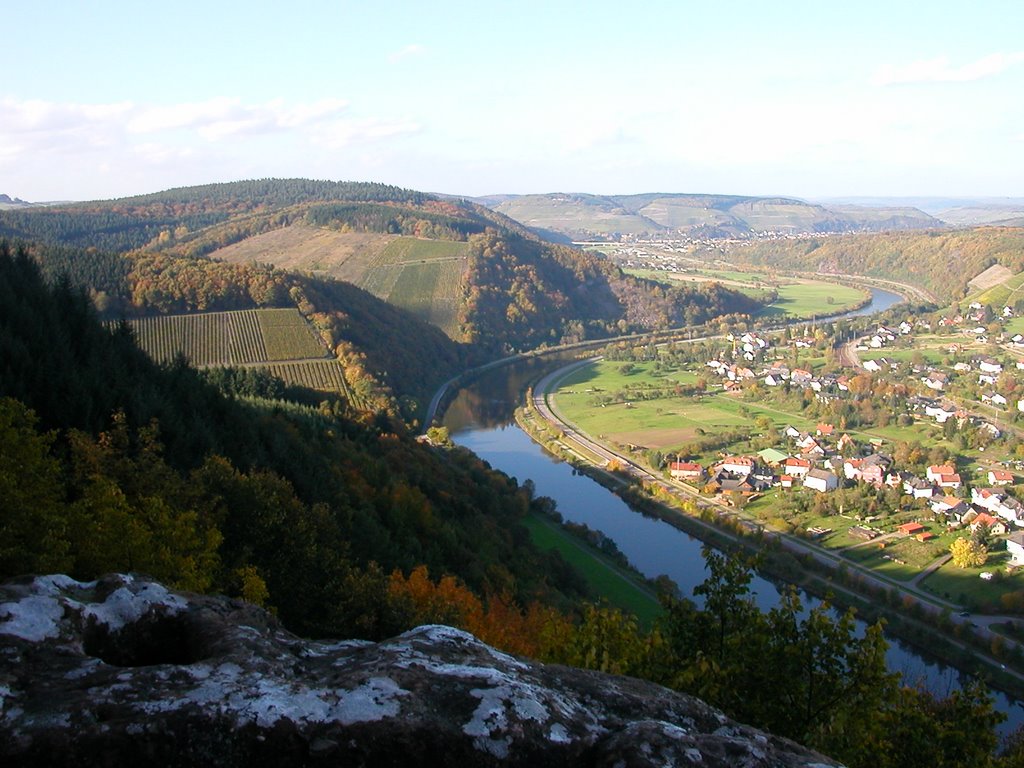
View from the Klause to the Saar and the village of Serrig


Klause - a German word for hermitage, cell, or den

When I saw the Klause at Kastel for the first time, I knew only that it was an impressive building, the burial site of a king called Johann. The view down to the Saar was even more impressive.

I thought no more about the place until, in 2003, I read the strange story of Blind King Johann of Bohemia, who was buried at this Klause almost five centuries after he had had been killed fighting in the battle of Crecy in 1346. He had come to the Klause by way of a porcelain factory in Mettlach.

A future king of Prussia makes a decision

The nineteenth century part of this story begins with a visit to the Saarburg area by Prince Regent Friedrich Wilhelm IV, who was destined, in just seven years, to be crowned the king of Prussia. Prussia had taken control of the Rhineland after the defeat of Napoleon. The Crown Prince was "a Rhine romantic," one of those persons who had discovered the enchantment of the winding Rhine, Saar, and Mosel rivers, each bordered by steep banks that were lush with vineyards or majestic with stony cliffs or green woodlands. He found excuses to visit this new Prussian province and took an interest in rebuilding the historic sites in the Rhineland with which he had become fascinated during the war with Napoleon when he was involved in the campaign in the Rhineland.

Friedrich Wilhelm made a trip to Kreis Saarburg in the year 1833, traveling from Saarburg City to Kastel and from there to Mettlach. As he admired the beauty of a high and scenic rocky cliff above the Saar River near the village of Kastel, the district magistrate from Saarburg, named Valentin von Cohausen, offered the prince this site in the name of the people of Kastel, explaining that it was where a holy hermit had once lived. The crown prince accepted the offer with delight. It seems to have come to his mind that here was a spot that would be a suitable place for a mausoleum to hold and honor the earthly remains of King Johann of Bohemia, a deceased member of the Hohenzollern dynasty to which the crown prince's family also belonged. He was on his way to Mettlach to the estate of Herr Jean Francois Boch (a cofounder of the firm of Villeroy and Boch that to this day makes fine porcelain) where, he had been told, the deceased king's bones now resided.

When the Prince had confirmed that what was left of King Johann was indeed in Herr Boch's keeping, stored in an attic room in his house, he set about planning for a chapel mausoleum to be built on the tall, rocky peak above the Saar at Kastel. Friedrich Wilhelm engaged the architect and artist Karl Friedrich Schinkel, and the building project was finally finished in 1838. The chapel/mausoleum was built in the gothic-romantic style, fused with and clinging to the rocks as if it had grown there.

Blind King Johann makes a stately journey

It was decided to transfer the coffin of King Johann from Mettlach to the Klause on August 26, 1838, the anniversary of the battle at Crecy. According to a Trier newspaper report of the time, people from the surrounding villages gathered at the heights of Castel on the 26th, a Sunday, for the solemn celebration.

Meanwhile many dignitaries were escorting King Johann's casket aboard a ship sailing from Mettlach to Kastel. One assumes that this vessel would have been supplied by Herr Boch or by Friedrich Willhelm, who by this time was king of Prussia. Among those aboard the ship were regional government officials, religious leaders, and Herr Boch himself, who carried the key to King Johann's coffin.

About 11 in the morning the crowd saw the vessel coming slowly along the Saar. When it landed at Staadt near Kastel, a cannon volley was fired. The arriving ship was met by four young men from Kastel and four from Saarburg who had volunteered to carry the coffin up to the mausoleum, undoubtedly taking turns carrying the burden as they struggled along the long, hilly road from Staadt to the Klause which had to be approached by a circuitous route around the back side of the cliff.


At last, with solemnity, the remains were brought into the chapel. The key was turned in the coffin, and it was opened for the inspection of several of the dignitaries. Then the casket was closed again and shut inside the sarcophagus. Muted light came through the colorful pieces of glass in the main space of the mausoleum's vault. The family tree of the Hohenzollern and the Wittelsbachs decorated the wall over the entrance and the sides. The marble sarcophagus had a bronze plate decorated with the royal Luxembourg family crest, and the king’s crown on which was an inscription telling the story of his death. The sarcophagus was decorated with stones considered precious in the first half of the 19th century. According to the Trier'sche Zeitung of 2 September 1838, there was deep silence and reverence from the huge crowd in attendance.

If your ancestors came from any of the villages near Kastel or from villages along the route the ship traveled on its way north from Mettlach, they probably came out on this August Sunday to see history taking place. The village of Serrig, directly across from the Klause, would have been an excellent vantage point, and I picture my Hauser, Maurer, Rommelfanger, and perhaps even my Rauls and Meier ancestors among the crowd.

Two questions should have come to your mind if you have read to this point. How could a blind king of Bohemia have fought and died in a major battle between the French and the English, and how did his earthly remains end up in a porcelain factory in the Rhineland? My next post will answer both of those questions.

Sources:
Hammächer, Klaus, Serrig: Landschaft, Geschichte & Geschichten, 2002
Saarburg: Geschichte einer Stadt, 1991

Tuesday, July 25, 2006

Bypassed by a Railroad


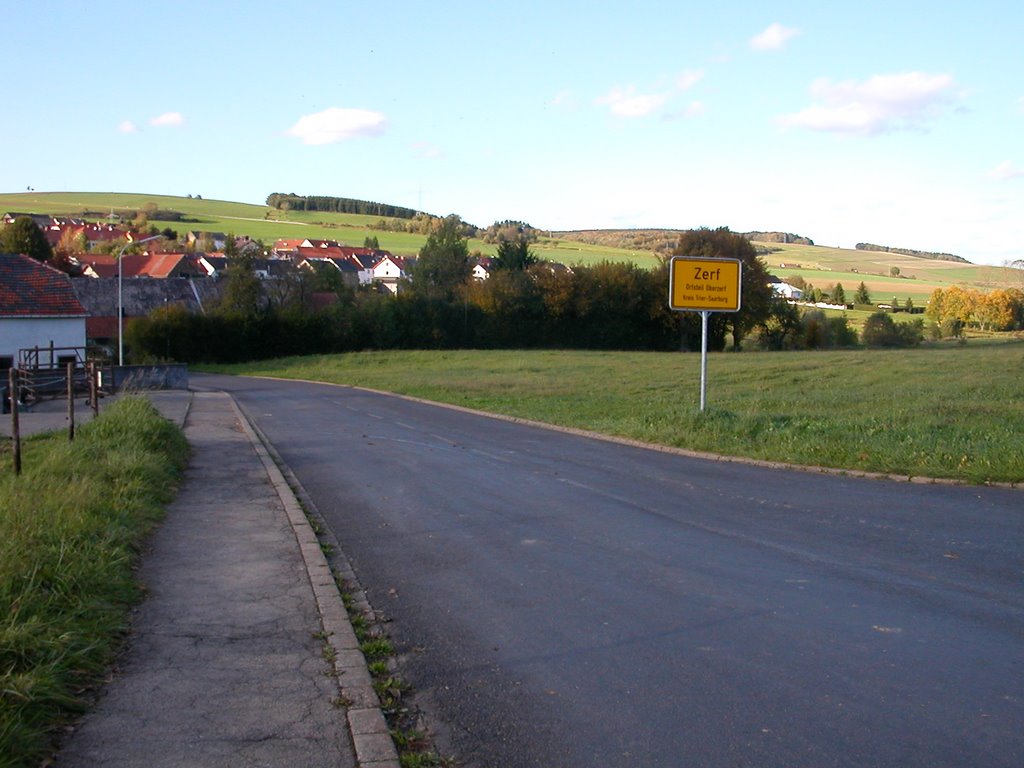
Approaching the village of Zerf - by car>>

For some of the farmers and craftsmen who lived in the Hunsruck area of the Rheinland, the building of the railroads influenced their decision to emigrate - but not always by making it easier and cheaper for them to reach an ocean port. The building of a railroad line through a remote area might give a man a hope for a brighter future, causing him to remain on his land. When his hope for a railroad line near his village was dashed, might it not cause that same man to pack up his family and try for a better life in America. The railroad line from Luxembourg to Saarbrucken is a case in point.

Villages like Irsch and Serrig had convenient access to the Saarburg-based cargo barges that sailed between Trier and Saarbrucken. The farmers in Zerf and the villages that surrounded it had much greater difficulty getting their products to appropriate markets than the people who lived nearer to the Saar River.

Then came a ray of hope. In 1844, the local city government in Trier began an active campaign to bring a railroad from Trier to Saarbrucken, fearing that the plan of running the railroad from Luxembourg City to Saarbrucken over Merzig and Remich would bypass Trier and affect the city negatively. They found an English company that was interested in a Trier-Saarbrucken railroad project. Two possible paths were debated. One was to follow the Saar valley; but the other was to go over the Hochwald through the Ollweg valley, with a tunnel from Franzenheim to the Ruwer valley, overland through Zerf, then leave the Ruwer valley and head toward Losheim. From there it would go to Illingen and end in Neunkirchen which would connect the line to Saarbrucken through the already existing Bexbach-Mannheimer railroad.

But unrest was in the air, leading up to the revolution of 1848. The foreign companies lost interest in building a railroad from Trier to Saarbrucken, so the city of Trier lobbied its cause directly in Berlin. Finally Berlin gave way to pressure from the Trier delegates, agreeing that running the rail line through Trier was a military necessity. The city was to be included in the railroad line stretching from Luxembourg to Saarbrucken. But which of the two routes originally considered by the British investors in 1844 would be the one chosen - the one running through the Saar valley or the high overland route through Zerf?

A committee of representatives from the Hochwald defended the route that would let the railroad pass over the Hochwald and through the Bliestal and the villages of Zerf, Losheim, St. Wendel and Ottweiler. They argued against placing the railroad line in the Saar valley because of its nearness to France, the higher land costs and the fact, that "all the Saar sailors, whose number are not small, would be cut off from a source of income." The Hochwald, on the other hand, needed a favorable route for its goods - wood, Lohe (tanning bark), and cattle - so that the population did not become even more impoverished. However, the petition of the Hochwald committee was rejected by Berlin, and the Saar valley gained the advantage for the railroad line. The representatives of the Saar valley industries had prevailed over the weakly structured Hochwald/Bliestal region’s committee, probably helped by the fact that the manufacturer Boch, owner of the porcelain factory at Mettlach, had never favored the Hochwald plan.

On 7 March 1857, Emperor Friedrich Wilhelm IV decreed the construction of the railroad line using the Saar Valley route. Zerf and the other Hochwald villages had lost their chance for prosperity.

The choice of the Saar route was not without problems. Terrain difficulty, especially in Mettlach, increased the total cost of of the project from five-and-a-half million Taler to eight million Taler and delayed the completion until 1860.

Mathias Rauls, the brother of my great-great grandmother, was one of the emigrants who left the Hochwald in 1857. He and his wife Elizabeth, along with 38 other residents of Zerf, received permission to emigrate during the months of February, March and April of 1857. I believe that these farmers and their families had already guessed that there would be no railroad line for Zerf and that most of the farmers in the Hochwald area of the Hunsruck would struggle with poverty for a long time to come.

The Rauls family settled on eighty acres of land in the Township of Berry, Dane County, Wisconsin. The plat map of 1864 shows a railroad line near their farm.

Sources: Hammaecher, Klaus. Serrig: Landschaft, Geschichte, Geschichten, pp. 115-117; Wisconsin State Historical Society, Plat Map of Dane County Wisconsin, 1864

Sunday, June 25, 2006

A Family Story with Extras


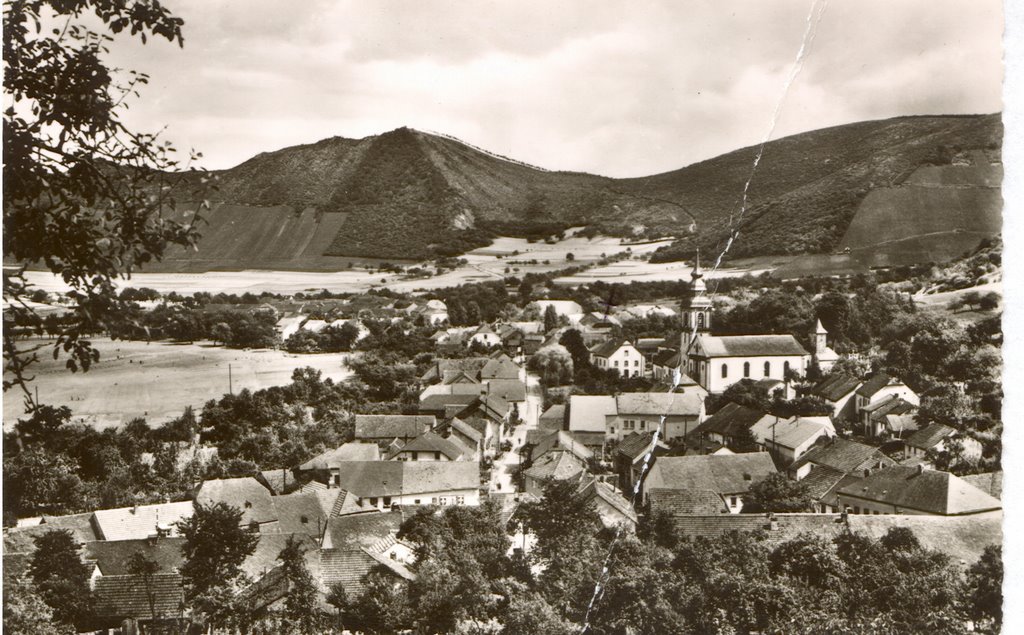
The Village of Irsch, 1937 and 2002

When I started “doing” genealogy, I kept my information on a form known to all genealogists – the family group sheet. While that works well for keeping track of names, dates and places, it is entirely unsatisfactory for all the pieces of information that breathe life into a family’s history. Eventually, I began to integrate historical information, especially social history, into a narrative for each family group.

While that prevented me from losing track of historical information, I soon realized that all of my ancestors from the Trier area shared a common history, leading to a lot of repetition in the text of each individual family’s story.

What to do? I invented what I call the combined family story with "extras." I put the information from the Rauls, Meier, Hauser, and Schawel family group sheets together, writing a single narrative that included all the brothers and sisters, parents, grandparents, etc., from all of my Rheinland families. Then I added what I considered relevant historical happenings. I also included social customs and any other tidbits of information that would get lost if I kept them on pieces of paper in my files. When I stumbled on a new piece of information of any kind, I just added it in. Here are some illustrations of my "extras."

A Picture of the Early Years

The first years of the nineteenth century were also the early years of my four great-great grandparents. While they were growing from babes to young adults, the other members of their families, the everyday world around them, and daily events both large and small, shaped them and formed the memories which they took to their new land when they emigrated.

Johann Meier, Magdalena Rauls, Michael Hauser, and Madgalena Schawel, did not come into the world at the best of times. These were bad harvest years, especially the mid-1820s when Johann Meier and Magadalena Rauls were born. The poorer people ate mostly bread made of potato flour. Some stole wood and poached in order to survive. The farmers with land fared a little better than the day laborers, but times were hard.

The residents of Irsch, Oberzerf, and Serrig had become citizens of Prussia after Napoleon’s defeat in 1814. There was no major war during the Prussian years from 1814 until the 1860's, and Irsch did not experience great changes of local governance under Prussian rule. For instance, Maximilian Keller served as Maire during the time that the Irsch villagers were French subjects. In 1814, Herr Keller kept his position as mayor. Only his title changed; he had become a Prussian Burgermeister. Unlike today, the term of office for a mayor could be lengthy. Nicolaus Bodem became the Burgermeister of Irsch in 1831 and kept this position for the next 48 years.

Even more respected than the civil authority of the mayor was the religious authority of the village priest. Like Mayor Bodem of Irsch, Fr. Matthias Guckeisen served the parish of Zerf, including Oberzerf and Greimerath, for an exceptionally long period of time, from 1824 to 1863 - almost 40 years. Father Peter Kremer was in charge of the Irsch congregation from 1817 to 1848, over 30 years. He might have served the parish longer but, like so many of his parishoners, he died during the cholera epidemic that was sweeping Europe at that time.

There is not much description available for the way that people lived their day-to-day lives in the villages of Irsch or Serrig. However, in neighboring Zerf where Magdalena Rauls grew up and which was only a few miles away from Irsch, the living conditions in the 1800's were well described by Edgar Christoffel in his history of Zerf.


"Most houses were damp...because they had only partial cellars. They were built of quarry stone, one or two stories tall, and had straw roofs. Only the public buildings, such as the mayor's house, the school, and the church had sloping tile roofs. Inside, the house was very simply furnished and rooms other than the kitchen and the 'good room' were seldom heated...[There was] an open fireplace where a large log burned. On an iron pole hung the big kettle. Meat was smoked in the open chimney..."

"Meat could only be kept by smoking it; when meat was eaten during the day, it was smoked and served with sauerkraut. The poorer people seldom had meat on the table. They had buckwheat dumplings with milk. More well off people might have bacon as well. In the evenings fried potatoes with sour milk were frequently eaten."

"In the winter evenings, the women busied themselves spinning flax, hemp, and wool. The men smoked their clay pipes...”The village streets had a slightly convex, bumpy surface, so that the horses often slipped off the road. In the dark, the men of the village sometimes did the same. Since the streets had no drainage, the water flowed in the gutters when it rained; and since the gutters lay right in front of the houses, the people had to make a huge jump to get across them or lay a plank over them. The waste water and sewage was dumped too...and there was a very unpleasant odor on some streets in the summer. Toilets were little houses with a small cut-out heart on the door. They stood near the manure pile or cesspool. Water came from village wells, although a few people had wells of their own."

Sicknesses such as typhus and scarlet fever were prevalent during the 1830's, and many children and adults died from these diseases as well as from diphtheria. I noted that two of Johann’s Meier's brothers died in those years; both were under four years of age.

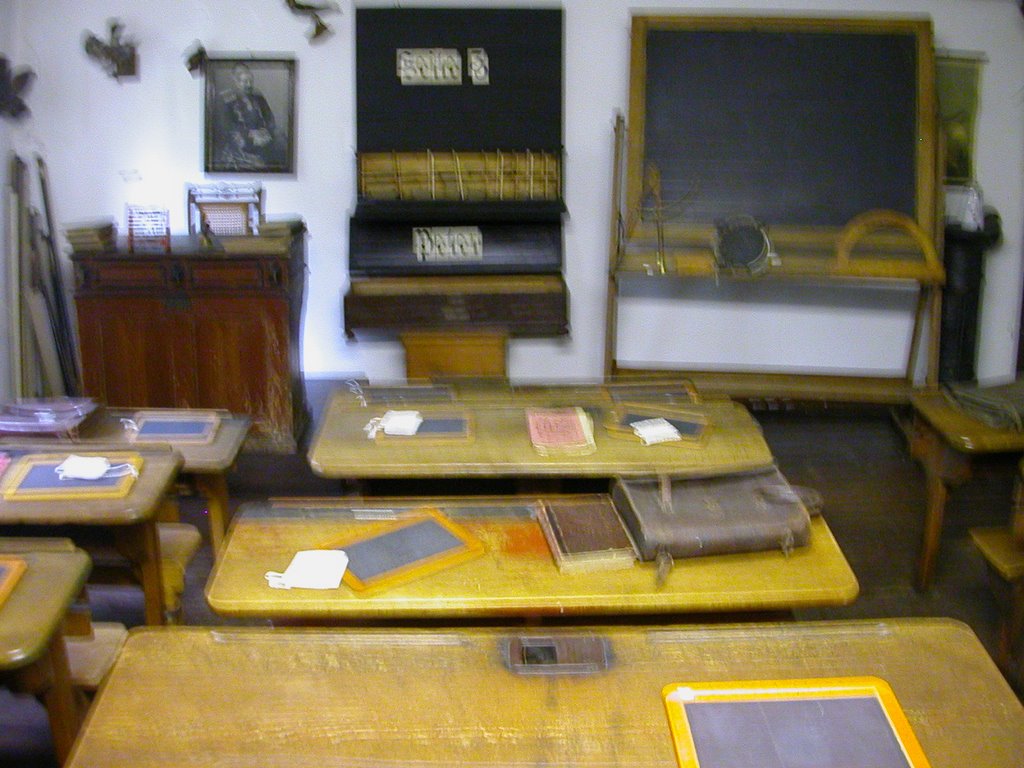
The children of Irsch received their education in the schoolhouse on the Irsch/Biest border. Infant mortality decreased during the first half of the 19th century and there were so many children enrolled in the school, newly built in 1828, that by 1833 there were two teachers. The principal subjects taught were writing, arithmetic, and Bible instructions.
Zerf too needed another teacher. The school population was as high as 100 students in 1826 and eventually there was a separation of the school children into a lower form and an upper form.

Irsch suffered a terrible tragedy in the dry summer of 1842. The biggest fire in 100 years destroyed 34 houses and 22 stables within a few hours, leaving 500 inhabitants without shelter. The stables, which contained fodder for the animals and the oak bark meant to be sold to the tanneries of Saarburg, were also reduced to ashes.

In 1844, the "Holy Robe" of Christ was displayed in the Cathedral in Trier. The robe, thought to be the seamless garment which Christ wore on the day of his crucifixion, supposedly was given to the Bishop of Trier by the Mother of the Emperor Constantine. It was displayed only periodically, and it brought a great number of pilgrims through the Saar villages as they made their way to Trier Dom Cathedral to venerate the the Holy Robe.

Irsch was approximately two miles from Saarburg, the seat of government for the Kreis. But its accessibility was limited because the Saar River separated it from all the small villages to its east. Since the stone bridge across the Saar was not completed until 1861, anyone coming from Irsch would have to be ferried across the river in order to get to Saarburg.

Some Questions
Did 17-year old Johann Meier see the family's possessions go up in flames; was Magdalena Rauls, born on December 25, baptized by Father Guckeisen in the chapel at Oberzerf while the boughs of fir trees still decorated the church altar; was Magdalena Schawel, on her first day of school, excited because she was among the first group of children to be taught in the new school building? I do not know the answers to those questions, but without the "extras" in my family story, I would never have had cause to wonder.

Sources:
Christoffel, Edgar, Der Hochwaldort Zerf am Fusse des Hunsrucks
Meyer, Ewald, Irsch/Saar: Geschichte eines Dorfes, 2002.
Photos within text taken at Roscheiderhof Open Air Museum