Showing posts with label Churches. Show all posts

Friday, May 31, 2013

From 1861 Irsch Kreis Saarburg to 1863 St. John Wisconsin

The Old Home
Photo from www.Irsch/Saar.de


The New Land
If you read posts on this blog regularly, you will recognize the name of the author of today's post which I have translated into English - Ewald Meyer. Herr Meyer has written two books, one about the village in which he now lives, Irsch; and one about the village in which he was born, Beurig. Those two villages are about a mile apart. So Ewald Meyer definitely has a wealth of information on the history of these two villages in Kreis Saarburg. 

Herr Meyer and his wife Helena have become good friends who continue to help me with my research whenever I need some elusive information on life in Kreis Saarburg or translation from the old German scripts. To my surprise, this month Ewald Meyer wrote a piece about Irsch's Germans in America for the Irsch monthly on-line newsletter. The family he described just happen to be my great-great grandparents, Johann Meier and Magdalena Rauls and their children. He wrote in German so, although I was bursting with pride and wanted to share my delight, I could not refer my friends or my blog's readers to a URL. Therefore I did my best to translate his article as my blog post for this month.

With apologies for any translation mistakes I make with my self-taught German, this is my attempt to share the May Irscher Newsletter article writtem by Herr Meyer to be read by the residents of Irsch, Kreis Saarburg, Rhineland, Germany."

GERMANS IN AMERICA 
by Ewald Meyer 

"During the colonization period of the United States of America, Germans were the largest non-English-speaking population. Around 1900, Wisconsin had about 2 million inhabitants, 710,000 of whom were of German descent. 

After publishing a list in 2002 of emigrants to the United States in the "Irsch Chronicle" on the Irsch Homepage, descendants of Irsch immigrants to the U.S. finally had an answer to their questions about the German home of their ancestors, "Where is Irsch in the former Prussia?" From then on, continuing to this day, a flood of requests for information have been received over the Internet. Visitors from overseas who are looking for their ancestors are not rare in Irsch. 

A particularly strong connection exists between a woman from Waukesha, Wisconsin and our family. For the time being, she has intensively researched the history of the emigration of her great-great grandparents: John Mayer (Meier, Meyer, Maier) from Irsch and Magdalena Rauls from Oberzerf. She is writing a book about them. In advance of that, extensive information on the project is contained in her versatile blog about Irsch, indexed on the Irsch-Saar website and called "Village Life in Kreis Saarburg, Germany" It is under the "Documents" link. To date, she has traveled to Germany four times and now calls our country "my old homeland."

In April 1861 her great-great grandparents with their family and some other families from Irsch started on their way to Le Havre. After receiving the naturalization permit, the 35-year-old John Mayer and his 33-year-old wife Magdalena Rauls Meier with their 10-year-old son Mathias; the 7-year-old daughter, Anna; the son, Johann 2; Michael,10 months old; and a 50-year-old uncle left for America on board the sailing ship "Rattler." A total of 197 passengers were crowded into it, including yet more families and people from Irsch. Thirty-two days after a perilous voyage across the Atlantic, they reached the Port of New York on 9 May 1861. 
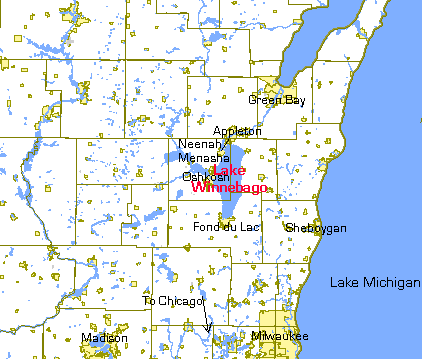
At length they settled in St. John, Wisconsin where already by 1856 some former immigrants from Irsch had joined a few others in this near wilderness in northern Calumet County. Possibly among them were John Mayer's sister Anna, born on February 26, 1829 and brother Michael, two years younger. The early years of the settlers were marked by hard work to convert the forest land into fertile farmland. Today, St. John in Woodville Township is located between Lake Winnebago and Lake Michigan in one of the most fertile farmlands in Wisconsin.

Since the settlers were almost all Catholic, in 1862 they established a parish church built of wooden logs. Between 1862 and 1869, the parish was run by the pastor from another village called Hollandtown (because it was first settled by emigrants from Holland). He came once a month to celebrate the Mass and the sacraments. In 1865 a new church was built because the log church was now too small for the church members. It was consecrated by the Archbishop of Milwaukee and dedicated to St. John the Baptist. The old log church became the first school building for St. John. The children of the settlers of St. John were taught by Theresa Wolf, a German Catholic who had, with her parents, immigrated a short time before. In 1870 Father Anton Leitner became the first priest of the parish.

 The parish of St. John celebrates its 150th anniversary this year on three Sundays in May, after re-establishing the original stones in the old part of the cemetery and doing extensive renovation and restoration work on the church. The Centenial festival committee was led by Joe Kees and his sister, two descendants of an early Irsch immigrant, Michael Kees, their great-great grandfather. The religious belief that originated with the St. John founders is still conserved and living today.

St. John the Baptist Church, St. John, Wisconsin
St. Gervasius and Protasius Church in Irsch
Photo from www.irsch/saar.de


Ewald Meyer, Germans in America,  htpp://www.irsch/saar.de


Tuesday, November 30, 2010

A Very Special Tour and Tour Guide

My vacation apartment's door (Erdenbach Strasse, Saarburg) is to the left of the garage door.


As I told you in September, I was planning to do some novel writing.  In the interests of home safety, I did not mention that I had reserved a vacation apartment in the city of Saarburg Germany as a wonderful way to inspire chapters for my novel.  A wise woman once told me that to improve my inspiration, I should go to my home villages, sit on the ground, and listen while they talked to me.  I'm a bit too old and my back is too touchy to do that literally, but I found that once I was in Saarburg, ideas for chapters came into my mind very easily - unlike the puzzlement I was experiencing at home.

What I hadn't reckoned with was the number of friends and acquaintances I have made in my past trips to Kreis Saarburg.  There was German hospitality being offered to me from the moment I arrived until the day before I left for home.   I had pictured myself busily writing most of my days in the city.  Instead, I was often having coffee and Kuchen.

On a sunny Sunday, I had a very special tour with a very special tour guide, Ewald Meyer, author of a published history of Irsch and Beurig.  He has been helping me ever since the first day I met him in 2002.  He was also the person who urged me to come back to Germany, offering to again help me with any local research trips I might want to make.

Ewald Meyer, Tour Guide
The tour began in the Beurig's cemetery.  Those who are not family historians will think that a strange place to begin a tour - I did not.  Beurig, about a mile from Irsch, is Ewald's birthplace.  In the Catholic cemetery I saw for myself the impressive monument to Herr Bürgermeister Bodem which I had written about in Sept. 2009, "Herr Burgermeister Bodem and his angel."  The monument was even bigger than it looked in the picture.  

We also visited smaller monuments to deceased officials of the Prussian Government, such as the district foresters and game wardens.  

A forester's grave monument
Unlike ordinary citizens who had (and still have) only a limited number of years to own their cemetery plots, these 19th century Prussian officials still keep their grave sites and monuments in the cemetery today, even if the family line has ceased to exist.    

As we drove through the village of Beurig which is now considered a part of Saarburg, Ewald pointed out Herr Bürgermeister Bodem's very impressive, somewhat Victorian-looking house.  Evidently finding favor with the Prussian government could be monetarily as well as socially and politically important.  Burdensome taxes were levied on the farmers and dayworkers, but even officials and the well-to-do didn't escape taxation.  Houses, including those of Herr Bürgermeister Bodem and his wealthy neighbors were taxed on the number of their chimneys.  Clearly, these houses were designed to show the status of their owners; men wealthy enough to have more than one fireplace.  The office of the Mayor was near the railroad station on the site of today's employment office.  The mayor's office was moved there from its earlier location in the village of Irsch in 1833, shortly after Herr Bodem was appointed Bürgermeister in 1832.

As I described in my July post, (From Bishop's Crosier to Napoleonic Flag), before the time of Napoleonic and then Prussian rule, the farmers, craftsmen, and day workers of Irsch, Beurig and the surrounding villages were governed by the Prince/Archbishop Electors of Trier and then Koblenz.  I had known that the peasant classes paid their "taxes" in the form of produce and farm animals, but not the specifics.  Herr Meyer explained that after the harvest, usually around St. Martin's Day in November, about 10 per cent of a farmer's crops and animals were sent to their Archbishop.  Wagon loads of "taxes" from the villages of the area were sent to the church estate at the edge of the Saar where today's Hotel Keller stands.  There they were housed until they could be sent, by barge, to Trier or Koblenz--depending on the location of the Archbishop Elector of the time.  

Today's Hotel Keller in Beurig on the Saar
In a year when the harvest was very bad, the peasant farmer paid his dues in the form of Frondienst; that is, as enforced service to a Fronherr or lord in lieu of produce.  Probably in this region, the "lord" was a high official of the church or the manager designated by the abbot of a monastery.  

From Beurig, our tour went on to the Catholic Church in Irsch.  The newly refurbished church retains an altar from the 19th century to one side, but the main altar is modern. Several statues from my ancestors' time also remain in various locations in the church.  


Historic Side Altar

Choir view of newly remodeled church
Back on our tour, Herr Meyer pointed out a raised plateau just outside the city limits call the Feuerstatt.  That innocent-looking field was the place where four people accused of witchcraft and found guilty by the Catholic church inquisition, were burned in the 1630s.  One of the women was a midwife.  She would also have used herbs and potions to try to heal disease, making her a prime target for stories of sorcery and probably blamed for the illness or death of a fellow villager.  None of those burned were from Irsch; three were from the small wine village of Filzen and midwife Barbelen came from Kommlingen.  

We peered at the buildings in the oldest part of the village, known as An der Wey, with narrow streets that resemble alleyways.  Here and there, parts of out-buildings made of lime, stones, dab and wattle, have stood the ravages of time and are now combined as part of later reconstructions.  It is a blending of old and new that testifies to the age of the village, which shows up in records as early as 957. 

We also drove through the district of Irsch which at one time was a separate section known as Biest.  It was larger than Irsch until the fire of 1842 in which the area was almost totally destroyed and was rebuilt as a part of Irsch.  

As with all tours, an end comes.  But I was luckier than most tourists.  I was to have "a coffee" with my tour guide.  I was invited to the Meyer home where Helena Meyer waited to welcome me.  

Coffee and Kuchen with the Meyers
Above is a fruit torte (grapes, mandarine oranges, and raspberries), baked and served by Helena Meyer after our afternoon tour of Beurig and Irsch.  It was as good as it looks.  

If I could, I would appoint Herr Ewald Meyer as the official historian and tour guide for the villages of Irsch and Beurig and Frau Helena Meyer as a five-star baker of Kreis Saarburg.  

Source
Conversation with Ewald Meyer and information from his books, Irsch/Saar: Geschichte eines Dorfes, and Beuriger Lese - und Bilderbuch, co-authored by Bernd Gehlen

Saturday, June 05, 2010

Two Churches Watched by the Eye of God


Main Altar in Oberzerf Church


Today Zerf and Oberzerf are considered one municipality, even though they are more than a mile apart.  But in the 1800s, Zerf and Oberzerf were distinct villages in Kreis Saarburg, each with its own Roman Catholic church, even though only one priest served both.

The main church was in the larger village of Zerf - as was the cemetery for both churches.  I can only guess about the celebration of the daily and Sunday Masses for these two churches.  My theory is that a daily Mass and Masses for special celebratory occasions such as Easter, Pentecost, Christmas Midnight Mass and the conferring of the Sacrament of Confirmation (requiring a Bishop) were all held in the larger Zerf church.  The Chapel Church in Oberzerf may have had a Sunday mass each week, as well as wedding and funeral Masses for the residents of the village.

A Visit to the Chapel Church of Oberzerf 

It was unusual that tiny Oberzerf had a place of worship all its own.  My Oberzerf ancestors lived in one of the smallest of the Saarburg Kreis villages. They were fortunate to have a spiritual home so close to them - the place where even the poor, landless day worker or pig herder of Oberzerf could experience beauty, both sacred and temporal.

Magdalena Rauls, my 2nd great-grandmother, her parents, brothers, sisters and all of her relatives, neighbors and friends, lived in Oberzerf. The pastor of both the two churches lived in the parish house in Zerf.  It was there that the villagers walked when they wanted permission to marry and have the banns of matrimony read, and it was from there that the pastor had to be summoned when one of the family required what the Catholic Church today calls "The Sacrament of the Dying."  

The altar of the Oberzerf church which is pictured at the beginning of this post is thoroughly described in the Zerf history by Edgar Christoffel.  It was a wooden high altar which had been designed and built about 1730 or a few years later.   It was baroque in style with a large curved niche that held the tabernacle.  Each side column had it's own capital supporting a pinnacle altar piece which stands above them.  This apex has two columns, similar to the ones below, supporting a curved, carved top.  A sunburst with a symbol of the eye of God fills its center.  The wood was painted to resemble the marble this little parish could never have afforded. 


On the window side of the church there was a stand holding a 60 cm high figure of Saint Hubertus. It was a hand carved oak baroque figure also dating from around 1730, about the time the old church was built.   Hubertus is in the garb of a Bishop and holds a staff. His stole and garments are very finely worked. A hunting horn is in his left hand and a small animal figure with antlers in the form of a cross stands at his right. These things signified that he was the patron saint of hunters and foresters. Legend has it that Hubertus, a wealthy young noble, went off to hunt while most people in his town were at Good Friday services. He chased a stag which suddenly turned to face him. The animal had a cross between his antlers. Hubertus heard the voice of God telling him to quit his worldly ways or he would surely find himself in hell. Hubertus heeded the warning, becoming a saintly cleric and bishop, devoted to helping the poor.

The oldest statue in the Oberzerf church is thought to be that of St. Anthony of Padua, much venerated because he was the patron Saint of the poor.  Its style is that of southern French statues in about the 1600's.  The statue of St Anne with her daughter Mary, the mother of Christ, was also displayed and venerated.

An eight sided wood pulpit in the little church dated from 18th century.  The chapel church was renovated in 1831, and a work, written in 1939 which described cultural landmarks of the region, called the Oberzerf Chapel Church a pleasing place to visit.  Unfortunately, the church was extremely damaged in World War II and the church of today is from about 1960.

The Parish Church of Zerf


The main altar of the Catholic Church in Zerf from 1858?                                    


The dominant Catholic church of the Zerf parish, located in what was then sometimes called Niederzerf (lower Zerf), was dedicated to St. Laurentius.  References to a Catholic church located in Zerf were noted even before the 30 Year's War.  The Niederzerf  church was rebuilt or refurbished many times over the last several centuries.   It is believed that those previous churches stood in the same location as the current church; a rocky hill that overlooks the valley where the Grossbach stream separates from the Ruwertal river.

By the 19th century, the Zerf church and bell tower from the previous century were once again badly in need of renovation.  So in 1819-1820, construction of a new building was begun with a bell tower around 30 meters high.  On May 26, 1830 the new church with its impressive tower was dedicated again to St. Laurentius but this time St. Sebastian was also included as a protector of the parish.  The bishop who officiated at the consecration was Joseph von Hommer.

Almost 40 years later, in 1859, that tall bell tower experienced a fire and the top portion of the tower had to be rebuilt.

The altar in the picture above is somewhat similar to the one in the chapel church in Oberzerf.  It is baroque in style though much bigger in size.  As you can see in the photo, the top section of the altar also contained a symbolic representation of the eye of God.  The University of Marsburg identifies the altar as one constructed in 1723.  The description of the new altar from 1858 in Herr Christoffel's book as well as photos from the early years of the 20th century match the Marburg picture in almost every detail.  Whether from the 18th or the 19th century, the handworked statues of St. Laurentius and St. Sebastian stood to each side of the central part of the altar piece.

It seems (if I have not misinterpreted a very complicated sentence construction from Herr Christofell's history of Zerf) that in the 1850's, the altar dating from the early 18th century which was from the St. Laurentius Church in Saarburg was sold to St. Laurentius parish in Zerf for a cost of 50 Taler, and that high altar was installed in Zerf.  The 1858 altar was destroyed during WWII.

Several statues were described by Herr Christoffel, but I was unable to tell if they dated from the time my ancestors lived in Oberzerf.  One important object that was a part of the church in their time was a baptismal font from 1838.  It was made of sandstone and the pedestal portion shows an apple tree with a serpent wound around the trunk.  The bowl of the font had perpendicular deep grooves and in each groove was carved a bell-shaped flower.

Conclusion

Perhaps it will seem that I have spent an inordinate amount of time describing the churches of my ancestors, but I think of it as plugging holes.  I began this blog to organize my factual materials in order to find illusive facts when I was ready to write a detailed novel.  I decided to share my material with anyone who chose to look for a topic which was also of interest to them.  

I started my writing with the most general material.  As I begin my sixth year of this blog, I'm capturing smaller and smaller details of the villages; and the books about the churches in the three Kreis Saarburg villages of my ancestors are filled with meaningful descriptions - for me.  I do hope that these last three posts will give you an idea of the church structures that your own ancestors knew.  With that in mind, let me refer you to an excellent source of pictures from the University of Marburg photo archive, with its 1.7 million pictures.   It was the source of the picture of the main altar in Zerf and is the first source listed below.   Perhaps you will find a picture of the church of your ancestors.

Sources:  Pictures
http://www.fotomarburg.de/
http://www.roscheiderhof.de/kulturdb/client/index.php
Nico Haas Thomassin, Trier
Theo Hasse, Zerf.


Sources: Text
Christoffel, Edgar.  Der Hochwaldort Zerf am Fuße des Hunrücks, Verlag W. Rassier, Saarburg, 1981

Saturday, May 08, 2010

The Catholic Church in Irsch from Manuscripts and Pictures


The Most Important Events Happen in God's House!


The small village church which my Meier, Hauser, Weber, Steffes, Schawel and Britten ancestors attended is still an active Catholic church today. The outside retains much of the appearance of the structure as it existed in the 1800s.

From the written sources available to me as well as the pictures below, I can ignore the modernized interior of the current Catholic Church in Irsch and visualize the heart of the older church as it was from 1806 until the Sunday that my great-great grandparents and their neighbors attended Sunday Mass there for the last time.

This was the structure that played such a large role in villagers' lives, a place that, even today, is filled with the spirit of all the religious ceremonies which have taken place inside the walls - baptisms, marriages, confirmations, feast days, and funerals.  From pictures of and writings about the history of the 19th century church structure, and all the items it held, I am able to accompany my great-great grandmother Magdalena as she walks toward the altar with Johann Meier, her husband-to-be, on their wedding day.  Or I can stand with my great-great grandfather as he views the coffin of his father and listens to the priest saying the prayers of the Requiem mass which beg God for the safe admittance of the soul of Michael Meier into eternal rest.

Some early photos and what books and manuscripts tell us about them.

According to a church history written by Father Markus Laser, Irsch pastor from 1969 to 1990, a major rebuilding of the original church took place in 1806, when the Emperor Napoleon ruled the people of the Saarburg District as their Emperor.  Irsch and its neighboring villages were was longer a part of a conquered territory but rather they were situated within the new borders of France, and the French laws were also the laws of Irsch

So it is that in the archives of the church, an unusual document from that time was discovered. It acknowledged that the church was built while Irsch and the rest of Kreis Saarburg were ruled by the Emperor Napoleon.  It then proclaimed that the people of Irsch would be honored and elated if Napoleon would deign to come to dedicate the new church. (Napoleon did not acede to the request).  The document also invited the French Prefect of Trier to the parish Kermis celebration.

A second document, found in the old bell tower, listed the names of the 1806 pastor, Henry Schneider; the Mayor, J. B. Britten; the eleven village council leaders; and the builder, Matthias Funck of Saarburg, all most loyal subjects of the Empire of France.


A picture of the expanded 1806 church shows the bell tower built in 1052.  The lean-to-style roof dates from the time of the first church expansion about 1450.  From the cemetery at the side of the church, it was possible to see, through the trees, the house where the teacher/sexton Herr Romey lived and gave lessons.  The church was rebuilt in a time of poverty and was only 75 feet long and 29 feet wide. It stood on a small hill, the 20 sandstone steps of a staircase leading up to it.  The shape of the church remained basically the same until 1913 when it was renovated and made larger.


The interior of the 1806 church was in the style of a long hall with an inner ceiling which was flat except for rounding at the edges. The chancel area had two windows, one on each side of the sanctuary, and three Romanesque style windows which provided light for each side of the nave where the congregation gathered.

The main altar, small in size, was adorned with tall silver candlesticks and a carved wooden crucifix dating from the mid-1800s.  The main altar displayed the statues of Sts. Gervasius and Protasius, the two saints to whom the church was dedicated.  

While the Church takes its name from Sts. Gervasius and Protasius, the inclusion of two additional patrons for the Irsch church, Saints Sebastian and Lucia, took place about the 1700s according to Fr. Laser's history.  It was a time of poverty, fire danger, and fear of the plague.

Saint Sebastian was condemned to death and shot with a multitude of arrows.  However a Christian widow, attempting to take away his body for burial, discovered he was still alive.  He quickly recovered and went on making converts to Christianity.  The emperor Diocletian ordered him killed a second time, and so he was clubbed to death.  He is the patron saint believed to protect people from the plague. A copper vessel within the Irsch church held the relics of Saint Sebastian according to a church document from 1808.  In addition, a fraternal flag of St. Sebastian was displayed inside the church; and the Brotherhood of St. Sebastian met four times a year, with its members coming from neighboring parishes to celebrate and to pray together in Irsch.

St. Lucia, an early Christian, was condemned to death for taking money without permission from her pagan fiance and giving it to the poor.  This was discovered, and Lucia was sentenced to be burned to death, but the young woman was untouched by the flames.  When it was clear that fire could not harm her, her throat was cut.  Thus she became the patron saint of firefighters and of the poor.  


Here is an undated picture of church interior, probably taken after the 1913 renovation.  The cross described below, which had hung above the main altar in the oldest of the Irsch churches was moved to the right wall next to the pulpit.


A major addition to the 1913 church was the tall bell tower at the front of the church.  A typical Saar house/barn stands next door to the church in the second picture.  The area to the left side of the church today is a parking lot.  But in this photo, it seems to be a garden area, probably belonging to the pastor of the church.  The pastor's residence stands unseen, just out of view at the left of the picture.  The church cemetery too is is out of view at the right rear of the church.  But it is clearly visible in the picture of the 1806 building above.

Two Treasures of the Irsch Parish Church.


About 1750, the church acquired a beautiful baroque gold-plated monstrance.  Foot, shaft, and a decorative knot support the oblong- shaped monstrance with its canopied top decoration of God the Father and the Holy Spirit Dove.  The windowed compartment which holds and displays the Eucharistic bread is surrounded with well polished quarz stones in the colors of emerald, carnelian and aquamarine and then by a flat oak-leaf wreath of silver.  This was especially fitting since so many of the Irsch villagers made their living by stripping the outer bark from oak trees and selling it to tanneries along the Saar.  Thus the heavenly Bread of Life is surrounded by the leaves of the tree which brings earthly food to the table.


The altar cross, which had hung over the small baroque high altar in 1739, was moved to the side of the pulpit after the 1806 construction.  The body of the crucified Christ was made of beech wood, 98 cm high.  Christ's head does not have the usual crown of thorns; instead a lock of hair falls forward, almost touching his shoulder.  His legs do not rest on the usual support but are nailed directly to the cross.  The body's anatomy is finely carved.  The face of Christ, with a short beard, has half-closed eyes and beautifully represents His submission to the will of the father.

In the 1800s, Pastor Peter Kremer baptized my great-great grandfather, Pastor B. Pfeiffer married him to my great-great grandmother, and Pastor Peter Schmitt baptized their children and said the last Mass the 1861 emigrants attended in their familiar church before leaving for Le Havre and the long trip to America.  I often imagine the special blessing he gave them, inside this church which held so much of their history.


References:
Meyer, Ewald, Irsch/Saar: Geschichte eines Dorfes, Gemeinde Irsch, 2002
Die Pfarrkirche in Irsch/Saar, a manuscript by Pastor P. Markus Laser, from 1979.  Website version:  http://www.irsch-saar.de/sdoku.htm
Photographs from http://www.irsch-saar.de


Saturday, March 27, 2010

The Village Church of Serrig at Kirten


The 12th century tower of the Catholic Church in Kirten


The book, "Serrig: Landschaft, Geschichte und Geschichten", says that while the population of Serrig grew in the 18th and 19th centuries, residents still traveled to the Kirten church, even though it was some distance away, and Kirten itself had only three mills and four nearby houses.

The visitation protocol of about 1810 (this was probably akin to a diocesan report on a Catholic Church in its jurisdiction) reports that Kirten's place of worship was too small by half for the number of people who attended services, most of whom, approximately 80 families and 560 communicants, came from Serrig to services.


The Kirten church had no organ and the mass was sung in Latin but regularly mixed with German songs. Every Sunday there was catechism instruction.

The cemetery was large enough for the needs of the parish. The church had two bells. The first bell was installed in 1753 (when the vestry and nave of the church were added to the first floor choir (which dated from the mid 1500s). Josef Mabillon from Saarburg was given the assignment of making the other bell tower larger in 1839 (to accomodate the new bell).

The rectory was in good condition with five rooms of which two had heat. There was a stable and stall and also a garden behind the house.

By 1853 the Kirten church was still in bad repair, although the protocol from 1853 noted that the altar was now very tasteful and modern. As if the author of the protocol was afraid to give too much praise, it was noted that t
he high altar of the church was overflowing with "bad" statues. Whether this refers to the condition of the statues or the quality of the craftsmanship is not clear.


Next: The Village Church of Irsch

Sources: