Showing posts sorted by date for query Raspeln. Sort by relevance Show all posts

Sunday, May 06, 2012

Easter Epilogue


Since I wrote my last blog post about the Kläpperjungen (young boys) in Kreis Saarburg and their duty to call their village to prayer and church services when the bells in the church steeple were silent from Holy Thursday to Holy Saturday, I have learned a few things more about both the Easter customs in the Rhineland and in my very own Heimat village in Irsch.

This epilogue began to take shape because of  comments about my last post: "Easter Tales: the Kläpperjungen and the Mirror in the Fountain." The first comment was made by a fellow blogger who was born and grew up in Germany.  She said that her village in the Lower Rhineland area had no Klapperjungen, but she remembered that the church bells were completely silent on Good Friday and Holy Saturday. The children were told that this silence occurred because the church bells had all "flown to Rome" to be blessed by the Pope.  On Easter Sunday morning, the bells flew back again, ready to ring out all over the city. This took me by surprise because Maria Croon, who had written about the Kläpperjungen in the Rhineland area that encompasses the Mosel and Saar rivers, had made no mention of flying bells in her reminiscence.

Friko, the blogger who had furthered my education on these Rhineland flying Easter bells, also said, "I come from the Lower Rhineland area, that is roughly the stretch between Cologne, Germany and the Dutch border, from the town of Krefeld. I went to Catholic schools and we were told these stories as children. Easter was the highest religious festival of the year and had a lot of ritual attached." 

Interesting, I thought.  Here is a person who came from today's Rhineland Pfalz state of Germany as do my ancestors, but her area lay north of Kreis Saarburg, and is not a quite as near to France as my ancestor's homeland. I knew that the French bells flew away during Holy Week.  Was it possible that my ancestors, too, believed the story of the bells making a trip to Rome, just as in France.

My relative Edeltrud, who grew up in the village of Irsch in the 1950s, was the logical person to ask. Her e-mail answer to my question read, "Yes, the bells leave here too, and kids run arround with wooden "Klappern" and call the hours when normally the bells were ringing. In Irsch they sang (in the old dialect): 'Beetgloock leut, de Beetgloock leut!' (The prayer bell is ringing). They are called Kläpperkinder. In earlier times they were just boys, but now there are girls too."  That accounted for the change of name from the more gender specific Kläpperjungen to the non-specific Kläpperkinder.

Ewald Meyer, who has been so much help to me in researching the social history of Irsch, e-mailed after he read my Easter blog. He had information about the Kläpperjungen and their three days of replacing the church bells.  He gave me another version of the calls of the Kläpperjungen - in the local dialect.  I believe he once called those words as he went about the village with the other boys who were replacing the voice of the bells.  Below are the calls and then, in parentheses, a translation of the dialect into today's German.:

1. Zum Angelusläuten am Abend ( before 7 p.m. ): "Et laut Baetglock!" (Es läutet Betglocke)
2. Mittags (noon): "Et laut Mettech!" (Es läutet Mittag)
3. Vor Beginn einer Messfeier: "Et laut zesummen!" (Es läutet zusammen).

Translation: 1. At Angelus time in the evening: "the prayer bell is ringing." 2. At midday: "It is ringing midday." 3. Before the celebration of a Mass: "It is calling (us) together."

My Summary of All the Additional Things I Learned:

*Church bells are silent as a sign of mourning for one or more days before Easter in Germany, The Netherlands, Belgium, and France. The tradition around the silent bells originates from the 7th century when the Church forbade the ringing of the bells in homage to the death of Christ between Maundy Thursday and Easter Sunday.

*In France, and in bordering parts of The Netherlands and Belgium, legend has it that on Maundy Thursday, the bell’s chimes flee to Rome where the Pope blesses them. There, they collect the Easter eggs which they will scatter in gardens and yards on their return journey which is the morning of Easter Sunday. When children hear the bells, they go out to the garden on an egg hunt. The Easter Bells are often represented with a pair of wings, ribbons or sometimes are transported in a cart. 

*In the Rhineland t"he bells also fly to Rome, but only here do the Kläpperjungen take on the bells' work until the bells return on Easter morning. The Easter rabbit, meanwhile, is busy hiding Easter eggs and chocolate eggs and bunnies in gardens all over Germany.

As I was writing this short piece I was struck by  something.  My great-great grandparent's emigration journey across Germany and France to the Port of Le Havre must have begun just after the auction of their moveable property on March 22.  Palm Sunday was on March 24 in 1861, very early.  Thus the day that they and the other families who were traveling with them began their journey was sometime just before or during the Kläpperjugen days.  Four boys, including my great grandfather Mathias, who should have been carrying their Raspeln and crying out  "Et laut Baetglock!, "Et laut zesummen!" were instead traveling into the unknown with the rest of their family.

Monday, April 06, 2009

Fastnachtzeit and Karwoche


Various kinds of Raspeln

My very first post to this blog in 2005 was about the Easter customs in small villages in the Hunsruck.  But I've learned that the season leading up to Easter deserves mention as well.  Here are some bits and pieces.

The Rheinlanders of today are still known for their Karneval celebrations which have the flavor of  Mardi Gras.  This was also true in earlier centuries.  Karneval can be traced back to pagan Roman festivals.  That may explain why Köln, Mainz, and Trier, which are ancient cities with Roman history, go all out for their carnivals on the Monday and Tuesday before Lent begins. 

In the Middle Ages, Karneval gave the people a break from the tightly structured class system, as they were able to hide their social background behind imaginative masks and costumes. Poor people were able to mix with all other levels of society and share the celebration with them. In those days people would dress up as knights, damsels and even priests as a way of poking fun of them. In a similar way, people these days sometimes wear masks which make fun of well-known politicians or celebrities.

In the small villages, the two days before the beginning of Lent or the Fastnachtzeit were celebrated in a variety of ways.  For instance, on the Monday before Lent, Rosenmontag, in the Hunsruck villages of Kreis Saarburg, the mothers baked special little Küchlein on the Monday before Easter.   These were round or longish raised cakes similar to our doughnuts.  They were made of flour, egg, a little sugar, and yeast.  When the dough had risen, each doughnut/cake was fried in an iron pot in extremely hot oil.   After the typical Rosenmontag meal of potato soup, the boys in each household would spear a Küchlein with a sharp stick.  Pulling on a stocking cap and a mask, they went from house to house with their spears, asking for eggs and ham.    

On the Tuesday before Lent (Fastnachtsdienstag), in many of the small Hunsruck villages, one would probably find the Fastnachtsbären, the "Mardi Gras" bear.  One or two young men were wrapped in straw.  After they put on bear-head masks, they were chained or tied together and led around the village by their keepers.  The straw bears growled and danced to the tinny sound of tambourines. The bears pranced their way to each house door and growled ferociously until their "keepers" were given ham, eggs or money.  Later there was a happy celebration by the bears and their keepers in the local Wirtshaus.

Lent began with fasting toward the end of winter.  When the farmers in Kreis Saarburg began their spring farm work, it was the sign that Karwoche, the solemn week leading up to Easter was not far away.  This special week of preparation before Easter was filled with religious customs, many from medieval times.

"Kar" comes from Old High German word "kara" meaning grief, complain or grieve.  Thus it was a week to meditate on the events leading up to Good Friday, called Karfreitag in German. The customs of the week, some with a history going back to the Middle Ages, were meant to symbolize the inner grieving for Christ as he came closer and closer to his crucifixion and death.
In Catholic services, one of the signs of mourning for the suffering and death of Christ was (and still is) the cessation of the use of any kind of musical instrument or any bells on Gründonnerstag,  Holy Thursday.  After the organ and choir performed the Latin "Gloria" of the mass, the choir sang a capella and the organ and bells were silent until Easter Sunday.  

Thus in Kreis Saarburg, during processions and at mass, Kleppern or Raspeln took the place of the bells from Karfreitag on.   Instead of tolling the bell, altar boys with wooden ratchets or clappers walked through the streets or from house to house, usually in procession, reminding people of the solemnity of the day.  There sounds were also a substitute for the ringing of the church bells for the Angelus at six a.m, noon, and six p.m.  

Some historians believe that the Kleppern and Raspeln were used in pre-Christian times to scare away the ghosts of winter in order to make way for the spring season. 

Ewald Meier, the author of the book "Irsch/Saar: Geschichte eines Dorfes" demonstrated one of the Raspeln for me when we visited the village museum in Zerf.  There should never be one unceasing sound for the Raspel, Ewald said, but rather a rhythmic tempo.  Ewald described his particular style as this: rum-pause-rum-pause-rum rum rum.  A boy beside him might use another rhythm, those coming behind chose distinctive rhythms as well.  There was quite a noise as several boys walked the streets of the village together, performing their Karwoche duty.   

Finally it was Easter Sunday.  The Hunsruck area Easter customs can be found in my blog post about Easter in the Hunsruck.  

Other sources:
www.mckinnonsc.vic.edu.au/la/lote/german/links/topics/karneval.htm
http://www.german-easter-holiday.com/
Christiane Becker.  Die Hunsrücker Küche.  

Friday, September 02, 2005

Of Apple Wine, Cabbage, and Other Everyday Things


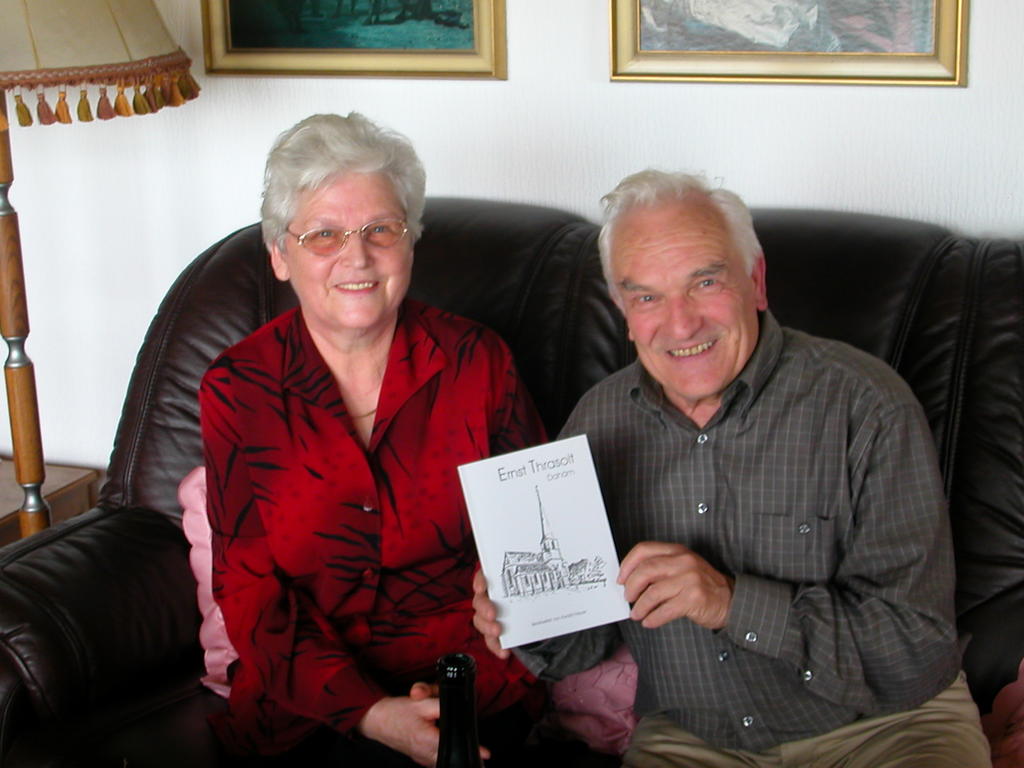
Helena and Ewald Meyer
at their home in Irsch


Imagine that you have been invited to the home of the author of a history of your ancestral village of Irsch
. His wife is seated nearby, and his son, who speaks English, has positioned himself where he can help if communication falters. Herr Ewald Meyer has just told you that he is available to be your tour guide for any place in the area that you wish to see, or your driver if you want to visit an archive to do research. Eyes sparkling with interest, he then asks, "Now, what is your heart's desire?"

That experience was overwhelming for me, especially since I wanted to know everything there was to know about Irsch and the surrounding countryside, see every place that my ancestors might have known, and speak fluent German as well as understand every word of German spoken to me. But that afternoon I chose to begin with the list of questions that I had jotted down as I wrote chapters in my novel. They were little questions, yet they were so important when you are trying to tell an ancestral story; the kind of questions I could answer for farm life in 1920-60 Wisconsin but which I knew nothing about for the Trier Saarburg area of 1820-1860.

Maybe Ewald and Helena Meyer were a bit surprised at how ordinary my questions were, but they answered them enthusiastically, and I took notes to the best of my ability to understand.

I began with, "What would the children call their parents? Were they Mama and Papa, Ma and Pa, Mutti and Vatti?" From them I learned that children in Beurich, where Ewald was born and in the Eifel Region, where Helena Meyer had grown up, called their parents Mutter and Vater or the less formal "Papp," and "Mamm".

Next I asked, "What kind of beds did they have? Herr and Frau Meyer said that the beds were rope tied. The mattress was usually stuffed with straw. There would be a Kisten, a cover filled with the feathers of geese or chickens. Sheets would be coarse linen, woven by hand. The pillows were stuffed with "Spreu", the hulls of the grains that were used to feed the cattle. (It took Arno's English and a drawing or two before I understood about Spreu). Three to four children shared one ordinary-sized bed.

The livestock kept by farmers in Irsch, as I expected, was similar to that found on a Wisconsin farm in the 1800's: pigs, cows, chickens, geese, horses, and oxen. Sheep too were raised in abundance in this region.

I asked how women did the laundry. The Meyers said that many women washed their clothes and bedding in the Grossbach, a small stream, as late as the 1920's or 1930's. (Later the landlord of the vacation apartment I had rented, Hans Dieter Jung, showed me a postcard picture of sheets spread out to dry on the banks of the Saar River after they had been washed there. It was my good luck to have found a landlord with an enormous collection of old postcards from the entire Saarburg area.)

We moved on to my questions about the houses, most of which were actually both house and barn under one roof. In earlier times there were straw roofs. Then in 1842 there was a terrible fire, and most of the village of Biest (today a part of Irsch) burned. The Prussian emperor forbad straw roofs after that time. So the roofs from that time on were made of tile (Ziegel) or slate. The kitchen floor would be of stone (probably sandstone), and in the older houses there were no hallways. One would enter the door from the street and be in the kitchen. The rest of the house was unheated in winter. The floors of the bedrooms would be of wood, and stamped lime was used for a cellar floor. There was a bake oven in the kitchen fireplace; meat could be smoked in the fireplace chimney. Or there might be a bake oven outside.

The bark of the oak trees in the area, known as Eichen Lohe, was used in the tanning industry. The farmers would strip the bark for the tanneries, and this was done when the trees were still quite young. Then two or three new shoots would come up and form even smaller trees, so that today there are no large oak trees in the area.

I had wondered if people drank both wine and beer in this region. People did drink some beer but wine was their usual alcoholic beverage. Each farmer had a few grape vines in cultivation and could make his own wine. In the autumn, Viez, an apple wine, was fermented from small, sour apples. (Note: Viez is still sold at farmers markets and at roadside stands today; it has actually gained popularity in the last several years. Its alcohol content varies, usually about six or seven percent. There is even a publicly proclaimed "Viezstrasse" or "Rue de Cidre" that runs between Saarburg and the Luxembourg border. The word "Viez" comes from Roman times [Lat. Vice = the second or deputy wine] and suggests this apple wine was drunk by the Roman occupiers as a replacement for genuine wine. In the Eifel, Hunsrück, Mosel Valley, and Trier the drinking container for Viez is a "Viezporz", a jug/jar made of white porcelain or stoneware, from which the name "Porz" is derived. In earlier times one stored the Viez in larger stoneware containers (Viezkrug). In the winter, people often drank their Viez warmed at the kitchen stove or fireplace. Source: http://adlexicon.de/viez.sthml)

Three meals were eaten each day. During the spring, summer, and fall, many of these meals were eaten in the fields; hilly fields that were far away from the farms. (On a drive with Herr Meyer, I saw that the fields of Irsch reach almost to the village of Oberzerf, about five miles away.) Probably it would be the grandmother who cooked at home while the adults and older children worked in the fields. The young children carried the lunch to the fields where the family was working.

The families purchased very little from shopkeepers because money was scarce. While they could make most things themselves or barter with neighbors, villagers always had to buy salt and sugar. Most of their food was grown in the garden or gathered from their trees: Potatoes, cabbage (Kappus in the Trier dialect), carrots, beets, celery, leeks, onion, lamb lettuce, beans, peas, kohlrabi, mirabel plums, pears, and many kinds of apples would be found in most gardens.

Clothing was mostly of linen or wool and work and bed clothes could usually be woven at home. However, families had to take the hides from their slaughtered animals to the tannery so that leather could be tanned for their shoes, then made by the village shoemaker.

Poor farmers had only cows to do the work normally done by a horse. Some farmers could afford oxen and the richest farmers had horses. Oxen or cows wore a head yoke when they pulled a plow or a wagon. Craftsmen like shoemakers, tailors, blacksmiths, etc., were better off financially than the average farmer.

In the meadows, growing wild or along the roadways, there were poppies, Kornblume (cornflowers) and Ganseblumchen (small white daisies). Edeltrud Heiser, a distant cousin, told me that children weave Kornblume and Ganseblumchen together to wear as a crown. She warned about the Brenn Nessel (stinging nettle), still remembering how much it hurt when she wandered into it as a child. Chicoree (chicory), which could be used in salads, Weiden Katzchen (meadow kittens, known to us as pussy willows), and Maiglöckchen (Little May bells/lily of the valley) were familiar to me but the Schnee Glockchen (snow bells) which flower in January were not. Deciduous trees in the area were oak, chestnut, and walnut. Hickory nut trees, a type of tree found in abundance when my ancestors came to St. John Wisconsin, have never grown in the Saarburg area.

Weddings were festive occasions, but Helena Meyer explained that there was not a wedding feast as we would know it. The food for the celebration was baked Kuchen of many kinds - Obst (fruit) Kuchen in summer and in winter, streusel, dried pear, or apple compote Kuchen. Most homes would have a small bake oven either in the kitchen or outside as a separate structure. But there was also a community bake oven which could handle many more loaves of bread (or Kuchen) and could be used when there was a special event, or if the family wanted to make a lot of loaves of bread at one time.

I asked about holidays, especially the celebration of Christmas. I was told that the people would always go to Midnight Mass at Christmas. If one priest was in charge of two or more parishes, people would walk to the principal or parish church where the Holy Mass would be celebrated. Even if the person were poor, there would be a Christmas tree with candles as well as baked and decorated figures. These would be given to the children as a gift.

Baptism was not celebrated in any special way in these small Catholic villages. As soon as possible after the child was born, usually the next day (there were no baptisms on Sundays or holy days) but sometimes on the same day if the child was born in the morning, the midwife - usually a family member there to assist the mother during the birth- and the godparents would take the child to the church to be baptized. The mother and father did not attend and the mother could not enter the church until nine days after the birth. (Rev. Leonard Barbian, Pastor of St. William Parish in Waukesha, says that from about 60 A.D., the church used running water or poured water three times over the head of the child - in the name of the Father, and of the Son, and of the Holy Ghost. At first the churches' baptismal fonts were sunken because most baptisms were of adults. But as time went on, the fonts were raised since children were baptized almost as soon as they were born)

During Holy Week, there was a procession on Karfreitag (Good Friday). It was a time when the church expressed its penitence and sorrow by foregoing music and bells. The children in the procession would use a large wooden noise-maker called a Raspeln, which looked almost like a small hurdy gurdy for an organ grinder. It had a handle connected to wooden gears inside a box. When the handle moved the gears, they ground together and there was a rasping noise that could be made rhythmic - rum--rum, rum-rum-rum, rum--rum, rum-rum-rum. Klappern or clappers were also used in the procession as well as to replace the altar bells would ordinarily be sounded at the consecration of the Sacred Host.

On Corpus Christi, a procession went through the streets of the village where each house had a small altar decorated in honor of the Body of Christ.

Musical instruments common to the area were harmonica, violin,and concertina (Ziehharmonika)

At the close of my first visit to the Meyer's home, we had coffee and Kuchen and then Herr Meyer drove me back to Saarburg, stopping along the way in his hometown of Beurig. Today it is part of the city of Saarburg but in the 1800's it was a separate village across the river from Saarburg. There were two things he thought I should see.

The first stop was a famous Pilgrim church of Our Lady. This is where people would come, making the stations of the cross as they approached. The last station was right outside the church on the church wall. Very close by on the corners of the streets leading to the church, there were bakers who sold their wares to the pilgrims who had been fasting and needed food after their pilgrimage was over. Herr Meyer told me that the pilgrims would put dried peas in their shoes as they started their journey to increase their penitence and petition. From about the 1600's until the time of Napoleon, there was a Franciscan cloister along side of the church where the brothers and priests lived, brothers on one side and priests on the other side of the cloister yard.

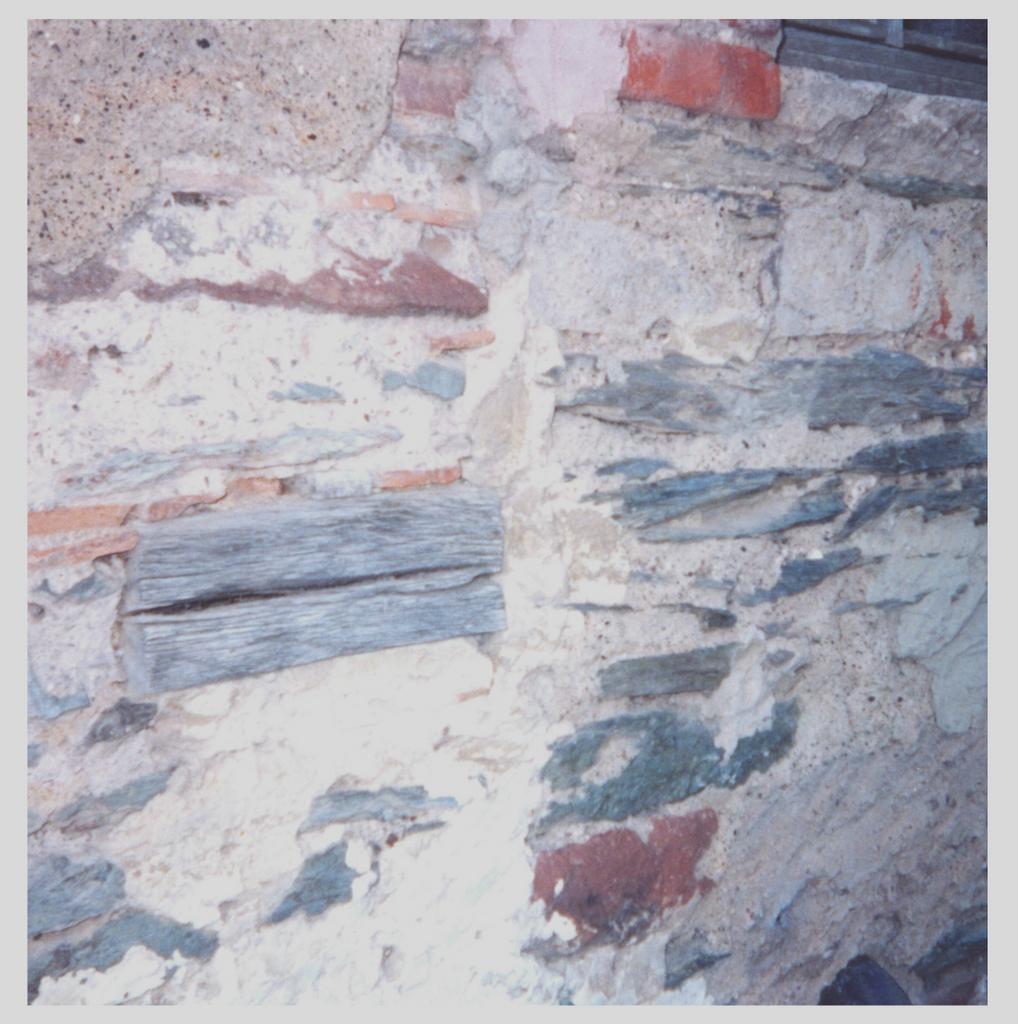
On our second stop, Herr Meyer showed me an old farm house. Up close, I could see that its thick walls were constructed of whatever materials had come to hand, including pieces of wood. (Few such buildings from the early 1800's exist in Irsch or Beurig. Both villages were heavily bombed and shelled during WWII.)


Old building in Beurig

Small window, upper right corner.
Stone and wood construction,
center left.


Our trip ended at the door of my vacation apartment. My head and notebook were filled with good information, and my stomach was soon to be filled with the remains of the Kuchen and Torte which Helena Meyer had sent as a dinner treat for me and my sister.

Books by Ewald Meyer:
Meyer, Ewald. Irsch/Saar: Geschichte eines Dorfes, ("Irsch/Saar: Story of a Village") 2002
Meyer, Ewald and Gehlen, Bernd. Beuriger Lese und Bilderbuch ("Beurich Reading and Picture Book") 2004
Thrasolt, Ernst. Hennerm Plou, ("Behind the Plow," poems and prose), translated from the Mosel-Frankischen dialect and edited by Ewald Meyer, 2000
Thrasolt, Ernst. Dahäm. Edited by Ewald Meyer, 2000


Saturday, July 23, 2005

A Visit to the Zerf Heimat Museum - Conclusion

The following section ends my information about the Zerf Heimatmuseum. It contains a description of miscellaneous artifacts not covered in the other posts. Just like the other entries I have posted, these artifacts may help paint a better picture of daily life in the village of Zerf and/or of the many other small villages near the Saar and Mosel rivers.

As I explained in my first post on the Zerf museum, the descriptions below without parentheses are my translations from the German language museum guide I received as a souvenir at the time of my visit. Anything in parentheses is additional information gleaned from other sources which I hope makes the original description a bit clearer.

Now back to the museum


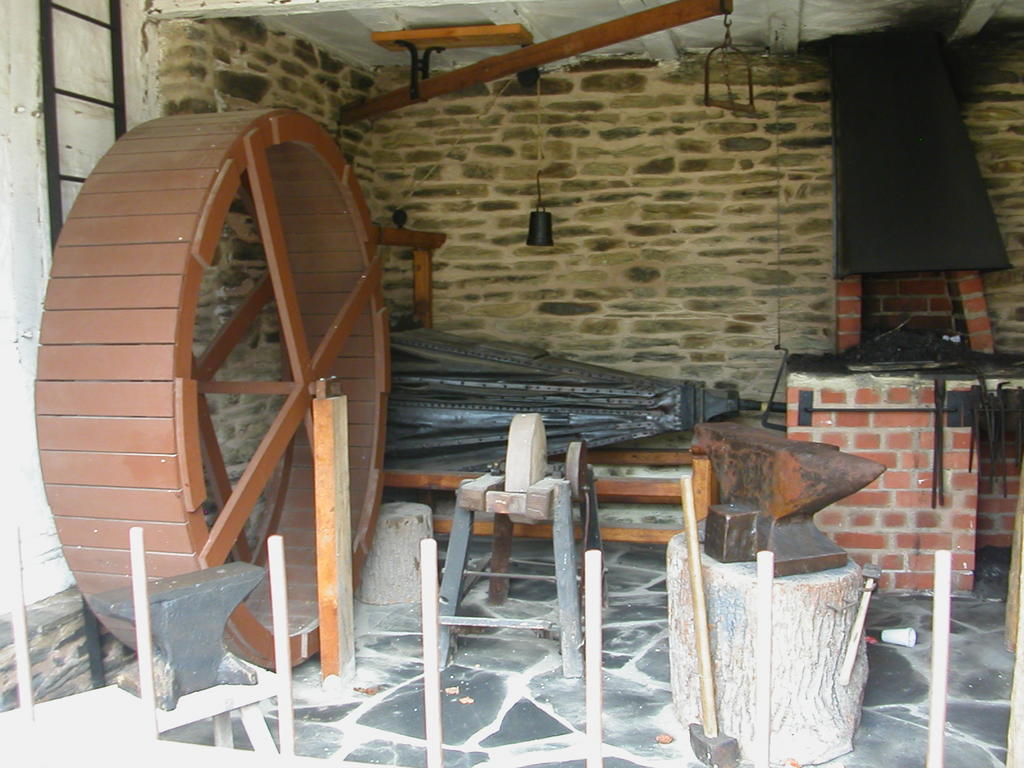
In the blacksmith's shop one can see the forge with the bellows, anvil, hammers, pliers, a bending machine for bending the eisenreifen (iron wheels) for the farm wagons. (According to the book, Serrig: Landschaft, Geschichte & Geschichtenby Klaus Hammächer, a dog could be trained to run inside the wheel shown in this picture. As he ran, he powered the bellows and the flame of the forge. The picture was taken at the Roscheider Hof open air museum near Konz)

Trumpets were used by Schweinehirt (swineherds). At the sound of the trumpet, the farmer opened the pig stalls and the Schweinehirt drove the pigs into the oak forests and guarded them there. In the evening the Schweinehirt brought them back with the trumpet signal. On the Feast of St. Martin (November 11) the Schweinehirt received a measuring beaker/cup full of grain for each pig under his care. (St. Martin's day was also the traditional time to prepare for winter by slaughtering pigs, geese, and other animals since they would soon be unable to forage for food and would have to be fed by the farmer)

The half Vierzel was a measuring instrument for grain. In former times the grain was not weighed; it was measured with this container. Four half Vierzel 'filled not too much and not too little' ( leveled?) equaled one hundredweight of corn, barley or wheat. Six half Vierzel made up a hundredweight of oats, because oats is finer. In earlier times, the teachers in the village were often also the swineherds, because there was no school in the summer (when the pigs could roam). School was held from St. Martin's Day to Easter.

One could distinguish cow, sheep and goat bells by the different tone qualities.

The small Nicholas bells were used by the adults to make the children aware of the feast day some weeks before it arrived. They rewarded the children's obedience by putting small gifts at the door on St. Nicholas Eve

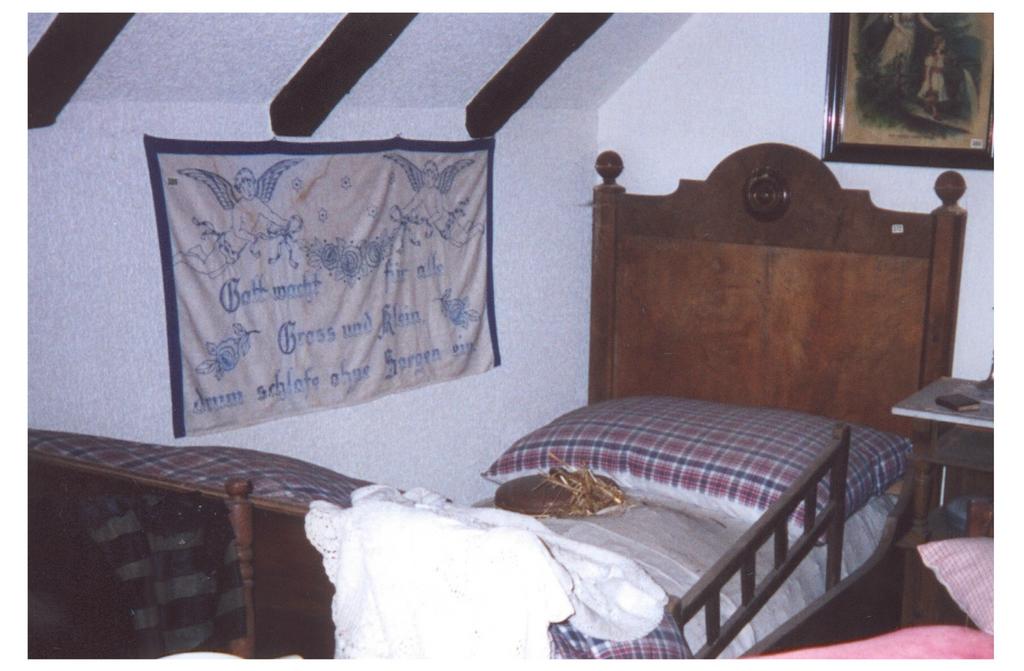
In the bedroom we see the straw filled mattress, the pillow filled with grain chaff, and the feather bed. (The villagers made use of almost any part of the crops that they grew, even in the bedroom. For instance, small pouches were filled with grape seeds and could be heated to ease pain, much as we can relax tight muscles by using the same sort of pouch and heating its "magic crystals" in a microwave. These grape seed pouches are still sold at the "Golden Autumn" festival and market in Saarburg)

The broad low-lying wooden box sled was, in former times, a popular plaything for the children during the long, snow-rich winters.

Kleppern (wooden clappers) and Raspeln (a rattle-like wooden device which rotated and made a rasping sound when shaken by its long handle) replaced the bells during Holy Week when bells could not be rung on Good Friday and Holy Saturday.

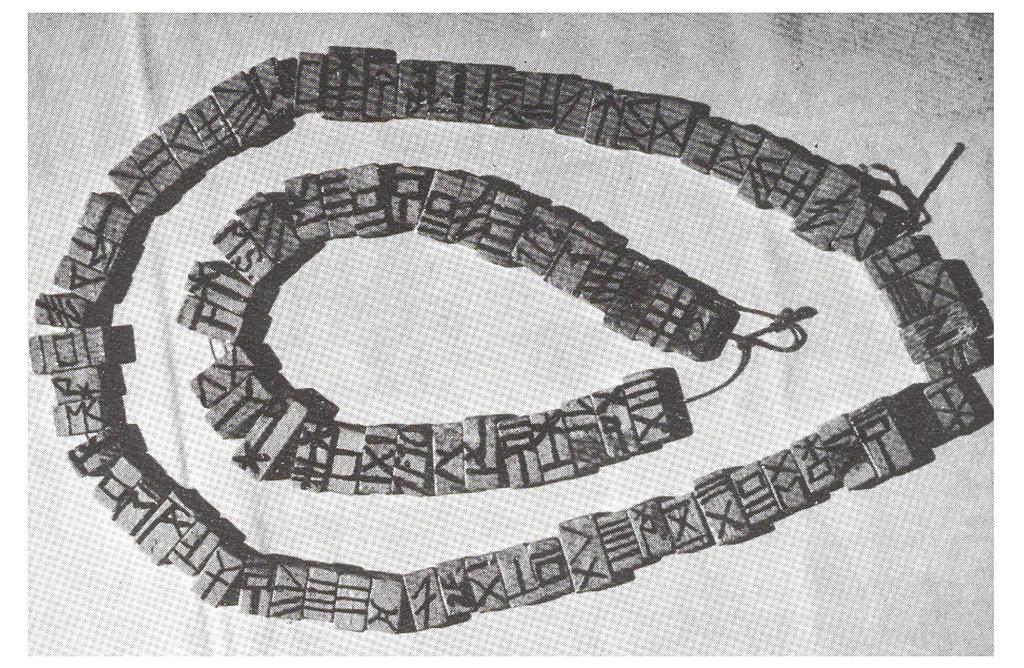
This is the Rosenkranz on which the house sign and hedge land identifiers for the Gehöfershaft were placed. These blocks were drawn in a lottery for distributing the Lohhecken among the farmers in the Gehöfershaft. (Above is a photo from Der Hochwaldort Zerf am Fuße des Hunsrücks, by Edgar Christoffel, c. 1981, Verlag W. Rassier, D5510 Saarburg. It shows wooden blocks with symbols which are rune-like rather than alphabetic characters. This Rosenkranz, the German word for rosary, served as a sort of plat map for the hedge lands which belonged to the entire community of land-owning farmers. In the Saar and Mosel region these landed farmers were usually referred to as a Gehöfershaft. A symbol identifying each section of the hedge lands, sections which were especially valuable for the oak tree bark stripped for tanning, was painted on one side of each small wooden block. Then a lottery was held. Each farmer in turn drew out a wooden block containing a hedge land symbol. His distinctive house mark could now be painted on the other side of the wooden block and the section was his to work until the next lottery was held. When the lottery was completed, the blocks were strung into the Rosenkranz and probably kept by the mayor of Zerf. In Zerf, this lottery took place every five years. The neighboring village of Irsch had a similar Rosenkranz, according to the book Irsch/Saar: Geschichte eines Dorfes, by Ewald Meyer).

The kitchen utensils and the farm equipment are described in Part 2 and Part 3, the other parts of this amazing visit to the past.