Tuesday, July 25, 2006

Bypassed by a Railroad


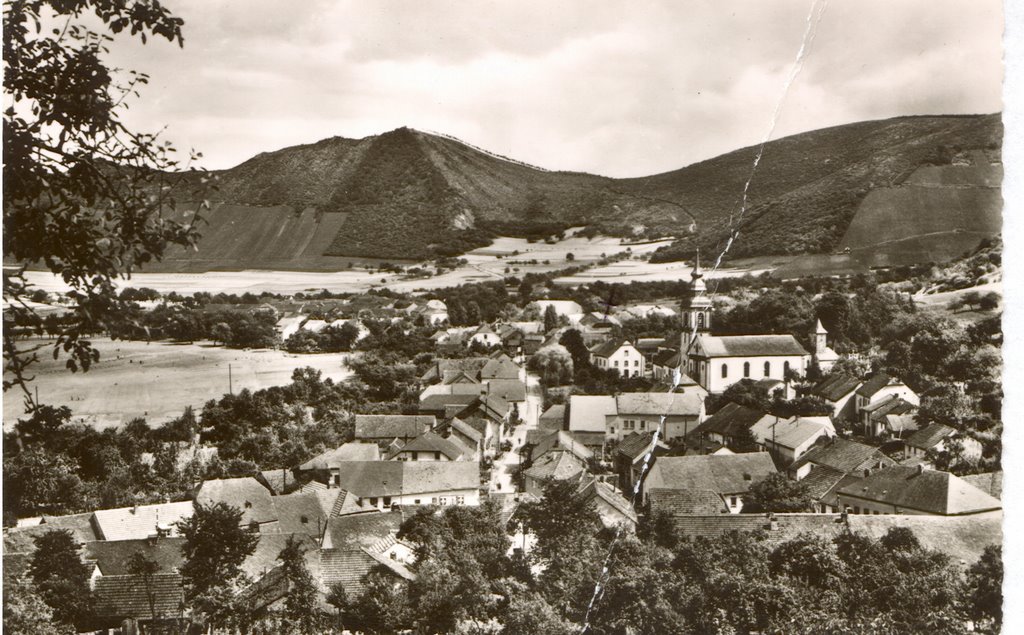
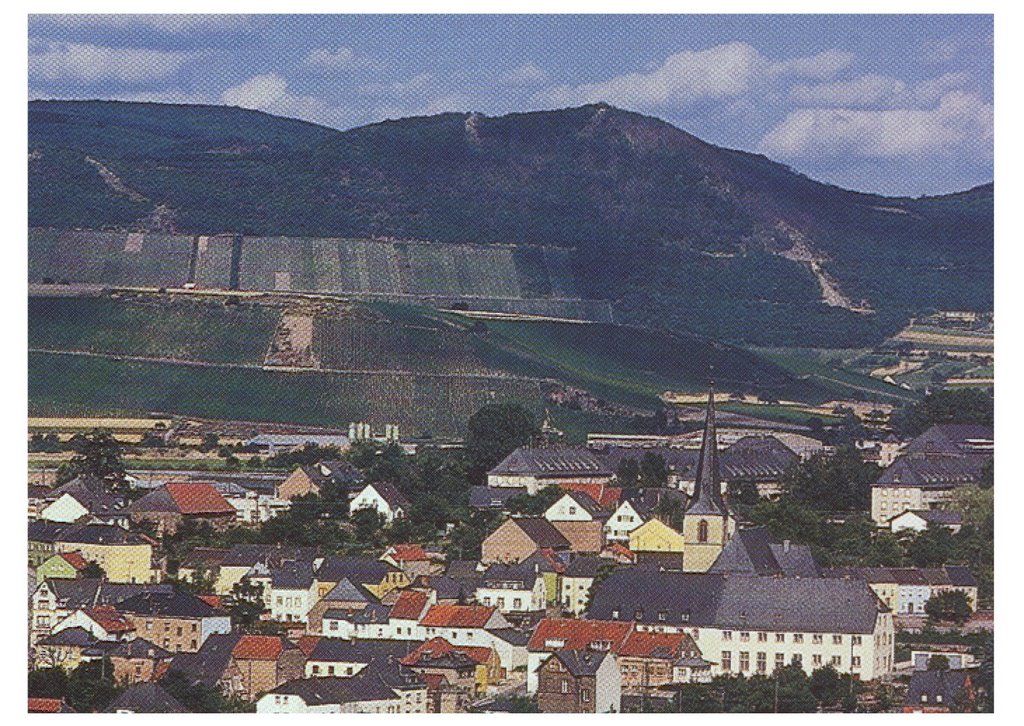
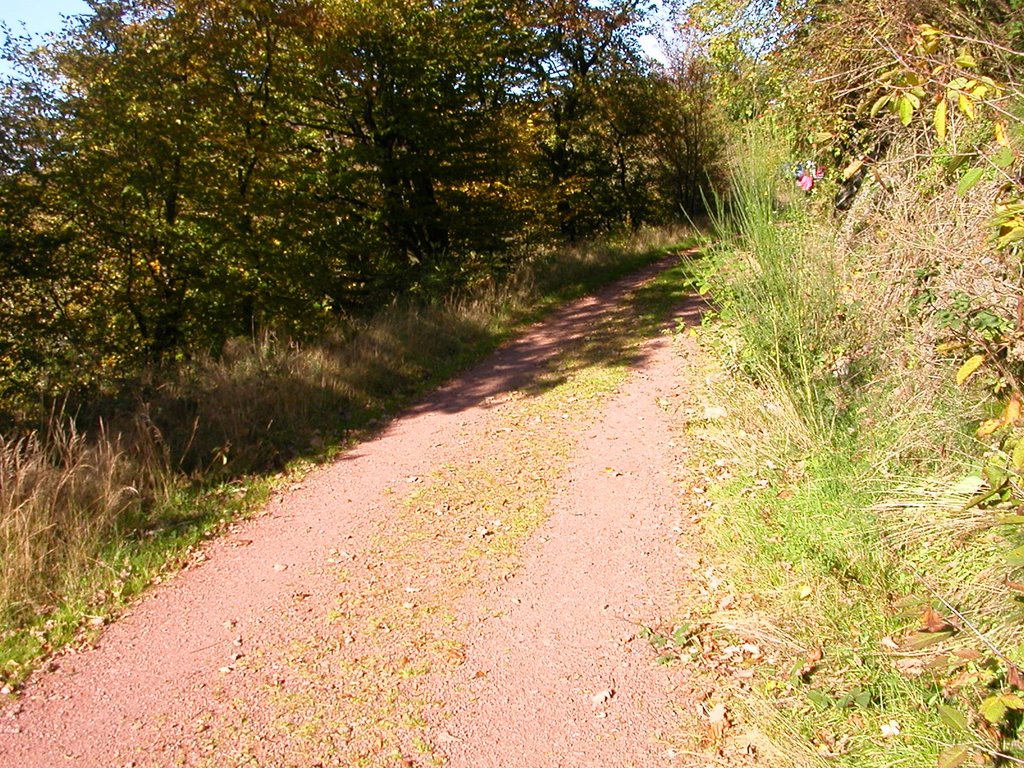
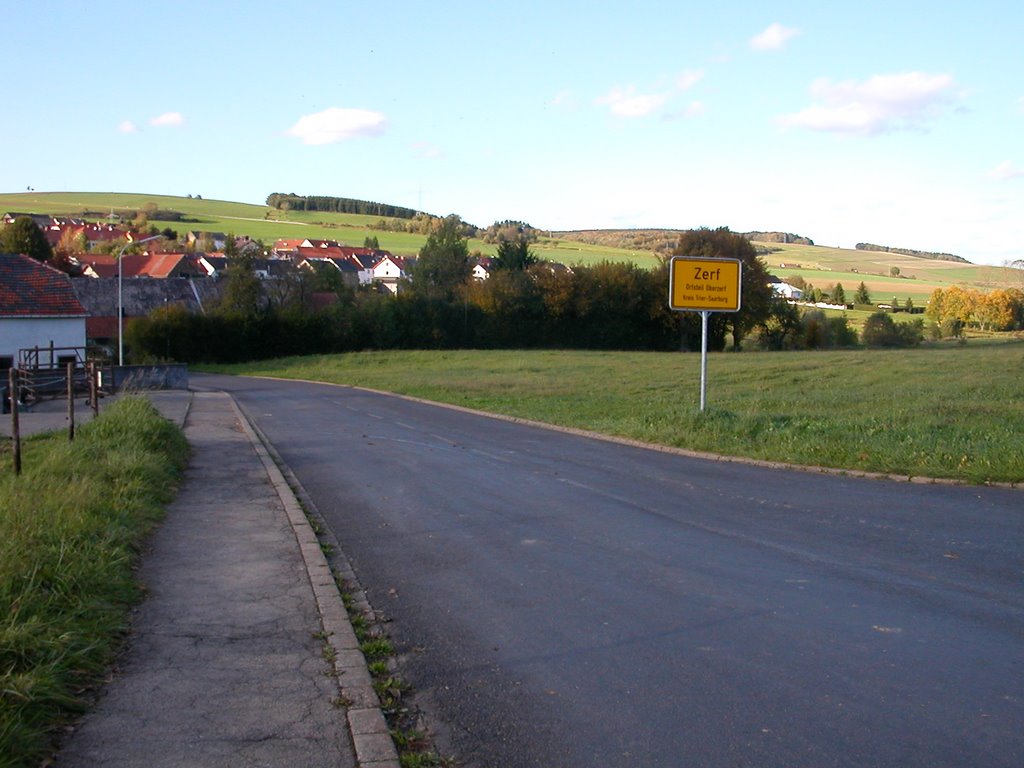
Approaching the village of Zerf - by car>>

For some of the farmers and craftsmen who lived in the Hunsruck area of the Rheinland, the building of the railroads influenced their decision to emigrate - but not always by making it easier and cheaper for them to reach an ocean port. The building of a railroad line through a remote area might give a man a hope for a brighter future, causing him to remain on his land. When his hope for a railroad line near his village was dashed, might it not cause that same man to pack up his family and try for a better life in America. The railroad line from Luxembourg to Saarbrucken is a case in point.

Villages like Irsch and Serrig had convenient access to the Saarburg-based cargo barges that sailed between Trier and Saarbrucken. The farmers in Zerf and the villages that surrounded it had much greater difficulty getting their products to appropriate markets than the people who lived nearer to the Saar River.

Then came a ray of hope. In 1844, the local city government in Trier began an active campaign to bring a railroad from Trier to Saarbrucken, fearing that the plan of running the railroad from Luxembourg City to Saarbrucken over Merzig and Remich would bypass Trier and affect the city negatively. They found an English company that was interested in a Trier-Saarbrucken railroad project. Two possible paths were debated. One was to follow the Saar valley; but the other was to go over the Hochwald through the Ollweg valley, with a tunnel from Franzenheim to the Ruwer valley, overland through Zerf, then leave the Ruwer valley and head toward Losheim. From there it would go to Illingen and end in Neunkirchen which would connect the line to Saarbrucken through the already existing Bexbach-Mannheimer railroad.

But unrest was in the air, leading up to the revolution of 1848. The foreign companies lost interest in building a railroad from Trier to Saarbrucken, so the city of Trier lobbied its cause directly in Berlin. Finally Berlin gave way to pressure from the Trier delegates, agreeing that running the rail line through Trier was a military necessity. The city was to be included in the railroad line stretching from Luxembourg to Saarbrucken. But which of the two routes originally considered by the British investors in 1844 would be the one chosen - the one running through the Saar valley or the high overland route through Zerf?

A committee of representatives from the Hochwald defended the route that would let the railroad pass over the Hochwald and through the Bliestal and the villages of Zerf, Losheim, St. Wendel and Ottweiler. They argued against placing the railroad line in the Saar valley because of its nearness to France, the higher land costs and the fact, that "all the Saar sailors, whose number are not small, would be cut off from a source of income." The Hochwald, on the other hand, needed a favorable route for its goods - wood, Lohe (tanning bark), and cattle - so that the population did not become even more impoverished. However, the petition of the Hochwald committee was rejected by Berlin, and the Saar valley gained the advantage for the railroad line. The representatives of the Saar valley industries had prevailed over the weakly structured Hochwald/Bliestal region’s committee, probably helped by the fact that the manufacturer Boch, owner of the porcelain factory at Mettlach, had never favored the Hochwald plan.

On 7 March 1857, Emperor Friedrich Wilhelm IV decreed the construction of the railroad line using the Saar Valley route. Zerf and the other Hochwald villages had lost their chance for prosperity.

The choice of the Saar route was not without problems. Terrain difficulty, especially in Mettlach, increased the total cost of of the project from five-and-a-half million Taler to eight million Taler and delayed the completion until 1860.

Mathias Rauls, the brother of my great-great grandmother, was one of the emigrants who left the Hochwald in 1857. He and his wife Elizabeth, along with 38 other residents of Zerf, received permission to emigrate during the months of February, March and April of 1857. I believe that these farmers and their families had already guessed that there would be no railroad line for Zerf and that most of the farmers in the Hochwald area of the Hunsruck would struggle with poverty for a long time to come.

The Rauls family settled on eighty acres of land in the Township of Berry, Dane County, Wisconsin. The plat map of 1864 shows a railroad line near their farm.

Sources: Hammaecher, Klaus. Serrig: Landschaft, Geschichte, Geschichten, pp. 115-117; Wisconsin State Historical Society, Plat Map of Dane County Wisconsin, 1864

Sunday, June 25, 2006

A Family Story with Extras


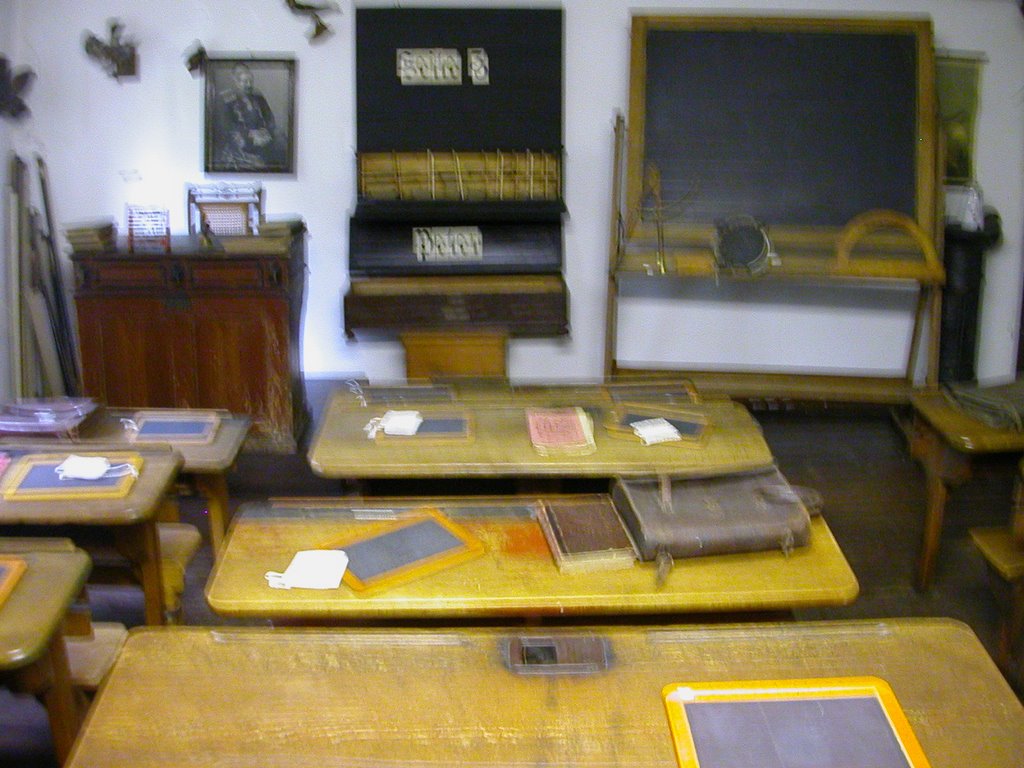
The Village of Irsch, 1937 and 2002

When I started “doing” genealogy, I kept my information on a form known to all genealogists – the family group sheet. While that works well for keeping track of names, dates and places, it is entirely unsatisfactory for all the pieces of information that breathe life into a family’s history. Eventually, I began to integrate historical information, especially social history, into a narrative for each family group.

While that prevented me from losing track of historical information, I soon realized that all of my ancestors from the Trier area shared a common history, leading to a lot of repetition in the text of each individual family’s story.

What to do? I invented what I call the combined family story with "extras." I put the information from the Rauls, Meier, Hauser, and Schawel family group sheets together, writing a single narrative that included all the brothers and sisters, parents, grandparents, etc., from all of my Rheinland families. Then I added what I considered relevant historical happenings. I also included social customs and any other tidbits of information that would get lost if I kept them on pieces of paper in my files. When I stumbled on a new piece of information of any kind, I just added it in. Here are some illustrations of my "extras."

A Picture of the Early Years

The first years of the nineteenth century were also the early years of my four great-great grandparents. While they were growing from babes to young adults, the other members of their families, the everyday world around them, and daily events both large and small, shaped them and formed the memories which they took to their new land when they emigrated.

Johann Meier, Magdalena Rauls, Michael Hauser, and Madgalena Schawel, did not come into the world at the best of times. These were bad harvest years, especially the mid-1820s when Johann Meier and Magadalena Rauls were born. The poorer people ate mostly bread made of potato flour. Some stole wood and poached in order to survive. The farmers with land fared a little better than the day laborers, but times were hard.

The residents of Irsch, Oberzerf, and Serrig had become citizens of Prussia after Napoleon’s defeat in 1814. There was no major war during the Prussian years from 1814 until the 1860's, and Irsch did not experience great changes of local governance under Prussian rule. For instance, Maximilian Keller served as Maire during the time that the Irsch villagers were French subjects. In 1814, Herr Keller kept his position as mayor. Only his title changed; he had become a Prussian Burgermeister. Unlike today, the term of office for a mayor could be lengthy. Nicolaus Bodem became the Burgermeister of Irsch in 1831 and kept this position for the next 48 years.
Even more respected than the civil authority of the mayor was the religious authority of the village priest. Like Mayor Bodem of Irsch, Fr. Matthias Guckeisen served the parish of Zerf, including Oberzerf and Greimerath, for an exceptionally long period of time, from 1824 to 1863 - almost 40 years. Father Peter Kremer was in charge of the Irsch congregation from 1817 to 1848, over 30 years. He might have served the parish longer but, like so many of his parishoners, he died during the cholera epidemic that was sweeping Europe at that time.

There is not much description available for the way that people lived their day-to-day lives in the villages of Irsch or Serrig. However, in neighboring Zerf where Magdalena Rauls grew up and which was only a few miles away from Irsch, the living conditions in the 1800's were well described by Edgar Christoffel in his history of Zerf.


"Most houses were damp...because they had only partial cellars. They were built of quarry stone, one or two stories tall, and had straw roofs. Only the public buildings, such as the mayor's house, the school, and the church had sloping tile roofs. Inside, the house was very simply furnished and rooms other than the kitchen and the 'good room' were seldom heated...[There was] an open fireplace where a large log burned. On an iron pole hung the big kettle. Meat was smoked in the open chimney..."

"Meat could only be kept by smoking it; when meat was eaten during the day, it was smoked and served with sauerkraut. The poorer people seldom had meat on the table. They had buckwheat dumplings with milk. More well off people might have bacon as well. In the evenings fried potatoes with sour milk were frequently eaten."

"In the winter evenings, the women busied themselves spinning flax, hemp, and wool. The men smoked their clay pipes...”The village streets had a slightly convex, bumpy surface, so that the horses often slipped off the road. In the dark, the men of the village sometimes did the same. Since the streets had no drainage, the water flowed in the gutters when it rained; and since the gutters lay right in front of the houses, the people had to make a huge jump to get across them or lay a plank over them. The waste water and sewage was dumped too...and there was a very unpleasant odor on some streets in the summer. Toilets were little houses with a small cut-out heart on the door. They stood near the manure pile or cesspool. Water came from village wells, although a few people had wells of their own."

Sicknesses such as typhus and scarlet fever were prevalent during the 1830's, and many children and adults died from these diseases as well as from diphtheria. I noted that two of Johann’s Meier's brothers died in those years; both were under four years of age.

The children of Irsch received their education in the schoolhouse on the Irsch/Biest border. Infant mortality decreased during the first half of the 19th century and there were so many children enrolled in the school, newly built in 1828, that by 1833 there were two teachers. The principal subjects taught were writing, arithmetic, and Bible instructions.
Zerf too needed another teacher. The school population was as high as 100 students in 1826 and eventually there was a separation of the school children into a lower form and an upper form.

Irsch suffered a terrible tragedy in the dry summer of 1842. The biggest fire in 100 years destroyed 34 houses and 22 stables within a few hours, leaving 500 inhabitants without shelter. The stables, which contained fodder for the animals and the oak bark meant to be sold to the tanneries of Saarburg, were also reduced to ashes.

In 1844, the "Holy Robe" of Christ was displayed in the Cathedral in Trier. The robe, thought to be the seamless garment which Christ wore on the day of his crucifixion, supposedly was given to the Bishop of Trier by the Mother of the Emperor Constantine. It was displayed only periodically, and it brought a great number of pilgrims through the Saar villages as they made their way to Trier Dom Cathedral to venerate the the Holy Robe.

Irsch was approximately two miles from Saarburg, the seat of government for the Kreis. But its accessibility was limited because the Saar River separated it from all the small villages to its east. Since the stone bridge across the Saar was not completed until 1861, anyone coming from Irsch would have to be ferried across the river in order to get to Saarburg.

Some Questions
Did 17-year old Johann Meier see the family's possessions go up in flames; was Magdalena Rauls, born on December 25, baptized by Father Guckeisen in the chapel at Oberzerf while the boughs of fir trees still decorated the church altar; was Magdalena Schawel, on her first day of school, excited because she was among the first group of children to be taught in the new school building? I do not know the answers to those questions, but without the "extras" in my family story, I would never have had cause to wonder.

Sources:
Christoffel, Edgar, Der Hochwaldort Zerf am Fusse des Hunsrucks
Meyer, Ewald, Irsch/Saar: Geschichte eines Dorfes, 2002.
Photos within text taken at Roscheiderhof Open Air Museum

Thursday, June 01, 2006

Feast of Corpus Christi


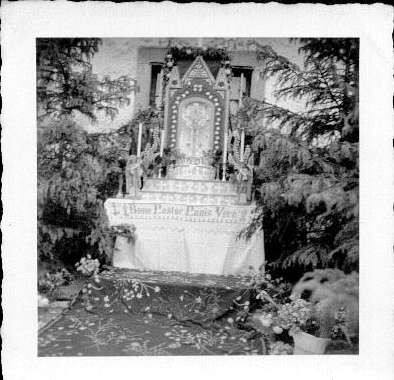
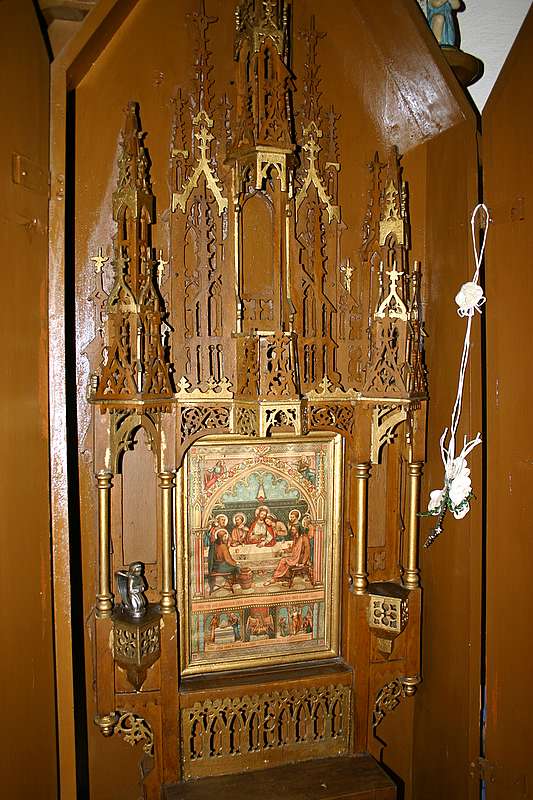
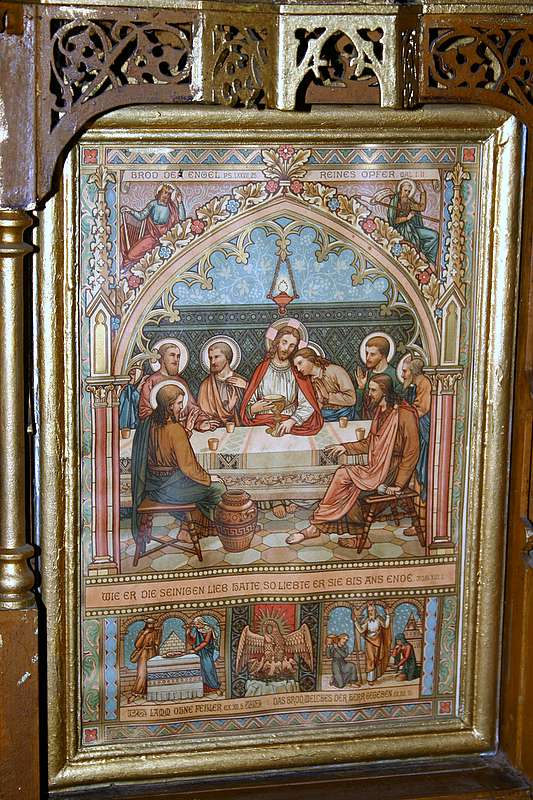
Traditional German Corpus Christi altar - photo from Ernst Mettlach who says he thinks the picture is from the 1950s.

In my Catholic parish in Wisconsin, the feast of the"Solemnity of the Body and Blood of Christ" will be observed on June 18. Most of us still think of this religious holiday as "Corpus Christi." It is not a Holy Day of Obligation in the United States, and it is now celebrated on the Sunday after Trinity Sunday.

However in many of the Federal States in Germany, including the Rheinland, Corpus Christi, known as Fronleichnam is still a solemn church holiday as well as a national holiday. It is celebrated on the Thursday following Trinity Sunday, a date that was chosen around the Thirteenth Century.

Fronleichnam Memories:

When he was growning up in Beurich (today part of the city of Saarburg) Ewald Meyer, author of a history of the village of Irsch, remembers Fronleichnam or Corpus Christi processions and the elaborate altars erected outside of the homes in his village, as illustrated by the photo above. As the Fronleichnam procession wound along the streets of the village, the village priest would bless each altar.

My German relative, Edeltrud Heiser, grew up in the village of Irsch. She says that when she was a child, the children in the Corpus Christi procession dressed in their best Sunday clothes. Little girls wore woven flower crowns of Ganseblumchen and Margarites and, if it was the year of their first Holy Communion, the girls would wear their white Communion dresses.


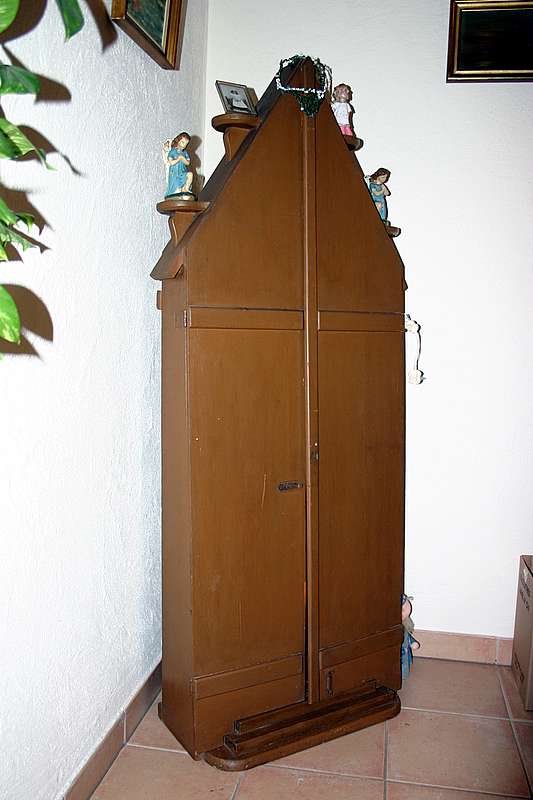
Ernst Mettlach also grew up in the Trier area. He is the fortunate owner of an elaborate Fronleichnam altar. He says, "I saved an old altar from the rubbish. It was decorated with flowers and placed at the feast of Corpus Christi (Fronleichnam in german) in front of the houses to honour Jesus Christ. There is still a procession today, but there are only a few house-altars left. Corpus Christi was an important day in the life of our ancestors."

As you can see from these four photos, the Corpus Christi altar that Ernst rescued is a wooden cabinet, rather like a triptych, that opens to reveal a painting of Christ and his apostles at the Last Supper. Intricate wood carving frames this picture, giving the whole piece the aura of an elaborate cathedral altar.

Some Additional Information about Corpus Christi

The feast of Corpus Christi was established in 1246 in Liege Belgium after Julianna of Mont Cornillon, a nun and mother superior who had always held the Holy Eucharist in great regard, reported a vision through which she understood that Jesus lamented the absence of a particular feast in the Church's calendar focused on his sacramental presence on the altar. When the former archdeacon of Liege, Jacques Pantaleon, became Pope Urban IV, he adopted the feast. It was (and in many countries like Germany still is) celebrated on the Thursday after Trinity Sunday. The Eucharistic procession, while not mentioned in the early office and texts of the Catholic Church, came to be connected with Corpus Christi and, in time, the hallmark of the religious observance. In addition to its religious significance, the feast also came to have great social and commercial significance. (Catholic Encyclopedia)

Fronleichnams-fest is celebrated throughout Catholic Germany with processions through streets that are charmingly decorated with flowers and garlands of green. Crucifixes and pictures of Christ are prominently displayed from window ledges and the steps of cottages and village fountains. In many places people display bright hangings and spread carpets before their houses in honor of the Sacrament and of the large crucifix, both of which are carried through the parish. One of the most beautiful features of the processions is the group of children, dressed in white with flower chaplets on their heads and nosegays of fragrant blossoms in their hands. Girls and women in magnificent regional costume add further distinction to the joyous event. http://www.sacred-texts.com

Cologne in 1279 had the first recorded Corpus Christi procession. Not content to adore the Eucharistic Christ exposed in a monstrance inside the church, the people appealed to have a Host consecrated during the Mass carried through the streets to be adored. The practice caught on throughout all of Europe, where it was seen as the triumph of Christ the King. In some places, the procession would wind through a town and even into the countryside. In Germany, each of the four Gospels was sung and Benediction of the Blessed Sacrament took place in four spots, north, south, east, west as a plea for good weather. (From the website Angel Fire)

Sunday, May 07, 2006

Thirty People on Their Way to a New Land


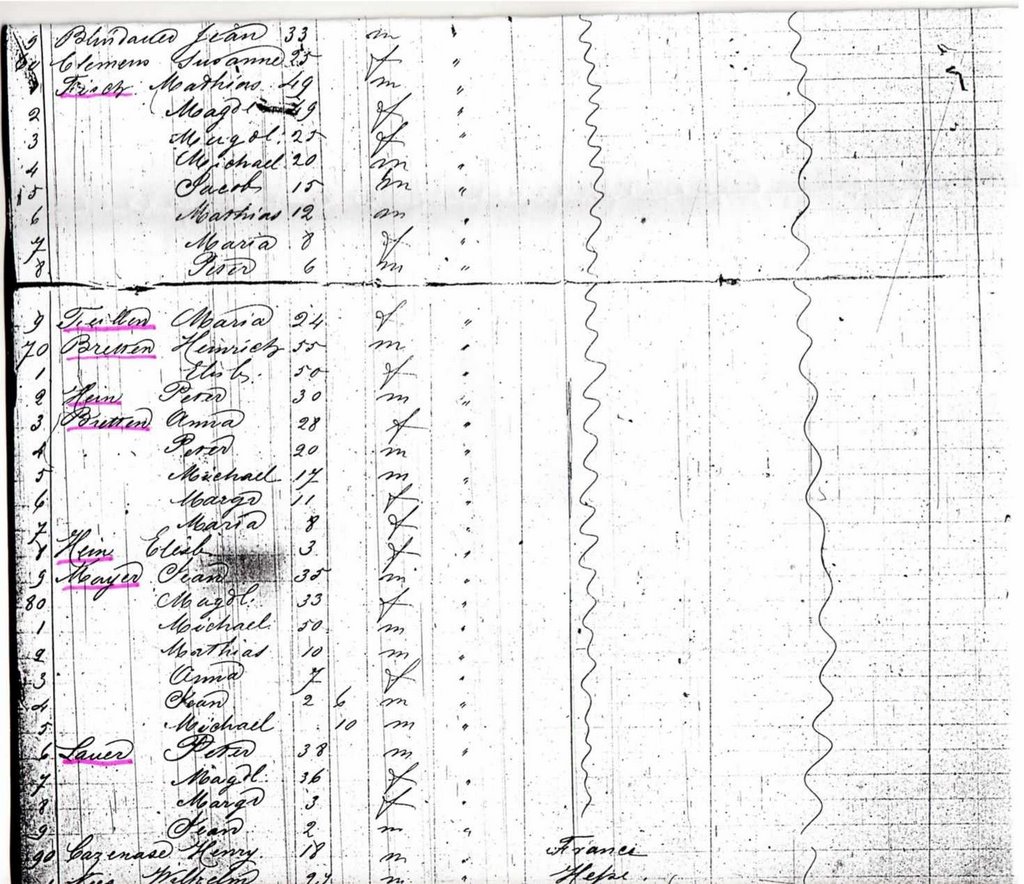
Sections of pages 1 and 2 of a passenger list filed with New York port authorities on May 9, 1861


In my last post I wrote about the process of obtaining permission to emigrate. This time I want to focus on a special group of emigrants from the village of Irsch, Kreis Saarburg, Rheinland. These neighbors, some of them related to each other, had all made a decision to seek a better life for themselves and their children in America; and, when they received the necessary documents, they traveled to Wisconsin aboard the same sailing ship. Among them were my great-great grandparents, Johann and Magdalena Meier and their four children. Their fifth child, Anna Maria, was left behind in the cemetery beside the church.

What was it like, I wonder, to sell your farm and almost all of your possessions, close the door of the house you had lived in for many years, and walk beside a wagon or push a wheelbarrow loaded with just those few item that you had packed into a trunk or some sturdy cloth bags. These stoughthearted men and women must have asked themselves over and over, "Will these things that we carry with us be what we need to help us survive the ocean trip and the first months in the new country?"

Did these travelers wave goodbye to their neighbors and pause for a moment to scan the still-fallow fields that they would never plant again? Did this last sight of their village happen on a day that was cold and rainy; or was it a sunny morning, the breeze tinged with a spring warmth?

While I have no way to prove it, I think it is likely that the people I am talking about not only traveled on the same ship; but also made the trip from Irsch to Le Havre together. If so, they probably boarded the train at the stop in Beurig and went on to Metz via Saarbrucken. In Metz, they changed trains in order to travel on to Paris. In Paris, one of Europe's largest and most cosmopolitan cities, these inexperienced villagers either transfered to yet another train or took a steamer up the Seine River to reach the port city of Le Havre.

The thirty emigrants whose names are recorded on the passenger list of the American ship Rattler (second page of the two documents above) were a mixed lot, ranging in age from over 50 to just one year old. There were four farmers, a wagon maker, a serving maid, and a day laborer. Six of the children listed were over 18 years of age - old enough to be a productive part of the workforce that the sparsely settled state of Wisconsin was seeking.

The Group of Thirty:

1. Maria Feilen, 23 years old, serving maid. She had received her permission to emigrate on February 22, 1861.


2. Heinrich Britten, 55 years old, farmer. He received emigration permision on February 25, 1861. He and his family settled in St. John/Hilbert, Wisconsin.

3. Elizabeth Mertes Britten, wife of Heinrich Britten, 51 years old. 


4. Peter Britten, 20 years old son of Heinrich and Elizabeth Britten.

5. Michel Britten, 18 years old, son of Heinrich and Elizabeth Britten.

6. Margaretha Britten, 8 years old, daughter of Heinrich and Elizabeth Britten.

7. Maria Britten, 7 years old, daughter of Heinrich and Elizabeth Britten.


8. Peter Hein, 30 years old, day laborer. He received permission to emigrate on February 25, 1861. He and his wife and daughter settled in St. John /Hilbert, Wisconsin.

9. Anna Britten Hein, wife of Peter Hein, 29 years old (daughter of Heinrich and Elizabeth Britten - see previous entry)

10. Elizabeth Britten, daughter of Anna and Peter Hein, 4 years old.


11. Michel Meier, 50 years old, unmarried farmer, uncle of #25, Johann Meier. He received his permission papers on February 27 1861 and settled in St. John, Wisconsin


12. Peter Lauer, 38 years old, wagon maker. He and his family received permission to emigrate on 2 March 1861. They settled in Fussville, Wisconsin which is now a part of Menomonee Falls, Waukesha County, Wisconsin. 


13. Magdalena Wagner Lauer, wife of Peter Lauer, 37 years old.


14. Margarethe Lauer, daughter of Peter and Magdalena Lauer, five years old, 


15. Johannes Lauer, son of Peter and Magdalena Lauer, two years old.


16. Mathias Fisch, 48 years old, farmer. He received his permission to emigrate on January 31, 1861. He wanted to leave, he said, because acquaintances living in American had convinced him that he could support his family better there. He settled in St. John, Wisconsin

17. Magdalena Lauer Fisch, 48 years old, wife of Mathias Fisch.


18. Magdalena Fisch, daughter of Mathias and Magdalena Fisch, 25 years old.


19. Johann Fisch, son of Mathias and Magdalena Fisch, 21 years old. He had served in the Hohenzollerschen Regiment, Nr. 40 in Saarlouis, according to information in the Koblenz Staatarchiv.


20. Michel Fisch, 20 years old, son of Mathias and Magdalena Fisch.


21. Jakob Fisch, 15 years old, son of Mathias and Magdalena Fisch.


22. Nikolaus Fisch, 13 years old, son of Mathias and Magdalena Fisch.


23. Maria Fisch, 10 years old, daughter of Mathias and Magdalena Fisch.


24. Peter Fisch, 8 years old, son of Mathias and Magdalena Fisch.

25. Johann Meier, 35 years old, farmer. He and his family received emigration permission on March 5, 1861. His reason for leaving..."that he already had two brother-in-laws there and was going to them." (One of these men was his wife's brother, Mathias Rauls, who had settled in Dane County Wisconsin about 1857.) Johann Meier and his family settled in St. John, Wisconsin.


26. Magdalena Rauls Meier, 33 years old, wife of Johann Meier.

27. Mathias Meier, 11 years old, son of Johann and Magdalena Meier

28. Anna Meier, 9 years old, daughter of Johann and Magdalena Meier


29. Johann Meier, 3 years old, son of Johann and Magdalena Meier


30. Michel Meier, one year old, son of Johann and Magdalena Meier


Early in April 1861, these thirty men, women, and children boarded the American sailing vessel, Rattler, which would take them across the Atlantic Ocean to the port of New York. Under the leadership of Captain Almay and his crew, they would live in the steerage area between decks for 32 days. By the time they stepped ashore in New York City on May 9, soldiers in dark blue Union uniform were everywhere. The American Civil War had just begun.


Sunday, April 09, 2006

The Government Bureaucracy and the Immigrant Ancestor


Beurig, once a village with its own mayor, is today a part of the city of Saarburg

THE IMMIGRATION DOCUMENTS

In October, 2004 I went to the Landeshauptarchiv Koblenz Archiv in an attempt to locate a copy of the passport for my great-great grandfather and his family who left Irsch in 1861. While I didn't find the passport, I had the chance to gently handle the actual immigration documents that were handwritten by the Burgermeister of Beurig/Irsch at the time of application; a rare opportunity that I will always treasure. These documents, along with hundreds of others from the Saarburg district, were bound in a volume that spanned the time period from January of 1859 to May of 1862. (Earlier and later volumes of application papers are also held at the Archive).

As I turned pages in the leather-bound book of applications, I confirmed that within the space of a few weeks in February and March of 1861, thirty inhabitants of the village of Irsch, including my 2nd great grandfather and his family, were granted permission to emigrate to America. These thirty people would soon travel together to Wisconsin to begin a new life in an unknown land. The men were also officially renouncing their Prussian citizenship. They were ready to take an enormous risk to improve their lives and the futures of their children.

WHY DID SO MANY LEAVE?

According to historian J. Bellot, the first half of the nineteenth century was a time when economic conditions in Germany were very bad. Wages were miserably poor and prices were rising. Factories were replacing the handworkers, and before 1850 there was already heavy migration out of the Trier and Saarburg districts.

Many chose to find a place where they could have land of their own and to be free from high taxes, especially the Klassensteuer of the Prussian Government. The Trier district also had exceedingly high church assessments from 1857 onward.

Then there were the "agents", men who promised to facillitate the trip. Some of these travel agents were honest; others were not. And a few of the agents in Germany were actually sent by the State of Wisconsin to find settlers to populate the state. They carried with them a pamphlet published in 1848 by German immigrant Carl De Haas. It was called NORTH AMERICA WISCONSIN; HINTS FOR EMIGRANTS. It had been written by Haas to help others who were considering the same trip he had made. Haas pointed out that Wisconsin had cheap land available - it was sold for $1.25 an acre in most cases - and Wisconsin was the first state in the Union to require just one year of residency to become a citizen (LeVern Rippley, OF GERMAN WAYS).

"America letters came from relatives or neighbors who had left their villages in the 1840's and 1850's. There were stories of cheap land, good crops, and success. In this 1846 letter, an immigrant writes to his relatives in the Rhineland from someplace near Milwaukee, Wisconsin: "Immediately I found land to purchase...I purchased a piece of property of 40 acres, which is the same as 55 Prussian acres. On this property stands a house and two pig stalls. Along with this we also received two beautiful oxen, one cow, one steer, eight pigs, eight chickens, the oven with which we cook and bake, one bed, one cabinet, one grindstone, and all farm equipment...We also got a garden, a beautiful garden, which had all kinds of beautiful plants...The beautiful melons were a special joy for me...We have enough here to live in abundance. It is a peaceful and contented life. No tax-collectors. Come here!"

By 1861 the railroads were crisscrossing Germany. Already in 1852, a rail line from Forbach (near Saarbrucken) to Havre made it easier for the emigrants from the Saarburg area to reach an Atlantic port. (Mergen, Josef, Die Auswanderungen aus den ehemals preussichen Teilen des Saarlandes im 19. Jahrhundert). On May 25, 1860, the railroad line connecting Trier with Saarbrucken was officially opened. The immigrant from the Saarburg area could finally reach the port of LeHavre in France entirely by rail. (Hammaecher, Klaus, SERRIG: LANDSCHAFT, GESCHICHTE & GESCHICHTEN, Saarburger Satz & Druck GmbH, Saarburg, 2002)

OFFICIAL REACTION TO INCREASING EMIGRATION

By the 1860's, the steady flow of emigrants to America was causing government officials to worry. They had assumed that the majority of immigrants would be day laborers and small farmers who teetered on the edge of destitution. There was, they had thought, little to be gained by trying to retain these people and then support them if they became improverished. But many of these first immigrants found that they could flourish in their adopted country; and they wrote to their relatives, encouraging them to leave Germany too. Hard-working, ordinary farmers and craftsmen began to leave the Rhineland in increasing numbers. In some villages, up to a third of the population had emigrated by the 1870's.

As they watched this "out wandering", government officials finally realized that the men who paid taxes and provided stability to the economy were being lost at an alarming rate. Hoping to stem this tide, the Prussian government prepared a standard list of warnings and advisements. The local mayors were required to read them to each person requesting permission to leave the country.

THE EMIGRATION INTERVIEW

A typical interview between a resident of the village of Irsch or Beurig seeking permission to leave the country and Burgermeister Nicholaus Bodem of Beurig might proceed something like this:

Burgermeister Bodem would probably ask the applicant to give his - or in some cases, her - reason for wanting to renounce Prussian citizenship in order to go to a new country; then record the answer. The Burgermeister would next read from the the official list of warnings. He would caution the applicant that not everyone found a good life in the new country; some were cheated badly and found themselves living in poverty. If life in the new land is not successful, he would say, you will no longer be a Prussian citizen. You may not be allowed to return to the home country. (Because of the time period in which my great-great grandfather applied for his passport, he was also cautioned that the United States was dangerously close to a civil war that might make travel within America dangerous or even impossible).

If the applicant persisted in requesting permission, the mayor asked for the details of his financial situation. The applicant had to give proof that he had no debts or fines. He had to document that he had completed his military service. Finally, when all seemed to be in order, a fee of 15 Silbergroschen, was paid. Burgermeister Bodem would end the session with the following advice. This advice, like the warnings, was required by governmental order.

1. Use the regular immigration office in Köln or Koblenz and do not trust underhanded agents in setting up travel.

2. Keep a record of payment of any bookings made so as not to have to pay a second time

3. Get explicit statements in the contracts with shippers or other persons regarding the voyage so that all is clear and so that help can be obtained from the Prussian consulate if difficulties arise.

4. Be watchful at the harbor for anyone trying to entice emigration to a South American country where slavery will probably result.

It took from 14 days to four weeks for the documents of dismissal to be processed. Once the document had all the necessary signatures, the prospective immigrant was given his travel pass and allowed to begin preparations for his journey. He had become a foreigner in the country he had so recently called his homeland.

Tuesday, March 14, 2006

The Revolution of 1848


Top: Today's Serrig at the edge of the Kammerforst
Bottom: The path beside the road from Oberzerf to Serrig


I asked my father, "Vater, what is the Revolution?"... '"Ach," he said, "nobody knows what it is, and everyone makes of it what he wants." Grandfather of Peter Fass, Serrig

The Revolution That Failed

Those of us who have 19th century Rhineland ancestors soon learn about the Revolution of 1848, when there was a short-lived struggle with the Emperor of Prussia for more individual liberty and the freedom to participate in the process of government.

After some initial success, the proponents of a more democratic form of government (or even a republic) in the Prussian Rheinland failed to bring it about. The Prussian emperor did not look kindly on the rebellious activities, and those identified as a threat were sought out for punishment. This caused many of those who had gained notoriety to flee.

Because America was seen as a place where democratic ideals flourished, some of the escaping so-called "48'ers" chose it as their new homeland. Most of these men were from the middle class and educated - the so-called "German gentlemen farmers." A good example is Carl Shurz who took up a new life in Watertown, Wisconsin; and in the 1860's became a leading figure in the Republican party and an advisor to President Abraham Lincoln.

Most of us are not the descendants of well-educated revolutionaries. Our forefathers were struggling farmers, craftsmen, and dayworkers. But just like the fleeing 48'ers, our immigrant ancestors wanted to escape - not from a courtroom or a prison but from economic hardship or outright poverty. This was a time when the winemakers of the Rhineland were suffering poverty because the bottom had fallen out of the wine market. New taxes and fees depleted even further the already stretched purses of the farmers, winemakers, craftsmen and laborers. They were ready to revolt.

While our Rhineland ancestors' activities during the revolution may not have put them in the history books, they, too, took part in the disorder and excitement that was sweeping the region; some as observers, others as occasional participants.

The Revolution Comes to the Saar Valley

In his history of Saarburg, Nikolaus Ritzler talks about 1848 bringing an overthrow movement to the city.

On March 25, 1848 toll stations in Trassem were destroyed. On the same day, a toll in Niederleuken was demolished. And in Freudenburg a toll was dismantled and the German flag of the revolution (not the Prussian flag) was flown. In this dangerous atmosphere, a regiment of soldiers was sent from Trier to Saarburg; but were withdrawn again because of the protests of the city government. This left the Saarburg mayor, Herr Crell, and the head of the Saarburg administrative district, Herr Von Nell, in a terribly difficult situation. The Prussian eagle was ripped from the city hall in Saarburg and ruined with excrement and dirt of the road. A pole called a "freedom tree" was planted, and the women and girls danced around it.

In his book about the small wine village of Serrig in the Saar valley, Serrig: Landschaft, Geschichte & Geschichten, Klaus Hammächer included a story by Peter Fass, whose grandfather was the schoolmaster in Serrig in 1848.

The Serrig Schoolteacher's Memories of the 1848 Revolution:

Herr Fass said that people talked of the revolution and believed it would come to them from Trier. One Sunday the men in their clean blue overalls stayed under the mighty Linden at the rear of the church. They talked about the revolution in Trier that was going against the Prussians. One of the men spoke up, looking around anxiously as he talked. He claimed to know that the Trier streets had barricades and that stores were being plundered with the cry of “Liberty, Equality, Fraternity.” The mayor, the police, even the Prussians were gone. A great cry went up from the men under the tree and echoed through the Saar hills. The French of the Saar drank many glasses of Saar wine and Viez that Sunday.

The school children came to school unhappily on Monday. Herr Fass, their schoolteacher, stood quietly on the big stone steps of the school. “Are you youngsters daring to make revolution? No! Are we having school? Ja, get inside!” So the 90 students climbed the stone steps and went into the classroom. Reading, writing, and arithmetic went on as usual, but Herr Fass stood near the window and kept looking out. The students were restless. They felt something important was happening.

Men came carrying a pole which they put up in the free space between the school and the Parish house. At the top there were colorful bands of ribbon. They called it the freedom tree. The men danced around it; one started and the others followed. Their pointed caps were thrown in the air, their blue overalls flapped as even stiff legs cut wonderful figures. No more teaching today. The students ran out to the pole. People from the upper and lower village and from Kirten came running. The Herr Fass still stood at the window and was joined by his wife. "We'll have to wait until they get tired," he said. "Then we'll finally be able to hear ourselves think."

The shouting and the dancing finally died away. But the young fellows cried, "to the Kammerforscht (dialect for the Kammerforst). They went with axes and saws. They found no forest keeper but they did find the men from Irsch and Beurich already cutting. The emperor's oaks fell under the blows of the “freedom men” that had plenty of wood in their own Gehöferschaft and community woods. They brought their burdens home on wagons.

Meanwhile Prussian Hussars had been called into Trier. They were led by a small, stocky general named Schreckensteiner. He jumped on a cannon and told the “freedom men” that if they didn’t make peace, he would fire the cannon and blow the town to bits. That did little to stop them. Suddenly there was a terrible noise; a cannon shot into the air. Almost immediately a white flag fluttered from the St. Gangolf church tower. "We will listen" came the cry.

Meanwhile, in Serrig, after the excitement died down, the freedom tree stood with only a ripped red band still hanging. The farmers, wagons heavy with logs, didn't know what to do with them; and they needed their wagons for hauling their hay

The forester who had run away from the Kammerforst had sent a message to Trier, and some Hussars came to Serrig. By the time they got there, they were very thirsty and hot and so were their horses. The people raced into cellars and stalls and brought out Viez, more and more, in bucketfuls. The soldiers drank and drank. They decided to use the schoolhouse as their headquarters, so they marched to the door and claimed it in the name of Prussia. Herr Fass and his wife had no choice but to turn it over.

The soldiers had little else to do but ride out now and then. They made themselves comfortable in the classroom. Mostly they played cards from early morning until late at night. They had made Serrig peaceful just by their presence. The worried villagers took care of the soldiers' food and drink. And they were hungry! After the soldiers left, there wasn’t much left to eat but pancakes. The school was cleaned and put back into use. The school children were sorry to see the soldiers leave.

Sunday, February 19, 2006

On the Kitchen Shelves


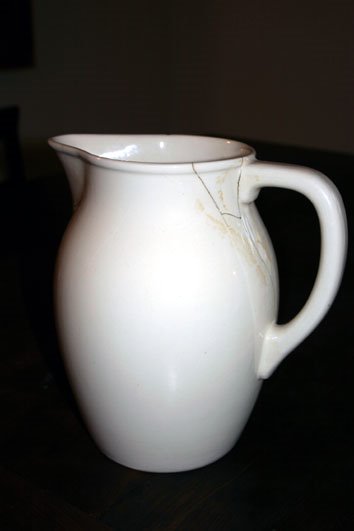
Left: Waschkrug/
Wash Pitcher
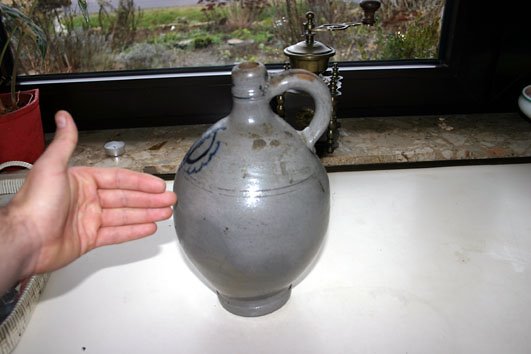
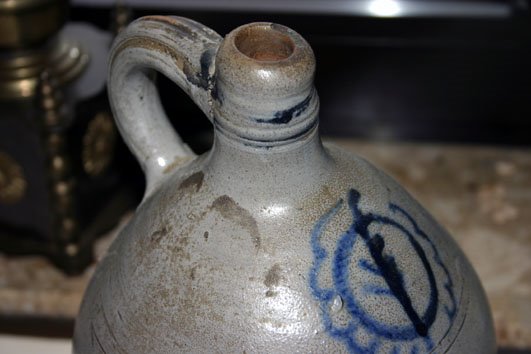
Right: Oelflasche/
Earthen Oil bottle


Most of us with ancestors who come from the Trier area have probably thought, at one time or another, about the houses they lived in. But how many of us have considered the small items, used on a regular basis, that would be found in a cupboard or on shelves in those homes.

As I attempted to write the first chapter in my novel about my ancestors, I created a scene in which grandfather, father, mother, and children came to the table to have a meal - and discovered that I had very little idea about what would be on that table. What were the mugs and plates made from? What kind of food and drink would be in or on them? How had the meal been cooked and in what kind of pots? I had the genealogical and historical events that I needed to write about my immigrant ancestors' lives, but I certainly lacked data on the simple things.

Little by little I've found information in books and at museums about the small things, like dishware and crockery, that might have been used by a family in Irsch or Oberzerf. I've also been fortunate to have some additional help in answering that question. Ernst Mettlach, who grew up in the Trier area, was kind enough to send me photos and descriptions of some of the everyday objects that might grace the shelves of my ancestors' kitchen shelves or cupboards. His descriptions of the photos were so good that I'm using them just the way he explained them to me in his e-mail.

* * *

Ernst says, "Most of the pieces (which he photographed) are still in use and they all are typical for the region."


"My Viezporz is my porcelain-made mug where I drink my apple cider from. It is an old one, in use since my grandfather's days. As I no longer live in the Trier region, it is an excellent medicine against homesickness. For my grandfather, ca.1910, Viez (selfmade and cheap) was an everyday drink, like mineral water is for me. But on special occasions, like Christmas and on Sundays, he preferred wine."

"For real Viez, a special apple, called Viezapfel is needed. The species mostly used are called Roter Trierer and weisser Trierer, some use the Bohnapfel or Erbachhofer, a special pear is also added, the name is Sievenicher Viezbirne. And sometimes, the fruit of the Speierling (sorb or service tree) is added, which preserved the Viez and made it very clear. Every family had its own formula, how the fruits should be mixed. All these fruits are small, very old and very sour, at least not really edible. In former days, the grassland in the countryside was covered with apple trees of this species. Today, the trees are hindering industrial farming and they`re cut. For a time, the Viezapfel was on the list for endangered species."


"The Viezkrug is very old, maybe 100 years. It was closed with cork. With the bigger Viezkrug made from Steinzeug (stone-ware), the Viez was taken from the cask in the cellar and was prepared for drinking; that is, it was placed on or near the oven, to warm it up a bit."


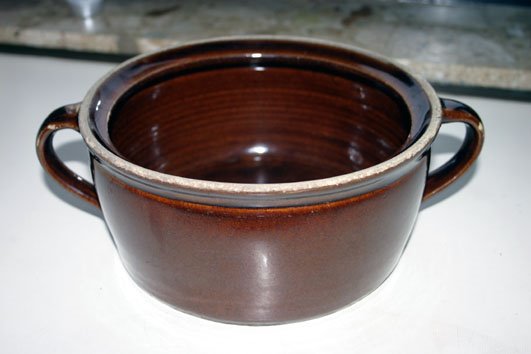
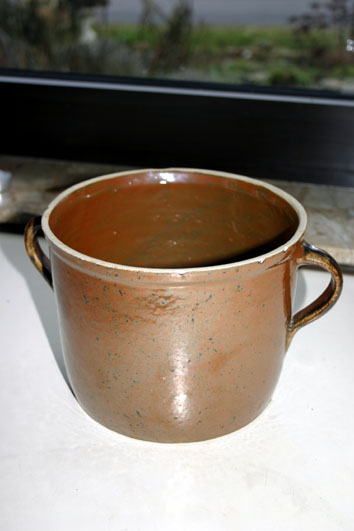
"These two earthen brown containers made of clay are very old too. They were used for multiple storage purposes (flour, lard...) and you can heat them up."


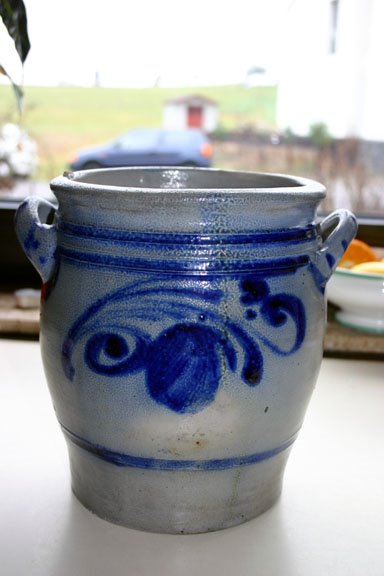
"The grey containers were used for storage and especially the bigger ones were used for making sauerkraut, which, as every American know, was an everyday dish in past days. Therefore, the kraut or as we say in dialect, the Kappes, was cut in pieces with a Krauthobel and put together with salt in the container. The container was closed with a wooden plank and a heavy stone on it. Then the kraut fermented. I`ll never forget the terrible smell, when Grandma opened the container the first time. But the homemade kraut was delicious and very healthy. It is eaten with boiled potatoes and smoked pork chops."


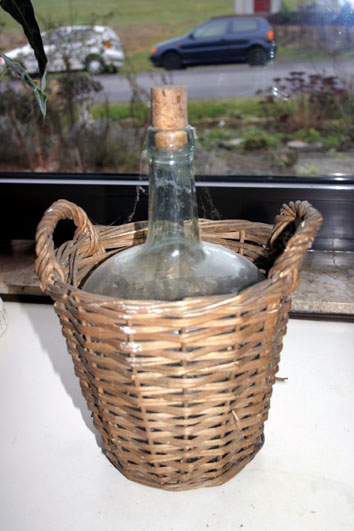
"The Bommes (dial.) or Korbflasche (German) was used for many purposes. During working in the fields, the Bommes was filled with Viez. It was a glass bottle coated with a meshwork made of willow branches."


"The wineglasses are different types: The green one is called Römer (Roman) and is still used in the region, especially along the Moselle River for drinking white wine. It is available in different sizes. The white glass is more exquisite, it is a so-called Treviris-Kristall-Glas. It was expensive and only used for special purposes like weddings etc."


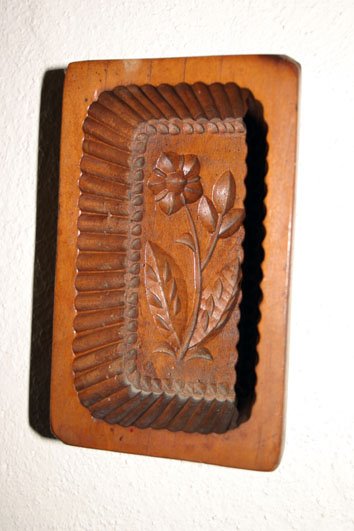
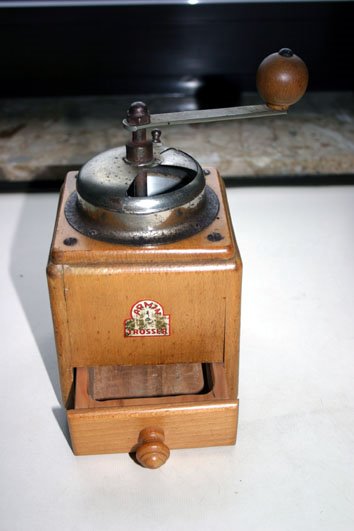
"The wooden form was used to bring the self-made butter into shapes." "The mill is from the 40s or 50s and was used for grinding coffee."


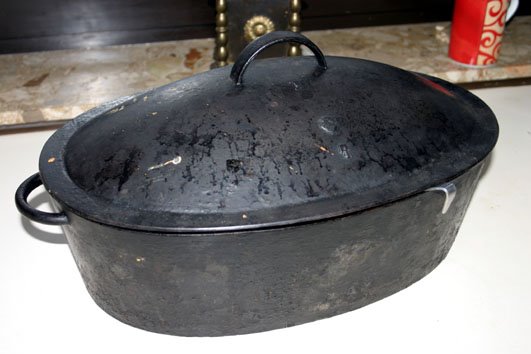
"Big pots like these are made of cast iron. They were essential in every kitchen and still today after a hundred years or so, they're the best you can cook with. They become rusty if you don`t use them, so you have to oil them. I`m in posession of one and I love it. They're essential for cooking regional specialties like Schaales (a special, Jewish-inspired potato casserole with leek to be eaten with apple puree) or gedämpfd Krumpern (fried potatoes)."

* * *

Thank you, Ernst, for adding so much knowledge to my ancestors' kitchen shelves.

Saturday, February 18, 2006

The Cargo Barge on the Saar


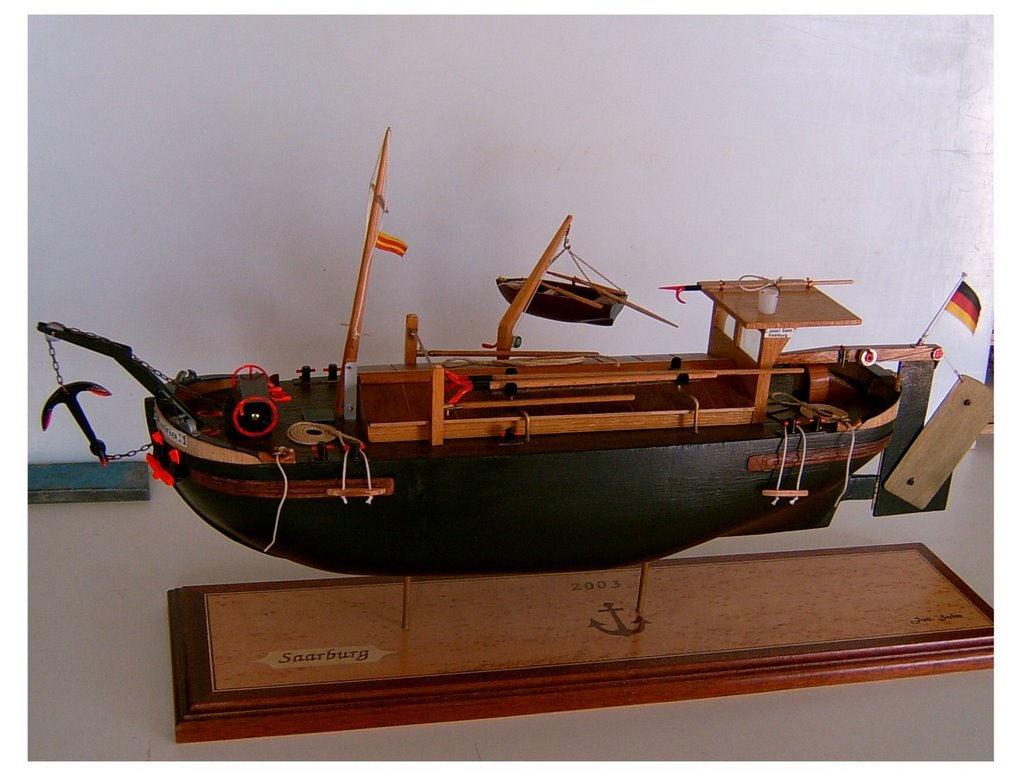
Model of the iron barge owned by a Saarburg family


In my August post called "Saar River Sailors and Their Helpers," I described the strong men who manned the cargo barges. But what about the barges themselves? These utilitarian vessels were one of the most effective means for transporting freight from place to place in Europe until the mid-1800's when the railroads began to take over the freight hauling market. Saarburg, only a few miles from the villages of my ancestors, was noted for its sailing families and its barge builders. As cargo, the Saarburg barges carried the Lohe (oak bark) that came from the neighboring forests for use by the tanneries; field crops grown by farmers; and wine that came from the hilly vineyards around Saarburg. Even coal, such as that which whas mined in the pit at Dudweiler was conveyed to Saarbrücken and loaded on barges for transport down the Saar and the Mosel.

There are many pictures of barges sailing the rivers and canals, such as the one above. But I had little understanding of the deck and the interior of a barge. I found some helpful information in the book by Nikolaus Ritzler,* but I had to struggle to understand the German, especially because the names that Ritzler used for many parts of the barge had not made their way into either my current or even my older German dictionaries.

So I did what I often do. I e-mailed Herr Ewald Meyer for help deciphering one of those frustrating words, "Hef." It was evidently a very important part of the barge, but I could not define it, much less form a picture of it.

To answer my question, Ewald and his son Arno went off to talk to a 70-year old man from Saarburg whose family had once owned a barge. Arno took pictures of a model of their barge "Patria" from several angles while Ewald asked questions about the Hef and other features of the boat. It is very true that one picture is worth a thousand words, but I think good pictures of a three-dimensional model of a barge are worth even more.

In his e-mail to me Ewald explained: "These photos are of a model of an iron barge. This ship belonged to the father of a 70-year-old man from Saarburg. His family sailed this ship between Saarbrücken and Basel (Switzerland) through the canals. On the bow of the ship was the anchor boom and on the stern of the ship the rudder boom. This ship could not be pulled by horses because it was too heavy. A tractor or an engine moved such iron barges. The barges made of wood were built in a similar way except for the pilot's cabin which would not be needed."

"The "Hef" is a space under the deck. Such a space would be located beneath the foredeck as a site for rope, spare parts, tar for patching, work tools and so forth. Under the small afterdeck there was living space with a cookstove, a benchbox and sleeping places (bunks with straw). The benchbox served as a place to sit as well as a storage place for plates, bowls, cutlery, etc. The floor of the Hef did not reach to the bottom of the barge. The space in the Hef was only high enough to accommodate an average man's height.  In this way, if water penetrated the barge's hull, there would be a good way and enough time to seal up the leak. The Hef was reached by steep steps or a ladder. The word `Hiaf´ comes from the word `heben´ (mosel-fränkisch `hiawen´)"

The following information is from the book by Nikolaus Ritzler. Doing a bit of educated guessing, I'm taking my best shot at some additional description:


"The length of the newly built Saar barge was between 25 to 35 meters. It was 5 to 6 meters wide and its depth was about 3.5 meters. At the tip of the foredeck one would find a beech spar. The anchor which hung from the spar was held in place over the water by a strong chain that could be raised or lowered. On each side of this deck and also on the afterdeck there were 2 strong Rangen (sturdy posts?) that were 50 to 60 cm high. Looped with strong rope, these Rangen were used to moor the barge when it was in port. On the forward deck there was a covered entrance leading down to the space under the foredeck where the rope and other necessary work equipment were kept.

Between the forward- and afterdeck was the barge's Laderaum or hold. Here coal, wine barrels, crated goods, bales, sacks of fruit--whatever there was to be transported--was stored. The hold was fully covered by a roof; the floor made of pine boards. This kept everything well protected and water could easily be pumped out. The mast was attached to the hold. The slender mast could be lowered over the hold when the barge passed under bridges.


The heavy tiller wheel or Steuerruder was located at the tip of the afterdeck. Under the afterdeck lay the small space for cooking and sleeping" (described by Ewald Meyer in the section above).

*Nikolaus Ritzler grew up in Saarburg. In 1912, after he had retired he wrote Burg und Kreisstadt Saarburg.

Friday, February 03, 2006

The Poorhouse of Trier


Poorhouse's education building constructed 1844-1846


The Library of the Latter Day Saints in Salt Lake City, Utah, has a large collection of bound volumes with an amazing breadth of subject matter. On my last trip to the library there, I checked the on-line catalog for books about the Kreis (county of) Saarburg. I found a few titles and then, as I often do, I browsed the surrounding shelves to see what else might be cataloged in the vicinity of the Dewey Decimal number for Saarburg. That's how I stumbled across the following book by Thomas Schmitt, Die Insassen des ehemaligen Landarmenhauses des Regierungsbezirkes Trier, Saarlouis 2000 ("The insane in the former state poorhouse of the Trier region"). *

Economic Realities:
While a description of the Trier poorhouse may be a somber subject, it is undeniable that the population of the Trier region often suffered from hard times in the 19th century. During these periods, poverty and hunger plagued city and village alike, and for some people destitution and the poorhouse became a reality.

There were a variety of reasons why people were no longer able to support themselves or their families. The tax burden imposed by the government, first of France and then of Prussia, was heavy. There were crop failures caused by early frosts, drought, or blight, especially the potato blight of the 1850's. Epidemics, such as the cholera outbreak of August 1849 killed entire families, leaving young children homeless orphans. Sudden, severe drops in the prices paid to farmers for crops or to craftsmen forced belt tightening. The entire community was affected by such misfortunes, but some population groups suffered more than others. The Tagelöhner (day laborers) were particularly vulnerable to changes in the economic fortune of the landed farmers and craftsmen. When they were unable to find work in their villages, many day laborers moved to the city of Trier, looking for employment, usually finding similar if not worse conditions than those they had just left.

Founding of the Poorhouse
In 1812, the French founded a governmental poorhouse for those unable to support themselves. After the defeat of Napoleon, Trier, along with much of the Rheinland, became a part of Prussia and on 22 April 1822, the poorhouse was placed under Prussian administration.

The location of the poorhouse was in the area of the Augustinerhof, a former monastery. It is the same area that currently accommodates the Rathaus of Trier and the city theater. The chapel of the poorhouse stood where today's city council chamber is located.

Administration of the Trier poorhouse lay with the Trier district government, and so the population of this district bore the cost of maintaining it. This meant that the inmates of the poorhouse came from the counties of Trier, Saarburg, Bernkastel, Wittlich, Bitburg, Prüm, Daun, Merzig, Saarlouis, Sankt Wendel, Ottweiler and Saarbrücken.

First Reorganization
From its founding until 1833, the poor, sick, insane, and criminals were all housed together "in the same pot." In the year 1833, the inmates were finally subdivided into these separate groups: (1) beggars admitted by court decision, (for whom work and an improved situation was sought), (2) felons in custody for thievery, (3) foundlings, abandoned children, and youngsters who had committed a criminal offense, and (4) the old, frail, work incapable and helpless poor. The curable sick without other means of medical care were placed in the hospital of the poorhouse and the insane were kept in the poorhouse's asylum.

The living conditions in the asylum became the scope of a court action against abuses in the year 1849. This court action was precipitated by an article entitled "the Mystery of the State Poorhouse of Trier," which appeared in the January and February 1849 issues of the Catholic "Volksboten" (Folk Messenger). It was a harsh indictment against the handling of the insane in the poorhouse and a strong outcry from the public resulted. Investigation by state officials confirmed the allegations in the newspaper article for the most part. For example, there were 600 insane inmates but only one cook kettle. This had the capacity to make food for a maximum of 450 persons. Clothing worn by the inmantes was dirty and dank; there was just one small bathing room for 600 people; and medicines were dispensed directly from the bottle, to name only a few of the infractions.

Second Reorganization
In 1850 a total reorganization of the Trier Poorhouse took place. There was a hospital for the work incapable and for the poor elderly; a cure and care institute for the blind and epileptic; an insane asylum; a work institute for vagrants and beggars, and an educational institute for poor orphans and young lawbreakers. Over the course of time, conditions in the poorhouse improved significantly until better economic stability in general and the formation of other types of care institutions made the poorhouse unnecessary. It closed January 1, 1919.

*The book by Thomas Schmitt is #21 in the series Quellen zur Genealogie im Landkreis Saarlouis und angrenzenden Gebieten, 1828-1899.

Friday, January 13, 2006

Nikolausabend/St. Nicholas Eve


This song about the much anticipated arrival of Saint Nicholas comes from the Hunsrück area of Germany


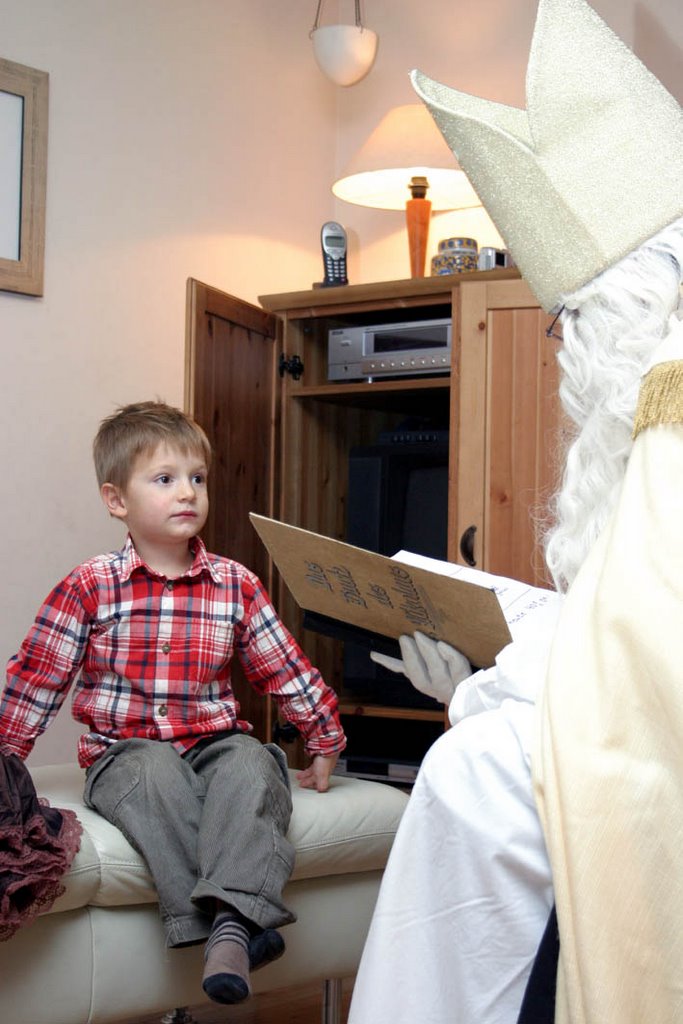
In my post about some significant holidays in the Christmas season, I did not mention St. Nicholas Day, or «Nikolausabend», perhaps because it was so familiar to me. This was not a little known saint's day in my small, German-American town. On the evening of December 5, St. Nicholas always came. Dad would knock on the door and ring sleighbells. He didn't dress up as St. Nicholas because he knew I was too scared to go to the door when he knocked. I would quiver with a mixture of fear and excitement and pray that my mom would not open the door until the good saint had gone on his way. By the time Mom looked outside, St. Nicholas had disappeared, leaving a brown paper bag filled with candy on the doorstep.

Ernst Mettlach, who grew up in the Trier region, says that as a child, St. Nicholas eve, the "Nikolausabend" was a major event in the year. He left that comment about my "The Magi and More" post, telling me that he wished the feast of St. Nicholas had been included. Since Ernst provided me with some very good information and photos as well, and because "Nikolausabend" is such an important German holiday, I am writing about it as a separate post, rather than slipping it into my original post.


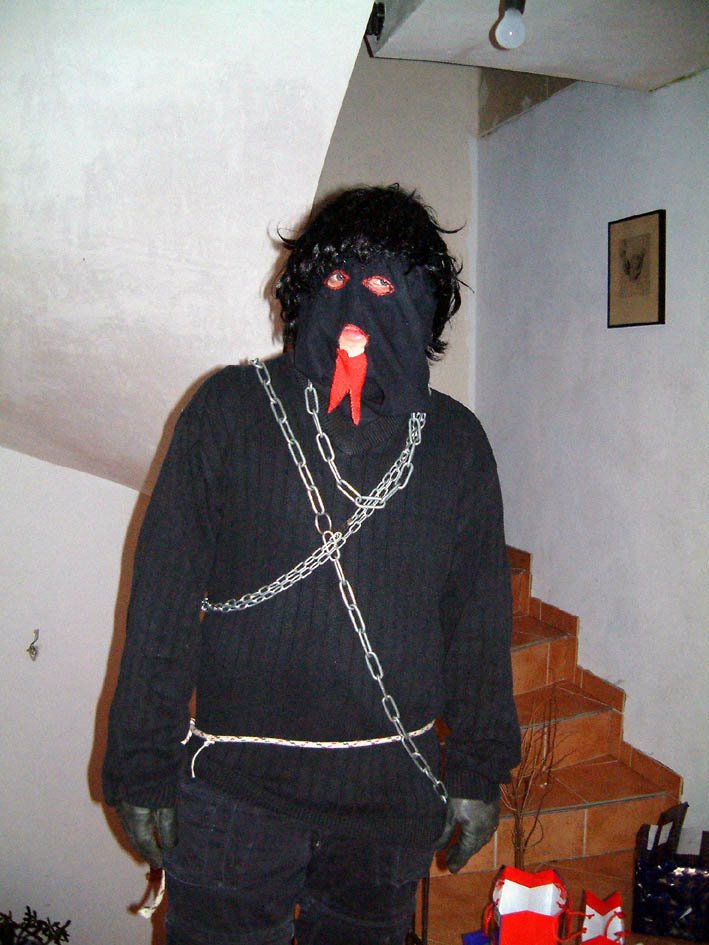
FROM ERNST: On the evening before 6th December, a man dressed as the holy bishop St. Nikolaus, sometimes accompanied by one or two angels, and the "Pelzebock", who is a fierce looking fellow dressed all in black, would go from house to house visiting the children. The "Pelzebock" - the word comes from the bible word Beelzebub (Mt 12,24, Mk 3,22, Lk 11,15), was a god of the Philistines. He is considered the highest demon or devil in the bible. (In other German regions the "Pelzebock" has names such as "Knecht Rupprecht," "Budelfrau", "Krampus", and "Pelznickel". The Pennsylvania Dutch in America called him "Belsnickel".)

The "Pelzebock" is the servant of Nikolaus, and the chains around his chest reassure the children that he is tamed. He carries a sack with presents and birch sticks inside. Usually he waits outside of the door and only comes in to hand out the presents. He has a big book in which are counted all the good and bad things the children have done throughout the year. Tradtionally, he brings a "Nikolausteller" ("Teller" is the German word for plate) or "Nikolaustuete" (a "Tuete" is a cone-shaped paper bag), filled with sweets, nuts and oranges, for each child. The children are asked to sing Nikolaus songs and recite Nikolaus poems.

SOME ADDITIONAL BACKGROUND:
"Der Nikolaus", as he is called in Germany, is said to have been the Bishop of Myra in Greece in about the 4th century. The historical Saint Nicholas was venerated in early Christian legends for saving storm-tossed sailors, defending young children, and giving generous gifts to the poor. Many of the stories about Saint Nicholas are of doubtful authenticity. One of the legends that grew up about him was that he helped a father and his three daughters who were too poor to have a dowry. The father was about to turn his daughters out on the street to make a living. The kindly saint, on three consecutive nights, entered their home in secret, leaving a gold ingot on the hearth so that each daughter could have a husband. In variations on the story, the saint dropped the gold down the chimney and it landed in the shoes on the hearth or in the stockings that the girls had hung near the chimney to dry. Over the centuries, these legends spread throughout Europe, emphasizing the saint's role as a traditional bringer of gifts on the eve of his feast day, Dec. 6. Martin Luther, hoping to put emphasis on the birth of Christ instead, initiated the custom of gifts brought by the "Christkind" (Christ Child) on Christmas Eve rather than the Nikolausabend gifts. But the saint, who was called Sankt Nikolaus in Germany and Sanct Herr Nicholaas or Sinter Klaas in Holland, prevailed as a gift giver, and the Nikolaus gift-giving tradition survived the Reformation. In Germany St. Nicholas is portrayed wearing a bishop's robes and the tall miter headdress. He carries a crozier, the hooked staff which symbolizes his office as a shepherd of men.

Saturday, December 31, 2005

The Magi and More


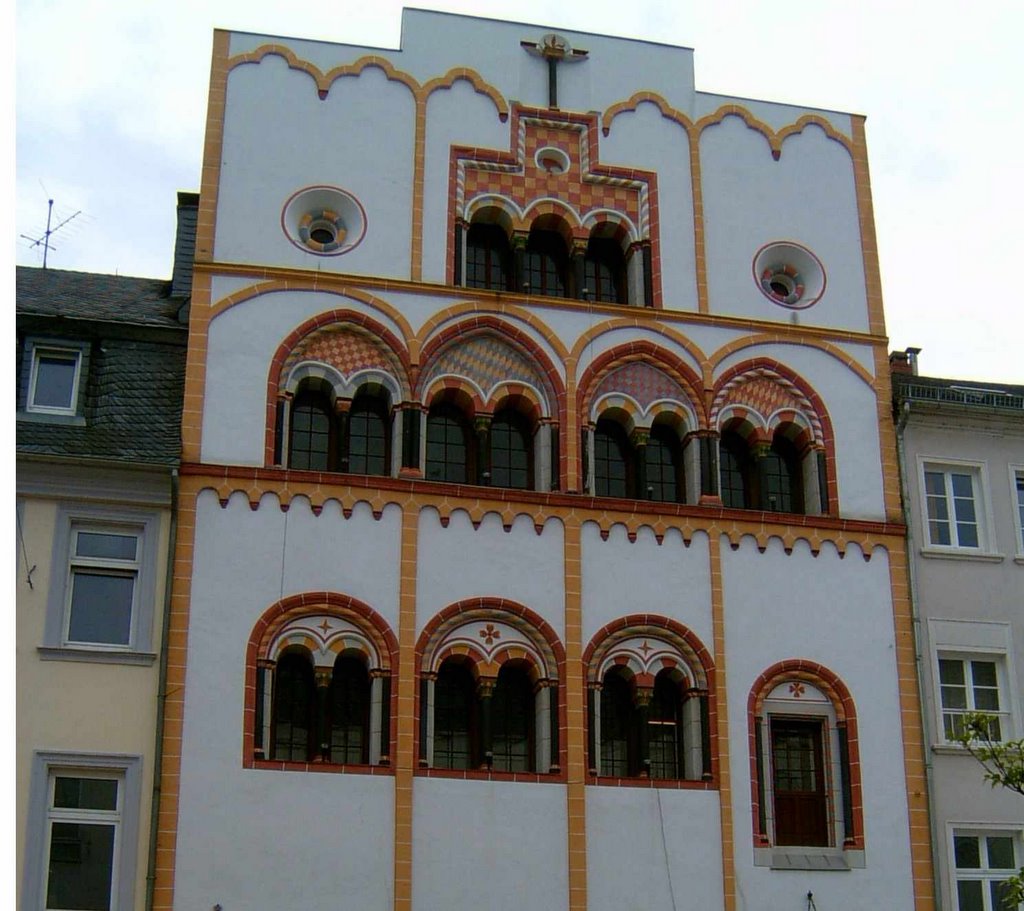
The 13th century Dreikonigshaus (Three Kings' House) in Trier, named for the effigies of the Magi on the façade*

I grew up in a small (350 population) German-American community where the Christmas traditions were very similar to those which still exist in many parts of Germany today. No one put up a Christmas tree until Christmas Eve day. Santa Claus made his visit to our farm in the early evening of December 24. That's when Christmas began and it lasted at least until Three Kings Day, when we moved the kings from their distant location in the manger scene to the very stable where the baby Jesus lay. I still find it difficult to accept the current practice of putting up a Christmas tree the day after Thanksgiving and taking it down on December 26.

With the feast of the Epiphany/Three Kings Day approaching, it seemed a good time to write about the German celebration of the coming of the Magi and also some of the other lesser know customs which led up to the celebration of Christmas in our German ancestors' pasts.

The Feast of the Magi
The Greek word "Epiphanias" means "uprise, appearance", i.e. appearance of the Lord. Epiphany is celebrated on January 6 and is better know as the feast of the Three Kings, the "Wise Men," or the Magi. According to an old legend based on a Bible story, the three kings or Magi saw, on the night when Christ was born, a bright star and followed it to Bethlehem. There they found the Christ child and presented him with gifts of gold, frankincense and myrrh.

As the centuries went on, customs grew up around the feast of Epiphany. In many places in Germany, including the Rheinland, the doorways were sprinkled with holy water and the initials of the Three Kings -- C+M+B (Caspar, Melchior, and Balthasar) -- plus the year were inscribed in chalk over doorways on the eve of January 5 or 6 to protect house and home. According to scholarly thought, the three letters really come from the Latin phrase for "Christ bless this house" -- "Christus mansionem benedicat."

In many places in Germany, on the afternoon of January 5, the local priest still blesses incense and chalk for use by the Sternsänger (star singers), three children selected to dress up as the kings. When the stars come out, the children go from house to house, chalking the initials KMB and the year at the entrance of each home. These initials signify that Kaspar, Melchior and Balthasar have passed each house as they follow the guiding star on the way to Bethlehem. The children also parade through each house, wafting incense to scare off evil spirits. That night a special dessert is served, Dreikönigskuchen, or Three Kings' Cake, a very elaborate fruit cake.

The German celebration of Christmas, unlike our own American Christmas celebration, has a definite beginning and ending. January 6, the last day of Christmas, comes with its own traditions, rituals and symbols. Carolers are going from house to house; in many homes the Christmas tree is taken down and in some areas it is burnt in a big bonfire. For the children this is an especially joyous occasion because, associated with taking down the tree goes the "plündern" (raiding) of the tree. The sweets, chocolate ornaments wrapped in foil or cookies, which have replaced the sugar plums, are the raiders' rewards.

Saint Barbara's Day
Barbara, the daughter of the rich merchant Dioscuros, grew up in Nikomedia (today's Izmet, Turkey). In order to retain her innocence, Barbara's father locked her up during his absence, in a tower with only two windows. When Dioscuros returned from his journey, he found a third window in the tower. Barbara had been baptized by a priest disguised as a physician, and she ordered the third window as a symbol of the Holy Trinity.

As this was done against her father's will, Barbara was accused, tortured and condemned to death. A branch of a cherry tree had gotten caught in her dress when she was locked in a dungeon. Barbara watered it with the water from her drinking cup, and on the day of her execution in the winter of 306, the branch bloomed. From this comes the "Barbarazweig," the custom of bringing branches into the house on December 4 to bloom on Christmas. In some areas St. Barbara's Day is also the day to bake Kletzenbrot, a loaf cake made with prunes, dried pears, raisins and currants. Kletzenbrot is most commonly made in Austria and Bavaria.

Saint Andreas Day
November 30 is dedicated in the evangelical, catholic and orthodox churches to Saint Andreas (St Andrew), the brother of Saint Peter and one of twelve Apostles. His feast day is November 30, traditionally considered the date of his martyrdom in 60 A.D.

St. Andreas' Day marks the opening of Christmas Markets, and many Midwinter customs and folk superstitions are connected to this day. It is the first of the "knocking nights" known as Klöpfelnächte.

"Anglöckeln, Klöpflgeher, Glöcklisinger, Kurrendesänger, Bosseln" describe the groups of Christmas carolers or star-singers from various German regions who walk from door to door. After knocking (klopfen) or ringing the doorbell (Glocke) they sing for gifts. Some sources say that this symbolizes the angel bringing the message of Christ's birth to Mary; others ascribe it to earlier rituals of driving out evil spirits with loud knocking sounds.

Whatever the symbolism, for a long time it was one of the few ways by which the poor could earn a meal during the winter season. The duration of this tradition varies widely and could last until Epiphany (January 6). Today it is mostly performed by children, who try to collect gifts for themselves or donations for some charity.

St. Andreas is also important as the patron saint of marriage and fertility. St. Andreas day was a traditional time of "oracles" for girls who prayed to the saint for a husband and wished to receive some visible assurance that their prayers had been heard. For example, a girl wishing to marry could throw a shoe at a door around midnight on November 29. If the toe of the shoe pointed in the direction of the exit, then she would marry and leave her parents' house within a year. Or she could peel a whole apple without breaking the peel and throw the peel over the shoulder. If the peel formed a letter of the alphabet, then this suggested the name of her future groom. So, the night of November 29 was the night to look into the future and find out one's fate.

*Note: Photos thanks to Arno and Ewald Meyer

Sunday, November 20, 2005

Weddings, Bavarian Style


The Hochzeitlader, "Der Blumenbaum, Jan., Feb., Mar., 2005


After a brief interruption for Martini I’m back to the subject of 19th century wedding customs, this time those of Bavaria. (Upon rereading that sentence, it sounds as if I've been having some liquid refreshment. Actualy, there is another kind of "martini" which is described in my previous post.)

Background
In 1984 I went to Eastern Bavaria with a second cousin on my mother’s side of the family to visit the little villages where our Probst ancestors had lived. When I dragged cousin Allen into a bookstore in the city of Regen, I gravitated toward a book with pretty pictures titled, Der Landkreis Regen: Heimat im Bayerischen Wald, and didn’t worry about the content. At that time the only German I knew was “Der Bleistift ist auf dem Tisch” (The pencil is on the table). An opportunity to read that phrase did not occur very often. But as so often has happened to me when I am on German soil, I had the good luck to pick a book with fantastic information in it.

As soon as I learned to read some German, I realized I had brought home a detailed word picture of life in Eastern Bavaria as well as a pretty picture book. In 1858, Bavaria’s King Maximilian II ordered the district medical officer in each Landkreis (administrative district) to send him an account of his subjects. It was to contain a description of their physical attributes, their clothes, their housing, the way they earned their living, even their customs and celebrations. Here was a king with an uncommon curiosity about the people he ruled.

A number of these written manuscripts were preserved and stored in the Bayerischen Staatsbibliothek (Bavarian State Library) in Munich. The reports about the Eastern Bavarian districts of Viechtach and Regen were translated by Dr. Reinhard Haller in a chapter called “Ethnographische Beschreibung der Landgerichte Viechtach und Regen aus den Jahren 1858-1860.” The report contained words that no longer exist in regular German dictionaries, which made me unsure of my translation. Help arrived in the form of an article in “Der Blumenbaum,” the magazine published by the Sacramento German Genealogy Society. An article about marriage customs in the mountains of Bavaria, “A Wedding in the Mountains,” was an English language description of very similar customs to the ones I was struggling to understand. In addition to the text, it reproduced pictures from a little book called “A Hochzeit im Gebirg.”

The Engagement
As in the Hunsrück, the prospective bridegroom came to look over the property of the bride’s father and, if his proposal was accepted, the bride-to-be cooked her first meal for him. In Bavaria, this dish was called “Schmarrn”, a popular Bavarian specialty that is a cross between a pancake and an omelet. When it is cooked, it is cut up and sprinkled with powdered sugar.

Soon after the second announcement of the marriage banns were called in the church, the Hochzeitslader or wedding inviter began his rounds with the bridegroom. All the relatives had to be invited, and the father of the groom might travel along to make sure none of the distant relatives or acquaintances were missed. The Hochzeitlader’s hat was decorated with rosemary and a cluster of flowers. On his left arm he wore a circle of artificial flowers, and he carried a Hochzeit ramrod (the rod used to push down gunpowder into old-fashioned weapons). To show its peaceful purpose for this occasion, it was decorated with many colorful silk ribbons.


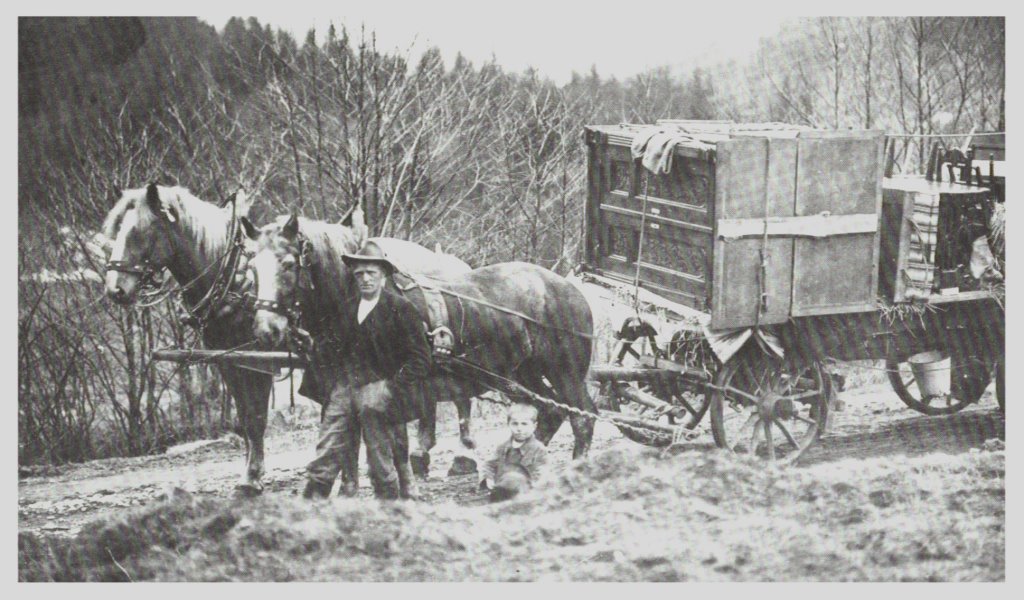
Kammerwagon (bedroom wagon) photo, Der Landkreis Regen in alten Ansichten

Shortly before the wedding ceremony, the bride’s possessions had to be transported to her new home. This was done with as much public display as possible, especially if the bride’s family was well to do. A wagon, loaded with furniture, linens, and whatever finery the bride was bringing to her home, was driven slowly through the village, giving everyone a chance to observe and comment.

The Wedding Day
The wedding itself usually took place in the late morning. As in Normandy and in the Hunsrück, there was a procession to the church, sometimes with musicians leading the way. The equivalent of today's bridesmaid and best man led the bride to the altar.

After the religious ceremony, the entire party made its way to the Gasthaus which, according to the article in “Der Blumenbaum,” was almost always located close by the church. Here a family would provide as fine a meal as their financial situation would allow. Those who were invited but who could not attend because of infirmity or farm duties were not overlooked. They received food packets, sent with friends or relatives and often wrapped in the women’s scarves.

After the wedding meal, it was time for the Hochzeitlader to perform his duties as master of ceremonies. The bride and groom usually sat at a special table that was covered with a white cloth. With them would be the Ehrenvater and Ehrenmutter. These were very honored guests, often a godparent or a grandparent of the bride or groom. The Hochzeitlader called the guests one by one to the table, announcing them with a polite phrase or sometimes a comic insult. There might be an appropriate flourish by the musicians as the family name was called, and guests were called in the order of their relationship to the bridal couple. Once at the table they would drink from the glasses of the bride and the groom and lay down the Mahlgeld, a contribution toward the expense of the meal as well as a wedding gift. Sometimes a well-to-do farmer would make a show of sprinkling just a few coppers or silver pennies in front of the bride and groom. As he turned away from the table he would surreptitiously slide his hand into his pocket, turn back to the table with his fist full of valuable Taler, pleased with his little joke.

When it is time for the dancing to begin, the newly married couple had the first dance. The Hochzeitlader was again in charge, deciding who, in turn, would be next to come to the dance floor. And he decided when it is time for the guests to go home. When he told the band to play the Rausschmeisser (literally translated it would be called "The Bouncer"), a piece of music that was known to everyone as the tune which ended the dancing, the celebration was over.

Thursday, November 10, 2005

November 11 - A Martini Celebration


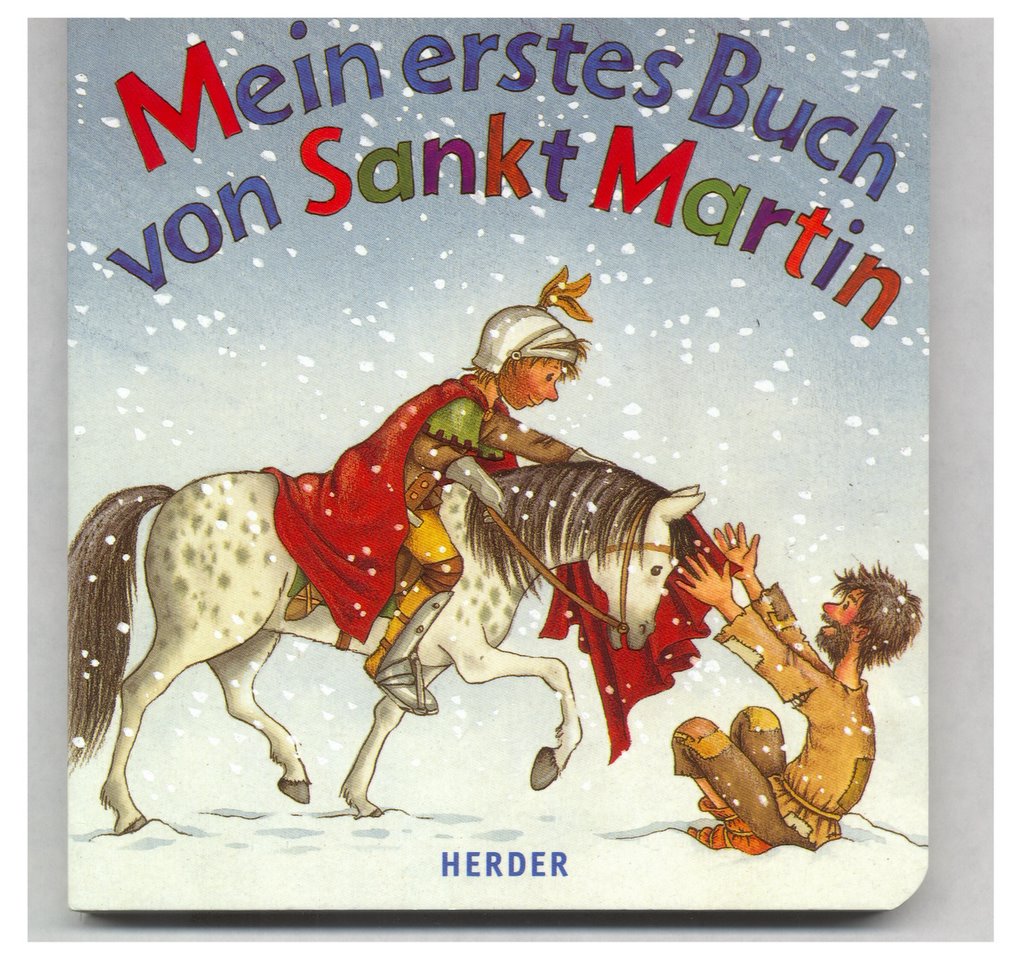
Cover of
Mein erstes
Buch von
Sankt Martin
Text by Thomas Erne
Pictures by Susanne Kraus
Verlag Herder, 2001


November 11 is Veterans Day here in the U.S, a holiday for acknowledging the sacrifices made by our soldiers and to remind us of their bravery.

Germany and Austria also celebrate on November 11 but it is a different kind of holiday. It is a remembrance of Saint Martin of Tours and is known as Martinstag or Martini.

Saint Martin of Tours is not a saint that we here in the US associate with any kind of festival or custom. So when my genial landlord, Hans Dieter Jung, took me on a short tour of some of the small villages near Saarburg, I wasn't prepared for a lesson on unusual customs in the Rheinland. We had stopped at Hofgut Serrig, a farming community where natural farming and animal husbandry is practiced by workers with disabilities. As we passed a field of fat geese, Herr Jung said they wouldn’t be around much longer because it was almost Martini. “What is martini?” I asked, picturing a stemmed glass, wide rimmed, with a couple of olives. He explained that November 11 is Saint Martin’s Day or Martini. It is the time when geese lose their heads, literally. That didn’t seem a very nice way to celebrate a saint’s feast day but I didn’t say that – mostly because I couldn’t figure out how to put that thought into German.

With the help of my English speaking relative Edeltrud Heiser who lives in Trier, and some research on my own, I soon learned much more about St. Martin and the significance of this holiday which is a combination of our own celebrations of Halloween and Thanksgiving. I also found out why geese are so associated with this feast day. (Edeltrud gave me the gift of the children's book pictured above, "My First Book of Saint Martin")

St. Martin was born in about 336, the son of a Roman soldier. He too became a soldier in the Roman cavalry. One day a beggar approached Martin, begging for alms. Since he had nothing to give him, Martin drew his sword and cut his cloak in half. A legend grew that the beggar was Christ and that this caused Martin’s conversion to Christianity. As word of his holiness grew, the pope sent messengers to him, naming him Bishop of Tours. Martin, feeling unworthy, ran away and hid in a stable among a flock of geese. But the geese, recognizing his virtues, gave him away by cackling loudly. One could draw the conclusion that Saint Martin took his revenge on them, silencing them each year on his feast day.

A more practical explanation is that on the feast of St. Martin, November 11, it was the time of slaughter for the farm animals, including the geese. Farmers could ill afford to feed all of their poultry during the winter months when the time for food foraging in the woodlots and pastures was ended. It was also the time that taxes were due, and a fat goose or two to the landlord was, in many places, accepted as payment in kind. And if a family could afford to do so, a roast goose was often the holiday fare on Martini. According to an article called ""Eat a fat goose on St. Martin's Day"" in Der Blumenbaum, Nov/Dec. 2002, many restaurants in Germany and Austria still feature Martinsgans (Martin goose) on their menus in late autumn and especially on St. Martin's Day.

The Blumenbaum article went on to say that St. Martin's Day was an important date for shepherds, who considered St. Martin to be their patron saint. His day coincided with the date that their contracts ended. At this time they could bargain for better terms for the coming year of service. By custom, they would blow their horns until their masters arrived to meet with them, at which time the masters were presented with a decorated branch or Martinsgerte. Then the shepherds would recite rhymes for which they received presents.

Saint Martin's day was not just for the shepherds or the landlords. It marked the coming of winter; now people could celebrate the end of harvesting and wine making and look forward to rest from their heaviest labors. For workers and the poor it was a time when they had a chance to enjoy some of the bounty of the harvest. And it would be the last celebration before the solemn season of Advent and the fasting which would not end until Christmas.

The little children would parade through the villages in the evening of St. Martin’s Day, carrying hollowed out pumpkins or turnips with bizarre carved faces. It was customary for them to sing St. Martin songs or “Martinslieder” and recite rhymes in return for small presents. The lantern procession is still observed today but now there are paper lanterns in various shapes and sizes. The children sing a St. Martin's Day song such as this:

"I go with my lantern
And my lantern goes with me.
Up above the stars are shining,
Down here we're shining.
The rooster, he crows; the cat meows.
Rabimmel, rabammel, rabum.
The rooster, he crows; the cat meows.
Rabimmel, rabammel, rabum."

"I go with my lantern
And my lantern goes with me.
Up above the stars are shining,
Down here we're shining.
St. Martin, he marches on.
Rabimmel, rabammel, rabum.
St. Martin, he marches on.
Rabimmel, rabammel, rabum."

"I go with my lantern
And my lantern goes with me.
Up above the stars are shining,
Down here we're shining.
Lantern light, don't go out on me!
Rabimmel, rabammel, rabum.
Lantern light, don't go out on me!
Rabimmel, rabammel, rabum."

"I go with my lantern
And my lantern goes with me.
Up above the stars are shining,
Down here we're shining.
A sea of light in honor of Martin.
Rabimmel, rabammel, rabum.
A sea of light in honor of Martin.
Rabimmel, rabammel, rabum."

"I go with my lantern
And my lantern goes with me.
Up above the stars are shining,
Down here we're shining.
My light is out,
Rabimmel, rabammel, rabum.
We're going home,
Rabimmel, rabammel, rabum."

Happy St. Martin's Day to those of you who read this on November 11!