Tuesday, August 23, 2005

Saar River Sailors and Their Helpers


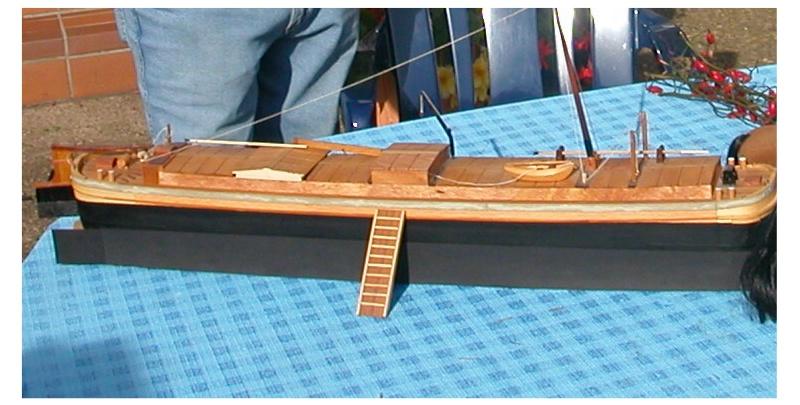
Upper - model of a barge owned by the grandfather of H.D. Jung of Saarburg

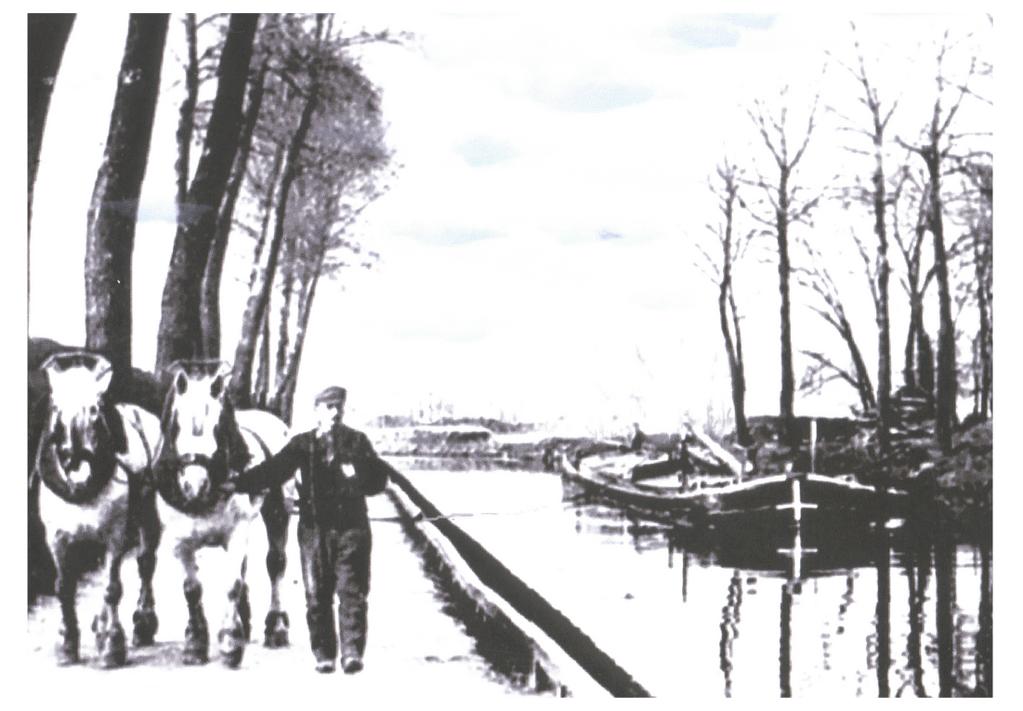
Lower - post card in collection of H.D. Jung, Saarburg


Grandma's Story
When I was twenty or so, my grandmother told me that her own grandmother, Magdalena Rauls, had run away from home to marry my great-great grandfather, Johann Meier, who was a sailor. For many years I pictured Johann as a seaman on an majestic sailing ship, a glamorous occupation indeed. No wonder Magdalena was smitten. But when my genealogical research started, I learned that Johann had always lived in Irsch and was listed as a farmer. I wrote the romantic story off as pure fiction.

But as I delved into history books about Saarburg and vicinity, I saw another possibility that gave me a far more likely scenario for Johann or for any man who lived so close to the Saar River. It was possible that as a farm boy who could handle horses, Johann might have looked for extra work on the river as a way to improve his economic situation. Was he a Halfen?

Nickolaus Ritzler in his book, Burg und Kreisstadt Saarburg, says that sailing families lived along the Saar River in Saarburg from the very beginnings of the city and that when the barges sailed, there were always men, known as "Halfen" traveling with them. These were the men who handled the horses that towed the barges against the current. Both of these occupations were held in high respect.

The sections which follow are taken from a village history by Klaus Hammächer called Serrig: Landschaft, Geschichte & Geschichten. In a section called "Earlier Village Life," information from Nikolaus Ritzler, Adam Görgen, and Peter Faas describe shipping on the Saar during the "Golden Age" of the river barges.

The Sailors

According to Ritzler, the sailors from Saarburg dressed in high vests topped by blue jackets. On their heads they wore blue caps. This distinctive uniform, along with their deeply tanned skin, marked them as the men who built and sailed the barges that carried cargo on the Saar. Their homes were in the lower city close to the water's edge, as were the buildings where they carefully fashioned their barges. The names Schulges and Mettloch are especially associated with the boat building and sailing families in Saarburg.

The Barges

The Saar barges were made from solid oak without any blemish, and held together by strong iron nails made especially for this purpose by the local nail smiths. When a newly built ship was ready to make its first trip, there was always a celebration in one of the inns in the lower city, with hardy food and drink for all. Once on the river, the barges carried a wide variety of cargo such as coal, wood, iron, hay, straw, and most kinds of produce. During the many wars over the centuries, the barges also carried soldiers, weaponry, horses and food rations.

The Halfen

The helpers or Halfen, a word that seems to have originated in the region of Cologne, came mostly from the small villages of Irsch, Serrig, Beurig, Krutweiler and Zerf. According to Nikolaus Ritzler, who wrote his account about 1912, the Halfen had broad chests and were usually of middle height. They were easy to identify from their clothing and their walk, a swinging gait which developed from the amount of time they spent riding the strong barge horses. Their arms, too, moved in a distinctive way as a result of swinging a "Peitsche" or whip while they worked.

The dress of the Halfen consisted of white woolen (but not knitted) socks, linen trousers of blue or white, and coarse, strongly nailed cowleather shoes. Under a strong, warm white overjacket with horn buttons, they wore unbleached linen shirts. Headware could be either a black, round hat made of coarse felt, or, when it was cold, a knit "zipfel" cap. This was a sort of a stocking cap worn under the felt hat to protect ears and neck from the cold. Red cotton kerchiefs with white stripes were tied around their necks.

In 1904, Adam Görgen also wrote a description of the Halfen. He said they were healthy, strongly built men of middle size. A humble black hat with a large brim fastened to the head by a thin, colorful cord was their headgear. A blue, red, or white striped cotton cap was put on whenever the other hat was taken off. A red scarf was knotted around the neck and a rough linen shirt covered by a gray or white short linen or "Tirtey" jacket was typical. Their trousers were made of thick, white canvas. Over their jackets, they pulled on a still shorter blue coat and over the stockings that reached above the knee, they wore gaiters. Wool stockings and sturdy nailed shoes completed the outfit.

Gorgen says that when a barge owner needed extra help, he would go to a tavern (most likely in the lower city) to find Halfen. To seal the contract between "Schiffer" and "Halfen", a bottle of wine would be set on the table and both men would drink a glass. Wine was also part of the Halfens' workday. At 10 a.m., a helper received a half quart of wine. At noon and in the evening, the helper was entitled to a quart. When a particularly dangerous stretch was successfully navigated, the Halfen received the so called "wave wine."

No matter the weather, the Halfen would lead the horses along the towpath, if there was one, or ride the horses if the landscape was rough or if their was a ford to be crossed. The horses struggled to pull the barges when the boats were sailing against the Saar's strong current, but they were well cared for and were never mistreated. At the end of the day, the men who handled them were probably as tired as their horses. When the horses faced an especially difficult pull, there was a great deal of shouting by the Halfen as they drove the animals forward. The whip was used then but only when it could not be avoided.

The Trip on the River

Ritzler says that a trip from Trier to Saarbrucken would take about three days. Typically it would involve three or more barges which traveled together. Three horses were needed to pull each of the larger barges. The horses were attached to the barge by means of a strong line attached to the tip of the mast. When the trip began, the sailors would shout "In God's name" and then "Johleit rack". The barges were pushed away from the bank and the horses began to pull. There was a great deal of shouting between the sailors and the men leading the horses. The sound, "juh, juh" signaled the horses. By nightfall the barges had usually reached Saarburg where the sailors and Halfen spent the first night. (The vacation apartment that my sister and I rented when we were in Saarburg was once a barge owner's home; our apartment the sleeping area for the Halfen).

Each day there were also rest stops and during that time the sailors and the Halfen would discuss any problems along the next stretch in the river. Lunch would be carried ashore from the ship and eaten at an inn or tavern, with the landlord providing the dishes, tableware and the wine. The shipowner, of course. paid for the wine that the landlord of the inn placed on the table.

During the trip the sailors and helpers might shout and curse and sometime come to blows with one another, but at lunch time and after there was rest. The men would sit outside, smoke a pipe, and enjoy camaraderie. Once rested, the hard work, shouts and grumbles began again. At night the sailors slept in a "Hef," the Halfen in a strawsack bed and the horses in their stalls aboard the ship.

According to Ritzler, the Halfen were paid cash for each day worked with the shipowners also providing food, drink, and feed for the horses. A lesser payment per day was given to each man for his trip back home. This amount paid for the cost of food, night quarters, bridge tolls, as well as hay and grain for the horses.

Thursday, August 11, 2005

Saarburg - the City and the Landkreis


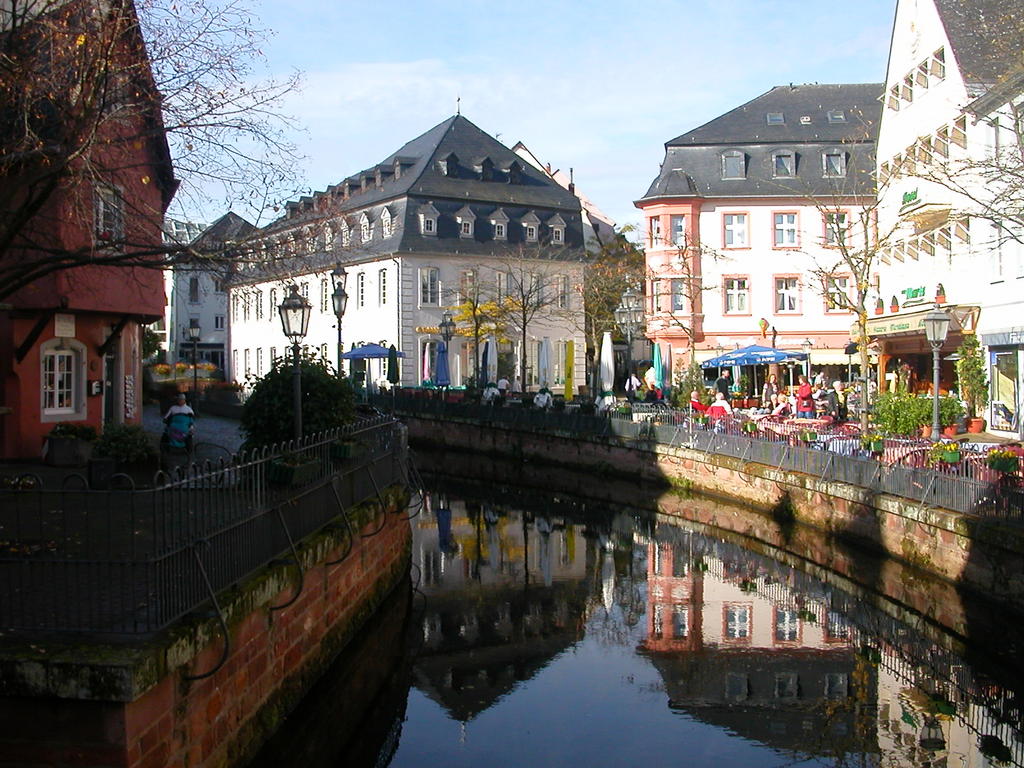
Top: Lower city
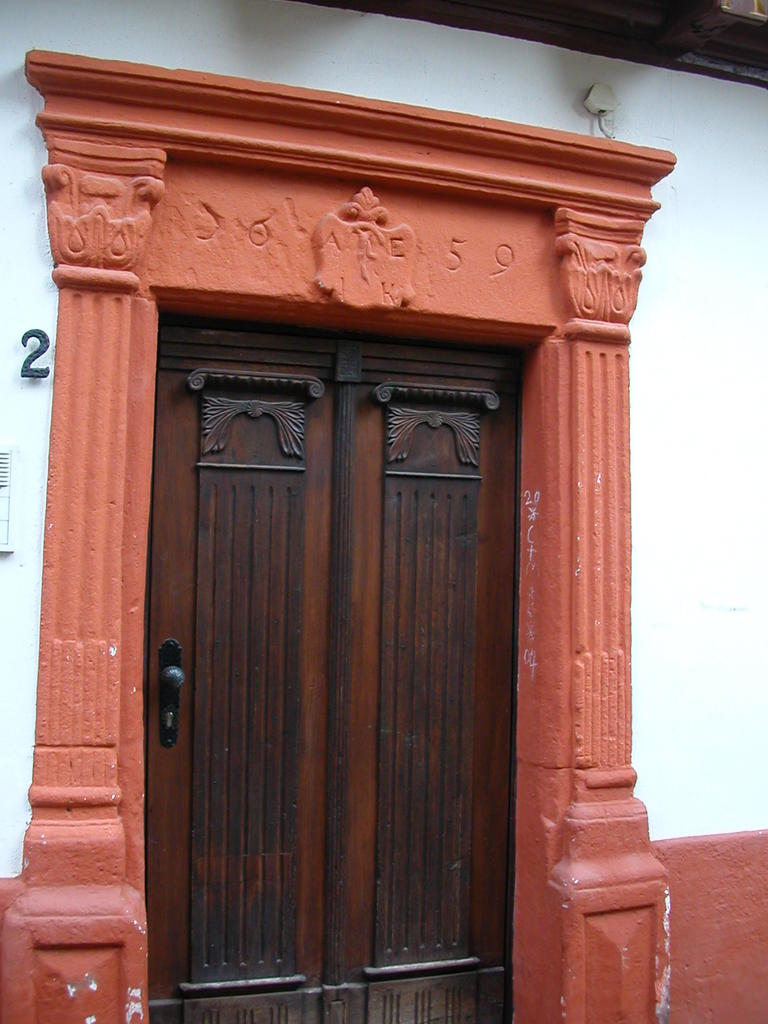
portal from 1659


Bottom: Upper City with
Saarburg's Butter Markt street and the Leukbach.


I made my first visit to Saarburg in 1984. I was not prepared for the rich history and the charm of this small city of approximately 6,100 inhabitants. I took picture after picture on my first trip, and the city has lured me back to it again and again over the years. The Saarburg of today is still the largest city in the Landkreis Saarburg as it was in the 1850's and 60's when my great-great grandparents lived in Irsch, a village approximately 1 1/2 miles to the east.

The Landkreis in Germany is similar to a county in the US, and the city of Saarburg is very much like the county seat with which most of us are familiar. The German word Kreis can mean both "circle" and "district." And just as in our own county seats, the government offices of the Kreis are located in Saarburg.

Founded in the ninth century, Saarburg has both an upper and a lower city. The lower city is situated at the edge of the Saar River. In the nineteenth century it was home to tanneries, boatsmen's and fishermen's houses, the hospital, barracks, wineries, warehouses and taverns. There was a factory that made the bells for some of Europe's largest cathedrals. This Mabilon bell works had moved from France to Saarburg in the late 1700's and continued to cast bells until 2002.

The upper city is slightly newer than the lower city. Houses and shops began to spread up the hill as the city grew. Saarburg was a market town and the markets gave names to streets and squares in both the upper and lower city. There was the horse market, the fruit market, the butter market in the upper city, and the old market in the lower city. The Butter Markt runs along side the Leukbach, a stream which runs through the upper city, then forms a waterfall and drops toward the old city. The waterfall on the Leukbach powered a water wheel for the former grist mill which is now a museum. Above the city stand the ruins of a castle built in 964. All around the city there are steep hills covered with vineyards.

Maybe it was the magic of Saarburg with its powerful waterfall and the castle ruins that made me want to write a novel about my Irsch ancestors, who surely came to this city's markets to sell fruit, butter, perhaps even livestock from time to time. I began to collect as much information as possible about Saarburg as it was in the 1800's.

Last year, in the city's bookstore, I bought Saarburg: Geschichte einer Stadt, vols. 1 & 2, c. 1991, a compilation of articles about the city by various authors. In it I found a goldmine of information about Saarburg in the mid-1800's. Rudolf Mueller, in his chapter, "Geschichte der Stadt Saarburg im 19. and 20. Jahrhundert," (History of the city of Saarburg in the 19th and 20th century) quoted many statistics on the population of 1861 Saarburg as tabulated by the Landsrat Mersmann, the chief administrator of the Landkreis at that time.

Herr Landsmann reported that there were 2,249 residents of the city of Saarburg in 1861, of whom 2,146 were Catholic, 78 were Evangelische (Lutheran), and 25 were Jewish. There were 306 habitations which would mean that the average house held 7.3 persons.

The Landsrat went on to report that there were 7 tanning factories, 15 looms, 4 water-powered grain mills, and 7 brandy distilleries in the city. There was also an oil mill, a tobacco and cigarette factory and a brewery.

The tradesmen and craftsmen were enumerated too. There were 50 fishermen, 9 master bakers, 7 master butchers, 8 master tanners and leather makers, 20 smiths of various kinds (nail makers, knife makers, locksmiths, etc.), 5 master plumbers, 20 master shoemakers, 13 joiners and furniture makers, 7 coopers (cask and barrel makers). All but the fishermen employed helpers and had apprentices.

There were also a few barbers, a stonemason, a potter, a glazier, some masons, carpenters, roofers, and horse shoers, a master clockmaker, some wool spinners, ropemakers, dyers, harness and saddle makers, milliners, men's hat makers, a basketmaker, a bookbinder, a furrier and even two upholsterers/decorators.

In addition to all of the above, there were 40 shopkeepers of one kind or another, as well as three traders described as "herumziehende" which would seem to mean traders who went door to door; 15 innkeepers; 15 tavern keepers, 7 agents, a hauler and 90 boatsmen.

While the statistics above are for just one small city on a river, I would venture to guess that the occupants of most of the small cities along the Saar and Mosel would have had similar groups of workers, shops, and factories during the time when many of our ancestors made the decision to leave all that was familiar and start a new life on farms, in small towns and big cities in Amerika.

Friday, July 29, 2005

A Visit To The Zerf Heimat Museum


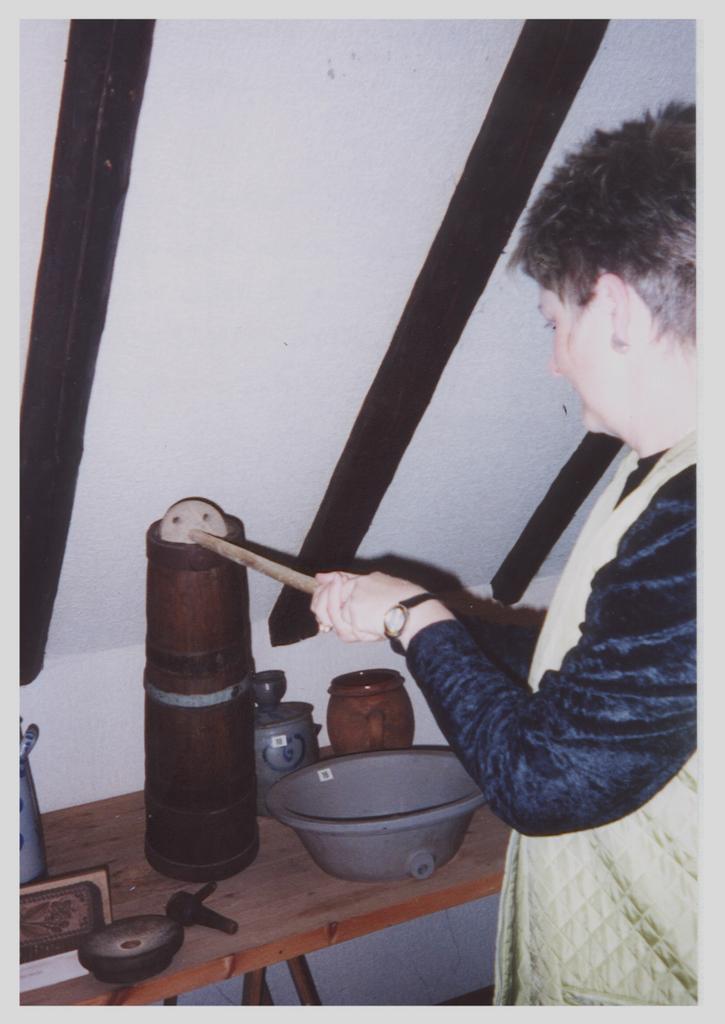
Edith Rommelfanger with butter churn
and the bowl used as a cream separator


In 2002 I planned a trip to the Saarburg area to try to learn more about the lives of my ancestors. I learned that the little village of Zerf, where my great-great grandmother had been born in 1827, had a Heimat Museum, a place where the everyday house and farm tools of the 19th and early 20th century could be seen.

I wrote to the museum to learn more about the open hours but never received a reply. Shortly before my trip, I decided to contact the mayor of the village to find out if there was any way that I could inside the museum. (It sounded so perfect for the kinds of information I needed that the thought that I might not be able to see it was making me crazy). In my letter, I gave my e-mail address as well as my home address and offered to pay for any costs involved.
Almost immediately I received a reply from Edith Rommelfanger, the mayor's wife. She said that when I arrived in the area, I should call, and they would arrange to show me the museum. From then on, the fates stepped in and made my visit to the museum as easy as finding a cheesehead in Green Bay.

Once I arrived in Saarburg, the call for an appointment to see the museum was made not by me but by Ewald Meyer, a retired teacher who was writing a history of another of my ancestral villages, Irsch bei Beurig. Herr Meyer took me "under his wing" and became my charming guide and chauffeur during my visit to Germany.

When all the arrangements were made, Herr Meyer and I drove to Zerf and were met by the mayor, Manfred Rommelfanger and his wife who gave me a two-hour tour of the museum, which is only open by special appointment.

As a souvenir, I was given several sheets of information on the exhibits. I believe Frau Rommelfanger herself wrote them, and she asked if I would translate the pages, which explained the majority of the exhibits, into English so that, should another American arrive, an English text would be available. She understood that my German is mostly self-taught and that mistakes were possible. She did not seem to mind. So when I came home I did my best at a translation and sent it to her.

I have decided to share some of this information in my blog from time to time, hoping that I have made only small errors in translation and that you will enjoy reading about some of the artifacts and how they were used. I will include a picture if I have one available. The quotation marks will indicate which information is translated from my Heimat Museum guide. Information that I added to help myself understand is in parentheses.

Heimat Museum Zerf
"This exhibit is about butter production. The first step was the Milchentrahmung or milk separation. A milk bowl served that function. It had a plug and a little sieve or filter. After approximately 12 hours the plug was removed, skim milk flowed off; and the lighter cream that had collected above was held back by the filter. The successor of the milk bowl was the centrifuge. There was a small bell on this centrifuge. As long as it made a sound, the cock had to remain closed, because the rotating speed was not yet fast enough. As soon as the little bell stopped, one untwisted the cock, and the centrifuge began the separation. The cream came out in front and the skim milk in the back."

"For honey production in former times a bee shed could be made in a very simple way. One pushed four stakes into the ground, placed a slanted roof covered with Ginster (broom) on top; and put the (woven) straw hives underneath." (Broom grows wild all over temperate Europe to a height of 3 to 5 feet. It produces numerous long, straight, slender bright green branches, tough and very flexible. The bright yellow fragrant flowers are large, in bloom from April to July, and are succeeded by oblong, flattened pods, about 1 1/2 inch long. The pods are nearly black when mature. They burst with a sharp noise when the seeds are ripe, flinging them some distance. The continuous crackling of the bursting seed pods on a hot, sunny July day is quite noticeable. The flowers have a great attraction for bees; they contain no honey, but an abundance of pollen).

Tuesday, July 26, 2005

A Visit to the Zerf Heimat Museum - Kitchen

Top - Wicker trays, Trockernhurten, for drying greens and fruit
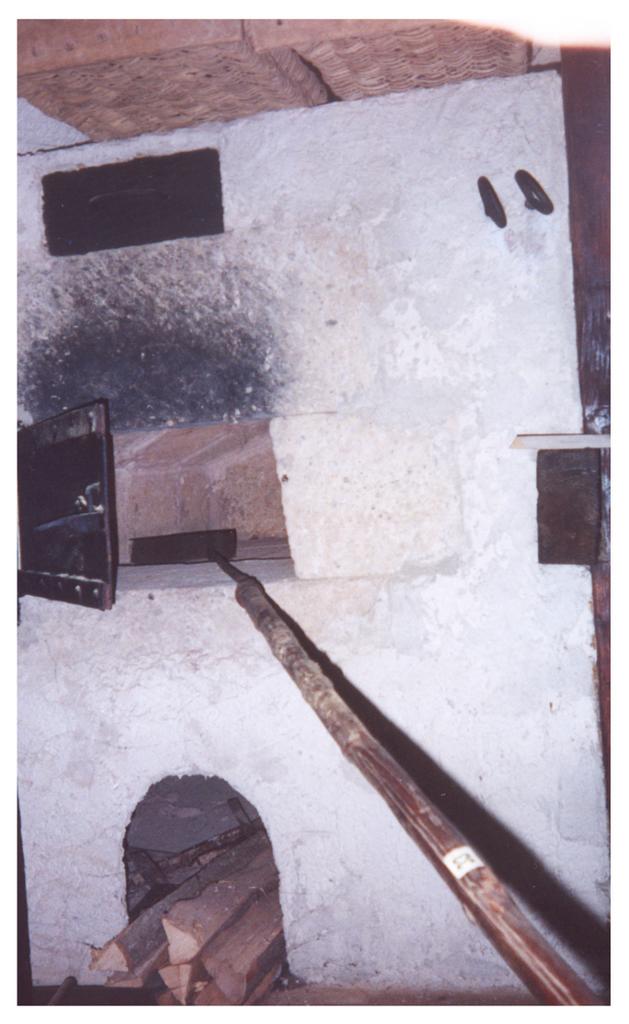
Middle - Bake oven door with Kiss rake


"In the corner is a complete bake oven, in which bread was baked in former times. The glowing ash was pulled out of the hot oven with the Kiss (a long-handled type of rake). With the Brotschiess (literally this is a bread shooter), the loaves of dough were quickly pushed into the oven and the finished bread pulled out with the same device. Once the oven was empty, the Trockernhurten (a woven drying rack) went in. On it might be greens for soup, little plums, or apples and pears cut in strips for drying."

"In the Muhle (a bread trough which could also be covered and used as a table), the bread dough was prepared for baking. If the dough had risen, it was put into the Kurbeln (a woven, round basket) and covered with a white linen cloth and left to rise for approximately10 hours. In former times they said the 'bread must steam'. When the Muhle was emptied, any remaining dough was scraped together and formed into a ball. This dough had to be kept at a place in the room where the temperature was always the same. It was covered with a white linen cloth and fermented for the next 10 days. That became the Sauerteig (leaven) for the next bread"


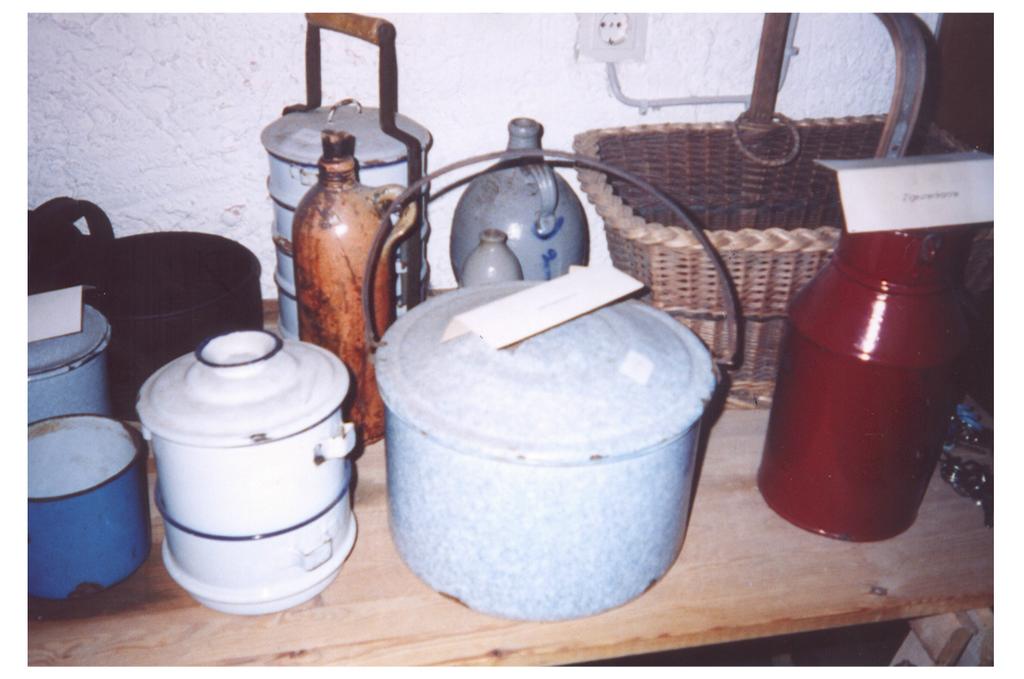
Henkelmänner


"Here are various Henkelmänner (lunch buckets). In former times during the potato and grain harvest, the meal was taken to the workers in the field in these Henkelmänner. There is a difference between the normal Henkelmänn and the Marmittchen (taken from the French word for a pot called the Marmit). The Marmittchen consists of several small pots stacked one above the other. This made it possible to transport and keep several meals divided. In the large Henkelmänn there was only an Eintop (a single pot). In the Fresskorb" (lunch basket), children brought an afternoon lunch (bread and so forth) to the fields after school. Coffee was carried in the Zigeunerkanne or gypsy jug. The popular homemade drink, Viez, was kept cool in the Viezbombel made of stoneware."

"In the farm kitchen, the floor is made of stone, usually this was sandstone. The open chimney is above the hearth. The cast-iron pot hangs on a rod that can be raised or lowered depending on the amount of heat needed. Ham, bacon and sausages were smoked in the open chimney."

Monday, July 25, 2005

A Visit to the Zerf Heimat Museum - Work in the Fields

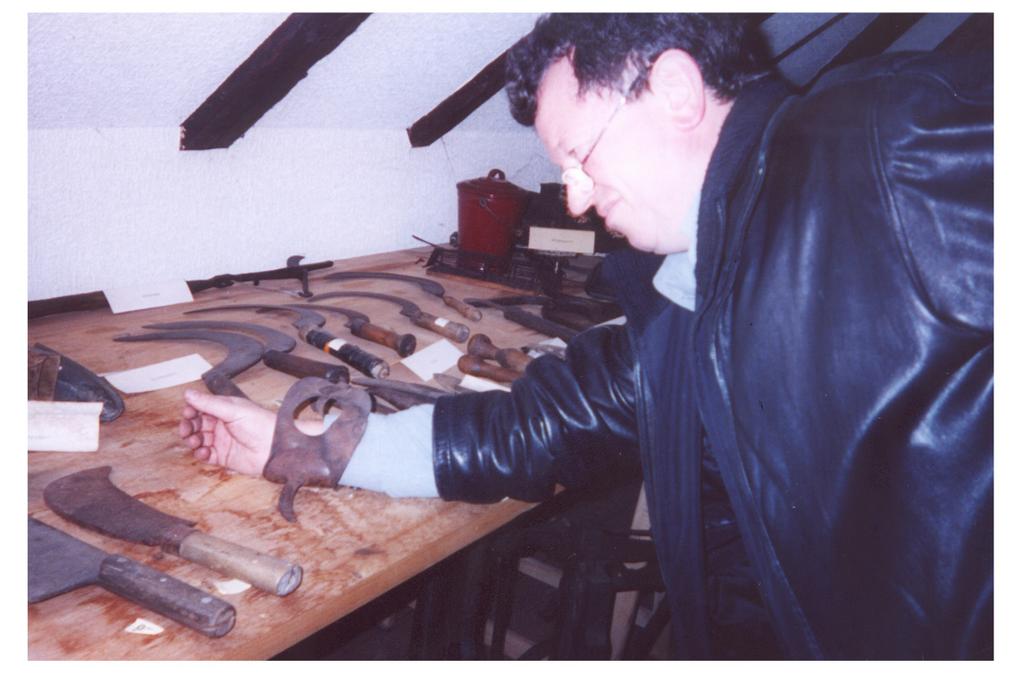
Zerf's Mayor, Manfred Rommelfanger, wears a wrist cutter sometimes used for grain or flax. Sickles at the right; Ginstereisen at the left


"Next to each other here you see Sichel (sickles) and the somewhat stronger Ginstereisen (iron tool for cutting brush). In former times Ginster was dried and used as straw for the cattle stalls. (See A Visit to the Zerf Heimat Museum for a description of the broom shrub called Ginster). The women used sickles to cut the grain stems and bind them into sheaves. They also used them to cut weeds. With a sickle, the goat farmers cut the grass and weeds along the waysides and the field borders to feed to their animals."

"The Dengelstöcke was a device that sharpened or 'whet' metal by hammering it. It was used for scythes when they became dull. The Denkelstöcke was struck into the ground or, more often, into a wood log. The cutting edge of the scythe was worked on with the hammer. The hammer had to be rounded at the head so that no depression was made in the scythe when it was struck."

"Reiserbesen (twig brooms) were made of birch twigs. In former times, most were bound with hazelnut switches; later with wire. The Reiserhaken (twig axe) was used to cut the birch twigs. The birch twigs was pressed together for binding with the broom press. After binding, the brooms were trimmed and shaped with the small Reisermesserchen (little twig knife). One used the twig brooms for sweeping of house, yard and stable."


"Planting tools lie on this table (center). Vegetable seedlings, beets, lettuce, etc. were planted in field and garden with them." (I was told that most are made of cow or ox horns. The tip of the horn was cut off so that the seeds could slowly come through. Different sizes of horns and how much of the tip of the horn was removed allowed for the planting of various sizes of seeds)

Here are Loheisen, iron tools for stripping bark (Lohecken) (tool at the back of the table). They are also called Lohlöffel or bark spoons. With them the bark was stripped from the oak trees. In former times one extracted Gerbsaüre (tanning acid) from this bark. The acid was necessary to process animal hide for leather." (At times there were as many as 20 tanneries in Saarburg in the 1800's, and the selling of the bark to the tanneries provided farmers with a much needed cash crop).

"Here one sees Schlotterfässer, small barrels made out of wood, horn and sheet metal (far left). The name Schlotterfass (shaking barrel) comes from the typical noise which developed when the whet stones inside knocked together. The farmer hung the Schlotterfass, which contained the whetstones and the water, on his belt when he went mowing. Then, if necessary, he could always sharpen the scythe."

"For beet cultivation, the Hackpflug plow was used. A cow led between the rows could pull it. Then the farmer only had to hoe the soil crosswise between the plants to chop out weeds." (To my surprise, I learned that many farmers could not afford an ox or a horse for field work. So their cow/s were pressed into service, very much decreasing the amount of milk that a cow could produce)

Saturday, July 23, 2005

A Visit to the Zerf Heimat Museum - Conclusion

The following section ends my information about the Zerf Heimatmuseum. It contains a description of miscellaneous artifacts not covered in the other posts. Just like the other entries I have posted, these artifacts may help paint a better picture of daily life in the village of Zerf and/or of the many other small villages near the Saar and Mosel rivers.

As I explained in my first post on the Zerf museum, the descriptions below without parentheses are my translations from the German language museum guide I received as a souvenir at the time of my visit. Anything in parentheses is additional information gleaned from other sources which I hope makes the original description a bit clearer.

Now back to the museum


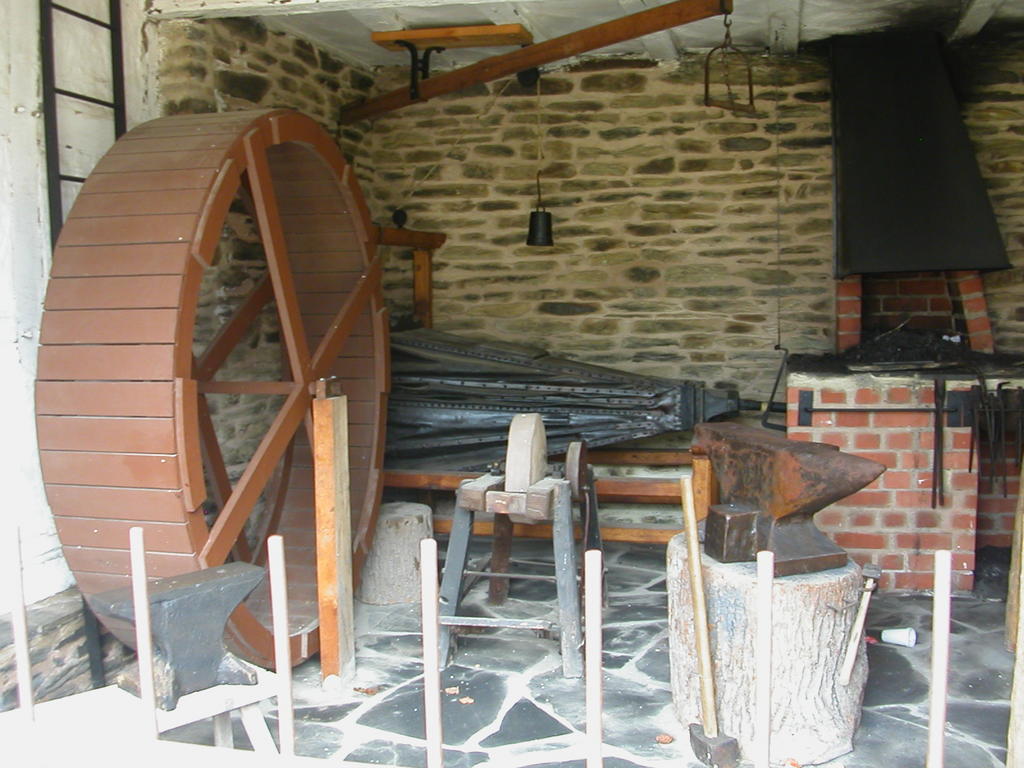
In the blacksmith's shop one can see the forge with the bellows, anvil, hammers, pliers, a bending machine for bending the eisenreifen (iron wheels) for the farm wagons. (According to the book, Serrig: Landschaft, Geschichte & Geschichtenby Klaus Hammächer, a dog could be trained to run inside the wheel shown in this picture. As he ran, he powered the bellows and the flame of the forge. The picture was taken at the Roscheider Hof open air museum near Konz)

Trumpets were used by Schweinehirt (swineherds). At the sound of the trumpet, the farmer opened the pig stalls and the Schweinehirt drove the pigs into the oak forests and guarded them there. In the evening the Schweinehirt brought them back with the trumpet signal. On the Feast of St. Martin (November 11) the Schweinehirt received a measuring beaker/cup full of grain for each pig under his care. (St. Martin's day was also the traditional time to prepare for winter by slaughtering pigs, geese, and other animals since they would soon be unable to forage for food and would have to be fed by the farmer)

The half Vierzel was a measuring instrument for grain. In former times the grain was not weighed; it was measured with this container. Four half Vierzel 'filled not too much and not too little' ( leveled?) equaled one hundredweight of corn, barley or wheat. Six half Vierzel made up a hundredweight of oats, because oats is finer. In earlier times, the teachers in the village were often also the swineherds, because there was no school in the summer (when the pigs could roam). School was held from St. Martin's Day to Easter.

One could distinguish cow, sheep and goat bells by the different tone qualities.

The small Nicholas bells were used by the adults to make the children aware of the feast day some weeks before it arrived. They rewarded the children's obedience by putting small gifts at the door on St. Nicholas Eve

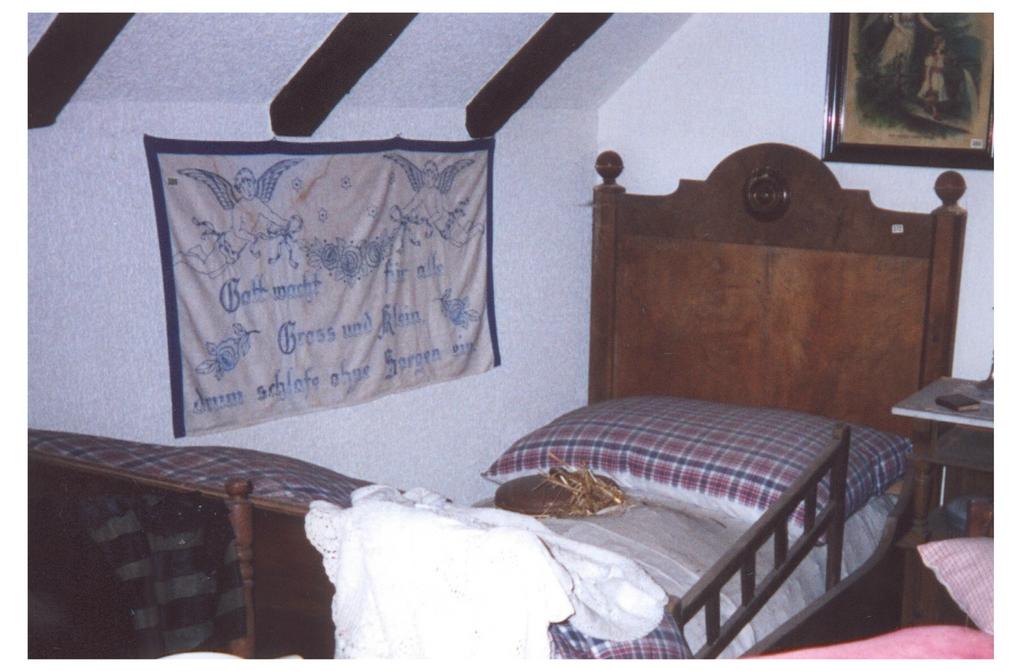
In the bedroom we see the straw filled mattress, the pillow filled with grain chaff, and the feather bed. (The villagers made use of almost any part of the crops that they grew, even in the bedroom. For instance, small pouches were filled with grape seeds and could be heated to ease pain, much as we can relax tight muscles by using the same sort of pouch and heating its "magic crystals" in a microwave. These grape seed pouches are still sold at the "Golden Autumn" festival and market in Saarburg)

The broad low-lying wooden box sled was, in former times, a popular plaything for the children during the long, snow-rich winters.

Kleppern (wooden clappers) and Raspeln (a rattle-like wooden device which rotated and made a rasping sound when shaken by its long handle) replaced the bells during Holy Week when bells could not be rung on Good Friday and Holy Saturday.

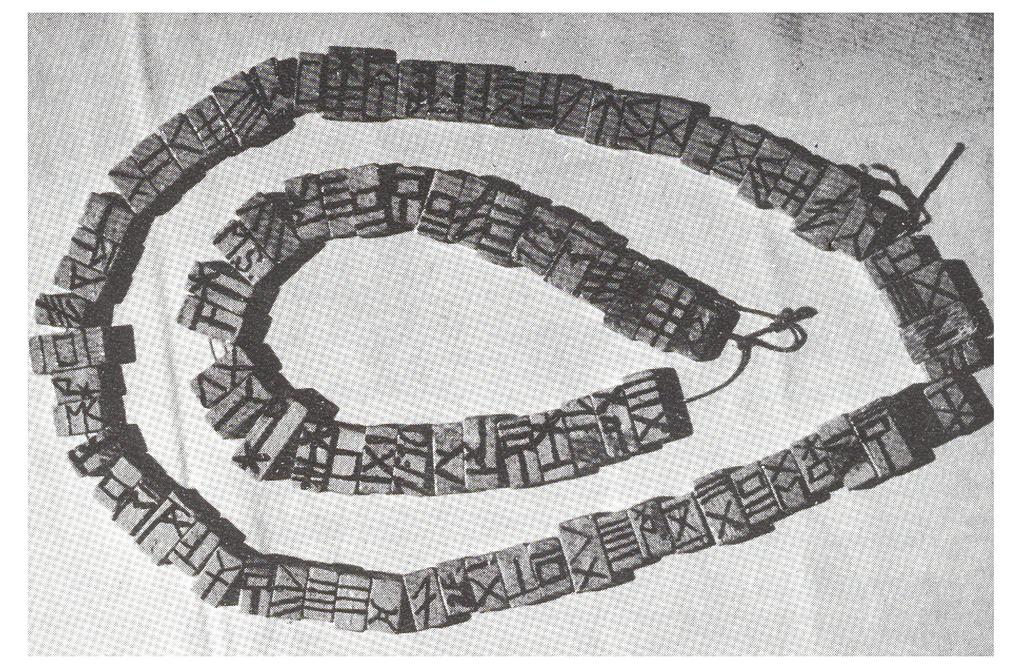
This is the Rosenkranz on which the house sign and hedge land identifiers for the Gehöfershaft were placed. These blocks were drawn in a lottery for distributing the Lohhecken among the farmers in the Gehöfershaft. (Above is a photo from Der Hochwaldort Zerf am Fuße des Hunsrücks, by Edgar Christoffel, c. 1981, Verlag W. Rassier, D5510 Saarburg. It shows wooden blocks with symbols which are rune-like rather than alphabetic characters. This Rosenkranz, the German word for rosary, served as a sort of plat map for the hedge lands which belonged to the entire community of land-owning farmers. In the Saar and Mosel region these landed farmers were usually referred to as a Gehöfershaft. A symbol identifying each section of the hedge lands, sections which were especially valuable for the oak tree bark stripped for tanning, was painted on one side of each small wooden block. Then a lottery was held. Each farmer in turn drew out a wooden block containing a hedge land symbol. His distinctive house mark could now be painted on the other side of the wooden block and the section was his to work until the next lottery was held. When the lottery was completed, the blocks were strung into the Rosenkranz and probably kept by the mayor of Zerf. In Zerf, this lottery took place every five years. The neighboring village of Irsch had a similar Rosenkranz, according to the book Irsch/Saar: Geschichte eines Dorfes, by Ewald Meyer).

The kitchen utensils and the farm equipment are described in Part 2 and Part 3, the other parts of this amazing visit to the past.

Friday, June 24, 2005

Easter in the Saar-Hunsrück Region


Christiane Schabel-Becker,
Verlag
Auricher Strasse 28
28219 Bremen
Deutschland


Holidays in Germany were rich with tradition, some of which have carried over into our own times. But others have nearly been lost, showing up only in German self-publications or the Heimat books published to commemorate 1,000 or more years of history in the little villages of the Rhineland.
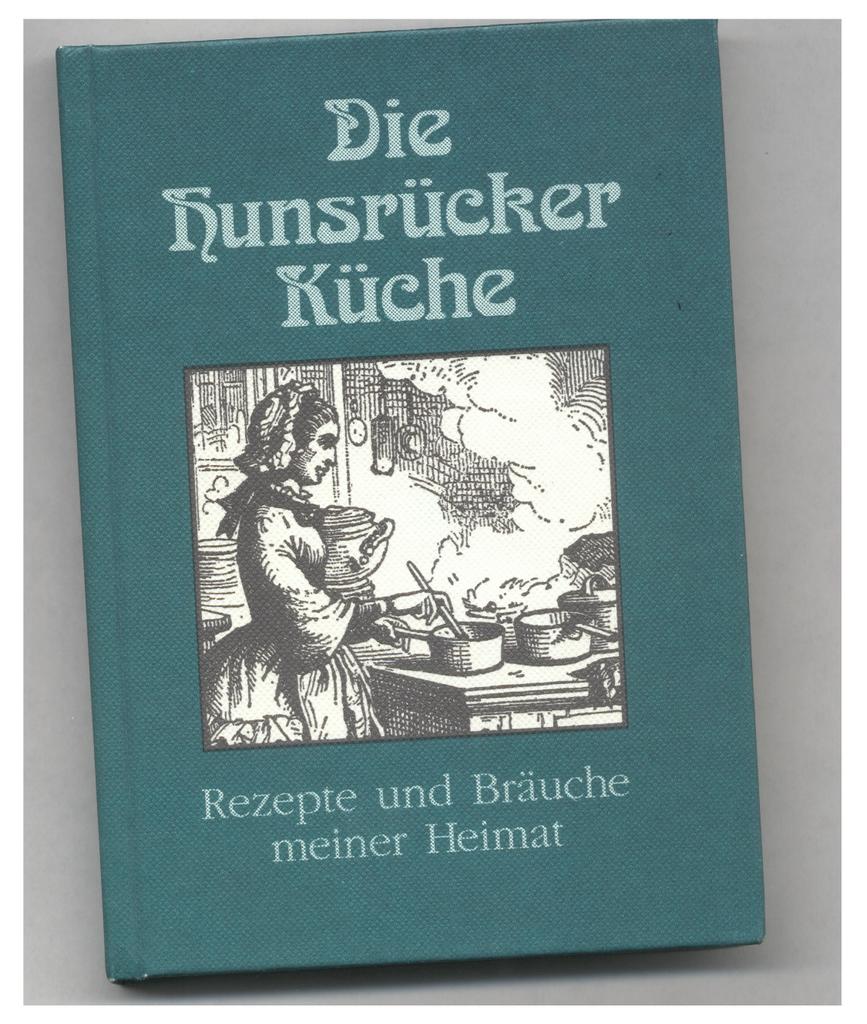
While I was looking for typical recipes from the Hunsrück region of Germany, an area which was mostly made up of small farmers, I found a little cookbook called Die Hunsrücker Küche by Christiane Becker. It not only provided recipes but also the little-known folk-customs that went along with holidays, marriages, harvests celebrations and more.


I was fascinated with Frau Becker’s description of the Easter of a Hunsrücker child. It seem that for a week or two ahead of Easter morning, the children went into the forests of the Hünsruck and gathered moss so that the Easter rabbit would find a soft nest for his eggs. This nest was usually placed in the garden unless the weather was so inclement that a little willow basket, lined with this moss, had to be brought into the kitchen of the farmhouse.
As in our own day, the children were the first up in the morning and the last child to leave his or her bed was called the "Österquack" (Easter Quack) and teased by the others for the remainder of the day. Then there was a rush to find the eggs (colored with onion skins, coffee grounds, and the early spring leaves of various plants). Once all of the eggs were found, it was traditional for each child to visit godparents and bring them some of the colorful eggs.


Then there was this somewhat unusual custom. In the afternoon of Easter day, the children would go looking for thriving anthills so that the colored eggs could receive further decoration – little dots that the ants left on the eggs placed in the middle of the teaming mounds. (Makes one appreciate Easter egg decals!)


There were countless games that were played in the meadows on Easter afternoon, all involving the eggs. Both children and adults enjoyed many of these activities. For example, two combatants would take their eggs in hand, small end forward, and smash them together. The object was to cause worse damage to the egg of your opponent than to your own. If your egg was the winner, you could claim the other egg. Another popular game was the rolling of an Easter egg down a slope. If by chance your egg hit another that had strayed off of its course, that egg was yours.


On the evening of the second day of Easter, the eggs were eaten as the supper meal. An old superstition said that if no lamps or candles were lighted on this day, one would be protected from the bite of gnats and midges for a full year. I wonder if that would work on mosquitos.